The
pick-up-ball type
Between the
upright frame, A, A, run the wheel, C, geared to the pinion, D, and on
the same shaft the two double pinions, D, D, over which double pinions
run a double chain, to which chain are fixed the buckets, F, F. The
chain is made with joints on each side and bars running across, equal
in .number to the cogs of the Q wheel C. Upon the same axle with the
wheel, C, on the farther side of the inner stile, A, runs the wheel, G,
whose diameter is double that of the wheel C.
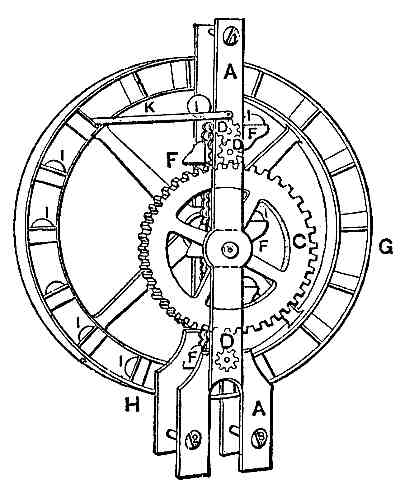
The wheel, G, is divided near the
periphery into receptacles in number
equal to the buckets on the chain, which receptacles are supplied with
metal balls, I, I, from the buckets, F, F, by means of the gutter, K,
which balls by their weight forcing round the wheel, G, and thereby
lifting up the buckets, F, F, on one side as they go down on the other
side, discharge, themselves again at the bucket, L, where they are
taken up by the buckets, F, F, and discharged again at the gutter, K,
and are so repeated in a constant succession as often as any receptacle
is vacant in the wheel, G, at the gutter, K, for their reception, and
by that means the perpetual revolution is obtained, the upper ball
being at the same time discharged from one bucket when the lower ball
is taken up by another.
(Subsection 921-922, from
p.368)
From: Gardner D. Hiscox, M.E., Mechanical Appliances and Novelties of Construction (1927), Norman W. Henley Publ. Co.







