23. Perpetual Motion
The
lever type
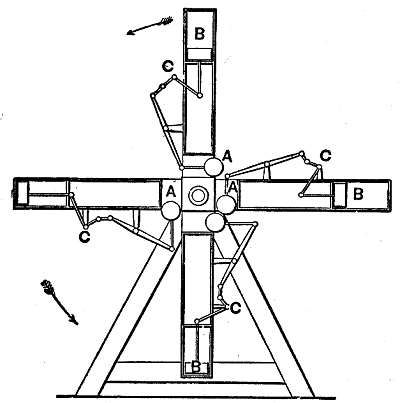
The central
weights, A, each weigh one-fourth more than the weights, B, at the
extremities of the arms. The two sets of weights are connected pairs,
each pair being joined by a lever, link, and bell crank C. The action
of gravity in the central weights compels the sliding weights at the
ends of the arms to assume the positions shown in the engraving.
Had this inventor applied a little
mathematical calculation to the
verification of the truth or falsity of the principle of his device, he
might easily have proved that it was a perfect balance, and saved
himself both trouble and expense. The leverage of the outside is
exactly counteracted by the leverage of the inside weights.
(Subsection 930, from
p.372)
From: Gardner D. Hiscox, M.E., Mechanical Appliances and Novelties of Construction (1927), Norman W. Henley Publ. Co.


Nature bears long with those who wrong her. She is patient under abuse. But when abuse has gone too far, when the time of reckoning finally comes, she is equally slow to be appeased and to turn away her wrath. (1882) --
Nathaniel Egleston, who was writing then about deforestation, but speaks equally well about the danger of climate change today.
 Carl Sagan
: In science it often happens that scientists say, 'You know that's a really good argument; my position is mistaken,' and then they would actually change their minds and you never hear that old view from them again. They really do it. It doesn't happen as often as it should, because scientists are human and change is sometimes painful. But it happens every day. I cannot recall the last time something like that happened in politics or religion. (1987) ...
(more by Sagan) Albert Einstein: I used to wonder how it comes about that the electron is negative. Negative-positive—these are perfectly symmetric in physics. There is no reason whatever to prefer one to the other. Then why is the electron negative? I thought about this for a long time and at last all I could think was “It won the fight!” ...
(more by Einstein) Richard Feynman: It is the facts that matter, not the proofs. Physics can progress without the proofs, but we can't go on without the facts ... if the facts are right, then the proofs are a matter of playing around with the algebra correctly. ...
(more by Feynman)




