Home

Mechanical Appliances and Novelties of Construction
by
Gardner D. Hiscox, M.E.
Norman W. Henley Publ. Co.
1927

The Inventor's Paradox - Desaguliers' Demonstration
The Prevailing Wheel Type
Marquis Of Worcester Wheel
Rolling Balls
Folding Arms
Chain Wheel
Most Common Idea
Magnetism And Gravity
Pick-up Ball
Ball-Carrying Belt
Ferguson's Type
French, 1858
Revolving Tubes And Balls
Geared Motive Power
Differential Hydrostatic Wheel
Lever Type
Double Cone
Rocking Beam
Titling Tray And Ball
Rolling Ring
Differential Water Wheel
Multiple Water Wheel
Gear Problem
Mercurial Wheel
Water Wheel
Air-Bag Wheel
Water Wheel
Air Transfer In Submerged Wheel
Extending Weights And Water Transfer
Chain Buckets
Congreve's Sponges
Transfer Of Air
Differential Weight of Balls
Inclined Disk And Balls
Self-Moving Water Power
Chain Pump, 1618
Archimedean Screw
Differential Weight By Flotation
Floatation Problem
Liquid Transfer Wheel
Chain-Pump
Mercurial Displacement
Air-Buoyed Wheel
Magnetic Resistance
Overbalanced Cylinder
Hydrostatic Weight
Capillary Attraction
Magnetic Pendulum
Magnetic Wheel
Magnetic Mill
Regenerating Pendulum
Magnetic Wheel
Alternate Magnet Type
Electro-magnetic Type
Electrical Generation
Perpetual-Motion Puzzle


23. Perpetual Motion
Mercurial wheel

     A is the screw turning on its two pivots; B is a cistern to be filled above the level of the lower aperture of the screw with mercury; D is a reservoir, which, when the screw is turned round, receives the mercury which falls from the top. 
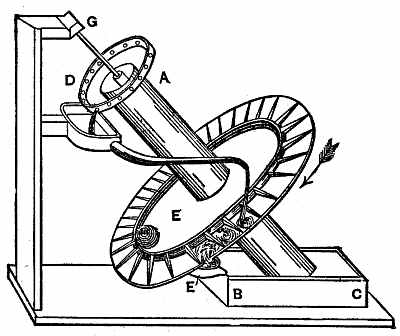
Perpetual Motion Machine: 938-MercurialWheel

     A pipe conveys the mercury from the reservoir on to the float-board, E, fixed at right angles to the center of the screw, and furnished at its circumference with ridges to intercept the mercury, the momentum and weight of which will cause the float-board and screw to revolve, until, by the proper inclination of the floats, the mercury falls into the receiver, E, from whence it again falls by its spout into the cistern, B, where the constant revolution of the screw takes it up again as before.

(Subsection 938, from p.375)


back next

