Mercurial
displacement in a cistern of water
A cistern full
of water 4 feet deep. Let B be a wheel; freely suspended within it, let
there be four glass tubes 40 inches long, c, c, c, c, having large bulbs, holding,
say, a pint, blown at the closed end. Fill these tubes with mercury,
fix on an India-rubber bladder, that will hold a pint, to each of them
at the open end, and let them be attached round the wheel, as in the
figure.
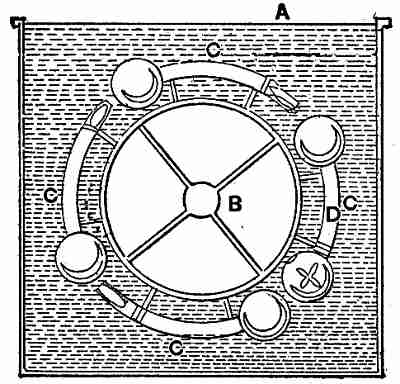
As the pressure
of 40 inches of mercury will exceed the atmospheric
pressure, and also that of the four-feet column of water, when the
India-rubber bottle is lowest, and the tube erect, as at D, the mercury
will fill it, leaving a vacuum in the glass bulb above. On the opposite
side the mercury will fill the glass bulb, and the India-rubber bottle
will be pressed flat, as will also be the case in the two horizontal
tubes. Now, it is evident that the two horizontal tubes exactly balance
each other; but the tube, D, with its bulb swelled out, displaces a
pint of water more than its opposite tube, and hence will attempt to
rise with the force of about one pound, and each tube, when it arrives
at the same position, must produce the same result; the wheel must have
a continual rower, equal to about one pound, with a radius of two feet.
(Subsection 956, from p.383)
From: Gardner D. Hiscox, M.E., Mechanical Appliances and Novelties of Construction (1927), Norman W. Henley Publ. Co.







