Regenerating
pendulum
A, B, E, F is a
frame connected by C, D, a crossbar, through which runs g, a pendulum hung on a pivot, C.
This pendulum has two arms, one, a,
measuring five feet, and the other, b,
one foot in length, connected so together to form a lever I with a long
and short arm, whose fulcrum is c.
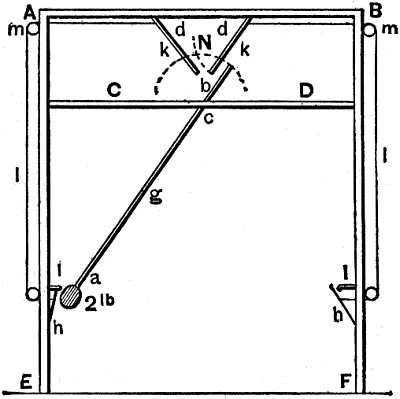
This pendulum
has a weight of two pounds at its end. K, K are two short
levers having a joint in them to allow the pendulum to pass them one
way, but not the other, without moving them, whose fulcra are d, d, by
which they are connected with A, B. From these run cords, l, l, over
pulleys, m, m, which cords are connected (for
the purpose of drawing
them up into catches) with h,
h, springs throwing with a
power of three
pounds. I, I are catches for the springs when brought back after
working their power. N is the point where the pendulum, g, will escape
from the lever K.
From: Gardner D. Hiscox, M.E., Mechanical Appliances and Novelties of Construction (1927), Norman W. Henley Publ. Co.







