23. Perpetual Motion
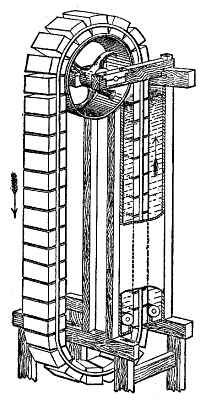
The
flotation problem
An upright
tank, through which passes a number of floats connected by a band of
elastic rubber attached to their ends, leaving just enough space
between them to secure action on each side by the water. They are each
of the same weight as an equal bulk of water at the surface, therefore
the upper one in the tank has no comparative weight.
The next lower
one has a unit of upward force equal to the condensation
of its bulk of water, and so on, each adding a unit to the upward
tendency, until we come to the last, the pressure on which is
altogether downward to the amount of the entire column of water; but we
already have a number of opposing upward forces, and when we look on
the other side and see the thirteen active weights, it seems clear that
there will be a large surplus weight, over and above the opposing
weight and the friction of the rollers and upper wheel. The weights
were to pass through an elastic cylinder at the bottom.
(Subsection 953, from
p.382) From: Gardner D. Hiscox, M.E., Mechanical Appliances and Novelties of Construction (1927), Norman W. Henley Publ. Co.


Nature bears long with those who wrong her. She is patient under abuse. But when abuse has gone too far, when the time of reckoning finally comes, she is equally slow to be appeased and to turn away her wrath. (1882) --
Nathaniel Egleston, who was writing then about deforestation, but speaks equally well about the danger of climate change today.
 Carl Sagan
: In science it often happens that scientists say, 'You know that's a really good argument; my position is mistaken,' and then they would actually change their minds and you never hear that old view from them again. They really do it. It doesn't happen as often as it should, because scientists are human and change is sometimes painful. But it happens every day. I cannot recall the last time something like that happened in politics or religion. (1987) ...
(more by Sagan) Albert Einstein: I used to wonder how it comes about that the electron is negative. Negative-positive—these are perfectly symmetric in physics. There is no reason whatever to prefer one to the other. Then why is the electron negative? I thought about this for a long time and at last all I could think was “It won the fight!” ...
(more by Einstein) Richard Feynman: It is the facts that matter, not the proofs. Physics can progress without the proofs, but we can't go on without the facts ... if the facts are right, then the proofs are a matter of playing around with the algebra correctly. ...
(more by Feynman)