Ferguson's
type
Ferguson's type
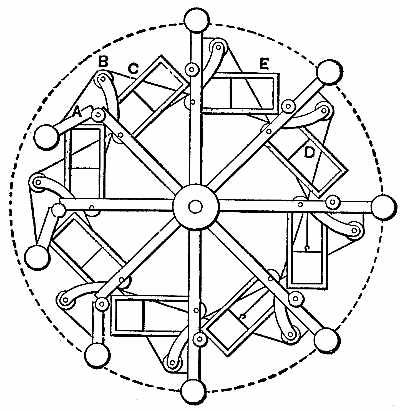
to prove its impossibility. 1770. The axle is placed horizontally, and
the spokes turn in a vertical position. The spokes are jointed, as
shown, and to each of them is fixed a frame in which a weight, D,
moves. When any spoke is in a horizontal position, the weight, D, in it
falls down, and pulls the weighted arm, A, of the then vertical spoke
straight out, by means of a cord, C, going over the pulley, B, to the
weight D. But when the spokes come about to the left hand, their
weights fall back and cease pulling, so that the spokes then bend at
their joints and the balls at their ends come nearer the center on the
left side.
(Subsection 925, from
p.369)
From: Gardner D. Hiscox, M.E., Mechanical Appliances and Novelties of Construction (1927), Norman W. Henley Publ. Co.







