Home

Mechanical Appliances and Novelties of Construction
by
Gardner D. Hiscox, M.E.
Norman W. Henley Publ. Co.
1927

The Inventor's Paradox - Desaguliers' Demonstration
The Prevailing Wheel Type
Marquis Of Worcester Wheel
Rolling Balls
Folding Arms
Chain Wheel
Most Common Idea
Magnetism And Gravity
Pick-up Ball
Ball-Carrying Belt
Ferguson's Type
French, 1858
Revolving Tubes And Balls
Geared Motive Power
Differential Hydrostatic Wheel
Lever Type
Double Cone
Rocking Beam
Titling Tray And Ball
Rolling Ring
Differential Water Wheel
Multiple Water Wheel
Gear Problem
Mercurial Wheel
Water Wheel
Air-Bag Wheel
Water Wheel
Air Transfer In Submerged Wheel
Extending Weights And Water Transfer
Chain Buckets
Congreve's Sponges
Transfer Of Air
Differential Weight of Balls
Inclined Disk And Balls
Self-Moving Water Power
Chain Pump, 1618
Archimedean Screw
Differential Weight By Flotation
Floatation Problem
Liquid Transfer Wheel
Chain-Pump
Mercurial Displacement
Air-Buoyed Wheel
Magnetic Resistance
Overbalanced Cylinder
Hydrostatic Weight
Capillary Attraction
Magnetic Pendulum
Magnetic Wheel
Magnetic Mill
Regenerating Pendulum
Magnetic Wheel
Alternate Magnet Type
Electro-magnetic Type
Electrical Generation
Perpetual-Motion Puzzle


23. Perpetual Motion
Geared motive power

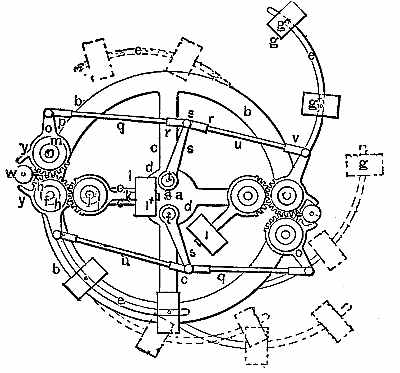
     a is the axis or shaft on which the wheels are all mounted; each wheel consists of two parallel rims, b. b, each of which is connected by radial arms, c, to a boss, d, keyed on the axis, a; the working parts of each wheel are mounted between the rims and arms thereof, but the outer rim, boss, and radial arms are removed in the figure in order that the working may be fully shown.
Perpetual Motion Machine: 928-GearedMotivePower

     It must be understood that the pivots or axis, j, j, n, t, hereinafter referred to, on which certain parts are mounted, are supported by and extend between the two parallel rims, radial arms, and bosses of the wheel, b, c, d. e, e are curved arms working on axes or pivots, j, fixed in the rims; each arm carries weights, g, g, held in place by adjusting screws g'. Each arm, e, terminates at its innermost end in a wheel, h, toothed on a portion of its periphery, through which the weight, v, forces the weights, g, outward at the right-hand side of the wheel, causing a preponderance of weight on that side.

(Subsection 928, from p.371)


back next

