• Science
    Quotes
  • What's
    New
  • Science
    Stories
  • Chemistry
    Stories
  • Perpetual
    Motion
  • Newsletter
    Sign-up
  • Search
    search icon
  • Feedback
    email icon
  • Home
  • Text Menu
  • Science Store
  • News
  • Wall Calendar
  • Survey
  • Privacy
  • Terms of Use
TODAYINSCI ®

Find science on your birthday
TODAY IN SCIENCE HISTORY
Follow @todayinsci
23. Perpetual Motion

Magnetic mill

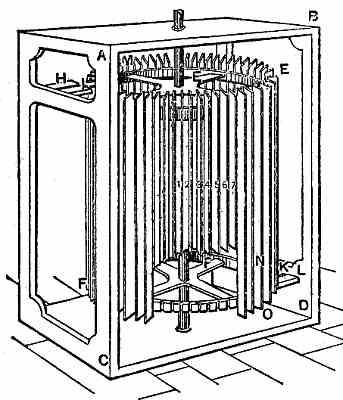
     Magnetic mill of the middle of the eighteenth century. A, B, C, D represents a frame of brass or wood B for the machine, E, F, to run in. E and F are two brass wheels, similar and equal, fixed upon a movable axis. 1, 2, 3, etc., are a number of artificial magnets placed within the teeth of the wheel all round, and as near each other as is possible, provided they do not touch; their north poles at E and their south poles at F.
Perpetual Motion Machine: 965-MagneticMill

     H and I are two similar and equal magnets fixed in the brass plate, A, C, very near each other, but not touching. K and L, two more, fixed in the brass plate, B, D. Now, as the north pole of one magnet repels the north pole of another magnet and attracts the south, and, inversely, the south pole of one magnet repels the south pole of another and attracts the north, so the south pole, I, "attracts all the north ones at E, and the north pole, H, repels all the nor in ones at M. In like manner, K attracts at N and L repels at O, and by this means the whole machine, E, F, is expected to move perpetually around.

     Now this would be all lovely if magnets did not attract in more than one direction. Many American inventors have tried the same principle over and over, only to find their wheel standing still, and have then sighed for some medium which, interposed between a magnet and its armature, would prevent attraction while thus interposed.

From: Gardner D. Hiscox, M.E., Mechanical Appliances and Novelties of Construction (1927), Norman W. Henley Publ. Co.



backnext

Introductionn
Desaguliers' Demonstration
The Prevailing Wheel Type
Marquis Of Worcester Wheel
Rolling Balls
Folding Arms
Chain Wheel
Most Common Idea
Magnetism And Gravity
Pick-up Ball
Ball-Carrying Belt
Ferguson's Type
French, 1858
Revolving Tubes And Balls
Geared Motive Power
Differential Hydrostatic Wheel
Lever Type
Double Cone
Rocking Beam
Titling Tray And Ball
Rolling Ring
Differential Water Wheel
Multiple Water Wheel
Gear Problem
Mercurial Wheel
Water Wheel
Air-Bag Wheel
Water Wheel
Air Transfer In Submerged Wheel
Ext. Weights And Water Transfer
Chain Buckets
Congreve's Sponges
Transfer Of Air
Differential Weight of Balls
Inclined Disk And Balls
Self-Moving Water Power
Chain Pump, 1618
Archimedean Screw
Differential Weight By Flotation
Floatation Problem
Liquid Transfer Wheel
Chain-Pump
Mercurial Displacement
Air-Buoyed Wheel
Magnetic Resistance
Overbalanced Cylinder
Hydrostatic Weight
Capillary Attraction
Magnetic Pendulum
Magnetic Wheel
Magnetic Mill
Regenerating Pendulum
Magnetic Wheel
Alternate Magnet Type
Electro-magnetic Type
Electrical Generation I
Electrical Generation II


Carl Sagan Thumbnail In science it often happens that scientists say, 'You know that's a really good argument; my position is mistaken,' and then they would actually change their minds and you never hear that old view from them again. They really do it. It doesn't happen as often as it should, because scientists are human and change is sometimes painful. But it happens every day. I cannot recall the last time something like that happened in politics or religion. (1987) -- Carl Sagan

More quotes:     Name Index    Isaac Newton    Lord Kelvin    Charles Darwin    Albert Einstein    Aristotle    Michio Kaku    Srinivasa Ramanujan    Carl Sagan    Florence Nightingale    Atomic  Bomb    Biology    Chemistry    Deforestation    Engineering

Sitewide search within all Today In Science History pages:
Custom Quotations Search - custom search within only our quotations pages:


Please add a link from your own site or blog if you find this site useful.
Author Icon by Ian Ellis
who invites your feedback
Thank you for sharing the site with Tweets, Facebook and Stumble Upon.


Explore 100 Famous Scientist Quotes Pages

Click above to expand
- 100 -
Sophie Germain
Gertrude Elion
Ernest Rutherford
James Chadwick
Marcel Proust
William Harvey
Johann Goethe
John Keynes
Carl Gauss
Paul Feyerabend
- 90 -
Antoine Lavoisier
Lise Meitner
Charles Babbage
Ibn Khaldun
Euclid
Ralph Emerson
Robert Bunsen
Frederick Banting
Andre Ampere
Winston Churchill
- 80 -
John Locke
Bronislaw Malinowski
Bible
Thomas Huxley
Alessandro Volta
Erwin Schrodinger
Wilhelm Roentgen
Louis Pasteur
Bertrand Russell
Jean Lamarck
- 70 -
Samuel Morse
John Wheeler
Nicolaus Copernicus
Robert Fulton
Pierre Laplace
Humphry Davy
Thomas Edison
Lord Kelvin
Theodore Roosevelt
Carolus Linnaeus
- 60 -
Francis Galton
Linus Pauling
Immanuel Kant
Martin Fischer
Robert Boyle
Karl Popper
Paul Dirac
Avicenna
James Watson
William Shakespeare
- 50 -
Stephen Hawking
Niels Bohr
Nikola Tesla
Rachel Carson
Max Planck
Henry Adams
Richard Dawkins
Werner Heisenberg
Alfred Wegener
John Dalton
- 40 -
Pierre Fermat
Edward Wilson
Johannes Kepler
Gustave Eiffel
Giordano Bruno
JJ Thomson
Thomas Kuhn
Leonardo DaVinci
Archimedes
David Hume
- 30 -
Andreas Vesalius
Rudolf Virchow
Richard Feynman
James Hutton
Alexander Fleming
Emile Durkheim
Benjamin Franklin
Robert Oppenheimer
Robert Hooke
Charles Kettering
- 20 -
Carl Sagan
James Maxwell
Marie Curie
Rene Descartes
Francis Crick
Hippocrates
Michael Faraday
Srinivasa Ramanujan
Francis Bacon
Galileo Galilei
- 10 -
Aristotle
John Watson
Rosalind Franklin
Michio Kaku
Isaac Asimov
Charles Darwin
Sigmund Freud
Albert Einstein
Florence Nightingale
Isaac Newton

Scroll above for more
Scientist Quotes Index
Today in Science History ©  1999 - 2013 by Todayinsci ®
