Home

Mechanical Appliances and Novelties of Construction
by
Gardner D. Hiscox, M.E.
Norman W. Henley Publ. Co.
1927

The Inventor's Paradox - Desaguliers' Demonstration
The Prevailing Wheel Type
Marquis Of Worcester Wheel
Rolling Balls
Folding Arms
Chain Wheel
Most Common Idea
Magnetism And Gravity
Pick-up Ball
Ball-Carrying Belt
Ferguson's Type
French, 1858
Revolving Tubes And Balls
Geared Motive Power
Differential Hydrostatic Wheel
Lever Type
Double Cone
Rocking Beam
Titling Tray And Ball
Rolling Ring
Differential Water Wheel
Multiple Water Wheel
Gear Problem
Mercurial Wheel
Water Wheel
Air-Bag Wheel
Water Wheel
Air Transfer In Submerged Wheel
Extending Weights And Water Transfer
Chain Buckets
Congreve's Sponges
Transfer Of Air
Differential Weight of Balls
Inclined Disk And Balls
Self-Moving Water Power
Chain Pump, 1618
Archimedean Screw
Differential Weight By Flotation
Floatation Problem
Liquid Transfer Wheel
Chain-Pump
Mercurial Displacement
Air-Buoyed Wheel
Magnetic Resistance
Overbalanced Cylinder
Hydrostatic Weight
Capillary Attraction
Magnetic Pendulum
Magnetic Wheel
Magnetic Mill
Regenerating Pendulum
Magnetic Wheel
Alternate Magnet Type
Electro-magnetic Type
Electrical Generation
Perpetual-Motion Puzzle


23. Perpetual Motion
Revolving tubes and balls

     The balls, A and B, are in equilibrium because they are at an equal distance from the vertical line that passes through the center E. By the construction of the machine, the ball, D, being, on the contrary, more distant from the point of support than the ball, C, must prevail over the latter and break the equilibrium.
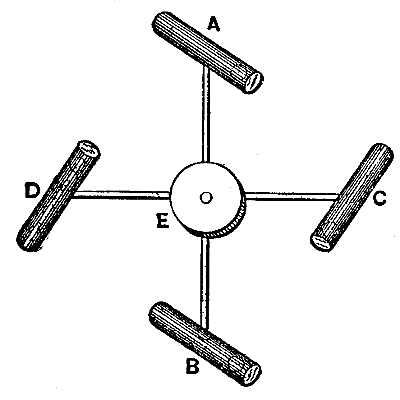
Perpetual Motion Machine: 927-RevolvingTubesAndBalls

     It must then descend to the point, B, and cause the apparatus to make a quarter revolution. Now, the latter can not take place without the rod, A, B, which was situated vertically, assuming a horizontal position, and then the balls, A and B, are to each other as were the balls D, C. One must overcome the other and cause the apparatus to make another quarter revolution. This second quarter revolution can not take place without being followed by a third, through the new position assumed by the balls A, B. Specious argument of the inventor.

(Subsection 927, from p.370)


back next

