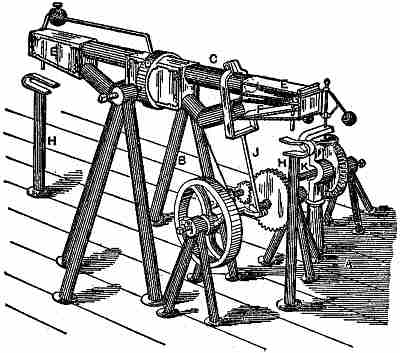
23. Perpetual Motion
The
rocking beam
A beam, C,
pivoted on a center at D, and connected by a pitman, J, to a crank and
fly wheel, contains a long straight tube at the top and two double
inclined tubes below. A ball rolls along the upper tube by gravity in
synchronism with the revolving wheel and axle, so that its momentum
just carries it to the drop valve and incline at F as the crank reaches
the upper point of its revolution. The steeper incline of the lower
double bend tube returns the ball to the farther end of the tube in
time to start in the straight tube for its next run. Patented in 1870.
(Subsection 932, from
p.373)
From: Gardner D. Hiscox, M.E., Mechanical Appliances and Novelties of Construction (1927), Norman W. Henley Publ. Co.


Nature bears long with those who wrong her. She is patient under abuse. But when abuse has gone too far, when the time of reckoning finally comes, she is equally slow to be appeased and to turn away her wrath. (1882) --
Nathaniel Egleston, who was writing then about deforestation, but speaks equally well about the danger of climate change today.
 Carl Sagan
: In science it often happens that scientists say, 'You know that's a really good argument; my position is mistaken,' and then they would actually change their minds and you never hear that old view from them again. They really do it. It doesn't happen as often as it should, because scientists are human and change is sometimes painful. But it happens every day. I cannot recall the last time something like that happened in politics or religion. (1987) ...
(more by Sagan) Albert Einstein: I used to wonder how it comes about that the electron is negative. Negative-positive—these are perfectly symmetric in physics. There is no reason whatever to prefer one to the other. Then why is the electron negative? I thought about this for a long time and at last all I could think was “It won the fight!” ...
(more by Einstein) Richard Feynman: It is the facts that matter, not the proofs. Physics can progress without the proofs, but we can't go on without the facts ... if the facts are right, then the proofs are a matter of playing around with the algebra correctly. ...
(more by Feynman)