Magnetic
pendulum
Let A, A,
represent two magnets revolving on axes. Let B
represent a larger magnet hanging on an axis, pendulum fashion, between
the two former.
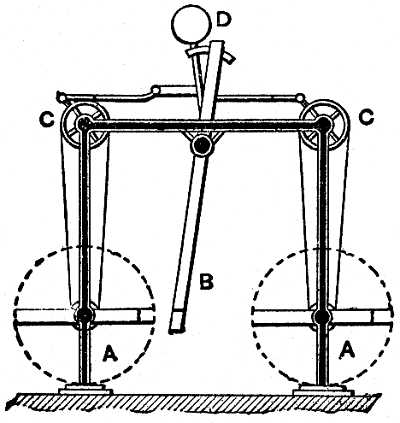
As the poles of
the two smaller magnets lie in the same direction, the
effect will be to draw the larger magnet toward that on the left hand,
while it is at the same time repelled by that on the right; but, while
this is going on, the upper end of the large magnet raises, by means of
a guide wire, the tumbler D, which, just before the magnets come in
contact, passes the perpendicular, and falls over, carrying with it the
lever connected with the two wheels, C, C, and causing them to perform
a quarter revolution; these wheels are connected by lines with two
small wheels fixed on the axles of the two mag-nets A, A. While the
former make a quarter revolution, the latter turn half round. Patented
in 1829.
(Subsection 963, from p.386)
From: Gardner D. Hiscox, M.E., Mechanical Appliances and Novelties of Construction (1927), Norman W. Henley Publ. Co.







