Born 4 Sep 1927. quotes
American computer scientist, the father of research in artificial intelligence (AI), who coined that term in 1956. Shortly after joining the faculty at M.I.T. (1958), he founded the first AI laboratory there. He created LISP (List Processing Language), the computer language most commonly used in AI research. Although he believed intelligence is made up of logic and common sense that can be mathematically represented, his optimism that artificially intelligent robots can be constructed to be more intelligent than human beings has yet to be fulfilled. He developed interactive time-sharing on computers to facilitate hundreds of people to use one large computer together.«
American computer scientist, the father of research in artificial intelligence (AI), who coined that term in 1956. Shortly after joining the faculty at M.I.T. (1958), he founded the first AI laboratory there. He created LISP (List Processing Language), the computer language most commonly used in AI research. Although he believed intelligence is made up of logic and common sense that can be mathematically represented, his optimism that artificially intelligent robots can be constructed to be more intelligent than human beings has yet to be fulfilled. He developed interactive time-sharing on computers to facilitate hundreds of people to use one large computer together.«
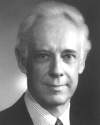
Born 4 Sep 1913; died 23 Aug 1982 at age 68. quotes
American biochemist, who shared (with Christian B. Anfinsen and William H. Stein) the 1972 Nobel Prize for Chemistry for his contribution to the understanding of the connection between chemical structure and catalytic activity of the active centre of ribonuclease molecule, an enzyme. Enzymes are large molecules (macromolecules). The way in which an enzyme accelerates a chemical reaction involves an interaction of the reacting substance (the substrate) with only a limited part of the enzyme molecule, its active site. Moore and Stein have carried out investigations which supplement each other and have led to a complete elucidation of the sequence of amino acids in the enzyme ribonuclease.
American biochemist, who shared (with Christian B. Anfinsen and William H. Stein) the 1972 Nobel Prize for Chemistry for his contribution to the understanding of the connection between chemical structure and catalytic activity of the active centre of ribonuclease molecule, an enzyme. Enzymes are large molecules (macromolecules). The way in which an enzyme accelerates a chemical reaction involves an interaction of the reacting substance (the substrate) with only a limited part of the enzyme molecule, its active site. Moore and Stein have carried out investigations which supplement each other and have led to a complete elucidation of the sequence of amino acids in the enzyme ribonuclease.
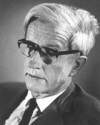
Born 4 Sep 1906; died 9 Mar 1981 at age 74. quotes
German-American microbiologist, who pioneered in the study of molecular genetics. He shared (with Alfred Day Hershey and Salvador Luria), the 1969 Nobel Prize for Physiology or Medicine for work on the replication mechanism and the genetic structure of bacteriophages (a type of virus that infects bacteria, rather than ordinary cells). Bacteriophages serve as models for the more complex, less approachable cells of animals and humans. This insight into the nature of viruses and of virus diseases leads to understanding the mechanism of inheritance, development growth and function of tissues and organs.
German-American microbiologist, who pioneered in the study of molecular genetics. He shared (with Alfred Day Hershey and Salvador Luria), the 1969 Nobel Prize for Physiology or Medicine for work on the replication mechanism and the genetic structure of bacteriophages (a type of virus that infects bacteria, rather than ordinary cells). Bacteriophages serve as models for the more complex, less approachable cells of animals and humans. This insight into the nature of viruses and of virus diseases leads to understanding the mechanism of inheritance, development growth and function of tissues and organs.
1987
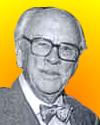
Born 4 Sep 1904; died 28 Jan 1996 at age 91.
Julian Werner Hill was an American chemist was a U.S. research chemist who discovered cold drawing, a technique of strengthening polymer fibers by stretching. Julian Hill and Wallace Carothers had been building long polymer chains by a reaction of a carboxylic acid with an alcohol to give an ester in a device called a molecular still. While removing a sample of the resultant product from the still, Hill observed that the molten polymer could be drawn into fibers. He then made an important and unexpected discovery - that after being cooled, these pliable filaments could be stretched or "cold drawn" to form very strong fibers. Further tests on the sample showed that it had a molecular weight of over 12,000, far higher than any previous polymer.
Julian Werner Hill was an American chemist was a U.S. research chemist who discovered cold drawing, a technique of strengthening polymer fibers by stretching. Julian Hill and Wallace Carothers had been building long polymer chains by a reaction of a carboxylic acid with an alcohol to give an ester in a device called a molecular still. While removing a sample of the resultant product from the still, Hill observed that the molten polymer could be drawn into fibers. He then made an important and unexpected discovery - that after being cooled, these pliable filaments could be stretched or "cold drawn" to form very strong fibers. Further tests on the sample showed that it had a molecular weight of over 12,000, far higher than any previous polymer.
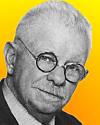
Born 4 Sep 1866; died 23 Jun 1945 at age 78.
U.S. inventor whose submarine, the Argonaut, was the first to make extensive open-sea operations and to salvage cargo from sunken vessels. His career began in 1883 in his father's foundry and machine shop. At first, Lake invented equipment for surface vessels, including a steering gear, dredge and other improvement for fishing and oyster ships sailing in the Chesapeake and Delaware bays. In 1884, he built the Argonaut Jr., his first trial submersible. He was issued U.S. patent 581,213 for his submarine (20 Apr 1897). From 1886 he built the Argonaut, with a 30-hp gasoline engine, which he publicly demonstrated on 16 Dec 1897. After refitting, over several years, it sailed 2,000 miles and salvaged cargo from 30 wrecks.«
U.S. inventor whose submarine, the Argonaut, was the first to make extensive open-sea operations and to salvage cargo from sunken vessels. His career began in 1883 in his father's foundry and machine shop. At first, Lake invented equipment for surface vessels, including a steering gear, dredge and other improvement for fishing and oyster ships sailing in the Chesapeake and Delaware bays. In 1884, he built the Argonaut Jr., his first trial submersible. He was issued U.S. patent 581,213 for his submarine (20 Apr 1897). From 1886 he built the Argonaut, with a 30-hp gasoline engine, which he publicly demonstrated on 16 Dec 1897. After refitting, over several years, it sailed 2,000 miles and salvaged cargo from 30 wrecks.«
Argonaut: The Submarine Legacy of Simon Lake, by John J. Poluhowich. - book suggestion.
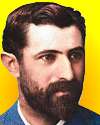
Born 4 Sep 1858; died 1 Aug 1905 at age 46. quotes
Léo Abram Errera was a Belgian botanist whose wrote his first paper in 1874, at age 16. After his death in his 47th year, selections collected from his prolific lifetime output of papers were planned to fill six volumes. Among other topics, he wrote on the Latin names of plants, the scientific basis of agriculture, plant physiology, algae, Darwinism, relation of plants to the environment, the composition of plants, critique of systematic botany and suggestions for research on bacteria.«
Léo Abram Errera was a Belgian botanist whose wrote his first paper in 1874, at age 16. After his death in his 47th year, selections collected from his prolific lifetime output of papers were planned to fill six volumes. Among other topics, he wrote on the Latin names of plants, the scientific basis of agriculture, plant physiology, algae, Darwinism, relation of plants to the environment, the composition of plants, critique of systematic botany and suggestions for research on bacteria.«
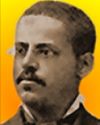
Born 4 Sep 1848; died 11 Dec 1928 at age 80. quotes
Lewis Howard Latimer was a Black-American inventor who contributed to electrical technology. After joining a Boston firm of patent solicitors as an office boy, he taught himself drafting and eventually rose in the mid-1870s to the position of chief draftman. Meanwhile, he was issued his first patent for his invention of a water-closet for railroad cars. In 1880, he moved to be draftsman and private secretary to Hiram Stevens Maxim of the U.S. Lighting Co. where he took charge of the installation of commercial incandescent lighting systems. He patented his carbon filament lamp improvements and other inventions. By 1883, he was working for the Edison Electric Light Co., where his expertise with patents was recognised with a position with its new legal department in 1889.«
Lewis Howard Latimer was a Black-American inventor who contributed to electrical technology. After joining a Boston firm of patent solicitors as an office boy, he taught himself drafting and eventually rose in the mid-1870s to the position of chief draftman. Meanwhile, he was issued his first patent for his invention of a water-closet for railroad cars. In 1880, he moved to be draftsman and private secretary to Hiram Stevens Maxim of the U.S. Lighting Co. where he took charge of the installation of commercial incandescent lighting systems. He patented his carbon filament lamp improvements and other inventions. By 1883, he was working for the Edison Electric Light Co., where his expertise with patents was recognised with a position with its new legal department in 1889.«
The Inventive Spirit of African Americans: Patented Ingenuity, by Patricia Carter Sluby. - book suggestion.
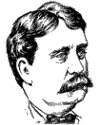
Born 4 Sep 1846; died 1 Jun 1912 at age 65. quotes
Daniel Hudson Burnham was an American architect, raised and educated in Chicago, who gained his early architectural experience with William Le Baron Jenney, the so-called "father of the skyscraper". With John Root (1850-91), he pioneered the construction methods which made modern skyscrapers possible. He designed the dramatic Flatiron Building in New York City. Burnham also gained his reputation as a city planner. In 1909, Burnham and his assistant Edward H. Bennett prepared The Plan for Chicago, which is considered the nation's first example of a comprehensive planning document.
Daniel Hudson Burnham was an American architect, raised and educated in Chicago, who gained his early architectural experience with William Le Baron Jenney, the so-called "father of the skyscraper". With John Root (1850-91), he pioneered the construction methods which made modern skyscrapers possible. He designed the dramatic Flatiron Building in New York City. Burnham also gained his reputation as a city planner. In 1909, Burnham and his assistant Edward H. Bennett prepared The Plan for Chicago, which is considered the nation's first example of a comprehensive planning document.
Born 4 Sep 1844; died 26 Nov 1895 at age 51.
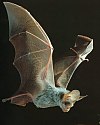
Irish zoologist, chiefly remembered for his laborious investigation into the structure and classification of the chiroptera and insectivora, on both of which he became the chief authority of his time." After graduating with medical training (1867) from Trinity College, Dublin, he rose to the rank of surgeon lieutenant colonel in the army. He also served in the Zulu war of 1879. He was awarded the gold medal of the Dublin Pathological Society for his essay on Diagnosis and Pathology of the Injuries and Diseases of the Shoulderblade. He contributed the sections for Insectivora, Chiroptera, and Rodentia, in the article Mammalia and the articles Mole, Shrew, and Vampire to the ninth edition of the Encyclopedia Britannica.[Image: example of a Chiroptera]
Irish zoologist, chiefly remembered for his laborious investigation into the structure and classification of the chiroptera and insectivora, on both of which he became the chief authority of his time." After graduating with medical training (1867) from Trinity College, Dublin, he rose to the rank of surgeon lieutenant colonel in the army. He also served in the Zulu war of 1879. He was awarded the gold medal of the Dublin Pathological Society for his essay on Diagnosis and Pathology of the Injuries and Diseases of the Shoulderblade. He contributed the sections for Insectivora, Chiroptera, and Rodentia, in the article Mammalia and the articles Mole, Shrew, and Vampire to the ninth edition of the Encyclopedia Britannica.[Image: example of a Chiroptera]
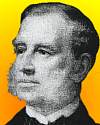
Born 4 Sep 1805; died 9 Feb 1883 at age 77.
American industrialist, cofounder of Phelps, Dodge & Company, which was one of the largest mining companies in the US for more than a century. His marriage (1828) to Melissa Phelps connected him with a wealthy New York family; his father-in-law was a successful metals trader. In 1833 Dodge joined the firm of Phelps, Dodge & Company, which for two generations held a foremost place as dealers in copper and other metals. The firm had an important part in the development of Lake Superior copper and of Pennsylvania iron. Dodge also made extensive investments in timber lands and in railroad enterprises - the Erie, Lackawanna, Jersey Central, and Texas Central.
American industrialist, cofounder of Phelps, Dodge & Company, which was one of the largest mining companies in the US for more than a century. His marriage (1828) to Melissa Phelps connected him with a wealthy New York family; his father-in-law was a successful metals trader. In 1833 Dodge joined the firm of Phelps, Dodge & Company, which for two generations held a foremost place as dealers in copper and other metals. The firm had an important part in the development of Lake Superior copper and of Pennsylvania iron. Dodge also made extensive investments in timber lands and in railroad enterprises - the Erie, Lackawanna, Jersey Central, and Texas Central.
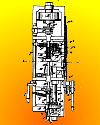
(USPTO)
Born 4 Sep 1801; died 23 Oct 1868 at age 67.
American inventor and machinist of Providence, RI, who patented the first practical screw machine in the U.S. for making pointed screws (14 Dec 1852, No. 9,477). Early screws had blunt ends, and it was necessary to drill a starter hole. In Oct 1840, he was one of ten incorporators of The New England Screw Co. He invented a machine for the company to use cutting the threads of screws (patented 18 Aug 1842), another for shaving the heads of screws (patented 6 Apr 1843) and one for removing the burs left in cutting the slots in the heads (patented 19 Apr 1843). He invented and patented seven other machines or devices for improving the manufacture of screws, such as a Screw-Blank Feeding mechanism (3 Jun 1856, No.15,052).«
American inventor and machinist of Providence, RI, who patented the first practical screw machine in the U.S. for making pointed screws (14 Dec 1852, No. 9,477). Early screws had blunt ends, and it was necessary to drill a starter hole. In Oct 1840, he was one of ten incorporators of The New England Screw Co. He invented a machine for the company to use cutting the threads of screws (patented 18 Aug 1842), another for shaving the heads of screws (patented 6 Apr 1843) and one for removing the burs left in cutting the slots in the heads (patented 19 Apr 1843). He invented and patented seven other machines or devices for improving the manufacture of screws, such as a Screw-Blank Feeding mechanism (3 Jun 1856, No.15,052).«
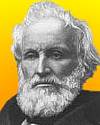
Born 4 Sep 1783; died 6 Feb 1864 at age 80.
American businessman who, long before the availability of electric refrigerators, created an export trade in block ice harvested from frozen fresh-water ponds in New England during Winter, and shipped to India, Europe and the Carribbean in insulated cargo holds, and stored in insulated warehouses. His first vessel left on 10 Feb 1806 to deliver ice from Boston to Martinique. In the following years, he improved methods of insulation during transport, experimented with exporting fruit preserved in the low temperature on top the ice in the ship's hold. His first cargo to Calcutta, India, arrived 13 Sep 1833. At times, he experienced huge debts. However, he managed eventually to pay off his debts and expand his ice business to produce comfortable profits.« more
American businessman who, long before the availability of electric refrigerators, created an export trade in block ice harvested from frozen fresh-water ponds in New England during Winter, and shipped to India, Europe and the Carribbean in insulated cargo holds, and stored in insulated warehouses. His first vessel left on 10 Feb 1806 to deliver ice from Boston to Martinique. In the following years, he improved methods of insulation during transport, experimented with exporting fruit preserved in the low temperature on top the ice in the ship's hold. His first cargo to Calcutta, India, arrived 13 Sep 1833. At times, he experienced huge debts. However, he managed eventually to pay off his debts and expand his ice business to produce comfortable profits.« more
The Ice King: Frederic Tudor and His Circle, by Carl Seaburg. - book suggestion.

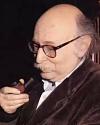
Died 4 Sep 1977 at age 82 (born 30 Oct 1894). quotes
French biologist and historian who did research as an experimental biologist in amphibian embryology, artificial ovulation, the effect of cold on reproductive systems, parthenogenesis, teratogeny and anomalies of batrachians (the order of amphibians which includes the frogs and toads). He was also known as a philosopher and a writer popularizing the science of evolutionary theory, genetics, entomology, and herpetology, as well as the history of science. Rostand was an outspoken critic of nuclear proliferation and the death penalty.«
French biologist and historian who did research as an experimental biologist in amphibian embryology, artificial ovulation, the effect of cold on reproductive systems, parthenogenesis, teratogeny and anomalies of batrachians (the order of amphibians which includes the frogs and toads). He was also known as a philosopher and a writer popularizing the science of evolutionary theory, genetics, entomology, and herpetology, as well as the history of science. Rostand was an outspoken critic of nuclear proliferation and the death penalty.«
Died 4 Sep 1940 at age 61 (born 17 Nov 1878). quotes
American bacteriologist and immunologist who was an international authority on typhus, the deadly disease for which he isolated the typhus germ (1936). By 1939 he had perfected a method to produce enough anti-typhus vaccine to protect a nation. He travelled abroad to study disease outbreaks: an typhus epidemic in Serbia (1915), cholera in the Soviet Union (1923), a prison typhus epidemic in Mexico (1931) and lectured in China (1938). He published over 160 scientific papers. The cause of typhus is Rickettsia organisms carried by a louse or a rat flea and transmitted to humans by a bite from the parasites, especially in areas of poor sanitation and overcrowding. He wrote his autobiography in the third person, As I Remember Him, while dying of leukemia.«
American bacteriologist and immunologist who was an international authority on typhus, the deadly disease for which he isolated the typhus germ (1936). By 1939 he had perfected a method to produce enough anti-typhus vaccine to protect a nation. He travelled abroad to study disease outbreaks: an typhus epidemic in Serbia (1915), cholera in the Soviet Union (1923), a prison typhus epidemic in Mexico (1931) and lectured in China (1938). He published over 160 scientific papers. The cause of typhus is Rickettsia organisms carried by a louse or a rat flea and transmitted to humans by a bite from the parasites, especially in areas of poor sanitation and overcrowding. He wrote his autobiography in the third person, As I Remember Him, while dying of leukemia.«
Rats, Lice, and History...of Typhus Fever, by Hans Zinsser. - book suggestion.
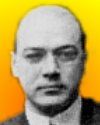
Died 4 Sep 1922 at age 46 (born 17 Jun 1876). quotes
American anatomist and brain morphologist who assisted at the autopsy (29 Oct 1901) of the brain of Leon Franz Czolgosz, the assassin of U.S. president William McKinley. At the time, he had just published an exhaustive series of eight papers on the human brain, but was only in the fourth year of his medical training. Although he detected a few very minor variations in gyri and sulci patterns in the brain of Czolgosz, he reported in the New York Medical Journal (1902) that “nothing has been found in the brain of this assassin that would condone his crime.” He became editor of, and revised, American editions of Gray's Anatomy. Throughout his career he studied the brain morphology of groups of famous people, different races, and criminals, thought ultimately he was unable to link traits to brain structure.« more
American anatomist and brain morphologist who assisted at the autopsy (29 Oct 1901) of the brain of Leon Franz Czolgosz, the assassin of U.S. president William McKinley. At the time, he had just published an exhaustive series of eight papers on the human brain, but was only in the fourth year of his medical training. Although he detected a few very minor variations in gyri and sulci patterns in the brain of Czolgosz, he reported in the New York Medical Journal (1902) that “nothing has been found in the brain of this assassin that would condone his crime.” He became editor of, and revised, American editions of Gray's Anatomy. Throughout his career he studied the brain morphology of groups of famous people, different races, and criminals, thought ultimately he was unable to link traits to brain structure.« more
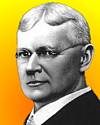
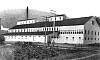
American inventor and manufacturer whose process for fabricating continuous sheets of flat glass made the mass production of glass for windows possible. Colburn began his experiments in 1899 which resulted in his patent for a sheet glass drawing machine on 25 Mar 1902. He formed the Colburn Machine Glass Co. in Aug 1906, installed drawing machines at two factories in 1908 but went bankrupt in 1911 before the technology was perfected. The Toledo Glass Company bought Colburn's patents in 1912 and hired him shortly thereafter. He began refining the process at the Toledo Glass experimental plant where its first draw of sheet glass took place on 25 Nov 1913. The company subsequently organized as the Libbey-Owens Sheet Glass Company in 1916. Colburn died in the following year, before seeing the eventual full success of his process.[Image right: Colburn Machine Glass Co., Reynoldsville, Pa, 1907.] more
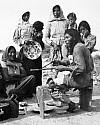
Died 4 Sep 1912 at age 59 (born 17 Apr 1853).
American geologist, hydrologist, archaeologist who was noted for his pioneer studies documenting the occurrence of waves of invasions and recessions of ice sheets in North America, thus establishing the complexity of the Great Ice Age. He worked in a number of governmental capacities, including as a director in the U.S. Geological Survey, and was a founder and president of the National Geographic Society. While on the staff of the Bureau of Soils, he organized the landmark Conference of Governors on Conservation of Natural Resources (13-15 May 1908) and has been called the "chief theorist of the conservation movement." As an anthropologist he studied the American Indians and wrote The Seri Indians (1898).[Image: Seri Indians]
American geologist, hydrologist, archaeologist who was noted for his pioneer studies documenting the occurrence of waves of invasions and recessions of ice sheets in North America, thus establishing the complexity of the Great Ice Age. He worked in a number of governmental capacities, including as a director in the U.S. Geological Survey, and was a founder and president of the National Geographic Society. While on the staff of the Bureau of Soils, he organized the landmark Conference of Governors on Conservation of Natural Resources (13-15 May 1908) and has been called the "chief theorist of the conservation movement." As an anthropologist he studied the American Indians and wrote The Seri Indians (1898).[Image: Seri Indians]
Trails to Tiburón: The 1894 and 1895 Field Diaries of W J McGee, by Hazel McFeely Fontana. - book suggestion.
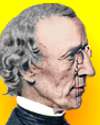
Died 4 Sep 1874 at age 59 (born 11 Aug 1815). quotes
American comparative anatomist and naturalist whose career began as an assistant physician, anatomy demonstrator and curator of the Lowell Museum, but later turned from medicine to comparative anatomy and anthropology. Wyman made the first scientific study of gorillas (the name he clarified), and identified them as a species different from orangutans. His paper announcing the newly discovered gorilla species was published in 1847 in the Journal of the Boston Society of Natural History. Wyman had a good talent for making detailed drawings. Although he also had expertise equal to that of his contemporaries at Harvard, Asa Gray and Louis Agassiz, Wyman’s personal modesty has left him remembered as less prominent.«
American comparative anatomist and naturalist whose career began as an assistant physician, anatomy demonstrator and curator of the Lowell Museum, but later turned from medicine to comparative anatomy and anthropology. Wyman made the first scientific study of gorillas (the name he clarified), and identified them as a species different from orangutans. His paper announcing the newly discovered gorilla species was published in 1847 in the Journal of the Boston Society of Natural History. Wyman had a good talent for making detailed drawings. Although he also had expertise equal to that of his contemporaries at Harvard, Asa Gray and Louis Agassiz, Wyman’s personal modesty has left him remembered as less prominent.«
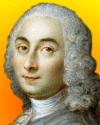
Died 4 Sep 1784 at age 70 (born 17 Jun 1714).
French astronomer and geodesist (Cassini III), who continued surveying work he began while assisting his father, Jacques Cassini (Cassini II), resulting in the first topographical map of France produced by modern principles. His grandfather, Giovanni Domenico Cassini (Cassini I) discovered four satellites of Saturn, a band on planet's surface, and that its ring was subdivided. Cassini I was the first to assume effective direction (1671) of the new observatory established by the Académie Royale des Sciences in Paris, which his descendants in turn continued. Cassini III was the first official director of the observatory when the post was created by the king in 1771. His son was Jean-Dominique Cassini (Cassini IV).«
French astronomer and geodesist (Cassini III), who continued surveying work he began while assisting his father, Jacques Cassini (Cassini II), resulting in the first topographical map of France produced by modern principles. His grandfather, Giovanni Domenico Cassini (Cassini I) discovered four satellites of Saturn, a band on planet's surface, and that its ring was subdivided. Cassini I was the first to assume effective direction (1671) of the new observatory established by the Académie Royale des Sciences in Paris, which his descendants in turn continued. Cassini III was the first official director of the observatory when the post was created by the king in 1771. His son was Jean-Dominique Cassini (Cassini IV).«
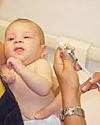
In 2006, a vaccine for a type of meningitis was offered for the first time in Great Britain for all babies at two, four and 13 months as part of the national childhood immunisation programme. The vaccine is designed for protection against pneumococcal disease which causes meningitis and septicaemia, a very serious infection, with a death rate of 20 per cent. Of children that survive infection, a quarter suffer life-long brain damage, deafness and epilepsy. Babies are particularly vulnerable. The Wyeth pharmaceuticals company, the vaccine supplier, reported that its use in America had shown a significant reduction in cases. An estimated 50 babies a year are expected to be protected from the devastating after-effects of pneumococcal meningitis.«
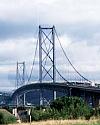
In 1964, the Forth Road Bridge opened. At 6,156 feet long it was the longest in Europe at that time. The Forth Road Bridge at Queensferry is shown at left. Both rail (1890) and road bridges are sited where hard volcanic rock is close to the surface and can make good foundations for the structures. Both bridges emphasise the historical importance of the Forth crossing as the opening of the Forth Road Bridge finally brought to an end a ferry service that could be traced back 800 years.
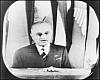
In 1951, President Harry Truman inaugurated transcontinental television service in the U.S. when AT&T carried his address to the opening session of the Japanese Peace Convention in San Francisco. The conference would formalize the end of hostilities with Japan, opening the door for Japan's economic recovery. The largest single television audience to date, estimated at over 30 million people, viewed the President Harry Truman, some as far away as New England. Eighty-seven stations all over the U.S. received and broadcast Truman's speech, the result of a $40 million infrastructure investment by AT&T. Microwave radio technology transmitted the television signal from San Francisco to Chicago. From there, it was carried on existing coaxial cables to the East Coast..«
detail
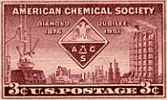
(USPTO)
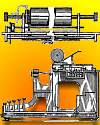
In 1906, U.S. patent No. 830,115 was issued to Robert Eugene Turner of Norfolk, Virginia, for his invention of a "Type Writing Machine,"(typewriter) with a carriage powered by a motor to "return automatically when the end of the writing-line is reached, also to return same by pressing a key-lever on the keyboard to return the carriage at any point of its stroke." Also, line spacing was provided by manual or automatic means. A low-powered motor was adapted to feed the carriage in the printing direction, a high-powered motor for returning the carriage in the reverse direction, and the necessary mechanism to control their action. A buffering mechanism was included to reduce the impact of the returning carriage at the end of its reverse stroke.«[Image: two figures from patent 830,115 showing details of carriage and platen (top) and a sectional elevation of the type writing machine showing the general arrangement of the mechanism.]
(USPTO)
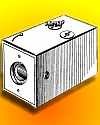
In 1888, George Eastman was issued a landmark U.S. patent No. 388,850 for his box camera. On the same date, he registered the trademark name: Kodak. The Eastman Kodak company was formed 24 Apr 1888. This design was the first Kodak mass-produced camera, and brought photography to the mass market. As described in its advertising, the operation was simple: “Pull the String, Turn the Key, Press the Button.” Now anyone could take pictures family, events, indoor and outdoor scenes, and vacations, without needing special skills. Only 22-ounces in weight, it required no tripod or table for support. It used a fixed-focus lens which was still fast enough to take practically instantaneously exposures. Its roll film was enough to take 100 pictures, each 2½ inches diameter.«* more
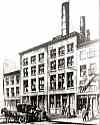
In 1882, the first central electric station to supply light and power was the Edison Electric Illuminating Company at 257 Pearl Street in New York City. Thomas Edison inaugurated its operation by operating a switch in the Wall Street office of his primary financial backer. The station's “Jumbo No.1” generator was a direct-current steam-powered dynamo. The armature alone was 6 tons of its total 27 ton weight, and used air cooling. It was built at the Edison Machine Works in 1881, and had its first test on 5 Jul 1882. It could power about 700 sixteen candlepower lamps. Within 14 months, Edison's first power station served 508 subscribers and powered 12,732 bulbs.«[Image: Exterior of Pearl Street station]
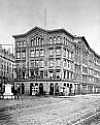
In 1882, the first newspaper plant to make use of the newly available electrical power provided by the Edison Illuminating Company was the New York Times. The building had previous been wired, with light fixtures and electric meters installed and inspected by an expert from the Board of Underwriters. There were 27 lamps installed in the editorial room and 25 lamps in the counting room. Next day, in the newspaper's own article, the workers were said to be unanimously in favour of the light provided by the carbon-filament lamps as being brighter and steadier than the gas lighting it replaced. There was no nauseous smell, and the lamps were very convenient to light by simply turning a thumbscrew. Additional lights were added later for the composing and press rooms.«[Image: Exterior of New York Times building, c. 1874.] more




