
Born 11 Feb 1915; died 7 Jan 1998 at age 82. quotes
Richard Wesley Hamming was an American computer scientist and mathematician who devised computer Hamming codes - error-detecting and correcting codes (1947). These add one or more bits to the transmission of blocks of data, used for a parity check, so that errors can be corrected automatically. By making a resend of bad data unnecessary, efficiency improved for modems, compact disks and satellite communications. He also worked on programming languages, numerical analysis and the Hamming spectral window (used to smooth data before Fourier analysis is carried out). He taught at University of Louisville, then during WW II worked (1945) on computers with the Manhattan Project creating the atomic bomb. From 1946, he spent 30 years with Bell Telephone Labs, eventually becoming head of computing science research.«
Richard Wesley Hamming was an American computer scientist and mathematician who devised computer Hamming codes - error-detecting and correcting codes (1947). These add one or more bits to the transmission of blocks of data, used for a parity check, so that errors can be corrected automatically. By making a resend of bad data unnecessary, efficiency improved for modems, compact disks and satellite communications. He also worked on programming languages, numerical analysis and the Hamming spectral window (used to smooth data before Fourier analysis is carried out). He taught at University of Louisville, then during WW II worked (1945) on computers with the Manhattan Project creating the atomic bomb. From 1946, he spent 30 years with Bell Telephone Labs, eventually becoming head of computing science research.«

Born 11 Feb 1908; died 13 Nov 1999 at age 91.
English geologist and explorer who initiated and led (with Sir Edmund Hillary) the Commonwealth Trans-Antarctic Expedition of 1957-58. In 1929 and 1930-31, Fuchs participated as a geologist on expeditions to East Greenland and the East African lakes. In 1958 Fuchs's 12-man party completed the first land journey across Antarctica in 99 days despite severe hardships, travelling 2,500 miles (4,000 kilometres) from the Filchner Ice Shelf to McMurdo Sound. Along the way a substantial scientific programme had been accomplished, including seismic soundings and a gravity traverse. The findings of the expedition confirmed earlier theories that a single continent exists beneath the Antarctic polar ice sheet.
English geologist and explorer who initiated and led (with Sir Edmund Hillary) the Commonwealth Trans-Antarctic Expedition of 1957-58. In 1929 and 1930-31, Fuchs participated as a geologist on expeditions to East Greenland and the East African lakes. In 1958 Fuchs's 12-man party completed the first land journey across Antarctica in 99 days despite severe hardships, travelling 2,500 miles (4,000 kilometres) from the Filchner Ice Shelf to McMurdo Sound. Along the way a substantial scientific programme had been accomplished, including seismic soundings and a gravity traverse. The findings of the expedition confirmed earlier theories that a single continent exists beneath the Antarctic polar ice sheet.
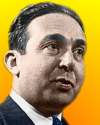
Born 11 Feb 1898; died 30 May 1964 at age 66. quotes
Hungarian-American physicist who, with Enrico Fermi, designed the first nuclear reactor that sustained nuclear chain reaction (2 Dec 1942). In 1933, Szilard had left Nazi Germany for England. The same year he conceived the neutron chain reaction. Moving to N.Y. City in 1938, he conducted fission experiments at Columbia University. Aware of the danger of nuclear fission in the hands of the German government, he persuaded Albert Einstein to write to President Roosevelt, urging him to commission American development of atomic weapons. In 1943, Major General Leslie Groves, leader of the Manhattan Project designing the atomic bomb, forced Szilard to sell his atomic energy patent rights to the U.S. government.
Hungarian-American physicist who, with Enrico Fermi, designed the first nuclear reactor that sustained nuclear chain reaction (2 Dec 1942). In 1933, Szilard had left Nazi Germany for England. The same year he conceived the neutron chain reaction. Moving to N.Y. City in 1938, he conducted fission experiments at Columbia University. Aware of the danger of nuclear fission in the hands of the German government, he persuaded Albert Einstein to write to President Roosevelt, urging him to commission American development of atomic weapons. In 1943, Major General Leslie Groves, leader of the Manhattan Project designing the atomic bomb, forced Szilard to sell his atomic energy patent rights to the U.S. government.
Genius in the Shadows: A Biography of Leo Szilard, the Man Behind the Bomb, by William Lanouette and Bela Silard. - book suggestion.
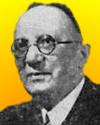
Born 11 Feb 1866; died 29 Oct 1956 at age 90.
Friedrich C. Hofmann was a German chemist who polymerized isoprene to create synthetic rubber (1909) while working as a senior chemist for Elberfelder Farbenfabriken vorm. Friedr. Bayer & Co. The process was granted the world's first patent for a “Method for producing synthetic rubber” (German No. 250690 on 12 Sep 1909). It began to solve the problem of the high cost of natural rubber as the need increased in the motor transportage age. Hofman had pursued the lead revealed by Carl Dietrich Harries who in 1905 had broken down natural rubber using ozone to reveal that it was formed from long chains in which many hundreds of isoprene molecules are bonded together. Hofman also studied the polymerization of butadiene and 2,3-dimethyl butadiene.«
Friedrich C. Hofmann was a German chemist who polymerized isoprene to create synthetic rubber (1909) while working as a senior chemist for Elberfelder Farbenfabriken vorm. Friedr. Bayer & Co. The process was granted the world's first patent for a “Method for producing synthetic rubber” (German No. 250690 on 12 Sep 1909). It began to solve the problem of the high cost of natural rubber as the need increased in the motor transportage age. Hofman had pursued the lead revealed by Carl Dietrich Harries who in 1905 had broken down natural rubber using ozone to reveal that it was formed from long chains in which many hundreds of isoprene molecules are bonded together. Hofman also studied the polymerization of butadiene and 2,3-dimethyl butadiene.«
The Devil's Milk: A Social History of Rubber, by John Tully. - book suggestion.
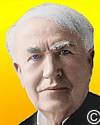
1931
Born 11 Feb 1847; died 18 Oct 1931 at age 84. quotes
Thomas Alva Edison was an American inventor who held a world record 1,093 patents (including those held jointly) and created the world's first industrial research laboratory. He showed an early curiosity for explanations of how everything worked and was especially interested in chemistry. He began selling newspapers on the railroad at age 12, and learned how to operate a telegraph. In 1868, his first invention was an electric vote-recording machine. In 1869, he made improvements on the stock-ticker. In 1876 he moved his laboratory to Menlo Park, N.J., where he invented his phonograph (1877) and the first prototype of a commercially practical incandescent electric light bulb (1879). Other inventions included storage batteries, a dictaphone, and a mimeograph. By the late 1880s he made motion pictures, and by 1912 was experimenting with talking pictures. Edison developed electric power from central generating stations. He became known internationally as “the Wizard of Menlo Park.” In 1962 his second laboratory and home in West Orange, New Jersey, was designated a U.S. National Historic Site. more
Thomas Alva Edison was an American inventor who held a world record 1,093 patents (including those held jointly) and created the world's first industrial research laboratory. He showed an early curiosity for explanations of how everything worked and was especially interested in chemistry. He began selling newspapers on the railroad at age 12, and learned how to operate a telegraph. In 1868, his first invention was an electric vote-recording machine. In 1869, he made improvements on the stock-ticker. In 1876 he moved his laboratory to Menlo Park, N.J., where he invented his phonograph (1877) and the first prototype of a commercially practical incandescent electric light bulb (1879). Other inventions included storage batteries, a dictaphone, and a mimeograph. By the late 1880s he made motion pictures, and by 1912 was experimenting with talking pictures. Edison developed electric power from central generating stations. He became known internationally as “the Wizard of Menlo Park.” In 1962 his second laboratory and home in West Orange, New Jersey, was designated a U.S. National Historic Site. more
Edison: A Biography, by Matthew Josephson. - book suggestion.
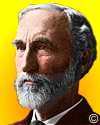
Born 11 Feb 1839; died 28 Apr 1903 at age 64. quotes
Josiah Willard Gibbs was an American mathematical physicist and chemist known for contributions to vector analysis and as one of the founders of physical chemistry. In 1863, He was awarded Yale University's first engineering doctorate degree. His major work was in developing thermodynamic theory, which brought physical chemistry from an empirical enquiry to a deductive science. In 1873, he published two papers concerning the fundamental nature of entropy of a system, and established the “thermodynamic surface,” a geometrical and graphical method for the analysis of the thermodynamic properties of substances. His famous On the Equilibrium of Homogeneous Substances, published in 1876, established the use of “chemical potential,” now an important concept in physical chemistry.«
Josiah Willard Gibbs was an American mathematical physicist and chemist known for contributions to vector analysis and as one of the founders of physical chemistry. In 1863, He was awarded Yale University's first engineering doctorate degree. His major work was in developing thermodynamic theory, which brought physical chemistry from an empirical enquiry to a deductive science. In 1873, he published two papers concerning the fundamental nature of entropy of a system, and established the “thermodynamic surface,” a geometrical and graphical method for the analysis of the thermodynamic properties of substances. His famous On the Equilibrium of Homogeneous Substances, published in 1876, established the use of “chemical potential,” now an important concept in physical chemistry.«
The Scientific Papers of J. Willard Gibbs, Vol. 1: Thermodynamics, by J. Willard Gibbs. - book suggestion.
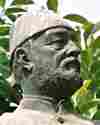
Born 11 Feb 1821; died 19 Jan 1881 at age 59.
Auguste-Ferdinand-François Mariette was a French archeologist who conducted major excavations throughout Egypt, revealing much about the earlier periods of Egyptian history. Sent by the Louvre, in 1850, to purchase papyruses, at Saqqara he discovered the Serapeum. Its rockcut corridors and burial chambers were excavated for the Apis bulls which were sacred to god Ptah. The corridors form a virtual underground extending for hundreds of metres. The stone sarcophagi weigh as much as 70 tonnes and average some 4 metres long and 3.3 metres high. Twenty chambers still contain sarcophagi. This was the start of French archaeology in Egypt. He won renown too, for his battle against looting and the illicit export of antiquities.
Auguste-Ferdinand-François Mariette was a French archeologist who conducted major excavations throughout Egypt, revealing much about the earlier periods of Egyptian history. Sent by the Louvre, in 1850, to purchase papyruses, at Saqqara he discovered the Serapeum. Its rockcut corridors and burial chambers were excavated for the Apis bulls which were sacred to god Ptah. The corridors form a virtual underground extending for hundreds of metres. The stone sarcophagi weigh as much as 70 tonnes and average some 4 metres long and 3.3 metres high. Twenty chambers still contain sarcophagi. This was the start of French archaeology in Egypt. He won renown too, for his battle against looting and the illicit export of antiquities.
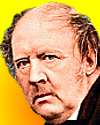
Born 11 Feb 1800; died 17 Sep 1877 at age 77.
William Henry Fox Talbot was an English inventor, mathematician, chemist, physicist, philologist and Egyptologist who invented the negative-positive photographic process. He improved the discovery by Thomas Wedgwood (1802) that brushing silver nitrate solution onto paper produces a light-sensitive medium able to record negative images, but Wedgewood was unable to control the darkening. In February 1835, Talbot found that a strong solution of salt fixed the image. Using a camera obscura to focus an image onto his paper to produce a negative, then - by exposing a second sheet of paper to sunlight transmitted through the negative - he was the first to produce a positive picture of which he was able to make further copies at will. His Pencil of Nature (1844) was the first photographically illustrated book.
William Henry Fox Talbot was an English inventor, mathematician, chemist, physicist, philologist and Egyptologist who invented the negative-positive photographic process. He improved the discovery by Thomas Wedgwood (1802) that brushing silver nitrate solution onto paper produces a light-sensitive medium able to record negative images, but Wedgewood was unable to control the darkening. In February 1835, Talbot found that a strong solution of salt fixed the image. Using a camera obscura to focus an image onto his paper to produce a negative, then - by exposing a second sheet of paper to sunlight transmitted through the negative - he was the first to produce a positive picture of which he was able to make further copies at will. His Pencil of Nature (1844) was the first photographically illustrated book.
First Photographs: William Henry Fox Talbot and the Birth of Photography, by William Henry Fox. Talbot, Michael Gray. - book suggestion.
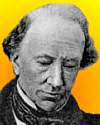
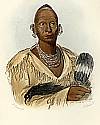
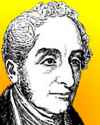
English physician and ethnologist who was among the first to argue that a single human species embraces all the world's races in Researches Into the Physical History of Man (1813). He was able to study sailors of many different races because his home was in the port town of Bristol. He later proposed a theory in a Treatise on Insanity and other Disorders affecting the Mind (1835) that moral insanity (psychopathic personality) was a distinct disease. Later he published on the legal questions of insanity (1842) was in 1845 moved to London as a commissioner of lunacy.«[Image right: Muck-a-tah-mish-a-kah-kaik, illustration by George Catlin, from Prichard's The Natural History of Man.]
James Cowles Prichard's Anthropology: Remaking the Science of Man in Early Nineteenth Century Britain, by H. F. Augstein. - book suggestion.
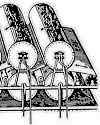
English inventor of paper-making machinery known by his name. He and his brother Sealy (d. 1847) spent a fortune over their lifetime perfecting a machine capable of producing paper of unlimited length, beginning with pulp fed at the beginning, to finished paper rolled on a drum at the other end. The pulp was carried on a wire-mesh belt and squeezed between rollers to remove the water. They were assisted by mechanic Bryan Donkin. Despite holding patents, the cost and effort involved to defend them left the brothers without any substantial return on their investment, and they died having obtained a small grant of compensation from Parliament. The principles developed in their machine are still in use in modern paper-making.«[Image right: detail showing delivery end of a Fourdrinier machine, c.1850.] more
Born 11 Feb 1657; died 9 Jan 1757 at age 99. quotes
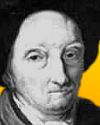
Bernard le Bovier de Fontenelle was a French science writer whose Conversations on the Plurality of Worlds (1686), was one of the first works to present science for the lay reader. He popularized the astronomical theories of Descartes. Many of the characteristic ideas of the Enlightenment are found in embryonic form in his works. From 1697 he became permanent secretary to the Académie des Sciences. He held the office for 42 years, and in this official capacity, he wrote the Histoire du renouvellement del Académie des Sciences (Paris, 3 vols., 1708, 1717, 1722) containing extracts and analyses of the proceedings, written with great simplicity and delicacy. Fontenelle presented many obituary notices to the Académie, including those of Newton and Leibniz.
Bernard le Bovier de Fontenelle was a French science writer whose Conversations on the Plurality of Worlds (1686), was one of the first works to present science for the lay reader. He popularized the astronomical theories of Descartes. Many of the characteristic ideas of the Enlightenment are found in embryonic form in his works. From 1697 he became permanent secretary to the Académie des Sciences. He held the office for 42 years, and in this official capacity, he wrote the Histoire du renouvellement del Académie des Sciences (Paris, 3 vols., 1708, 1717, 1722) containing extracts and analyses of the proceedings, written with great simplicity and delicacy. Fontenelle presented many obituary notices to the Académie, including those of Newton and Leibniz.

Died 11 Feb 2009 at age 97 (born 14 Feb 1911).
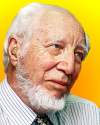
Willem Johan Kolff was a Dutch-American physician and biomedical engineer who pioneered artificial organs. He invented the artificial kidney machine in 1943, before he emigrated to the U.S. (1950). In Spring 1955, the American Society for Artificial Internal Organs was formed. Kolff became its first president. He headed a team which invented the first totally artificial heart, a pneumatic pump, which was tested on 12 Dec1957, implanted within the chest of dog. It kept the 20.7-kg dog alive for 90 minutes. This was the first time an animal had lived with an implanted totally artificial heart. By 2 Dec 1982, under his supervision, the first fully artificial heart was implanted in a human patient. It was designed by Robert K. Jarvik, one of Kolff's students, that implanted the artificial heart which kept the patient, Barney Clark, alive for 112 days, thus proving the viability of such a procedure.«
Willem Johan Kolff was a Dutch-American physician and biomedical engineer who pioneered artificial organs. He invented the artificial kidney machine in 1943, before he emigrated to the U.S. (1950). In Spring 1955, the American Society for Artificial Internal Organs was formed. Kolff became its first president. He headed a team which invented the first totally artificial heart, a pneumatic pump, which was tested on 12 Dec1957, implanted within the chest of dog. It kept the 20.7-kg dog alive for 90 minutes. This was the first time an animal had lived with an implanted totally artificial heart. By 2 Dec 1982, under his supervision, the first fully artificial heart was implanted in a human patient. It was designed by Robert K. Jarvik, one of Kolff's students, that implanted the artificial heart which kept the patient, Barney Clark, alive for 112 days, thus proving the viability of such a procedure.«
Inventor for Life: The Story of W. J. Kolff, Father of Artificial Organs, by Herman Broers. - book suggestion.
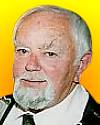
Died 11 Feb 2006 (born 1932).
German taxidermist who attempted to resurrect the quagga by selective breeding. The quagga, related to the zebra, had been hunted into extinction (1883). Rau took a taxidermy post at the South Africa Museum in 1959. He found there a quagga hide with tissue traces remaining on it. By 1983, Californian geneticists extracted mitochondrial DNA which showed that quagga genes still existed in a living sub-species - the Plains or Burchell's zebra. In 1987, Rau founded the Quagga Project to locate Plains zebras with quagga-like markings and isolate them in breeding herds. He predicted that a full quagga would emerge in four generations, and saw the third generation with stripes approaching those of a quagga before his death.« more
German taxidermist who attempted to resurrect the quagga by selective breeding. The quagga, related to the zebra, had been hunted into extinction (1883). Rau took a taxidermy post at the South Africa Museum in 1959. He found there a quagga hide with tissue traces remaining on it. By 1983, Californian geneticists extracted mitochondrial DNA which showed that quagga genes still existed in a living sub-species - the Plains or Burchell's zebra. In 1987, Rau founded the Quagga Project to locate Plains zebras with quagga-like markings and isolate them in breeding herds. He predicted that a full quagga would emerge in four generations, and saw the third generation with stripes approaching those of a quagga before his death.« more
Quaggas and Other Zebras, by David Barnaby. - book suggestion.
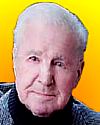
Died 11 Feb 2005 at age 90 (born 21 Oct 1914).
American physicist and engineer who invented the crash-test dummy used to test the safety of cars, parachutes and other devices. From the 1930's, when safety of cars during a crash was tested, cadavers had been used. When he started a company in 1952, Alderson Research Laboratories, which designed an anthropomorphic dummy, the first application was for testing jet ejection seats. In 1968, he produced a dummy (called the V.I.P.) built specifically for automotive testing with built-in instruments for collecting data. It had articulated joints with dimensions and weight distribution like an average adult man. His company later also made medical phantoms for simulations such as synthetic wounds that oozed mock blood.«
American physicist and engineer who invented the crash-test dummy used to test the safety of cars, parachutes and other devices. From the 1930's, when safety of cars during a crash was tested, cadavers had been used. When he started a company in 1952, Alderson Research Laboratories, which designed an anthropomorphic dummy, the first application was for testing jet ejection seats. In 1968, he produced a dummy (called the V.I.P.) built specifically for automotive testing with built-in instruments for collecting data. It had articulated joints with dimensions and weight distribution like an average adult man. His company later also made medical phantoms for simulations such as synthetic wounds that oozed mock blood.«
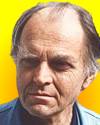
Died 11 Feb 1994 at age 70 (born 13 Jan 1924). quotes
Austrian-American philosopher of science whose provocative critiques sparked discussions on the nature of scientific inquiry. His most influential work, Against Method (1975), challenged the notion that science follows a single, fixed methodology, instead advocating for an “anything goes” approach. He held that scientific progress often results from breaking traditional rules rather than adhering to them, citing historical examples such as Galileo’s defense of heliocentrism. Feyerabend emphasized the role of social, historical, and political factors in shaping scientific theories. He became an American citizen in 1935, but spent parts of his his life in other countries, including England and New Zealand. He also wrote Science in a Free Society.«
Austrian-American philosopher of science whose provocative critiques sparked discussions on the nature of scientific inquiry. His most influential work, Against Method (1975), challenged the notion that science follows a single, fixed methodology, instead advocating for an “anything goes” approach. He held that scientific progress often results from breaking traditional rules rather than adhering to them, citing historical examples such as Galileo’s defense of heliocentrism. Feyerabend emphasized the role of social, historical, and political factors in shaping scientific theories. He became an American citizen in 1935, but spent parts of his his life in other countries, including England and New Zealand. He also wrote Science in a Free Society.«
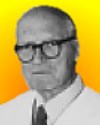
c.1980s
Died 11 Feb 1994 at age 94 (born 17 Apr 1899).
English entomologist who pioneered in the study of insect physiology; he was particularly respected for his research into the role of hormones in insect growth, metamorphosis, and reproduction and for his insights into simple mechanisms, such as how insects walk upside down. His investigations of the living insect body and its tissues and organs revealed much about the dynamic complexity of individual insects and their interactions with the environment. An important contribution was his recognition that insects could be used - instead of mice or other laboratory animals - for the fundamental investigation of animal physiology and function. His Insect Physiology (1934) is often considered the foundation for this branch of entomology.
English entomologist who pioneered in the study of insect physiology; he was particularly respected for his research into the role of hormones in insect growth, metamorphosis, and reproduction and for his insights into simple mechanisms, such as how insects walk upside down. His investigations of the living insect body and its tissues and organs revealed much about the dynamic complexity of individual insects and their interactions with the environment. An important contribution was his recognition that insects could be used - instead of mice or other laboratory animals - for the fundamental investigation of animal physiology and function. His Insect Physiology (1934) is often considered the foundation for this branch of entomology.
Insect Physiology, by Vincent B. Wigglesworth. - book suggestion.
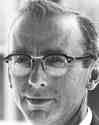
Died 11 Feb 1993 at age 71 (born 28 Jan 1922).
Robert William Holley was an American biochemist who shared the 1968 Nobel Prize in Physiology or Medicine (with Marshall Warren Nirenberg and Har Gobind Khorana). The three scientists independently conducted research that helped to decipher the genetic code chemically and explain how the genetic information stored in the DNA of a cell controls the synthesis of proteins, the building blocks of cells.
Robert William Holley was an American biochemist who shared the 1968 Nobel Prize in Physiology or Medicine (with Marshall Warren Nirenberg and Har Gobind Khorana). The three scientists independently conducted research that helped to decipher the genetic code chemically and explain how the genetic information stored in the DNA of a cell controls the synthesis of proteins, the building blocks of cells.
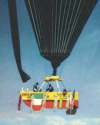
Double Eagle II
Died 11 Feb 1985 at age 54 (born 9 Jun 1930).
American balloonist who, with three crew mates, made the first transpacific balloon flight that was also the longest nonstop balloon flight, in the Double Eagle V. Thirteen-stories high, helium filled Double Eagle V, piloted by Ben Abruzzo, Larry Newman, Ron Clark and Rocky Aoki of Japan, launched from Nagashimi, Japan on 10 Nov 1981. When it landed 84 hours, 31 minutes later in Mendocino National Forest, Cal., the new distance record was set at 5,768 miles. He also accompanied Maxie Anderson and Larry Newman on the first tranatlantic balloon flight in the Double Eagle II (11-17 Aug 1978). Abruzzo died when his twin-engine airplane crashed in Albuquerque.See National Geographic, 4/82, First Across the Pacific: Flight of Double Eagle V, pp. 513-521.
American balloonist who, with three crew mates, made the first transpacific balloon flight that was also the longest nonstop balloon flight, in the Double Eagle V. Thirteen-stories high, helium filled Double Eagle V, piloted by Ben Abruzzo, Larry Newman, Ron Clark and Rocky Aoki of Japan, launched from Nagashimi, Japan on 10 Nov 1981. When it landed 84 hours, 31 minutes later in Mendocino National Forest, Cal., the new distance record was set at 5,768 miles. He also accompanied Maxie Anderson and Larry Newman on the first tranatlantic balloon flight in the Double Eagle II (11-17 Aug 1978). Abruzzo died when his twin-engine airplane crashed in Albuquerque.See National Geographic, 4/82, First Across the Pacific: Flight of Double Eagle V, pp. 513-521.
Double Eagle, by Charles McCarry. - book suggestion.
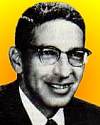
Died 11 Feb 1983 at age 66 (born 22 Mar 1916).
Nathan Schellenberg Kline was an American psychiatrist who is credited with founding the field of psychopharmacology. In 1953, he began investigating the use of a new drug, reserpine, to treat schizophrenia. He continued to pioneer in the biochemical treatment of mentally ill patients by introducing the use of such drugs as the antidepressants lithium and iproniazid and the tranquilizer resperine. Because these drugs so successfully drugs treated two of the major categories of psychiatric illness, thousands of patients - formerly considered untreatable - were able to leave institutions and to rejoin society. By 1957, iproniazid, first in the class of monoamine oxidase (MAO) inhibitors, was treating an estimated 400,000 people in the U.S.«
Nathan Schellenberg Kline was an American psychiatrist who is credited with founding the field of psychopharmacology. In 1953, he began investigating the use of a new drug, reserpine, to treat schizophrenia. He continued to pioneer in the biochemical treatment of mentally ill patients by introducing the use of such drugs as the antidepressants lithium and iproniazid and the tranquilizer resperine. Because these drugs so successfully drugs treated two of the major categories of psychiatric illness, thousands of patients - formerly considered untreatable - were able to leave institutions and to rejoin society. By 1957, iproniazid, first in the class of monoamine oxidase (MAO) inhibitors, was treating an estimated 400,000 people in the U.S.«
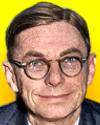
Died 11 Feb 1978 at age 84 (born 26 Mar 1893). quotes
James Bryant Conant was an American educator and scientist. After earning his PhD at Harvard (1916), Conant spent a year in the research division of the chemical warfare service during World War I, then returned to Harvard as a chemistry instructor. In research, he made important findings on the chemistry of chlorophyll and hemoglobin. In 1933, Conant became president of Harvard University. An early advocate of aid to the Allies, Conant became a central figure in organizing American science for WW II, including the development of the atomic bomb. Following WW II, he became a diplomat, as U.S. high commissioner for western Germany (1953). From 1957, he was an education reformer.
James Bryant Conant was an American educator and scientist. After earning his PhD at Harvard (1916), Conant spent a year in the research division of the chemical warfare service during World War I, then returned to Harvard as a chemistry instructor. In research, he made important findings on the chemistry of chlorophyll and hemoglobin. In 1933, Conant became president of Harvard University. An early advocate of aid to the Allies, Conant became a central figure in organizing American science for WW II, including the development of the atomic bomb. Following WW II, he became a diplomat, as U.S. high commissioner for western Germany (1953). From 1957, he was an education reformer.
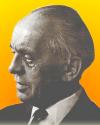
Died 11 Feb 1976 at age 81 (born 2 Nov 1894).
Alexander M(artin) Lippisch was a German-American aerodynamicist whose designs of tailless and delta-winged aircraft in the 1920s and 1930s were important in the development of high-speed jet and rocket airplanes. Lippisch based his tailless arrow shaped aircraft on this example from nature - a flying seed of a tropical plant sent to him by a friend. He felt that the wing near the body should be thicker so that it could be utilized for additional storage, made possible by making the wing near the body longer. This is how he arrived at the delta shaped wing. His first motorized delta wing flew in 1931.
Alexander M(artin) Lippisch was a German-American aerodynamicist whose designs of tailless and delta-winged aircraft in the 1920s and 1930s were important in the development of high-speed jet and rocket airplanes. Lippisch based his tailless arrow shaped aircraft on this example from nature - a flying seed of a tropical plant sent to him by a friend. He felt that the wing near the body should be thicker so that it could be utilized for additional storage, made possible by making the wing near the body longer. This is how he arrived at the delta shaped wing. His first motorized delta wing flew in 1931.
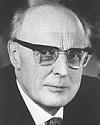
Died 11 Feb 1973 at age 65 (born 25 Jun 1907).
Johannes Hans Daniel Jensen was a German physicist who proposed the shell theory of nuclear structure of nucleons - protons and neutrons - grouped in onion-like layers of concentric shells. He suggested that the nucleons spun on their own axis while they moved in an orbit within their shell and that certain patterns in the number of nucleons per shell made the nucleus more stable. Scientists already knew that the electrons orbiting the nucleus were arranged in different shells. For his model of the nucleus, Jensen shared the 1963 Nobel Prize in physics (with Maria Goeppert-Mayer, who arrived at the same hypothesis independently in the U.S.; and Eugene P. Wigner for unrelated work.) Through the 1950s, Jensen worked on radioactivity.
Johannes Hans Daniel Jensen was a German physicist who proposed the shell theory of nuclear structure of nucleons - protons and neutrons - grouped in onion-like layers of concentric shells. He suggested that the nucleons spun on their own axis while they moved in an orbit within their shell and that certain patterns in the number of nucleons per shell made the nucleus more stable. Scientists already knew that the electrons orbiting the nucleus were arranged in different shells. For his model of the nucleus, Jensen shared the 1963 Nobel Prize in physics (with Maria Goeppert-Mayer, who arrived at the same hypothesis independently in the U.S.; and Eugene P. Wigner for unrelated work.) Through the 1950s, Jensen worked on radioactivity.
Died 11 Feb 1973 at age 65 (born 25 Jun 1907).
Johannes Hans Daniel Jensen was a German physicist who devised the shell nuclear model (1949).
Johannes Hans Daniel Jensen was a German physicist who devised the shell nuclear model (1949).
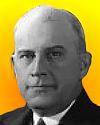
Died 11 Feb 1959 at age 74 (born 10 Feb 1885). quotes
U.S. professor of civil and structural engineering whose outstanding contribution was a method of calculating tendencies to produce motion (moments) in the members of a continuous framework, such as the skeleton of a building. By the use of Cross's technique, known as the moment distribution method, or simply the Hardy Cross method, calculation can be carried to any required degree of accuracy by successive approximations, thus avoiding the immense labour of solving simultaneous equations that contain as many variables as there are rigid joints in a frame. He also successfully applied his mathematical methods to the solution of pipe network problems that arise in municipal water supply design; these methods have been extended to gas pipelines.
U.S. professor of civil and structural engineering whose outstanding contribution was a method of calculating tendencies to produce motion (moments) in the members of a continuous framework, such as the skeleton of a building. By the use of Cross's technique, known as the moment distribution method, or simply the Hardy Cross method, calculation can be carried to any required degree of accuracy by successive approximations, thus avoiding the immense labour of solving simultaneous equations that contain as many variables as there are rigid joints in a frame. He also successfully applied his mathematical methods to the solution of pipe network problems that arise in municipal water supply design; these methods have been extended to gas pipelines.
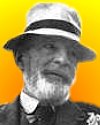
Died 11 Feb 1958 at age 79 (born 1 Jan 1879). quotes
Welsh psychoanalyst who introduced psychoanalysis into Great Britain and North America. His admiration for Sigmund Freud's approach to neurosis led him to learn German to read Freud's work. This led to a lifelong association with Freud from 1908. Jones founded the International Journal of Psychoanalysis (1920), and was its editor for two decades. In 1925, he founded and was director of the London Clinic of Psycho-Analysis. When the Nazis invaded Austria in 1938, Jones went to Vienna to enable Freud's escape with his family to London. He published extensively, including a definitive three-volume biography of Freud (1953-57). His interests included chess, and as a youth, figure skating about which he later wrote a textbook.
Welsh psychoanalyst who introduced psychoanalysis into Great Britain and North America. His admiration for Sigmund Freud's approach to neurosis led him to learn German to read Freud's work. This led to a lifelong association with Freud from 1908. Jones founded the International Journal of Psychoanalysis (1920), and was its editor for two decades. In 1925, he founded and was director of the London Clinic of Psycho-Analysis. When the Nazis invaded Austria in 1938, Jones went to Vienna to enable Freud's escape with his family to London. He published extensively, including a definitive three-volume biography of Freud (1953-57). His interests included chess, and as a youth, figure skating about which he later wrote a textbook.
Ernest Jones: Freud's Alter Ego, by Vincent Brome. - book suggestion.
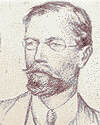
Died 11 Feb 1949 at age 91 (born 31 Oct 1857).
Swedish physician, psychiatrist, and writer whose book The Story of San Michele (1929), one of the world first best sellers in its original English version and in many translations. The book recounts his experiences as a doctor in Paris and Rome and in semiretirement at the villa of San Michele on Capri. Munthe himself was a fascinating man, youngest doctor in the history of France, society doctor to European royalty, but who understood that medicine and doctoring is more about people than wonder drugs and technology. He left the lucrative medical practice in Paris to practice his profession part time time so that he could build the house of his dreams, creating of one of the world's most beautiful houses.
Swedish physician, psychiatrist, and writer whose book The Story of San Michele (1929), one of the world first best sellers in its original English version and in many translations. The book recounts his experiences as a doctor in Paris and Rome and in semiretirement at the villa of San Michele on Capri. Munthe himself was a fascinating man, youngest doctor in the history of France, society doctor to European royalty, but who understood that medicine and doctoring is more about people than wonder drugs and technology. He left the lucrative medical practice in Paris to practice his profession part time time so that he could build the house of his dreams, creating of one of the world's most beautiful houses.
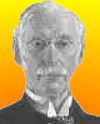
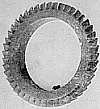
Straight blading of Parsons first turbine (1884)
British engineer whose invention of a multi-stage steam turbine revolutionized marine propulsion (1884). Each stage was designed to control and maximize the power delivered. By 1891, he had designed his turbine with a condenser for powering dynamos in electric generating stations. In 1897, using his turbine to power his 100-ft ship Turbinia, he reached 35 knots. The first vessel to be propelled by turbines, with its amazing speed led to the construction of many turbine propelled warships for the British navy. He further improved efficiency with a mechanical reducing gear to link the engine to the propellers. Parsons also invented a device for improving phonographs, pioneered in aviation, and produced a nonskid device for automobile tires.
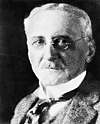
(EB)
Died 11 Feb 1924 at age 64 (born 7 Apr 1859). quotes
German-born American biologist noted chiefly for his experimental work on artificial parthenogenesis (reproduction without fertilization). Loeb was able to bring the unfertilized eggs of urchins and frogs to maturity by manipulating their environment, which influenced cell division. He also studied the tropisms of plants and simple animals, which means their reflexive responses to environmental stimuli. Before the age of thirty he published the "tropism theory" which was destined to make him famous. Loeb also worked on brain physiology and tissue regeneration.
German-born American biologist noted chiefly for his experimental work on artificial parthenogenesis (reproduction without fertilization). Loeb was able to bring the unfertilized eggs of urchins and frogs to maturity by manipulating their environment, which influenced cell division. He also studied the tropisms of plants and simple animals, which means their reflexive responses to environmental stimuli. Before the age of thirty he published the "tropism theory" which was destined to make him famous. Loeb also worked on brain physiology and tissue regeneration.
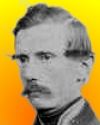
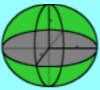
English geodesist with the Army Ordnance Survey who made calculations of the size and shape of the Earth (the Clarke ellipsoid) were the first to approximate accepted modern values with respect to both polar flattening and equatorial radius. The figures from his second determination (1866) became a standard reference for U.S. geodesy for most of the twentieth century until satellites could improve accuracy. In 1880, Clarke coined the term “Geodesy” when he published his famous book by that title. He wrote articles on mathematical geography and geodesy and also contributed “The Figure of the Earth” in the Encyclopedia Britannica. His military service with the Ordnance Survey lasted 27 years.«[Image right: Clarke ellipsoid]
Died 11 Feb 1904 at age 66 (born 25 Dec 1837). quotes
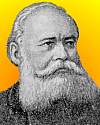
Russian organic chemist who established the Markovnikov addition rule (1869) which predicts the results when an ionic halogen halide (HX, like HCl) reacts with the carbon double bond (C=C) of an unsymmetrical alkene. The hydrogen from HX attaches to the carbon with more hydrogens already attached; the halogen X attaches to the carbon with fewer hydrogens attached. (A half century later Linus Pauling’s resonance theory gave an explanation). Markovnikov also found that carbon can form a four-carbon ring (1879), and a seven-carbon ring (1889) overcoming the prior belief that carbon rings only existed with six carbons. He also discovered that isobutyric and butyric acids are isomers.«[DSB gives date of birth as 25 Dec 1837 (or 22 Dec 1838). EB gives 22 Dec 1838. Other spellings: Vasilevich and Markownikoff]
Russian organic chemist who established the Markovnikov addition rule (1869) which predicts the results when an ionic halogen halide (HX, like HCl) reacts with the carbon double bond (C=C) of an unsymmetrical alkene. The hydrogen from HX attaches to the carbon with more hydrogens already attached; the halogen X attaches to the carbon with fewer hydrogens attached. (A half century later Linus Pauling’s resonance theory gave an explanation). Markovnikov also found that carbon can form a four-carbon ring (1879), and a seven-carbon ring (1889) overcoming the prior belief that carbon rings only existed with six carbons. He also discovered that isobutyric and butyric acids are isomers.«[DSB gives date of birth as 25 Dec 1837 (or 22 Dec 1838). EB gives 22 Dec 1838. Other spellings: Vasilevich and Markownikoff]
Died 11 Feb 1888 at age 76 (born 21 Aug 1811).
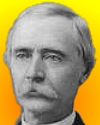
American ironmaster who invented the pneumatic process of making steel. While a Kentucky manufacturer of iron kettles, he discovered that cold air blown on red-hot iron caused the metal to become white-hot by igniting the carbon and thus eliminating impurities. He applied his “air boiling” technique to his own product, but his customers decried “Kelly's fool steel,” and his business declined. In a legal fight, by asserting his practical efforts investigating the process had been carried out earlier in time, his belated patent of 23 Jun 1857 won priority over the U.S. patent of Sir Henry Bessemer of Great Britain. However, Kelly's invention was only a first step. They jointly licenced their patents. Bessemer's further developments were more successful. The Bessemer-Kelly process won acceptance, produced the first inexpensive steel, and furthered the industrial age.« more
American ironmaster who invented the pneumatic process of making steel. While a Kentucky manufacturer of iron kettles, he discovered that cold air blown on red-hot iron caused the metal to become white-hot by igniting the carbon and thus eliminating impurities. He applied his “air boiling” technique to his own product, but his customers decried “Kelly's fool steel,” and his business declined. In a legal fight, by asserting his practical efforts investigating the process had been carried out earlier in time, his belated patent of 23 Jun 1857 won priority over the U.S. patent of Sir Henry Bessemer of Great Britain. However, Kelly's invention was only a first step. They jointly licenced their patents. Bessemer's further developments were more successful. The Bessemer-Kelly process won acceptance, produced the first inexpensive steel, and furthered the industrial age.« more
William Kelly: a True History of the So-Called Bessemer Process, by John Newton Boucher. - book suggestion.
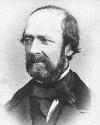
Died 11 Feb 1868 at age 48 (born 18 Sep 1819). quotes
French physicist whose Foucault Pendulum experimentally proved that the Earth rotates on its axis (6 Jan 1851). Using a long pendulum with a heavy bob, he showed its plane rotated at a rate related to Earth's angular velocity and the latitude of the site. He studied medicine and physics and became an assistant at the Paris Observatory (1855). He invented an accurate test of a lens for chromatic and spherical aberrations. Working with Armand Fizeau, and also independently, he made accurate measurements of the absolute velocity of light. In 1850, Foucault showed that light travels slower in water than in air. He also built a gyroscope (1852), the Foucault's prism (1857) and made improvements for mirrors of reflecting telescopes.« more
French physicist whose Foucault Pendulum experimentally proved that the Earth rotates on its axis (6 Jan 1851). Using a long pendulum with a heavy bob, he showed its plane rotated at a rate related to Earth's angular velocity and the latitude of the site. He studied medicine and physics and became an assistant at the Paris Observatory (1855). He invented an accurate test of a lens for chromatic and spherical aberrations. Working with Armand Fizeau, and also independently, he made accurate measurements of the absolute velocity of light. In 1850, Foucault showed that light travels slower in water than in air. He also built a gyroscope (1852), the Foucault's prism (1857) and made improvements for mirrors of reflecting telescopes.« more
Pendulum: Leon Foucault and the Triumph of Science, by Amir D. Aczel. - book suggestion.
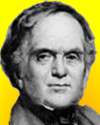
Died 11 Feb 1823 at age 63 (born 22 Sep 1759). quotes
Scottish engineer and economist who pioneered the graphical representation of statistics, creating the line graph, bar graph and pie chart, though his name is little known. His inventions and patents included metal-working machines, the mass-production of silver-plated spoons, improvements to agricultural implements, and modification of the bows to ships to imrove speed. He had gained experience as apprentice to Andrew Meikle (inventor of the threshing machine) and working with James Watt and Matthew Boulton (manufacturers of steam engines). Playfair’s book Commercial and Political Atlas (1786), which introduced his graphical display methods, was the first major work to use statistical graphs.«
Scottish engineer and economist who pioneered the graphical representation of statistics, creating the line graph, bar graph and pie chart, though his name is little known. His inventions and patents included metal-working machines, the mass-production of silver-plated spoons, improvements to agricultural implements, and modification of the bows to ships to imrove speed. He had gained experience as apprentice to Andrew Meikle (inventor of the threshing machine) and working with James Watt and Matthew Boulton (manufacturers of steam engines). Playfair’s book Commercial and Political Atlas (1786), which introduced his graphical display methods, was the first major work to use statistical graphs.«
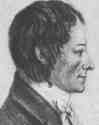
Died 11 Feb 1813 at age 46 (born 16 Jan 1767).
Swedish chemist who in 1802 discovered the element tantalum. A graduate of the University of Uppsala (1788) he began teaching at Uppsala (1794), introducing the chemistry of Antoine-Laurent Lavoisier. He continued his experiments despite partial deafness from a childhood infection and one eye blinded by an exploding flask (1801). His most notable student was Jöns Jacob Berzelius.
Swedish chemist who in 1802 discovered the element tantalum. A graduate of the University of Uppsala (1788) he began teaching at Uppsala (1794), introducing the chemistry of Antoine-Laurent Lavoisier. He continued his experiments despite partial deafness from a childhood infection and one eye blinded by an exploding flask (1801). His most notable student was Jöns Jacob Berzelius.


Italian physiologist who made important contributions to the experimental study of bodily functions and animal reproduction. Spallanzani demonstrated that microorganisms arose not by spontaneous generation but from spores in the air. He also studied regeneration and spermatozoa. He showed that contact by semen was necessary for development of the egg and he achieved the first successful artificial insemination of a dog (1785). He explained the circulation of the blood and the digestive system of animals. Spallanzani also worked on various problems in the physical and earth sciences. His investigations into the development of microscopic life in nutrient culture solutions paved the way for the research of Louis Pasteur.
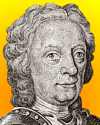
Died 11 Feb 1755 at age 79 (born 1 Jun 1675).
(marquess) Italian dramatist and archaeologist whose studies made from 1718 of the archaeology of his native town were published in his four-volume Verona illustrata (1731-32). From 1732, he spent four years pursuing archaeological research in France and also travelled through England, Holland and Germany. He built a museum to house his valuable collection, which he bequeathed to his native city. The Museo Lapidario holds many precious stone relics with runic Latin, Greek, Arabic, Egyptian, Persian and Hebrew inscriptions. He also was interested in physics and astronomy, and built his own observatory to study the movements of the stars. His hometown celebrated him with a statue in the Piazza de Signori.«
(marquess) Italian dramatist and archaeologist whose studies made from 1718 of the archaeology of his native town were published in his four-volume Verona illustrata (1731-32). From 1732, he spent four years pursuing archaeological research in France and also travelled through England, Holland and Germany. He built a museum to house his valuable collection, which he bequeathed to his native city. The Museo Lapidario holds many precious stone relics with runic Latin, Greek, Arabic, Egyptian, Persian and Hebrew inscriptions. He also was interested in physics and astronomy, and built his own observatory to study the movements of the stars. His hometown celebrated him with a statue in the Piazza de Signori.«
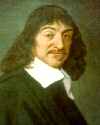
Died 11 Feb 1650 at age 53 (born 31 Mar 1596). quotes
French philosopher and mathematician who is known as “the father of modern philosophy.” His work, La géométrie, includes his application of algebra to geometry from which we now have Cartesian geometry. During 1620-28, Descartes travelled through Europe, then settled in Holland. Soon after, he began work on his first major treatise on physics, Le Monde, ou Traité de la Lumière. This work was near completion when news that Galileo was condemned to house arrest reached him. He decided not to publish that work during his lifetime. Later, he turned to philosophy, one of the first to oppose scholastic Aristotelianism, he began by methodically doubting knowledge based on authority, the senses, and reason. His most famous quote is “I think, therefore I am.”
French philosopher and mathematician who is known as “the father of modern philosophy.” His work, La géométrie, includes his application of algebra to geometry from which we now have Cartesian geometry. During 1620-28, Descartes travelled through Europe, then settled in Holland. Soon after, he began work on his first major treatise on physics, Le Monde, ou Traité de la Lumière. This work was near completion when news that Galileo was condemned to house arrest reached him. He decided not to publish that work during his lifetime. Later, he turned to philosophy, one of the first to oppose scholastic Aristotelianism, he began by methodically doubting knowledge based on authority, the senses, and reason. His most famous quote is “I think, therefore I am.”
Descartes: A Biography, by Desmond M. Clarke. - book suggestion.
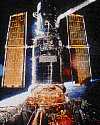
In 1997, making significant upgrades to the scientific capabilities of the Hubble Space Telescope was the objective of the space shuttle Discovery, launched on mission STS-82. This was the second in a series of planned servicing missions to the orbiting Hubble Space Telescope which was placed in orbit on 24 Apr 1990. During a record five extravehicular activities (EVAs), astronauts performed repairs to the Hubble Space Telescope using over 150 tools and crew aids. Two older instruments were replaced with the Space Telescope Imaging Spectrograph (STIS) and the Near Infrared Camera and Multi-Object Spectrometer (NICMOS). science instruments aboard the Telescope include two cameras, two spectrographs, and fine guidance sensors.

In 1994, the rBGH genetically engineered growth hormone for cows goes on sale to dairy farmers under the name Posilac, made by Monsanto Company. Also known as "Bovine Somatotropin" or BST, it is a genetically engineered copy of a naturally occurring hormone produced in the pituitary gland of cattle and is a major regulator of milk production. This is the first time altered genes have been approved by the U.S. Food and Drug Administration for injection into live animals. The purpose is to improve a cow's production of milk as much as 5 to 15 pounds per day per cow. The approval process took nine years. Nevertheless, the rBGH has drawn criticism from people concerned about food purity.

In 1970, Japan became the fourth country to put a satellite into orbit with the launch of Osumi 5. (Four earlier launches since 1966 had failed.) The University of Tokyo's Institute of Space and Aeronautical Science launched the 24-kg satellite from the Kagoshima Space Center on the Osumi peninsula, using a Lambda 4S solid-fuel rocket. Its mission was to explore the upper atmosphere. NEC made Osumi, and later satellites for meteorological and communications. The USSR was the first nation with a satellite in earth orbit (Sputnik on 4 Oct 1957), second the U.S. (Explorer I on 31 Jan 1958), third France (Astrix-1, 26 Nov 1965). China was fifth (DFH-1, 24 Apr 1970) and the U.K. sixth (Prospero, 28 Oct 1972).«
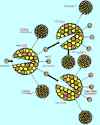
In 1939, the journal Nature published a theoretical paper on nuclear fission. The term was coined by the authors Lise Meitner and Otto Fritsch, her nephew. They knew that when a uranium nucleus was struck by neutrons, barium was produced. Seeking an explanation, they used Bohr's “liquid drop” model of the nucleus to envision the neutron inducing oscillations in a uranium nucleus, which would occasionally stretch out into the shape of a dumbbell. Sometimes, the repulsive forces between the protons in the two bulbous ends would cause the narrow waist joining them to pinch off and leave two nuclei where before there had been one. They calculated calculated the huge amounts of energy released. This was the basis for nuclear chain reaction.
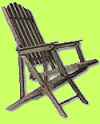
In 1928, the La-Z-Boy reclining chair was invented. Ed Shoemaker (1907-98), and his cousin Edward Knabusch, designed the first La-Z-Boy with a piece of plywood and a yardstick. Then, it was a comfortable wood slat porch chair. In Spring 1929, the upholstered chairs were introduced for a year-round market.
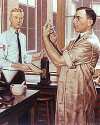
In 1922, the use of insulin to treat diabetes in a dog was announced in their first paper* published on the subject by the Canadian surgeon Frederick Banting and his assistant Charles Best. The previous year, Best had made an extract from pancreatic tissue. At 10:15 a.m., on 10 Jul 1921, they injected a pinkish solution into a diabetic dog. After an hour, the blood glucose had dropped from 0.2 to 0.1%. They continued their research, and improved the purity of what they named insulin, the hormone responsible for controlling blood sugar levels. The discovery was one of the most revolutionary moments in medicine. Within a year, diabetics had hopes of living full and productive lives. Banting received a share of the Nobel Prize in 1923 for the work.*Banting, F.G. and Best, C.H. The internal secretion of the pancreas. J. Lab. Clin. Med. (1922) 7 (5): 465-480.
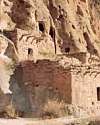
In 1916, Bandelier National Monument was proclaimed by President Woodrow Wilson. Located near Los Alamos, New Mexico, USA, it is best known for mesas, sheer-walled canyons, and the ancestral Pueblo dwellings found among them. Of its 32,737 acreage, over 23,000 acres are designated as Wilderness. It was named for Adolph Bandelier, a 19th-century pioneering anthropologist whose main focus was the American and Pueblo Indians of southwest America and northern Mexico. The Anasazi ruins at Bandelier National Monument are said by some to be one of the two most important Indian ruin sites in the state of New Mexico, the other being Chaco Canyon.
Bandelier: The Life and Adventures of Adolph Bandelier, by Lange and Riley. - book suggestion.
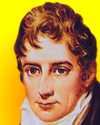
In 1809, Robert Fulton patented his steamboat for the first time in the U.S., although he had already made his first successful steamboat trip on the Clermont between New York City and Albany in 1807. He obtained a supplementary patent on 9 Feb 1811. Few inventions have been as important as the steamboat, which opened up American rivers to two-way travel. Obtaining the patent for which he applied on 1 Jan 1809 was routine. However, defending them against the lawsuits of competitors proved troublesome for years. He also had to be wary of the Superintendent of Patents, Dr. William Thornton, who had a conflict of interest from his association with John Fitch's Delaware steamboat.
more
In 1808, Judge Jesse Fell of Wilkes-Barre, Penn experimented by burning anthracite coal to keep his house warm. He developed a method to burn the stone coal without the use of forced air and his fireplace grate opened up the home heating market. On the fly-leaf of one of his books he wrote: February 11, 1808, made the experiment of burning the common stone coal of the valley in a grate, in a common fireplace in my house, and found it will answer the purpose of fuel, making a clearer and better fire, at less expense, than burning wood in the common way. He had found a cheap, clean burning fuel. As a result, that area of northeast Pennsylvania became an important coal mining area for generations.
In 1801, Giuseppe Piazzi made a 24th observation of the position of Ceres, the asteroid he discovered between the orbits of Mars and Jupiter, on 1 Jan 1801. It was the first and largest of the dwarf planets now known. After this, it moved into the light of the Sun, and was lost to view for most of the rest of the year. To mathematically relocate Ceres, Carl Gauss, age 24, took up the challenge to calculate its orbital path, based on the limited number of observations available. His method was tedious, requiring 100 hours of calculation. He began with a rough approximation for the unknown orbit, and then used it to produce a refinement, which became the subject of another improvement.. And so on. Astronomers using them found his results in close agreement as they located Ceres again 25 Nov-31 Dec 1801.«
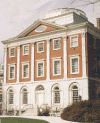
In 1752, the Pennsylvania Hospital, the first in America, opened in Philadelphia through the indefatigible efforts of Benjamin Franklin, who was involved in drafting the petition for its establishment and fund-raising. It was established on 11 May 1751, when the colonial governor of Pennsylvania approved its charter as a proposed hospital to include treatment of people with mental illness. The first patient was received on 11 Feb 1752, at the hospital's temporary quarters in the Judge Kinsey mansion on Market St. The Pine Street Hospital opened 17 Dec 1756, and accepted both mentally ill and general medical patients. Inmates were provided with light manual labor such as spinning and carding wool for recreational therapy activities.




