Born 7 Dec 1910; died 4 Apr 1980 at age 69.
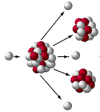
American biophysicist who contributed most to the discovery of "delayed neutrons" - that uranium fission does not release all the neutrons it produces at one time, but some come off at measurably later times. Some are emitted seconds to minutes later. This is crucial in the operation of a fission reactor. In uranium-235 fission in a thermal reactor, the proportion of delayed neutrons is about 0.65 percent. If the reactivity stays below the proportion of delayed neutrons, the reactor can be controlled. The delayed neutrons modify the rate of fission sufficiently to give time for the insertion of control rods. Without the margin of safety provided by the delayed neutrons, nuclear reactors might not be practical at all.*
American biophysicist who contributed most to the discovery of "delayed neutrons" - that uranium fission does not release all the neutrons it produces at one time, but some come off at measurably later times. Some are emitted seconds to minutes later. This is crucial in the operation of a fission reactor. In uranium-235 fission in a thermal reactor, the proportion of delayed neutrons is about 0.65 percent. If the reactivity stays below the proportion of delayed neutrons, the reactor can be controlled. The delayed neutrons modify the rate of fission sufficiently to give time for the insertion of control rods. Without the margin of safety provided by the delayed neutrons, nuclear reactors might not be practical at all.*
Born 7 Dec 1910; died 30 Dec 2002 at age 92.
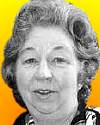
Eleanor Jack Gibson was an American psychologist who studied learning processes in children. She is remembered for her "visual cliff" experiment which showed how an infant's depth perception helps prevent injuries and falls. In 1960, she placed 6-14 month old infants on a table covered with a sheet of plate glass that extended beyond the table's edge. When enticed with a favorite toy or coaxed by their mothers to crawl out beyond the table's edge onto the clear glass extension, nearly all of the babies withdrew. Thus she demonstrated that babies can distinguish depth. In 1992, Gibson was awarded the National Medal of Science, becoming one of only ten psychologists among 304 recipients of the award since 1962.«
Eleanor Jack Gibson was an American psychologist who studied learning processes in children. She is remembered for her "visual cliff" experiment which showed how an infant's depth perception helps prevent injuries and falls. In 1960, she placed 6-14 month old infants on a table covered with a sheet of plate glass that extended beyond the table's edge. When enticed with a favorite toy or coaxed by their mothers to crawl out beyond the table's edge onto the clear glass extension, nearly all of the babies withdrew. Thus she demonstrated that babies can distinguish depth. In 1992, Gibson was awarded the National Medal of Science, becoming one of only ten psychologists among 304 recipients of the award since 1962.«
An Odyssey in Learning and Perception, by Eleanor Gibson. - book suggestion.
Born 7 Dec 1905; died 23 Dec 1973 at age 68.
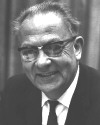
Dutch-born American astronomer, who discovered Miranda, a moon of Uranus, and Nereid, a moon of Neptune. The Kuiper Belt is so-named after his original suggestion of its existence outside the orbit of Neptune before it was confirmed as a belt of small bodies. He measured the diameter of Pluto. In the Martian atmosphere Kuiper detected carbon dioxide, but the absence of oxygen (1947). In the 1960s, Kuiper pioneered airborne infrared observing using a Convair 990 aircraft and served as chief scientist for the Ranger spacecraft crash-landing probes of the moon. By analyzing Ranger photographs, he identified landing sites on the lunar surface most suitable for safe manned landings.«
Dutch-born American astronomer, who discovered Miranda, a moon of Uranus, and Nereid, a moon of Neptune. The Kuiper Belt is so-named after his original suggestion of its existence outside the orbit of Neptune before it was confirmed as a belt of small bodies. He measured the diameter of Pluto. In the Martian atmosphere Kuiper detected carbon dioxide, but the absence of oxygen (1947). In the 1960s, Kuiper pioneered airborne infrared observing using a Convair 990 aircraft and served as chief scientist for the Ranger spacecraft crash-landing probes of the moon. By analyzing Ranger photographs, he identified landing sites on the lunar surface most suitable for safe manned landings.«
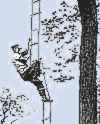

Canadian naturalist, ornithologist, bander and banker whose investigations were among the first to implicate DDT in raptor declines and thus pesticides as environmental threats. Upon retirement from a career in banking (1938) he expanded his interest in nature, and at age 58, he began his study of Florida's bald eagles. In the early 1940s, Broley followed 125 active nests along the peninsula's west coast from Tampa to Fort Myers and banded some 150 young eaglets each year. After 1947, he found the eagle population was declining precipitously. He noted this coincided with the start of DDT spraying in the area. Having concluded that DDT was the culprit, he wrote and lectured on the topic. Later, the early 1960's, others confirmed his suspicions.[Image left: Broley banding young eagles in 1946, using a rope ladder to climb a tree. Image right: Bald eagle (source)]
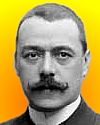
Born 7 Dec 1857; died 19 Apr 1931 at age 73.
Louis Antoine Marie Joseph Dollo was a French vertebrate paleontologist who stated Dollo's Law of Irreversibility whereby in evolution an organism never returns exactly to its former state such that complex structures, once lost, are not regained in their original form. (While generally true, some exceptions are known.) He began as an assistant (1882), became keeper of mammals (1891) at the Royal Museum of Natural History in Brussels where he stayed most of his life. He was a specialist in fossil fishes, reptiles, birds, and their palaeoecology. He supervised the excavation of the famous, multiple Iguanodons found in 1878 by miners deep underground, at Bernissart, Belgium.«
Louis Antoine Marie Joseph Dollo was a French vertebrate paleontologist who stated Dollo's Law of Irreversibility whereby in evolution an organism never returns exactly to its former state such that complex structures, once lost, are not regained in their original form. (While generally true, some exceptions are known.) He began as an assistant (1882), became keeper of mammals (1891) at the Royal Museum of Natural History in Brussels where he stayed most of his life. He was a specialist in fossil fishes, reptiles, birds, and their palaeoecology. He supervised the excavation of the famous, multiple Iguanodons found in 1878 by miners deep underground, at Bernissart, Belgium.«
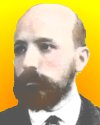
Born 7 Dec 1830; died 10 Jun 1903 at age 72. quotes
Antonio Luigi Gaudenzio Giuseppe Cremona was an Italian mathematician who was an originator of graphical statics (the use of graphical methods to study forces in equilibrium) and work in projective geometry. Cremona's work in statics is of great importance and he gave, in a clearer form, some theorems due to Maxwell. In a paper of 1872 Cremona took an idea of Maxwell's on forces in frame structures that had appeared in an engineering journal in 1867 and interpreted Maxwell's notion of reciprocal figures as duality in projective 3-space. These reciprocal figures, for example, have three forces in equilibrium in one figure represented by a triangle while in the reciprocal figure they are represented by three concurrent lines.
Antonio Luigi Gaudenzio Giuseppe Cremona was an Italian mathematician who was an originator of graphical statics (the use of graphical methods to study forces in equilibrium) and work in projective geometry. Cremona's work in statics is of great importance and he gave, in a clearer form, some theorems due to Maxwell. In a paper of 1872 Cremona took an idea of Maxwell's on forces in frame structures that had appeared in an engineering journal in 1867 and interpreted Maxwell's notion of reciprocal figures as duality in projective 3-space. These reciprocal figures, for example, have three forces in equilibrium in one figure represented by a triangle while in the reciprocal figure they are represented by three concurrent lines.
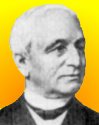
Born 7 Dec 1823; died 29 Dec 1891 at age 68. quotes
German mathematician who worked who worked to unify arithmetic, algebra and analysis, with a particular interest in elliptic functions, algebraic equations, theory of numbers, theory of determinants and theory of simple and multiple integrals. However the topics he studied were restricted by the fact that he believed in the reduction of all mathematics to arguments involving only the integers and a finite number of steps. He believed that mathematics should deal only with finite numbers and with a finite number of operations. He was the first to doubt the significance of non-constructive existence proofs, and believed that transcendental numbers did not exist. The Kronecker delta function is named in his honour.«
German mathematician who worked who worked to unify arithmetic, algebra and analysis, with a particular interest in elliptic functions, algebraic equations, theory of numbers, theory of determinants and theory of simple and multiple integrals. However the topics he studied were restricted by the fact that he believed in the reduction of all mathematics to arguments involving only the integers and a finite number of steps. He believed that mathematics should deal only with finite numbers and with a finite number of operations. He was the first to doubt the significance of non-constructive existence proofs, and believed that transcendental numbers did not exist. The Kronecker delta function is named in his honour.«
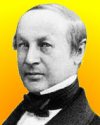
Born 7 Dec 1810; died 11 Jan 1882 at age 71. quotes
German physiologist who founded modern histology by defining the cell in Mikroskopische Untersuchungen (1839) as the basic unit of animal structure that makes elementary parts (such as teeth, bone, muscle, cartilage, nerve tissue) by cell differentiation. This laid the foundations for the cell theory. Schwann also worked on fermentation and discovered the enzyme pepsin. Schwann cells are named after him. He also investigated muscular contraction and nerve structure; discovered the striated muscle in the upper esophagus and the Schwann sheath; identified the role of microorganisms in putrefaction; formulated basic principles of embryology (that the egg is a single cell that develops into a complete organism); and coined the term metabolism.
German physiologist who founded modern histology by defining the cell in Mikroskopische Untersuchungen (1839) as the basic unit of animal structure that makes elementary parts (such as teeth, bone, muscle, cartilage, nerve tissue) by cell differentiation. This laid the foundations for the cell theory. Schwann also worked on fermentation and discovered the enzyme pepsin. Schwann cells are named after him. He also investigated muscular contraction and nerve structure; discovered the striated muscle in the upper esophagus and the Schwann sheath; identified the role of microorganisms in putrefaction; formulated basic principles of embryology (that the egg is a single cell that develops into a complete organism); and coined the term metabolism.
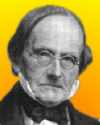

Glacier
Swiss pioneer glaciologist, who was one of the first to explain how the movement of glaciers produced geological results, such as the random scattering of even exceptionally large boulders, such as those he found strewn in the Jura range. He discarded prior proposals, such as meteoritic origin (since their composition matched other rocks in the Alps). He also rejected the idea of boulders transported within icebergs during a flood, a theory favoured by Charles Lyell (since the origin and disappearance of the flood water was not explained). Charpentier recognized lines of debris (lateral moraines) along the sides of glacial valleys - which often stretched further downhill than the current end of the glaciers - suggesting those glaciers were previously larger. Charpentier realized more widespread glaciation a past era had formed huge ice sheets that dumped boulders, gravel and sand across northern Europe. The glacial theory he presented in 1835 at first gained little support except from Louis Agassiz (1837), though the work eventually became quite influential.«[DSB gives dates 7 Dec 1786 - 12 Sep 1855. EB gives 8 Dec 1786 - 12 Nov 1855.] more

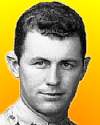
Died 7 Dec 2020 at age 97 (born 13 Feb 1923). quotes
Charles Elwood “Chuck” Yeager was an American pilot who returned from WW II as a decorated fighter pilot, and began testing new technology aircraft using jet power and rocker power. He achieved numerous speed records. His most famous is his 1947 flight faster than sound. The Bell X-1 was a built as a research aircraft to reach extreme speeds and alititudes. On 14 Oct 1947 in the X-1 was piggy-backed on a B-29 and was carried up to 21,000 ft (6,400 m). He detached, firing four liquid-fuel rockets, which took him at up to a supersonic speed of Mach 1.06 and a maximum altitude of 45,000 ft (13,700 m). He served for decades, training test pilots and with other research program until retiring in 1976.«
Charles Elwood “Chuck” Yeager was an American pilot who returned from WW II as a decorated fighter pilot, and began testing new technology aircraft using jet power and rocker power. He achieved numerous speed records. His most famous is his 1947 flight faster than sound. The Bell X-1 was a built as a research aircraft to reach extreme speeds and alititudes. On 14 Oct 1947 in the X-1 was piggy-backed on a B-29 and was carried up to 21,000 ft (6,400 m). He detached, firing four liquid-fuel rockets, which took him at up to a supersonic speed of Mach 1.06 and a maximum altitude of 45,000 ft (13,700 m). He served for decades, training test pilots and with other research program until retiring in 1976.«
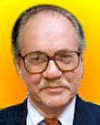
Died 7 Dec 2008 at age 88 (born 22 Jun 1920).
James Herbert Pomerene was an American computer designer who, in Apr 1946, joined John von Neumann and Herman Goldstine in their newly organized Electronic Computer Project at the Institute for Advanced Study in Princeton, New Jersey. This project was to build a parallel stored-program computer. He designed the adder portion of the arithmetic unit and then was entirely responsible for the development and construction of the electrostatic (Williams tube) memory and became the chief engineer of the project 1951-56. Then he joined IBM to assist development of the HARVEST computer, a special system built for the National Security Agency. It had two levels of program control and also had a tape and tape library system that was fully automatic and of great capacity.
James Herbert Pomerene was an American computer designer who, in Apr 1946, joined John von Neumann and Herman Goldstine in their newly organized Electronic Computer Project at the Institute for Advanced Study in Princeton, New Jersey. This project was to build a parallel stored-program computer. He designed the adder portion of the arithmetic unit and then was entirely responsible for the development and construction of the electrostatic (Williams tube) memory and became the chief engineer of the project 1951-56. Then he joined IBM to assist development of the HARVEST computer, a special system built for the National Security Agency. It had two levels of program control and also had a tape and tape library system that was fully automatic and of great capacity.
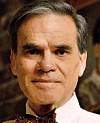
Died 7 Dec 1998 at age 73 (born 1 Dec 1925).
American biochemist who was awarded the 1994 Nobel Prize for Physiology or Medicine for his discovery in the 1960s of natural signal transducers called G-proteins that help cells in the body communicate with each other. He shared the prize with Alfred G. Gilman, who later proved Rodbell's hypothesis, by isolating the G-protein, which is so named because it binds to nucleotides called guanosine diphosphate and guanosine triphosphate, or GDP and GTP. Prior to Rodbell's research, scientists believed that only two substances—a hormone receptor and an interior cell enzyme—were responsible for cellular communication. Rodbell, however, discovered that the G-protein acted as an intermediate signal transducer between the two.
American biochemist who was awarded the 1994 Nobel Prize for Physiology or Medicine for his discovery in the 1960s of natural signal transducers called G-proteins that help cells in the body communicate with each other. He shared the prize with Alfred G. Gilman, who later proved Rodbell's hypothesis, by isolating the G-protein, which is so named because it binds to nucleotides called guanosine diphosphate and guanosine triphosphate, or GDP and GTP. Prior to Rodbell's research, scientists believed that only two substances—a hormone receptor and an interior cell enzyme—were responsible for cellular communication. Rodbell, however, discovered that the G-protein acted as an intermediate signal transducer between the two.
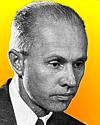
Died 7 Dec 1982 at age 82 (born 18 Nov 1900).
George Bogdan Kistiakowsky was a Russian chemist who worked on developing the first atomic bomb but later advocated banning nuclear weapons. He immigrated to the U.S. in 1926, and taught chemistry at Princeton University then Harvard (1930-71). He served as special assistant to President Eisenhower for science and technology (1959-61). As head of the explosives division of the Los Alamos Laboratory during WW II (1944-46), he oversaw 600 people developing explosives for the first atom bomb. The conventional explosives are used for its detonation to uniformly compress the plutonium sphere and achieve critical mass. In 1977, he became chairman of the Council for a Livable World, which opposes nuclear war.
George Bogdan Kistiakowsky was a Russian chemist who worked on developing the first atomic bomb but later advocated banning nuclear weapons. He immigrated to the U.S. in 1926, and taught chemistry at Princeton University then Harvard (1930-71). He served as special assistant to President Eisenhower for science and technology (1959-61). As head of the explosives division of the Los Alamos Laboratory during WW II (1944-46), he oversaw 600 people developing explosives for the first atom bomb. The conventional explosives are used for its detonation to uniformly compress the plutonium sphere and achieve critical mass. In 1977, he became chairman of the Council for a Livable World, which opposes nuclear war.
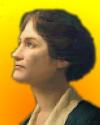
Died 7 Dec 1979 at age 79 (born 10 May 1900). quotes
Cecilia Helena Payne-Gaposchkin was an English-American astronomer who was the first to apply laws of atomic physics to the study of the temperature and density of stellar bodies, and the first to conclude that hydrogen and helium are the two most common elements in the universe. During the 1920s, the accepted explanation of the Sun's composition was a calculation of around 65% iron and 35% hydrogen. At Harvard University, in her doctoral thesis (1925), Payne claimed that the sun's spectrum was consistent with another solution: 99% hydrogen with helium, and just 1% iron. She had difficulty persuading her superiors to take her work seriously. It was another 20 years before Payne's original claim was confirmed, by Fred Hoyle.
Cecilia Helena Payne-Gaposchkin was an English-American astronomer who was the first to apply laws of atomic physics to the study of the temperature and density of stellar bodies, and the first to conclude that hydrogen and helium are the two most common elements in the universe. During the 1920s, the accepted explanation of the Sun's composition was a calculation of around 65% iron and 35% hydrogen. At Harvard University, in her doctoral thesis (1925), Payne claimed that the sun's spectrum was consistent with another solution: 99% hydrogen with helium, and just 1% iron. She had difficulty persuading her superiors to take her work seriously. It was another 20 years before Payne's original claim was confirmed, by Fred Hoyle.
Cecilia Payne-Gaposchkin: An Autobiography and Other Recollections, by Cecilia Payne-Gaposchkin. - book suggestion.

Died 7 Dec 1978 at age 92 (born 18 Jun 1886).
Frank Alexander Wetmore was an American ornithologist whose lifelong fieldwork and scholarship helped shape modern bird science. He conducted extensive expeditions across North and Central America (especially Panama), documenting avian diversity, behavior, avian paleontology and evolution. He joined the U.S. Bureau of Biological Survey in 1910. By 1925, he was appointed Asst. Secretary, head of the Smithsonian’s U.S. National Museum. He was the sixth Secretary of the Smithsonian Institution (1945-52), and continued research there after retirement for another quarter century. Wetmore published over 600 papers and the landmark multi-volume The Birds of Panama. He advanced museum research, expanded national collections, and promoted rigorous systematic ornithology.« more
Frank Alexander Wetmore was an American ornithologist whose lifelong fieldwork and scholarship helped shape modern bird science. He conducted extensive expeditions across North and Central America (especially Panama), documenting avian diversity, behavior, avian paleontology and evolution. He joined the U.S. Bureau of Biological Survey in 1910. By 1925, he was appointed Asst. Secretary, head of the Smithsonian’s U.S. National Museum. He was the sixth Secretary of the Smithsonian Institution (1945-52), and continued research there after retirement for another quarter century. Wetmore published over 600 papers and the landmark multi-volume The Birds of Panama. He advanced museum research, expanded national collections, and promoted rigorous systematic ornithology.« more
Song and Garden Birds of North America, by Alexander Wetmore. - book suggestion.
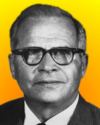
Died 7 Dec 1977 at age 71 (born 2 Dec 1906).
American engineer (naturalized 1937). While working for Columbia Broadcasting System (CBS), he developed the first commercial color television system (1936), which used a rotating three-color disk. Although initially approved by the Federal Communications Commission, it was later superseded by an all-electronic color system that was compatible with black-and-white sets. Goldmark also developed the 33-1/3 LP phonograph that greatly increased the playing time of records, which revolutionized the recording industry. He also pioneered in video cassette recording, and developed a scanning system used by the Lunar Orbiter spacecraft in 1966 to transmit photographs to the earth from the moon.
American engineer (naturalized 1937). While working for Columbia Broadcasting System (CBS), he developed the first commercial color television system (1936), which used a rotating three-color disk. Although initially approved by the Federal Communications Commission, it was later superseded by an all-electronic color system that was compatible with black-and-white sets. Goldmark also developed the 33-1/3 LP phonograph that greatly increased the playing time of records, which revolutionized the recording industry. He also pioneered in video cassette recording, and developed a scanning system used by the Lunar Orbiter spacecraft in 1966 to transmit photographs to the earth from the moon.
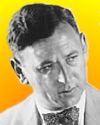
Died 7 Dec 1970 at age 87 (born 4 Jul 1883).
American cartoonist who satirized the American preoccupation with technology. His name became synonymous with any simple process made outlandishly complicated because of his series of “Invention” cartoons which use a string of outlandish tools, people, plants and steps to accomplish everyday simple tasks in the most complicated way. Goldberg applied his training as a graduate engineer and used his engineering, story-telling, and drawing skills to make sure that the “Inventions” could work, even though dozens of arms, wheels, gears, handles, cups, and rods were put in motion by balls, canary cages, pails, boots, bathtubs, paddles, and even live animals for simple tasks like squeezing an orange for juice or closing a window in case it should start to rain.
American cartoonist who satirized the American preoccupation with technology. His name became synonymous with any simple process made outlandishly complicated because of his series of “Invention” cartoons which use a string of outlandish tools, people, plants and steps to accomplish everyday simple tasks in the most complicated way. Goldberg applied his training as a graduate engineer and used his engineering, story-telling, and drawing skills to make sure that the “Inventions” could work, even though dozens of arms, wheels, gears, handles, cups, and rods were put in motion by balls, canary cages, pails, boots, bathtubs, paddles, and even live animals for simple tasks like squeezing an orange for juice or closing a window in case it should start to rain.
Rube Goldberg: Inventions!, by Maynard Frank Wolfe. - book suggestion.
Died 7 Dec 1963 at age 83 (born 16 Jun 1880).
Austrian-American chemist and historian. After obtaining a university degree in Vienna he emigrated to the U.S. (1901). He worked as a chemist with the American Linseed Co. In 1910, with Norman Copthorne, he developed a method of determining the presence of fish oils in vegetable oils, and the method was adopted by the U.S. Dept of Agriculture in 1925. Earlier, he had developed the first one-piece window envelope for the Window Envelope Company. Partly to supply the Window Envelope Company with a special varnish for its envelopes, Eisenschiml established the Scientific Oil Company (now Scientific Chemicals, Inc.) He also wrote over a dozen books on the Civil War; the best known is Why Was Lincoln Murdered? (1937).
Austrian-American chemist and historian. After obtaining a university degree in Vienna he emigrated to the U.S. (1901). He worked as a chemist with the American Linseed Co. In 1910, with Norman Copthorne, he developed a method of determining the presence of fish oils in vegetable oils, and the method was adopted by the U.S. Dept of Agriculture in 1925. Earlier, he had developed the first one-piece window envelope for the Window Envelope Company. Partly to supply the Window Envelope Company with a special varnish for its envelopes, Eisenschiml established the Scientific Oil Company (now Scientific Chemicals, Inc.) He also wrote over a dozen books on the Civil War; the best known is Why Was Lincoln Murdered? (1937).

Died 7 Dec 1960 at age 67 (born 17 Aug 1893).
Walter Karl Friedrich Noddack was a German chemist who discovered the element rhenium (Jun 1925) in collaboration with his wife Ida Tacke. In 1922, he began a long search for undiscovered elements. After three years, the careful fractionation of certain ores yielded element 75, a rare heavy metallic element that resembles manganese. Named rhenium after the Rhine River, it was the last stable element to be discovered. Noddack is also remembered for arguing for a concept he called allgegenwartskonzentration or, literally, omnipresent concentration. This idea, reminiscent of Greek philosopher Anaxagoras, assumed that every mineral actually contained every element. The reason they could not all be detected was they existed in too small quantities.
Walter Karl Friedrich Noddack was a German chemist who discovered the element rhenium (Jun 1925) in collaboration with his wife Ida Tacke. In 1922, he began a long search for undiscovered elements. After three years, the careful fractionation of certain ores yielded element 75, a rare heavy metallic element that resembles manganese. Named rhenium after the Rhine River, it was the last stable element to be discovered. Noddack is also remembered for arguing for a concept he called allgegenwartskonzentration or, literally, omnipresent concentration. This idea, reminiscent of Greek philosopher Anaxagoras, assumed that every mineral actually contained every element. The reason they could not all be detected was they existed in too small quantities.
Died 7 Dec 1952 at age 80 (born 29 Apr 1872). quotes
American astronomer who collaborated with Thomas Chamberlin in advancing the planetesimal theory of the origin of the solar system (1904). They suggested filaments of matter were ejected when a star passed close to the Sun, which cooled into tiny solid fragments, “planetesimals.” Over a very long period, grains collided and stuck together. Continued accretion created pebbles, boulders, and eventually larger bodies whose gravitational force of attraction accelerated the formation of protoplanets. (This formation by accretion is still accepted, but not the stellar origin of the planetesimals.) Moulton was first to suggest that the smaller satellites of Jupiter discovered by Nicholson and others in the early 20th century were captured asteroids, now widely accepted.
American astronomer who collaborated with Thomas Chamberlin in advancing the planetesimal theory of the origin of the solar system (1904). They suggested filaments of matter were ejected when a star passed close to the Sun, which cooled into tiny solid fragments, “planetesimals.” Over a very long period, grains collided and stuck together. Continued accretion created pebbles, boulders, and eventually larger bodies whose gravitational force of attraction accelerated the formation of protoplanets. (This formation by accretion is still accepted, but not the stellar origin of the planetesimals.) Moulton was first to suggest that the smaller satellites of Jupiter discovered by Nicholson and others in the early 20th century were captured asteroids, now widely accepted.
Died 7 Dec 1912 at age 67 (born 9 Jul 1845). quotes
Sir George (Howard) Darwin, the second son of the famous biologist Charles Darwin, was an English astronomer who championed a theory (no longer accepted) that the Moon was once part of the Earth, in what is now the Pacific Ocean. His was the first mathematical analysis of the evolution of Earth's Moon. He suggested that since the effect of the tides has been to slow the Earth's rotation and to cause the Moon to recede from the Earth, then by extrapolating back 4.5 billion years ago the Moon and the Earth would have been very close, with a day being less than five hours. Before this time the two bodies would actually have been one, until the Moon was torn away from the Earth by powerful solar tides that would have deformed the Earth every 2.5 hours.
Sir George (Howard) Darwin, the second son of the famous biologist Charles Darwin, was an English astronomer who championed a theory (no longer accepted) that the Moon was once part of the Earth, in what is now the Pacific Ocean. His was the first mathematical analysis of the evolution of Earth's Moon. He suggested that since the effect of the tides has been to slow the Earth's rotation and to cause the Moon to recede from the Earth, then by extrapolating back 4.5 billion years ago the Moon and the Earth would have been very close, with a day being less than five hours. Before this time the two bodies would actually have been one, until the Moon was torn away from the Earth by powerful solar tides that would have deformed the Earth every 2.5 hours.
Died 7 Dec 1898 at age 83 (born 30 Jan 1815).
Sir William Jenner was an English physician who distinguished between typhus and typhoid. Beginning in 1847 at the London Fever Hospital, by clinical and post mortem examination of thirty-six patients, he recognised that under the name of "continued fever" doctors had confused the two different diseases. He published the results in 1849. His reputation as a pathologist principally rests on making this distinction. In 1861 he was appointed physician extraordinary, and in 1862 physician-in-ordinary to Queen Victoria in 1862, and to the Prince of Wales (later Edward VIII) in 1863. He attended both the prince consort during the attack of typhoid fever which caused his death, and the prince of Wales in his attack of typhoid fever.«
Sir William Jenner was an English physician who distinguished between typhus and typhoid. Beginning in 1847 at the London Fever Hospital, by clinical and post mortem examination of thirty-six patients, he recognised that under the name of "continued fever" doctors had confused the two different diseases. He published the results in 1849. His reputation as a pathologist principally rests on making this distinction. In 1861 he was appointed physician extraordinary, and in 1862 physician-in-ordinary to Queen Victoria in 1862, and to the Prince of Wales (later Edward VIII) in 1863. He attended both the prince consort during the attack of typhoid fever which caused his death, and the prince of Wales in his attack of typhoid fever.«
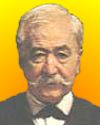
Died 7 Dec 1894 at age 89 (born 19 Nov 1805). quotes
French diplomat, who supervised the construction of the Suez Canal. While in the consular service in Egypt he became aware of plans to link the Mediterranean and the Red Sea by means of a canal, and from 1854 onwards devoted himself to the project. Work began in 1859 and the Suez Canal was opened ten years later (1869). In 1881, he embarked on the building of the Panama Canal, but had not anticipated the difficulties of this very different enterprise. The climate, with its torrential rains, incessant heat and fatal disease, took its toll. Financial mismanagement, stock failure and bad publicity eventually forced the failure of the company. The project was abandoned in 1889. It was eventually completed by the United States.
French diplomat, who supervised the construction of the Suez Canal. While in the consular service in Egypt he became aware of plans to link the Mediterranean and the Red Sea by means of a canal, and from 1854 onwards devoted himself to the project. Work began in 1859 and the Suez Canal was opened ten years later (1869). In 1881, he embarked on the building of the Panama Canal, but had not anticipated the difficulties of this very different enterprise. The climate, with its torrential rains, incessant heat and fatal disease, took its toll. Financial mismanagement, stock failure and bad publicity eventually forced the failure of the company. The project was abandoned in 1889. It was eventually completed by the United States.
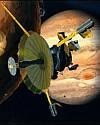
(NASA)
In 1995, the Galileo spacecraft arrived at Jupiter and entered orbit after 6 years years of travel including a flyby of Venus and two asteroids, Gaspra and Ida. The orbiter had also carried an atmospheric probe with scientific instruments, which it had released from the main spacecraft in Jul 1995, five months before reaching Jupiter Galileo then spent a further 8 years examining Jupiter and its moons Io and Europa. In 1994, the Galileo orbiter was present to watch the fragments of comet Shoemaker-Levy 9 crash into Jupiter. Its mission was concluded 21 Sep 2003 by sending the orbiter into Jupiter's atmosphere at a speed of nearly 50 km/sec, destroying it to avoid any chance of it contaminating local moons with bacteria from Earth.«
In 1982, the first person executed by lethal injection in the U.S. was Charles Brooks in Texas. In this form of execution, the condemned person is usually bound to a gurney, attached to heart monitors and two needles (one is a back-up) are then inserted into suitable veins. Long tubes connect the needle through a hole in a cement block wall to several intravenous drips. The first is a harmless saline solution followed by an anesthetic, which puts the inmate to sleep. Next flows a chemical which paralyzes the entire muscle system and stops the inmate's breathing. Finally, the flow of another chemical stops the heart. Death results from anesthetic overdose and respiratory and cardiac arrest while the condemned person is unconscious.
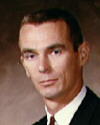
In 1972, Apollo 17, the sixth and last U.S. moon mission, blasted off from Cape Canaveral. Flight Commander Eugene Cernan was the last man on the moon. With him on the voyage of the command module America and the lunar module Challenger were Ronald Evans (command module pilot) and Harrison H. "Jack" Schmitt (lunar module pilot). In maneuvering Challenger to a landing at Taurus-Littrow, located on the southeast edge of Mare Serenitatis, Cernan and Schmitt activated a base of operations from which they completed three highly successful excursions to the nearby craters and the Taurus mountains, making the Moon their home for over three days. The mission returned on 19 Dec.
The Last Man on the Moon: Astronaut Eugene Cernan and America's Race in Space, by Eugene Cernan and Donald A. Davis. - book suggestion.
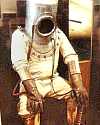
In 1934, Wiley Post is credited with discovering the jet stream when he flew into the stratosphere over Bartlesville, Oklahoma. With the financial backing of Oklahoma oil pioneer Frank Phillips, Post planned flights to test the "thin air" in the stratosphere above 50,000 feet. The Winnie Mae, made of plywood, could not be pressurized so Post developed the pressurized flying suit, forerunner of the modern space suit. Made by B.F. Goodrich, it was of double ply rubberized parachute fabric, with pigskin gloves, rubber boots, and aluminium helmet, pressurized to 0.5 bar. In Mar 1935, Post flew from Burbank California to Cleveland Ohio in the stratosphere using the jet stream. At times, his ground speed exceeded 550 kph in a 290 kph aircraft.
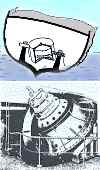
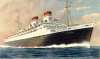

In 1926, the first U.S. patent for a household refrigerator, operating on gas, was issued to The Electrolux Servel Corporation. The gas-heat driven absorption refrigerator was invented by Swedish engineering students Carl G. Munters and Baltzar von Platen. The new concept avoided the use of toxic gases such as sulphur dioxide, methyl chloride, and ammonia gases, used in earlier mechanical compressor home refrigerators since 1918. The new Electrolux-Servel refrigerator entered the US market in 1926, and after 1927 became the sole gas refrigerator on the US market until the 1950s. A tiny gas flame and a tiny flow of water in the refrigerator took the place of all moving parts, circulating a liquid refrigerant which was hermetically sealed in rigid steel.
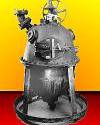
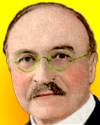
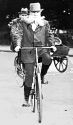
In 1889, John Boyd Dunlop, a Scottish inventor, was issued a patent for his pnematic tyre. In 1887, when his 9-yr-old son complained of the rough ride he experienced on his tricycle over the cobbled streets of Belfast. Dunlop devised and fitted rubber air tubes held on to a wooden ring by tacking a linen covering fixed around the wheels. Due to the major improvement in riding comfort, Dunlop continued development, until he patented the idea. *[p.223] [Image: John Boyd Dunlop]
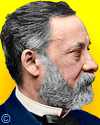
In 1884, during a lecture presented at the University of Lille, Louis Pasteur made his much-quoted remark, "In the fields of observation chance favours only the prepared mind" (Dans les champs de l'observation le hasard ne favorise que les esprits préparés). Earlier in the same year, Pasteur had announced a vaccine against rabies in dogs. His work on rabies had begun in 1880, but progress was slow because he was dealing with a virus and that would not grow on artificial media. But eventually he applied his passaging technique with great success. With the universal application of this vaccine, he thought that the threat of rabies could surely be reduced if not eliminated.
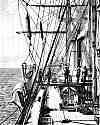
HMS Challenger, Instrument and Sampling Platform
In 1872, the H.M.S. Challenger set out from Sheerness, Kent, for Portsmouth, England, arriving on 11 Dec 1872. After loading more stores, the world's first global scientific voyage embarked on 21 Dec 1872, with a group of scientists and expert navigators to research the oceans. The Challenger was a military corvette sailing ship with auxiliary steam power, converted at Sheerness for the scientific voyage. The ship had a natural history laboratory where specimens were examined, identified, dissected and drawn; a chemistry laboratory; and scientific equipment. During the 4 year journey, ending on 24 May 1876, the voyage zig-zagged around the globe to visit every continent, sounded the ocean bottom to a depth of 26,850-ft, found many new species, and provided collections for scores of biologists.«
The Silent Landscape: The Scientific Voyage of HMS Challenger, by Richard Corfield. - book suggestion.
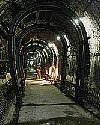
In 1869, the Thames Tunnel between Rotherhithe and Wapping in London, the world's first tunnel under a navigable river, was re-opened with the East London Railway line. Work had started on 2 Mar 1825. Excavation was engineered by Marc Brunel, for which he invented the tunneling shield to reduce the danger of collapse while digging through soft sediments. Beginning his own engineering career, his son Isambad Brunel assisted. They persevered through 18 years, including floods, human disasters, and delays caused by financing difficulties. Planned ramps for use by carts and freight traffic were never added due to cost, but it was opened for pedestrian use on 25 Mar 1843. It continued in use as the oldest part of the London Underground.«
more




