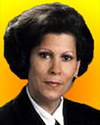
Born 23 Aug 1944.
Puerto Rican physician and public official, the first woman and the first Hispanic to serve as Surgeon General of the United States.
Puerto Rican physician and public official, the first woman and the first Hispanic to serve as Surgeon General of the United States.
Born 23 Aug 1933; died 3 Jul 2022 at age 88. quotes
Robert Floyd Curl Jr. was an American chemist who shared the 1996 Nobel Prize for Chemistry (with Richard E. Smalley and Sir Harold W. Kroto) for discovering the first fullerene, a spherical cluster of carbon atoms. Their discovery opened a new branch of chemistry. In Sep 1985, Curl met with Kroto of the University of Sussex, England, and Smalley, a colleague at Rice Institute, and, in 11 days of research, they discovered fullerenes. Their technique vaporized carbon from the surface of a solid disk of graphite into a high-density helium flow, using a focused pulsed laser. They announced their findings to the public as 'C60: Buckminsterfullerene', in a letter in the 14 Nov 1985, issue of the journal Nature.«
Robert Floyd Curl Jr. was an American chemist who shared the 1996 Nobel Prize for Chemistry (with Richard E. Smalley and Sir Harold W. Kroto) for discovering the first fullerene, a spherical cluster of carbon atoms. Their discovery opened a new branch of chemistry. In Sep 1985, Curl met with Kroto of the University of Sussex, England, and Smalley, a colleague at Rice Institute, and, in 11 days of research, they discovered fullerenes. Their technique vaporized carbon from the surface of a solid disk of graphite into a high-density helium flow, using a focused pulsed laser. They announced their findings to the public as 'C60: Buckminsterfullerene', in a letter in the 14 Nov 1985, issue of the journal Nature.«
Born 23 Aug 1931.
American microbiologistt who shared, with Werner Arber and Daniel Nathans, the Nobel Prize for Physiology or Medicine in 1978 for his discovery of a new class of restriction enzymes that recognize specific sequences of nucleotides in a molecule of DNA (deoxyribonucleic acid) and cleave the molecule at that particular point.
American microbiologistt who shared, with Werner Arber and Daniel Nathans, the Nobel Prize for Physiology or Medicine in 1978 for his discovery of a new class of restriction enzymes that recognize specific sequences of nucleotides in a molecule of DNA (deoxyribonucleic acid) and cleave the molecule at that particular point.
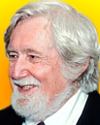
Born 23 Aug 1923; died 18 Apr 2003 at age 79.
British-American computer scientist and mathematician who laid the theoretical foundation for relational databases, for storing and retrieving information in computer records. He also contributed knowledge in the area of cellular automata.
British-American computer scientist and mathematician who laid the theoretical foundation for relational databases, for storing and retrieving information in computer records. He also contributed knowledge in the area of cellular automata.
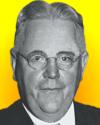
1943
Born 23 Aug 1887; died 14 Oct 1974 at age 87. quotes
American chemical engineer, industrialist and inventor who left M.I.T. with Charles Almy. They became young army officers during World War I, in the Chemical Warfare Service. There, they supervised design and manufacture of gas masks issued to American military in Europe. Postwar, they founded Dewey & Almy Chemical Company (1919) engaged in much research assisting the chemical and engineering industries. From 1921, when Dewey developed the first water-based latex sealing compound, the business manufactured such products for many years. By 1939, research on synthetic rubber led to building a full-scale factory, which opened in 1942. Later, he expanded into plastic film for vacuum sealing foods, and plastic food containers.«
American chemical engineer, industrialist and inventor who left M.I.T. with Charles Almy. They became young army officers during World War I, in the Chemical Warfare Service. There, they supervised design and manufacture of gas masks issued to American military in Europe. Postwar, they founded Dewey & Almy Chemical Company (1919) engaged in much research assisting the chemical and engineering industries. From 1921, when Dewey developed the first water-based latex sealing compound, the business manufactured such products for many years. By 1939, research on synthetic rubber led to building a full-scale factory, which opened in 1942. Later, he expanded into plastic film for vacuum sealing foods, and plastic food containers.«
Born 23 Aug 1885; died 9 Oct 1959 at age 74. quotes
English chemist, inventor and administrator. Around 1920, with David Pye, his work on aircraft fuels ultimately led to the octane rating system, which expresses the anti-knocking characteristics of the fuel. In the 1930-40s he advised the British government in the scientific aspects of air defence, particularly radar. He led a mission of leading British and Canadian scientists to the USA (29 Aug 1940) to brief official American representatives on devices under active development for war use and to enlist the support of American scientists. Thus began a close cooperation of Anglo-American scientists in such fields as aeronautics and rocketry. His influence probably made the difference between defeat or victory at the Battle of Britain in 1940.
English chemist, inventor and administrator. Around 1920, with David Pye, his work on aircraft fuels ultimately led to the octane rating system, which expresses the anti-knocking characteristics of the fuel. In the 1930-40s he advised the British government in the scientific aspects of air defence, particularly radar. He led a mission of leading British and Canadian scientists to the USA (29 Aug 1940) to brief official American representatives on devices under active development for war use and to enlist the support of American scientists. Thus began a close cooperation of Anglo-American scientists in such fields as aeronautics and rocketry. His influence probably made the difference between defeat or victory at the Battle of Britain in 1940.
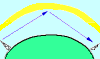
British physicist who pioneered in the development of radio communication. He was an early proponent of Oliver Heaviside's theory that an upper layer of the atmosphere reflects radio waves, thus enabling their transmission over long distances. He also suggested in 1912 that solar radiation accounted for the differences in wave propagation during the day and night. He experimented with detectors and amplifiers for radio reception, coined the term "diode," and studied atmospheric disturbances of radio reception. After WW I, he made many contributions to electronic circuit development, including the Eccles-Jordan "flip-flop" patented in 1918 and used in binary counters (working with F.W. Jordan).*
Born 23 Aug 1829; died 10 Apr 1920 at age 90. quotes
German historian of mathematics, one of the greatest of the 19th century. He is best remembered for the four volume work Vorlesungen über Geschichte der Mathematik which traces the history of mathematics up to 1799. The first volume (published 1880) traces the general history of mathematics up to 1200. The second volume traces the history up to 1668 (the year Newton and Leibniz were just about to embark on their mathematicalresearches). The third volume continues up to 1758 (Lagrange's work began shortly after this date). Cantor then, at the age of 69, as editor-in-chief, organised a team with nine further contributors to collaborate on the fourth volume (published 1908), continuing to 1799, the year of Gauss's doctoral thesis.
German historian of mathematics, one of the greatest of the 19th century. He is best remembered for the four volume work Vorlesungen über Geschichte der Mathematik which traces the history of mathematics up to 1799. The first volume (published 1880) traces the general history of mathematics up to 1200. The second volume traces the history up to 1668 (the year Newton and Leibniz were just about to embark on their mathematicalresearches). The third volume continues up to 1758 (Lagrange's work began shortly after this date). Cantor then, at the age of 69, as editor-in-chief, organised a team with nine further contributors to collaborate on the fourth volume (published 1908), continuing to 1799, the year of Gauss's doctoral thesis.
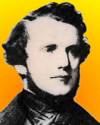
Born 23 Aug 1811; died 30 Mar 1863 at age 51.
French physicist and mineralogist, best remembered for his work on the lattice theory of crystals. Bravais lattices are named for him. In 1850, he showed that crystals could be divided into 14 unit cells for which: (a) the unit cell is the simplest repeating unit in the crystal; (b) opposite faces of a unit cell are parallel; and (c) the edge of the unit cell connects equivalent points. These unit cells fall into seven geometrical categories, which differ in their relative edge lengths and internal angles. In 1866, he elaborated the relationships between the ideal lattice and the material crystal. Sixty years later, Bravais' work provided the mathematical and conceptual basis for the determination of crystal structures after Laue's discovery of X-ray diffraction in 1911.
French physicist and mineralogist, best remembered for his work on the lattice theory of crystals. Bravais lattices are named for him. In 1850, he showed that crystals could be divided into 14 unit cells for which: (a) the unit cell is the simplest repeating unit in the crystal; (b) opposite faces of a unit cell are parallel; and (c) the edge of the unit cell connects equivalent points. These unit cells fall into seven geometrical categories, which differ in their relative edge lengths and internal angles. In 1866, he elaborated the relationships between the ideal lattice and the material crystal. Sixty years later, Bravais' work provided the mathematical and conceptual basis for the determination of crystal structures after Laue's discovery of X-ray diffraction in 1911.
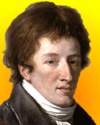
Born 23 Aug 1769; died 13 May 1832 at age 62. quotes
Baron Georges Léopold Chrêtien Frédéric Dagobert Cuvier was a French zoologist, statesman, anatomist and paleontologist who did important work in comparative anatomy, paleontology, and extended the work by Linnaeus on the classification of the animal kingdom. His careful study of fossil remains established paleontology as its own new field of research. He coined the name for the pterodactyl based on his identifcation of its fossil remains. He understood fossils represented the preservation of an former organic life form, and his classification scheme incorporated such life forms. In analysis of anatomic structures, he recognized a correlation of parts, by which he was able to make astute insights in reconstructing an entire extinct animal from its disjointed parts. He believed in catastrophism, whereby the ancient world underwent periodic massive flooding, which eliminated some life forms.«
Baron Georges Léopold Chrêtien Frédéric Dagobert Cuvier was a French zoologist, statesman, anatomist and paleontologist who did important work in comparative anatomy, paleontology, and extended the work by Linnaeus on the classification of the animal kingdom. His careful study of fossil remains established paleontology as its own new field of research. He coined the name for the pterodactyl based on his identifcation of its fossil remains. He understood fossils represented the preservation of an former organic life form, and his classification scheme incorporated such life forms. In analysis of anatomic structures, he recognized a correlation of parts, by which he was able to make astute insights in reconstructing an entire extinct animal from its disjointed parts. He believed in catastrophism, whereby the ancient world underwent periodic massive flooding, which eliminated some life forms.«
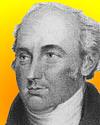
Born 23 Aug 1768; died 12 Feb 1841 at age 72. quotes
(1st Baronet) English surgeon who was a pioneer in experimental surgery. He was the first to tie the abdominal aorta in treating an aneurysm (1817), among various other operations he performed successfully at a time before antiseptic procedures. He was devoted to the study and teaching of anatomy, and is said to have dissected daily throughout his career. In 1820, for removing a small tumour from the head of King George IV, he was rewarded with a baronetcy, and later appointed Sergeant-Surgeon to the King (1828). He wrote many medical books, including his major work The Anatomy and Surgical Treatment of Hernia (1804-07), and Dislocations and Fractures (1822). He became president of the Royal College of Surgeons in 1827, and vice-president of the Royal Society in 1830.«
(1st Baronet) English surgeon who was a pioneer in experimental surgery. He was the first to tie the abdominal aorta in treating an aneurysm (1817), among various other operations he performed successfully at a time before antiseptic procedures. He was devoted to the study and teaching of anatomy, and is said to have dissected daily throughout his career. In 1820, for removing a small tumour from the head of King George IV, he was rewarded with a baronetcy, and later appointed Sergeant-Surgeon to the King (1828). He wrote many medical books, including his major work The Anatomy and Surgical Treatment of Hernia (1804-07), and Dislocations and Fractures (1822). He became president of the Royal College of Surgeons in 1827, and vice-president of the Royal Society in 1830.«

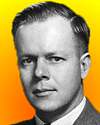
Died 23 Aug 2008 at age 93 (born 15 Jun 1915).
Thomas Huckle Weller was an American physician, microbiologist and virologist who was a co-recipient of the Nobel Prize for Physiology or Medicine in 1954 (which shared with John Enders and Frederick Robbins) for the successful cultivation of poliomyelitis virus in tissue cultures. This made it possible to study the virus “in the test tube,” a procedure that led to the development of polio vaccines.
Thomas Huckle Weller was an American physician, microbiologist and virologist who was a co-recipient of the Nobel Prize for Physiology or Medicine in 1954 (which shared with John Enders and Frederick Robbins) for the successful cultivation of poliomyelitis virus in tissue cultures. This made it possible to study the virus “in the test tube,” a procedure that led to the development of polio vaccines.
Growing Pathogens in Tissue Cultures: Fifty Years in Academic Tropical Medicine..., by Thomas Huckle Weller. - book suggestion.
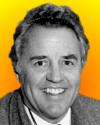
Died 23 Aug 1999 at age 63 (born 18 Mar 1936).
American marine geologist whose pioneering studies of the deep-sea floor revealed not tranquil depths but that strong currents and storms occur there. He started the development of the giant piston coring system and in the 1970's, documented the longest continuous record of ocean basin history in a single 100-ft core sample that contained a continuous 65 million-year-long record of ocean-basin history. He also made significant discoveries concerning ocean sediment transport and directed the High Energy Benthic Boundary Layer Experiment (HEBBLE). Also, he initiated the sub-seabed concept and led the international team that studied the scientific feasibility of isolating high-level radioactive material into sediments below the sea floor.
American marine geologist whose pioneering studies of the deep-sea floor revealed not tranquil depths but that strong currents and storms occur there. He started the development of the giant piston coring system and in the 1970's, documented the longest continuous record of ocean basin history in a single 100-ft core sample that contained a continuous 65 million-year-long record of ocean-basin history. He also made significant discoveries concerning ocean sediment transport and directed the High Energy Benthic Boundary Layer Experiment (HEBBLE). Also, he initiated the sub-seabed concept and led the international team that studied the scientific feasibility of isolating high-level radioactive material into sediments below the sea floor.
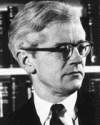
Died 23 Aug 1997 at age 80 (born 24 Mar 1917). quotes
English biochemist who shared the 1962 Nobel Prize for Chemistry (with colleague Max Ferdinand Perutz) “for their studies of the structures of globular proteins.” Perutz had determined the structure of hemoglobin. Kendrew worked out the structure of the muscle protein myoglobin, which stores oxygen and gives it to the muscle cells when needed.«
English biochemist who shared the 1962 Nobel Prize for Chemistry (with colleague Max Ferdinand Perutz) “for their studies of the structures of globular proteins.” Perutz had determined the structure of hemoglobin. Kendrew worked out the structure of the muscle protein myoglobin, which stores oxygen and gives it to the muscle cells when needed.«
The Thread of Life: An Introduction to Molecular Biology, by John Cowdery Kendrew. - book suggestion.
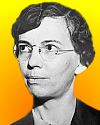
Died 23 Aug 1991 at age 93 (born 6 Oct 1897).
American scientist who developed the protein substance used for the tuberculosis skin test, and contributed to safety measures for intravenous drug therapy. In the early 1920s, she discovered that the sudden fevers that sometimes occurred during intravenous injections were caused by bacteria in the distilled water used to make the protein solutions. She invented a distillation apparatus designed to prevent such contamination. In 1941, her improved TB skin test became the standard test in the U.S. and a year later was adopted by the World Health Organization. It is still in use today. Her later research involved the study of bacteria associated with certain cancers.
American scientist who developed the protein substance used for the tuberculosis skin test, and contributed to safety measures for intravenous drug therapy. In the early 1920s, she discovered that the sudden fevers that sometimes occurred during intravenous injections were caused by bacteria in the distilled water used to make the protein solutions. She invented a distillation apparatus designed to prevent such contamination. In 1941, her improved TB skin test became the standard test in the U.S. and a year later was adopted by the World Health Organization. It is still in use today. Her later research involved the study of bacteria associated with certain cancers.
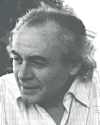
Died 23 Aug 1989 at age 61 (born 7 Oct 1927). quotes
Ronald David Laing was a British psychiatrist who was noted for his alternative approach to the treatment of schizophrenia. His first book, The Divided Self, was an attempt to explain schizophrenia by using existentialist philosophy to vividly portray the inner world of a schizophrenic, which Laing presented as an attempt to live in an unlivable situation. His work tends to be dismissed by most psychiatrists; however, droves of mentally ill people insist that this was a man who truly understood how they felt. Laing always insisted that psychotherapists should act as shamans, exorcising the illness through a process of mutual catharsis. Since Laing refused to view mental illness in biomedical/clinical terms, he has often been labelled as part of the so-called 'antipsychiatry' movement.
Ronald David Laing was a British psychiatrist who was noted for his alternative approach to the treatment of schizophrenia. His first book, The Divided Self, was an attempt to explain schizophrenia by using existentialist philosophy to vividly portray the inner world of a schizophrenic, which Laing presented as an attempt to live in an unlivable situation. His work tends to be dismissed by most psychiatrists; however, droves of mentally ill people insist that this was a man who truly understood how they felt. Laing always insisted that psychotherapists should act as shamans, exorcising the illness through a process of mutual catharsis. Since Laing refused to view mental illness in biomedical/clinical terms, he has often been labelled as part of the so-called 'antipsychiatry' movement.
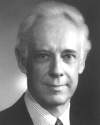
Died 23 Aug 1982 at age 68 (born 4 Sep 1913). quotes
American biochemist, who shared (with Christian B. Anfinsen and William H. Stein) the 1972 Nobel Prize for Chemistry for his contribution to the understanding of the connection between chemical structure and catalytic activity of the active centre of ribonuclease molecule, an enzyme. Enzymes are large molecules (macromolecules). The way in which an enzyme accelerates a chemical reaction involves an interaction of the reacting substance (the substrate) with only a limited part of the enzyme molecule, its active site. Moore and Stein have carried out investigations which supplement each other and have led to a complete elucidation of the sequence of amino acids in the enzyme ribonuclease.
American biochemist, who shared (with Christian B. Anfinsen and William H. Stein) the 1972 Nobel Prize for Chemistry for his contribution to the understanding of the connection between chemical structure and catalytic activity of the active centre of ribonuclease molecule, an enzyme. Enzymes are large molecules (macromolecules). The way in which an enzyme accelerates a chemical reaction involves an interaction of the reacting substance (the substrate) with only a limited part of the enzyme molecule, its active site. Moore and Stein have carried out investigations which supplement each other and have led to a complete elucidation of the sequence of amino acids in the enzyme ribonuclease.
Died 23 Aug 1947 at age 54 (born 30 Apr 1893).
British aeronautical engineer, who during WW I, designed the Avro 504 trainer. His other designs include the Baby (a truly light aircraft), Avian, and the Anson (used for RAF coastal reconnaissance). In WW II, he developed the Manchester and the famous Lancaster heavy bombers. Later, he worked jet-propelled planes, the Tudor and Ashton. He died in a test flight crash of the Tudor II prototype, near Woodford airfield, Manchester.*
British aeronautical engineer, who during WW I, designed the Avro 504 trainer. His other designs include the Baby (a truly light aircraft), Avian, and the Anson (used for RAF coastal reconnaissance). In WW II, he developed the Manchester and the famous Lancaster heavy bombers. Later, he worked jet-propelled planes, the Tudor and Ashton. He died in a test flight crash of the Tudor II prototype, near Woodford airfield, Manchester.*
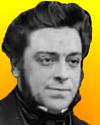
Died 23 Aug 1888 at age 78 (born 6 Apr 1810). quotes
English naturalist and science writer who wrote books illustrating such topics as Jamaican wildlife and marine zoology. Stephen Jay Gould called Gosse the “ David Attenborough of his day.” However, he did not accept the theory of evolution, and in his best-known book, Omphalos, he attempted to apply biblical literalism in a way still consistent with uniformitarianism. His premise in the book was criticized by both sides of the debate. He invented the institutional aquarium when on 21 May 1853, he opened the Aquatic Vivarium, the world's first public aquarium in Regent's Park, London.*
English naturalist and science writer who wrote books illustrating such topics as Jamaican wildlife and marine zoology. Stephen Jay Gould called Gosse the “ David Attenborough of his day.” However, he did not accept the theory of evolution, and in his best-known book, Omphalos, he attempted to apply biblical literalism in a way still consistent with uniformitarianism. His premise in the book was criticized by both sides of the debate. He invented the institutional aquarium when on 21 May 1853, he opened the Aquatic Vivarium, the world's first public aquarium in Regent's Park, London.*
Glimpses of the Wonderful: The Life of Philip Henry Gosse, by Ann Thwaite. - book suggestion.
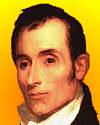
Died 23 Aug 1813 at age 47 (born 6 Jul 1766). quotes
Scottish-American ornithologist and poet who left his homeland in 1794, aged 27, in search of a better life in America. Naturalist William Bartram sparked his interest in birds. By 1802, Wilson had resolved to author a book illustrating every North American bird. He travelled extensively to make paintings of the birds he observed. This pioneering work on North American birds grew to nine volumes of American Ornithology, (1808-1814), with illustrations of 268 species, of which 26 were new. As a founder of American ornithology he became one of the leading naturalists who also made the first census of breeding birds, corrected errors of taxonomy, and may have inspired Audubon’s later work when they met in 1810.« more
Scottish-American ornithologist and poet who left his homeland in 1794, aged 27, in search of a better life in America. Naturalist William Bartram sparked his interest in birds. By 1802, Wilson had resolved to author a book illustrating every North American bird. He travelled extensively to make paintings of the birds he observed. This pioneering work on North American birds grew to nine volumes of American Ornithology, (1808-1814), with illustrations of 268 species, of which 26 were new. As a founder of American ornithology he became one of the leading naturalists who also made the first census of breeding birds, corrected errors of taxonomy, and may have inspired Audubon’s later work when they met in 1810.« more
Alexander Wilson: Naturalist and Pioneer,: A biography, by Robert Cantwell. - book suggestion.
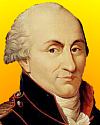
Died 23 Aug 1806 at age 70 (born 14 Jun 1736). quotes
French physicist best known for the formulation of Coulomb's law, which states that the force between two electrical charges is proportional to the product of the charges and inversely proportional to the square of the distance between them. Coulombic force is one of the principal forces involved in atomic reactions. The inverse-square relationship is also seen in the relationship of the gravitation force between masses. In 1777, he invented a torsion balance which he subsequently modified for electrical measurements. He also did research on friction of machinery, on windmills, and on the elasticity of metal and silk fibres. more
French physicist best known for the formulation of Coulomb's law, which states that the force between two electrical charges is proportional to the product of the charges and inversely proportional to the square of the distance between them. Coulombic force is one of the principal forces involved in atomic reactions. The inverse-square relationship is also seen in the relationship of the gravitation force between masses. In 1777, he invented a torsion balance which he subsequently modified for electrical measurements. He also did research on friction of machinery, on windmills, and on the elasticity of metal and silk fibres. more
Coulomb and the Evolution of Physics and Engineering in Eighteenth Century France, by C. Stewart Gilmor. - book suggestion.
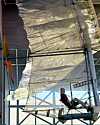
In 1977, Bryan Allen won the Kremer Prize for the first human-powered flight as he pedalled the Gossamer Condor for at least a mile at Schafter, California.
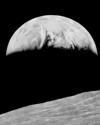
In 1966, the Lunar Orbiter 1 took the first photograph of the Earth from the Moon. In grainy black and white, the earthrise picture was made using computer imaging that was then in its infancy. As then released to the public, the image looked starkly black and wide with poor resolution. Forty-two years later, an Image Recovery Project used restored 1960s tape drives to access the original analog data from the tapes. With modern digital processing, a striking level of detail was obtained in a much higher resolution picture. Yet, that image was an after-thought, because the essential purpose of the Lunar Orbiter mission was to identify suitable landing sites on the moon surface in preparation for the manned missions to the moon.«

(USPTO)
In 1904, Harry D. Weed of Canastota, NY, was issued a U.S. patent for his "Grip-Tread for Pneumatic Tires" - a snow tire chain for automobiles (No. 768,495). His invention was "to provide a fexible and collapsible grip or tread composed entirely of chains linked together and applied to the sides and periphery of the tire and held in place solely by the inflation of the tire, and which is reversible" when one side is worn so the other side may be used. The linked-chain device is assembled around a partially deflated tyre, fastened by hooks at each end, and then the tyre is reinflated. His patent was eventually acquired by the American Chain and Cable Company. Weed subsequently held several related patents and also patents for a bomb carrying gear and a bomb-release gear filed after WWI. «
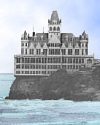
Cliff House 1896
In 1899, the first ship-to-shore wireless message to be received in the U.S was: "Sherman is sighted." U.S. Lightship No. 70, San Francisco, announced the arrival of the U.S. Army troopship Sherman to the crowd assembled at the Cliff House. Reporters there from the San Francisco Call, who relayed this information to a city awaiting the return of its hometown regiment from the battlefields of the Spanish-American War. The lightship, miles out at sea in deep fog, relayed this message via wireless telegraphy (later known as radio) through the fog to the Cliff House. This was the first 19th-century working use of wireless telegraphy outside of England. The method was still primitive, using sparks to emit intermittent radio waves and code messages.
In 1783, filling of the first hydrogen balloon began, with the gas produced by the action of sulphuric acid on iron. Following the success of the Montgolfier brother's hot air balloon ascent on 5 Jun 1783, a 13-ft (4-m) diameter balloon was built by two brothers named Robert, under the auspices of the French Academy of Sciences. Its construction was supervised by physicist Jacques A.C. Charles, who had suggested the use of hydrogen rather than hot air. The process of filling the balloon took place over several days, beginning at the Place des Victoires, Paris. Because of the crowds, it was moved on the night of 26 Aug to the Champ de Mars, where it was eventually released, on 27 Aug 1783.«
more
In 1617, the first one-way streets were established in London. An Act of Common Council was passed to regulate the "disorder and rude behaviour of Carmen, Draymen and others using Cartes." Seventeen narrow and congested lanes were specified. They ran into Thames Street, including Pudding Lane (where the Great Fire of London began in 1667). "No Carter or Carman to come into Thames Street by Saint Magnus Corner Eastward with his Carr before he is hired under penalty of 2s. 6d. for the 1st offence, 5s. for the 2nd and to be disabled from using a Carr." and "For avoiding the great numbers of Carrs which come out of ...As late as 1755, the Christ's Hospital Carmen's Committee fined seven carmen 5s. each for violations. The traffic regulation continued for two centuries.*
In 1609, the telescope was demonstrated by Galileo.




