Thm.jpg "Jocelyn Bell Burnell")
1969
Born 15 Jul 1943. quotes
Dame Susan Jocelyn Bell Burnell is a British astronomer who discovered the first four pulsars. While a Cambridge University graduate student, age 24, searching for quasars in 1967, she noticed an unusual stellar radio signal—a rapid series of pulses repeating every 1.337 sec. This interstellar beacon was not man-made. For fun, it was nicknamed as LGM, for Little Green Men. In a few more months, Bell (her maiden name) found three more sources of radio pulses by scrutinizing hundreds of feet of pen-recorder paper. These were a new class of celestial objects—pulsars. Astronomers subsequently associated them with superdense matter in the final stage of the evolution of massive stars. Hundreds more pulsars have since been identified.«
Dame Susan Jocelyn Bell Burnell is a British astronomer who discovered the first four pulsars. While a Cambridge University graduate student, age 24, searching for quasars in 1967, she noticed an unusual stellar radio signal—a rapid series of pulses repeating every 1.337 sec. This interstellar beacon was not man-made. For fun, it was nicknamed as LGM, for Little Green Men. In a few more months, Bell (her maiden name) found three more sources of radio pulses by scrutinizing hundreds of feet of pen-recorder paper. These were a new class of celestial objects—pulsars. Astronomers subsequently associated them with superdense matter in the final stage of the evolution of massive stars. Hundreds more pulsars have since been identified.«
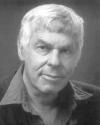
Born 15 Jul 1930. quotes
American mathematician who was awarded the Fields Medal in 1966 for his work in topology and dynamical systems. One of his studies (1961) was on the generalised Poincaré conjecture, a famous problem of 20th-century, which asserts that a simply connected closed 3-dimensional manifold is a 3-dimensional sphere. Smale proved a higher dimensional Poincaré conjecture for an n-dimensional manifold where n is at least 5. In other work, related to strange attractors, one of the early fractals to be studied known, he discovered strange attractors which lead to chaotic dynamical systems. (An attractor in classical mechanics is a geometrical way of describing the behaviour of a dynamical system.) His recent work has been on theoretical computer science.
American mathematician who was awarded the Fields Medal in 1966 for his work in topology and dynamical systems. One of his studies (1961) was on the generalised Poincaré conjecture, a famous problem of 20th-century, which asserts that a simply connected closed 3-dimensional manifold is a 3-dimensional sphere. Smale proved a higher dimensional Poincaré conjecture for an n-dimensional manifold where n is at least 5. In other work, related to strange attractors, one of the early fractals to be studied known, he discovered strange attractors which lead to chaotic dynamical systems. (An attractor in classical mechanics is a geometrical way of describing the behaviour of a dynamical system.) His recent work has been on theoretical computer science.
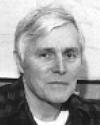
Born 15 Jul 1928.
American microbiologist who recognized the existence of the organisms Archaea as a third domain of life, distinct from the previously recognized two domains of bacteria, and life other than bacteria. On 2 Nov 1977, his identification of methanogens, a form of life dating back some 3.5 billion years, was reported from the University of Illinois. Woese had long studied the evolutionary track of DNA and RNA. In 1976, he was approached by his colleague Ralph Wolfe, who presented a group of methane producing organisms. Woese studied their RNA and recognized their lack of the entire oligonucleotide sequences. Methanogens are found in oxygen-deficient environments, and mostly obtain their energy by reducing CO2 and oxidizing hydrogen, and releasing methane.
American microbiologist who recognized the existence of the organisms Archaea as a third domain of life, distinct from the previously recognized two domains of bacteria, and life other than bacteria. On 2 Nov 1977, his identification of methanogens, a form of life dating back some 3.5 billion years, was reported from the University of Illinois. Woese had long studied the evolutionary track of DNA and RNA. In 1976, he was approached by his colleague Ralph Wolfe, who presented a group of methane producing organisms. Woese studied their RNA and recognized their lack of the entire oligonucleotide sequences. Methanogens are found in oxygen-deficient environments, and mostly obtain their energy by reducing CO2 and oxidizing hydrogen, and releasing methane.
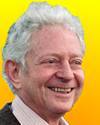
Born 15 Jul 1922; died 3 Oct 2018 at age 96. quotes
Leon Max Lederman was an American physicist who shared (with Melvin Schwartz and Jack Steinberger) the 1988 Nobel Prize for Physics for their joint research and discovery (1960-62) of a new subatomic particle, the muon neutrino. Neutrinos are subatomic particles having no detectable mass and no electric charge, which travel at the speed of light. The discovery of the muon neutrino, was followed by discoveries by other scientists of a number of different “families” of subatomic particle. Together, they now form a standard model, a scheme that has been used to classify all known elementary particles. He was director of the Fermi National Accelerator Laboratory in Batavia, Ill. (1979-89).
Leon Max Lederman was an American physicist who shared (with Melvin Schwartz and Jack Steinberger) the 1988 Nobel Prize for Physics for their joint research and discovery (1960-62) of a new subatomic particle, the muon neutrino. Neutrinos are subatomic particles having no detectable mass and no electric charge, which travel at the speed of light. The discovery of the muon neutrino, was followed by discoveries by other scientists of a number of different “families” of subatomic particle. Together, they now form a standard model, a scheme that has been used to classify all known elementary particles. He was director of the Fermi National Accelerator Laboratory in Batavia, Ill. (1979-89).
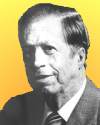
Born 15 Jul 1921; died 14 May 2006 at age 84.
Robert Bruce Merrifield was an American biochemist who received the 1984 Nobel Prize for Chemistry for his development of the solid phase peptide synthesis method to build up large organic molecules on a solid matrix. He first attached an amino acid to small plastic polymer spheres, then added other amino acids, one after another, until a polypeptide chain was built up. The chain was then released from the polymer. Chains of amino acids can thus be built in any predetermined order to synthesize a wide variety of proteins, hormones, and other organic molecules. Merrifield's work has encompassed the development of resins, protecting groups and chemical strategies, and the engineering which brought automation to peptide chemistry.«
Robert Bruce Merrifield was an American biochemist who received the 1984 Nobel Prize for Chemistry for his development of the solid phase peptide synthesis method to build up large organic molecules on a solid matrix. He first attached an amino acid to small plastic polymer spheres, then added other amino acids, one after another, until a polypeptide chain was built up. The chain was then released from the polymer. Chains of amino acids can thus be built in any predetermined order to synthesize a wide variety of proteins, hormones, and other organic molecules. Merrifield's work has encompassed the development of resins, protecting groups and chemical strategies, and the engineering which brought automation to peptide chemistry.«
Life During a Golden Age of Peptide Chemistry, by Robert Merrifield. - book suggestion.
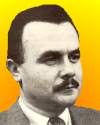
Born 15 Jul 1918; died 13 Oct 2003 at age 85. quotes
Bertram Neville Brockhouse was a Canadian physicist who developed neutron diffraction techniques used to study the structure and properties of matter, for which he shared the Nobel Prize for Physics in 1994 (with American physicist Clifford G. Shull). By devising instrumentation to measure the energy of neutrons scattered from a solid material, Brockhouse provided insight to its atomic structure. It made possible advances in semiconductor technology. His Triple-Axis Neutron Spectrometer is now widely used not only to investigate atomic structures, but also virus and DNA molecules.«
Bertram Neville Brockhouse was a Canadian physicist who developed neutron diffraction techniques used to study the structure and properties of matter, for which he shared the Nobel Prize for Physics in 1994 (with American physicist Clifford G. Shull). By devising instrumentation to measure the energy of neutrons scattered from a solid material, Brockhouse provided insight to its atomic structure. It made possible advances in semiconductor technology. His Triple-Axis Neutron Spectrometer is now widely used not only to investigate atomic structures, but also virus and DNA molecules.«
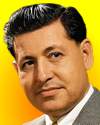
Born 15 Jul 1915; died 26 Dec 2010 at age 95.
American nuclear physicist who co-discovered 12 new elements. With an electrical engineering B.S. (1937), his career soon led to a lifetime collaboration with Glenn Seaborg in nuclear chemistry. He helped build the first equipment to identify isotopes by a non-chemical spectroscopic method, enabling co-discovery of new elements with atomic numbers 95-100 (Am, Cm, Bk, Cf, Es, Fm). The recoil technique he developed made possible finding element 101 (Md). After the mid-1950s, the Heavy ion Linear Accelerator (HILAC) produced further discoveries, with new identification techniques and later new equipment, of elements 102-105 (No, Lr, Rf, Db) and eventually 106 (seaborgium, Sg), in 1974.«
American nuclear physicist who co-discovered 12 new elements. With an electrical engineering B.S. (1937), his career soon led to a lifetime collaboration with Glenn Seaborg in nuclear chemistry. He helped build the first equipment to identify isotopes by a non-chemical spectroscopic method, enabling co-discovery of new elements with atomic numbers 95-100 (Am, Cm, Bk, Cf, Es, Fm). The recoil technique he developed made possible finding element 101 (Md). After the mid-1950s, the Heavy ion Linear Accelerator (HILAC) produced further discoveries, with new identification techniques and later new equipment, of elements 102-105 (No, Lr, Rf, Db) and eventually 106 (seaborgium, Sg), in 1974.«
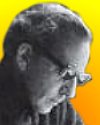
Born 15 Jul 1914; died 7 Sep 1969 at age 55.
Scottish naturalist and author best known for his book Ring of Bright Water (1960), the story of his life in the western Highlands of Scotland with two pet otters. In 1945, he bought the small Hebridean island of Soay, to create a shark fishery there, but his effort was undercapitalized and failed. He found the sharks elusive, difficult to land in a small boat and he underestimated the refrigeration capacity required to keep the stored meat edible. However, the experience became the source for his book Harpoon Venture (1952). His later enterprises included encouraging Eider Ducks to breed on the small island of Eilean Dudh so that the down from their nests could be harvested, and establishing a collection of wild animals indigenous to Scotland to create a private zoo.«
Scottish naturalist and author best known for his book Ring of Bright Water (1960), the story of his life in the western Highlands of Scotland with two pet otters. In 1945, he bought the small Hebridean island of Soay, to create a shark fishery there, but his effort was undercapitalized and failed. He found the sharks elusive, difficult to land in a small boat and he underestimated the refrigeration capacity required to keep the stored meat edible. However, the experience became the source for his book Harpoon Venture (1952). His later enterprises included encouraging Eider Ducks to breed on the small island of Eilean Dudh so that the down from their nests could be harvested, and establishing a collection of wild animals indigenous to Scotland to create a private zoo.«
Ring of Bright Water, by Gavin Maxwell. - book suggestion.

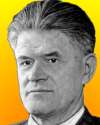
Born 15 Jul 1904; died 6 Jan 1990 at age 85.
Pavel Alekseyevich Cherenkov (or Cerenkov) was a Russian physicist who discovered Cherenkov radiation (1934), a faint blue light emitted by electrons passing through a transparent medium when their speed exceeds the speed of light in that medium. Fellow Soviet scientists Igor Y. Tamm and Ilya M. Frank investigated the phenomenon from which the Cherenkov counter was developed. Extensive use of this Cherenkov detector was later made in applications of experimental nuclear and particle physics. For their work, the trio shared the 1958 Nobel Prize for Physics.[Note: birth date 15 Jul 1904 Old Style is 28 Jul 1904 New Style]
Pavel Alekseyevich Cherenkov (or Cerenkov) was a Russian physicist who discovered Cherenkov radiation (1934), a faint blue light emitted by electrons passing through a transparent medium when their speed exceeds the speed of light in that medium. Fellow Soviet scientists Igor Y. Tamm and Ilya M. Frank investigated the phenomenon from which the Cherenkov counter was developed. Extensive use of this Cherenkov detector was later made in applications of experimental nuclear and particle physics. For their work, the trio shared the 1958 Nobel Prize for Physics.[Note: birth date 15 Jul 1904 Old Style is 28 Jul 1904 New Style]
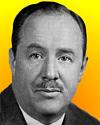
Born 15 Jul 1900; died 1 Oct 1969 at age 69.
American physician, physician, virologist and epidemiologist who was the first in the U.S. to isolate the virus influenza A (1934) and showed that there are other strains, such as influenza B (1940). Francis developed a polyvalent vaccine effective against both strains and conducted research that led to the development of antiserums for the treatment of pneumonia. In 1953, he was asked to design, supervise, and evaluate the field trials of the polio vaccine developed by his former protegé, Jonas Salk. The trials were of unprecedented scope and magnitude, involving about 1.8 million children from across the U.S., Canada, and Finland. On 12 Apr 1955, Francis announced that the Salk vaccine was indeed "safe, effective, and potent."«
American physician, physician, virologist and epidemiologist who was the first in the U.S. to isolate the virus influenza A (1934) and showed that there are other strains, such as influenza B (1940). Francis developed a polyvalent vaccine effective against both strains and conducted research that led to the development of antiserums for the treatment of pneumonia. In 1953, he was asked to design, supervise, and evaluate the field trials of the polio vaccine developed by his former protegé, Jonas Salk. The trials were of unprecedented scope and magnitude, involving about 1.8 million children from across the U.S., Canada, and Finland. On 12 Apr 1955, Francis announced that the Salk vaccine was indeed "safe, effective, and potent."«
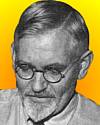
Born 15 Jul 1887; died 31 Jan 1977 at age 89.
American zoologist, geneticist and ecologist who introduced biotic provinces to characterize areas of continuous ecological similarity in climate, soils, and topography. He investigated geographical and ecological distribution pertaining to plants and animals in fieldwork throughout the Southwest and Mexico in the 1920s and 30s. When he found C. Hart Merriam's idea of life zones to be inadequate for modeling distribution patterns, he developed his concept of biotic provinces. Dice demonstrated their application in his book, The Biotic Provinces of North America (1943). He is also known for his derivation of the Dice index, a similarity coefficient used to measure degree of association between biotic samples.«
American zoologist, geneticist and ecologist who introduced biotic provinces to characterize areas of continuous ecological similarity in climate, soils, and topography. He investigated geographical and ecological distribution pertaining to plants and animals in fieldwork throughout the Southwest and Mexico in the 1920s and 30s. When he found C. Hart Merriam's idea of life zones to be inadequate for modeling distribution patterns, he developed his concept of biotic provinces. Dice demonstrated their application in his book, The Biotic Provinces of North America (1943). He is also known for his derivation of the Dice index, a similarity coefficient used to measure degree of association between biotic samples.«
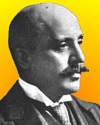
Born 15 Jul 1856; died 1 May 1927 at age 70.
(1st Viscount Cowdray of Midhurst) British engineer and a developer of the Mexican petroleum industry. At age 19, Pearson became a partner in his family's contracting firm, the operation of which he extended to Spain and the U.S. In Dec 1889, he went to Mexico, where he drained swamps, built railways, power lines and waterworks for the Mexican government. Realizing the need for fuel to power the locomotives, he began as early as 1901 to buy concessions and drilled for oil. When the drilling site, known as Portrero del Llano No 4 struck oil, the plume of crude oil spurted 300 feet into the air. Within a couple of years Mexico was one of the world's biggest oil producer and by 1918 Pearson was one of the richest men in the world.
(1st Viscount Cowdray of Midhurst) British engineer and a developer of the Mexican petroleum industry. At age 19, Pearson became a partner in his family's contracting firm, the operation of which he extended to Spain and the U.S. In Dec 1889, he went to Mexico, where he drained swamps, built railways, power lines and waterworks for the Mexican government. Realizing the need for fuel to power the locomotives, he began as early as 1901 to buy concessions and drilled for oil. When the drilling site, known as Portrero del Llano No 4 struck oil, the plume of crude oil spurted 300 feet into the air. Within a couple of years Mexico was one of the world's biggest oil producer and by 1918 Pearson was one of the richest men in the world.
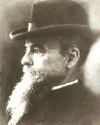
Born 15 Jul 1848; died 20 Aug 1923 at age 75. quotes
Italian economist and sociologist, known for his application of mathematics to economic analysis and for his theory of the 'circulation of elites'. His initial five-year course in civil engineering, graduating in 1870, gave him a grounding in mathematics. While working as an engineer, he studied philosophy and politics and wrote many periodical articles in which he was one of the first to analyse economic problems with mathematical tools. Pareto's first work, Cours d'economie politique (1896-97), included his famous 'law' of income distribution, a complicated mathematical formulation attempting to prove the distribution of incomes and wealth in society is not random and that a consistent pattern appears throughout history, in all parts of the world and in all societies.
Italian economist and sociologist, known for his application of mathematics to economic analysis and for his theory of the 'circulation of elites'. His initial five-year course in civil engineering, graduating in 1870, gave him a grounding in mathematics. While working as an engineer, he studied philosophy and politics and wrote many periodical articles in which he was one of the first to analyse economic problems with mathematical tools. Pareto's first work, Cours d'economie politique (1896-97), included his famous 'law' of income distribution, a complicated mathematical formulation attempting to prove the distribution of incomes and wealth in society is not random and that a consistent pattern appears throughout history, in all parts of the world and in all societies.
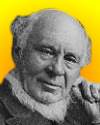
Born 15 Jul 1817; died 20 Nov 1898 at age 81.
Sir John Fowler, 1st Baronet was an English civil engineer who helped design and build the London Metropolitan Railway, thus pioneering the original London underground. He was a railway consultant from 1844, and later was engaged in river improvement and dock construction. He designed the Pimlico Railway Bridge which carried the first railway across the Thames (1860) and was consulting engineer to Ismail Pasha, the Khedive of Egypt (1871-79). He was joint designer (with Sir Benjamin Baker) of the Forth Railway Bridge in Scotland (1882-90), for which work he was knighted (1890). more
Sir John Fowler, 1st Baronet was an English civil engineer who helped design and build the London Metropolitan Railway, thus pioneering the original London underground. He was a railway consultant from 1844, and later was engaged in river improvement and dock construction. He designed the Pimlico Railway Bridge which carried the first railway across the Thames (1860) and was consulting engineer to Ismail Pasha, the Khedive of Egypt (1871-79). He was joint designer (with Sir Benjamin Baker) of the Forth Railway Bridge in Scotland (1882-90), for which work he was knighted (1890). more
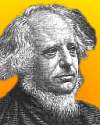
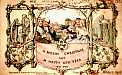
British industrial designer who produced the first commercial Christmas card.* Cole played a pivotal role in the introduction of the Penny Post, the English postal system (assistant to Rowland Hill, 1837-40), influenced the expansion of railways, helped establish the Victoria and Albert Museum, contributed greatly to the success of London's Great Exhibition of 1851, and promoted art and science education. In 1843, wishing to save much handwriting of seasonal correspondence, Cole introduced the world's first commercial Christmas card. He commissioned artist John Callcott Horsley to make the artwork for 1000 hand-coloured lithographs. (Individuals' homemade Christmas cards had existed earlier.)«[Image right: Cole's 1843 Christmas card.]
The Great Exhibitor: The Life and Work of Henry Cole, by Elizabeth Bonython. - book suggestion.

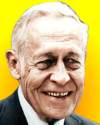
Died 15 Jul 1991 at age 82 (born 7 Mar 1909). quotes
Roger Randall Dougan Revelle was an American oceanographer whose research interests integrated study of the sea with geography, geology, geophysics, and meteorology. After WW II, as a commander in the Naval Reserve, he supervised oceanographic measurements during the Operation Crossroads (1946) atom bomb tests off Bikini. In pioneering work in deep-sea drilling he measured the upward flow of heat through ocean floors. His tectonic studies in the Pacific Ocean helped advance the theory of ocean floor spreading. Although in 1955, he was not alarmed about using the oceans as a depository for radiactive wastes, Revelle expressed an early concern about global warming (1957) due to increasing carbon dioxide to the atmosphere.«
Roger Randall Dougan Revelle was an American oceanographer whose research interests integrated study of the sea with geography, geology, geophysics, and meteorology. After WW II, as a commander in the Naval Reserve, he supervised oceanographic measurements during the Operation Crossroads (1946) atom bomb tests off Bikini. In pioneering work in deep-sea drilling he measured the upward flow of heat through ocean floors. His tectonic studies in the Pacific Ocean helped advance the theory of ocean floor spreading. Although in 1955, he was not alarmed about using the oceans as a depository for radiactive wastes, Revelle expressed an early concern about global warming (1957) due to increasing carbon dioxide to the atmosphere.«

Died 15 Jul 1970 at age 86 (born 2 Jan 1884). quotes
British industrial chemist who became chief chemist (1908, age 26) with Brunner, Mond and Co. Called up (4 Aug 1914) at the outbreak of World War I, he served as an army captain and was sent to the trenches in France. By Mar 1915, he was ordered to return from France to the chemical company (1915-18) to devote his prior skills to large-scale production of ammonium nitrate for explosives, a vital wartime need. His solution was controlling the conditions of the double-replacement reaction between ammonium sulphate and Chile saltpetre. Subsequently, he spent much of his career as research manager, including with I.C.I., when it was formed by the merger (1926) of several companies including Brunner Mond.«
British industrial chemist who became chief chemist (1908, age 26) with Brunner, Mond and Co. Called up (4 Aug 1914) at the outbreak of World War I, he served as an army captain and was sent to the trenches in France. By Mar 1915, he was ordered to return from France to the chemical company (1915-18) to devote his prior skills to large-scale production of ammonium nitrate for explosives, a vital wartime need. His solution was controlling the conditions of the double-replacement reaction between ammonium sulphate and Chile saltpetre. Subsequently, he spent much of his career as research manager, including with I.C.I., when it was formed by the merger (1926) of several companies including Brunner Mond.«
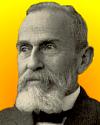
Died 15 Jul 1939 at age 82 (born 30 Apr 1857). quotes
Swiss psychiatrist who made notable contributions to the understanding of mental illness, and coined the term “schizophrenia” (1908) for the disorder previously named as dementia praecox by Emil Kraepelin. Bleuler realised the condition was neither a dementia, nor did it always occur in young people (praecox meaning early) and so gave the condition the name from the Greek for split (schizo) and mind (phrene). Contrary to the belief of the time, he held that schizophrenia was neither invariably incurable, nor would always progress to full dementia. He was one of the first psychiatrists to apply psychoanalytical methods in his research, and was an early proponent of the theories of Sigmund Freud.«
Swiss psychiatrist who made notable contributions to the understanding of mental illness, and coined the term “schizophrenia” (1908) for the disorder previously named as dementia praecox by Emil Kraepelin. Bleuler realised the condition was neither a dementia, nor did it always occur in young people (praecox meaning early) and so gave the condition the name from the Greek for split (schizo) and mind (phrene). Contrary to the belief of the time, he held that schizophrenia was neither invariably incurable, nor would always progress to full dementia. He was one of the first psychiatrists to apply psychoanalytical methods in his research, and was an early proponent of the theories of Sigmund Freud.«
Dementia Praecox or The Group of Schizophrenias, by Eugen Bleuler. - book suggestion.
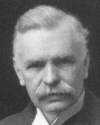
Died 15 Jul 1936 at age 77 (born 31 Jul 1858). quotes
Irish geologist and seismologist who discovered evidence for the existence of the Earth's liquid core (1906). In studying seismograms of great 1897 Indian Earthquake he identified P (primary) and S (secondary) waves. It is interesting that he did not get a clue to the presence of the core from the S waves, which are actually incapable of being transmitted through the liquid of the outer core. (The liquid core does not transmit the shear wave energy released during an earthquake.) Rather he noted the existence of a shadow zone in which P waves from an earthquake in the opposite hemisphere of the earth failed to appear.
Irish geologist and seismologist who discovered evidence for the existence of the Earth's liquid core (1906). In studying seismograms of great 1897 Indian Earthquake he identified P (primary) and S (secondary) waves. It is interesting that he did not get a clue to the presence of the core from the S waves, which are actually incapable of being transmitted through the liquid of the outer core. (The liquid core does not transmit the shear wave energy released during an earthquake.) Rather he noted the existence of a shadow zone in which P waves from an earthquake in the opposite hemisphere of the earth failed to appear.
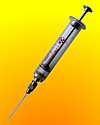
Died 15 Jul 1930 at age 54 (born 3 Aug 1875). quotes
American physician who championed the use of scopolamine hydrobromide in criminology, which became known as a “truth serum.” Based on research into its use as a general birth anaesthetic by J. Christian Gauss, House interpreted from the results that a patient in the twilight state was unable to tell a lie. From 1924, House convinced Texas criminologists, to use the drug to “assist” in determination of guilt or innocence of a suspect. Later, it was found by legal challenges and CIA research in the 1950s that House's confidence was misplaced; its value was very much exaggerated. Any “truth” confessed under the drug's influence was distorted by the drug's halucinogenic side effects. Such use was ended. (Scopolamine is still used in minute doses to control motion sickness, and as a veterinary preanesthetic medication.« more
American physician who championed the use of scopolamine hydrobromide in criminology, which became known as a “truth serum.” Based on research into its use as a general birth anaesthetic by J. Christian Gauss, House interpreted from the results that a patient in the twilight state was unable to tell a lie. From 1924, House convinced Texas criminologists, to use the drug to “assist” in determination of guilt or innocence of a suspect. Later, it was found by legal challenges and CIA research in the 1950s that House's confidence was misplaced; its value was very much exaggerated. Any “truth” confessed under the drug's influence was distorted by the drug's halucinogenic side effects. Such use was ended. (Scopolamine is still used in minute doses to control motion sickness, and as a veterinary preanesthetic medication.« more
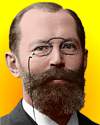
Died 15 Jul 1919 at age 66 (born 9 Oct 1852). quotes
Hermann Emil Louis Fischer was a German chemist, awarded the 1902 Nobel Prize in Chemistry, transformed organic and biological chemistry through his studies of purines, sugars, and proteins. He identified the structures of uric acid, xanthine, caffeine, and theobromine, proving they are derivatives of a single compound he named purine. His research on carbohydrates established the stereochemical relationships among sugars like glucose and fructose, and he introduced the Fischer projection still used today. Fischer also synthesized short peptide chains, laying the groundwork for protein and enzyme chemistry. During World War I, he organized chemical production in Germany. He died by suicide after the death of his two sons.«
Hermann Emil Louis Fischer was a German chemist, awarded the 1902 Nobel Prize in Chemistry, transformed organic and biological chemistry through his studies of purines, sugars, and proteins. He identified the structures of uric acid, xanthine, caffeine, and theobromine, proving they are derivatives of a single compound he named purine. His research on carbohydrates established the stereochemical relationships among sugars like glucose and fructose, and he introduced the Fischer projection still used today. Fischer also synthesized short peptide chains, laying the groundwork for protein and enzyme chemistry. During World War I, he organized chemical production in Germany. He died by suicide after the death of his two sons.«
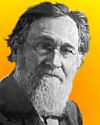
Elie Metchnikoff (a.k.a. Ilya Ilych Mechnikov) was a Russian-French biologist and immunologist who shared, the 1908 Nobel Prize for Physiology or Medicine with Paul Ehrlich “in recognition of their work on immunity.” Metchnikoff's research was on phagocytosis, a fundamental process in immunology whereby macrophages and other specialized cells engulf and digest bacteria and other foreign particles. In 1882, leaving his university teaching career, he set up a private laboratory at Messina to better pursue his interest in microbes and the immune system. He discovered phagocytosis by experiments on the larvae of starfish. His theory that certain white blood cells could engulf and destroy harmful bacteria was at first disbelieved, then slowly accepted by other scientists.«[(also spelled Ilich). DSB and a NYT obituary give the date of death as 15 Jul 1916. EB gives 16 Jul 1916.]
The Life of Elie Metchnikoff, by Olga Metchnikoff. - book suggestion.
Died 15 Jul 1897 at age 56 (born 4 Jul 1841). quotes
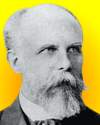
English physiologist who was born in England, but spent most of his adult life in Germany. He spent several of his early career years working in the laboratory of Claude Bernard, and by age 28 was a professor of physiology at Jena, Germany. He published research on hemoglobin, gaseous aspects of blood, muscle physiology, color vision and the lower limit of hearing. The Preyer reflex is the response he described of the pinna to sound in certain mammals. Widening his interests, he wrote on sleep and hypnotism. His later books translated from German include Mental Development in the Child (1893), followed by On the Psychology of Writing (1895) and Darwin: His Life and Works (1896), in the year before he died at 56.«[birth name William Terry Preyer]
English physiologist who was born in England, but spent most of his adult life in Germany. He spent several of his early career years working in the laboratory of Claude Bernard, and by age 28 was a professor of physiology at Jena, Germany. He published research on hemoglobin, gaseous aspects of blood, muscle physiology, color vision and the lower limit of hearing. The Preyer reflex is the response he described of the pinna to sound in certain mammals. Widening his interests, he wrote on sleep and hypnotism. His later books translated from German include Mental Development in the Child (1893), followed by On the Psychology of Writing (1895) and Darwin: His Life and Works (1896), in the year before he died at 56.«[birth name William Terry Preyer]
Died 15 Jul 1868 at age 48 (born 9 Aug 1819).
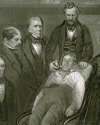
William T(homas) G(reen) Morton was an American surgeon who was the first dentist to use ether (letheon) during an tooth extraction, privately on on 30 Sep 1846. He followed this by a public demonstration of this method of anesthesia on16 Oct 1846 during an operation performed by Dr. John Collins Warren (1778-1856) at the Massachusetts General Hospital in Boston. The patient, Gilbert Abbott, age 20, had a small superficial tumor removed from beneath the left lower jaw. The suggestion to use ether came from the chemist Charles T. Jackson, (1860-1913). After the success of the public demonstration, the use of ether for painless operations spread quickly to other countries.
William T(homas) G(reen) Morton was an American surgeon who was the first dentist to use ether (letheon) during an tooth extraction, privately on on 30 Sep 1846. He followed this by a public demonstration of this method of anesthesia on16 Oct 1846 during an operation performed by Dr. John Collins Warren (1778-1856) at the Massachusetts General Hospital in Boston. The patient, Gilbert Abbott, age 20, had a small superficial tumor removed from beneath the left lower jaw. The suggestion to use ether came from the chemist Charles T. Jackson, (1860-1913). After the success of the public demonstration, the use of ether for painless operations spread quickly to other countries.

Died 15 Jul 1751 (born 1696). quotes
English botanist who was the first writer that attempted a systematic arrangement of English indigenous plants in the English language, which he published in Synopsis of British Plants (1744). Wilson was self-taught in botany, and built on the method of Ray, which he had to read in Latin. Wilson preferred to write plainly, in English, recording his finds made on frequent trips into the local countryside. His systematic studies did much to bring some order and place the science on the broad scientific basis. He died at age 55, before finishing a second volume intended to contain the fungi, mosses, grasses, and trees. Wilson remains little known because his book was eclipsed by the writings of Linnæus that became popular shortly after his death*.[Image: view of Longsleddale countryside.] more
English botanist who was the first writer that attempted a systematic arrangement of English indigenous plants in the English language, which he published in Synopsis of British Plants (1744). Wilson was self-taught in botany, and built on the method of Ray, which he had to read in Latin. Wilson preferred to write plainly, in English, recording his finds made on frequent trips into the local countryside. His systematic studies did much to bring some order and place the science on the broad scientific basis. He died at age 55, before finishing a second volume intended to contain the fungi, mosses, grasses, and trees. Wilson remains little known because his book was eclipsed by the writings of Linnæus that became popular shortly after his death*.[Image: view of Longsleddale countryside.] more
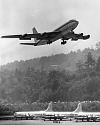
In 1954, the first commercial jet transport airplane built in US - the Boeing 707 prototype - the model 367-80, made its maiden flight from Renton Field, south of Seattle, Washington. From its model number, it was nicknamed the Dash 80. The flight marked the 38th anniversary of the Boeing Company. The project was announced on 30 Aug 1952. Within two years, the company's $16 million investment produced the airplane rolled out for display on 14 May 1954. The 707 series of jetliners, being larger and faster soon replaced propeller airplanes for international travel. On 26 Oct 1958, Pan American World Airways began trans-Atlantic 707 jet service between New York and Paris.«
Boeing 707: Pioneer Jetliner, by Rene J. Francillon. - book suggestion.
In 1941, development work began on the mold cultures Howard Florey and Norman Heatley had brought with them from England to the Northern Regional Research Lab of the U.S. Dept of Agriculture in Peoria, Illinois. They wanted to produce sufficient quantities for treatment of the many wartime military casualties. The potency of the sample provided was preserved by a freeze-drying process devised by Ernst Chain. Heatley remained to get the mold culture started, while Florey left on 17 Jul to enlist drug companies. In the original process, mold was grown only on the surface of the medium in shallow pans. Instead, deep culture fermentation (similar to beer brewing) would be developed using tanks of corn steep liquor to provide a large volume for submerged growth. This greatly multiplied the yield.«
The Mold in Dr. Florey's Coat: The Story of the Penicillin Miracle, by Eric Lax. - book suggestion.
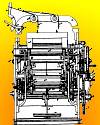
(USPTO)
In 1879, a patent for the first American "dobby" loom (U.S. No. 217,589) was issued to Horace Wyman and George Crompton of Worcester, Mass. This was a type of loom on which small, geometric figures can be woven in as a regular pattern as exemplified in Turkish towelling. The harness frames are elevated by hooked jacks and depressed by springs. Originally this type of loom needed a dobby boy who sat on the top of the loom and drew up warp threads to term a pattern. Wyman was an American inventor who in his life held 260 patents related to textile machinery. He assigned the patent to George Crompton.
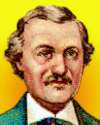
In 1869, margarine was patented by Hippolyte Mège Mouriés in France (No. 86489). He won the contest held by Emperor Napoleon III to find a substitute for butter used by the French Navy. HisH formula included a fatty component that mixed to a pearly luster, so he named his product after the Greek word for pearl - margaritari. His margarine was manufactured from tallow. Although the prize winner, it was not until F. Boudet patented a process for emulsifying it with skimmed milk and water (1872) that magarine was made sufficiently palatable to be a commercial success. The U.S. dairy industry opposed the introduction of margarine in the U.S. For years, they pressed Congress for many legislative restrictions on its production.«[Image: Mege-Mouriés.]
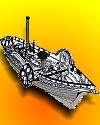
In 1783, the first successful steamboat, the Pyroscaphe, made a trial run on the River Saône in France. It was invented by a Frenchman, the Marquee Claude de Jouffroy d'Abbans. His earlier steam-powered boat tested in 1778 on the river Doubs used a Newcomen steam engine driving a hinged flap he modelled after the webbed feet of an aquatic bird, which was unsuccessful. He then built on ideas from James Watt's inventions to design a parallel-motion double-acting steam engine to drive a pair of large paddle wheels on the Pyroscaphe. Several thousand people viewed its trial, a 15 minute journey upstream on the River Saône. (Montgolfier's first balloon demonstration took place a few weeks earlier on 4 Jun 1783.)«
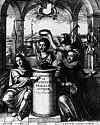
In 1662, the Royal Society, London, received its Royal Charter, which was passed by the Great Seal, from King Charles II. It was a successor to the Society for the Promoting of Physico-Mathematical Experimental Learning, constituted to promote experimental philosophy, formed at a meeting of a dozen scientists on 28 Nov 1660 in Gresham College, London. The Society subsequently petitioned the King to recognise it and to make a royal grant of incorporation. Gresham College is named after Sir Thomas Gresham (son of Sir Richard Gresham, Lord Mayor 1537/38) who conceived the idea of building an Exchange modelled on the Antwerp Bourse.«[Image: Frontispiece from Sprat 's History of the Royal Society (1667). President of the Royal Society, Lord Brouncker (left); bust of the King; Francis Bacon (right).]





