
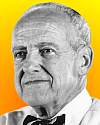
Born 24 Oct 1932; died 18 May 2007 at age 74.
French physicist who was awarded the 1991 Nobel Prize for Physics for "discovering that methods developed for studying order phenomena in simple systems can be generalized to more complex forms of matter, in particular to liquid crystals and polymers." He described mathematically how, for example, magnetic dipoles, long molecules or molecule chains can under certain conditions form ordered states, and what happens when they pass from an ordered to a disordered state. Such changes of order occur when, for example, a heated magnet changes from a state in which all the small atomic magnets are lined up in parallel to a disordered state in which the magnets are randomly oriented. Recently, he has been concerned with the physical chemistry of adhesion.
French physicist who was awarded the 1991 Nobel Prize for Physics for "discovering that methods developed for studying order phenomena in simple systems can be generalized to more complex forms of matter, in particular to liquid crystals and polymers." He described mathematically how, for example, magnetic dipoles, long molecules or molecule chains can under certain conditions form ordered states, and what happens when they pass from an ordered to a disordered state. Such changes of order occur when, for example, a heated magnet changes from a state in which all the small atomic magnets are lined up in parallel to a disordered state in which the magnets are randomly oriented. Recently, he has been concerned with the physical chemistry of adhesion.

PET bottles
Nathaniel Convers Wyeth was an American chemist and inventor who created the PET plastic beverage bottle. His patent was asssigned to Du Pont for the “Biaxially Oriented Poly(Ethylene Terephthalate) Bottle” and described these bottles as “useful in bottling liquids under pressure such as ... carbonated beverages” which had “excellent strength properties, are impact resistant, and are capable of holding liquids under pressures as high as about 100 p.s.i.g.” (U.S. No. 3,733,309, issued 15 May 1973). It was the first plastic suitable to hold carbonated beverages that was safe enough to satisfy the food safety requirements. His other career contributions include development of polymer processing equipment, synthetic textile fibres, and other plastic products. Andrew Wyeth, distinguished American painter, was his brother.
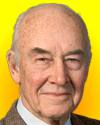
Born 24 Oct 1908; died 15 Apr 1993 at age 84. quotes
John Tuzo Wilson was a Canadian geologist and geophysicist who determined the underlying structure of faults, continents across the globe. From the early 1960s, Wilson revolutionized the emerging field of plate tectonics. He coined the word “plate” for the rigid subdivisions of the Earth's crust of both land and ocean beds. By 1963, he identified some of the earliest evidence supporting the sea-floor spreading hypothesis of Harry H. Hess. Wilson showed the relationship that islands were older for those further away from mid-ocean ridge. One of his important new ideas (1965) was for transform faults, where plate boundaries meet in a series of of offsets, and the plates slide alongside past each other without any creation or destruction of the crust. It is a conservative plate boundary beecause neither plate slides under the other.«
John Tuzo Wilson was a Canadian geologist and geophysicist who determined the underlying structure of faults, continents across the globe. From the early 1960s, Wilson revolutionized the emerging field of plate tectonics. He coined the word “plate” for the rigid subdivisions of the Earth's crust of both land and ocean beds. By 1963, he identified some of the earliest evidence supporting the sea-floor spreading hypothesis of Harry H. Hess. Wilson showed the relationship that islands were older for those further away from mid-ocean ridge. One of his important new ideas (1965) was for transform faults, where plate boundaries meet in a series of of offsets, and the plates slide alongside past each other without any creation or destruction of the crust. It is a conservative plate boundary beecause neither plate slides under the other.«
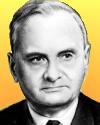
Born 24 Oct 1906; died 7 Nov 1968 at age 62.
Russian mathematician who originated basic techniques in the study of transcendental numbers (numbers that cannot be expressed as the root or solution of an algebraic equation with rational coefficients). He profoundly advanced transcendental-number theory, and the theory of interpolation and approximation of complex-variable functions. He established the transcendental character of any number of the form ab, where a is an algebraic number different from 0 or 1 and b is any irrational algebraic number, which is now known as Gelfond's theorem. This statement solved the seventh of 23 famous problems that had been posed by the German mathematician David Hilbert in 1900.
Russian mathematician who originated basic techniques in the study of transcendental numbers (numbers that cannot be expressed as the root or solution of an algebraic equation with rational coefficients). He profoundly advanced transcendental-number theory, and the theory of interpolation and approximation of complex-variable functions. He established the transcendental character of any number of the form ab, where a is an algebraic number different from 0 or 1 and b is any irrational algebraic number, which is now known as Gelfond's theorem. This statement solved the seventh of 23 famous problems that had been posed by the German mathematician David Hilbert in 1900.
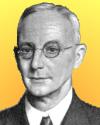
Born 24 Oct 1873; died 24 Mar 1956 at age 82.
English mathematician who made pioneering contributions to the area of the special functions, which is of particular interest in mathematical physics. Whittaker is best known work is in analysis, in particular numerical analysis, but he also worked on celestial mechanics and the history of applied mathematics and physics. He wrote papers on algebraic functions and automorphic functions. His results in partial differential equations (described as most sensational by Watson) included a general solution of the Laplace equation in three dimensions in a particular form and the solution of the wave equation. On the applied side of mathematics he was interested in relativity theory and he also worked on electromagnetic theory.
English mathematician who made pioneering contributions to the area of the special functions, which is of particular interest in mathematical physics. Whittaker is best known work is in analysis, in particular numerical analysis, but he also worked on celestial mechanics and the history of applied mathematics and physics. He wrote papers on algebraic functions and automorphic functions. His results in partial differential equations (described as most sensational by Watson) included a general solution of the Laplace equation in three dimensions in a particular form and the solution of the wave equation. On the applied side of mathematics he was interested in relativity theory and he also worked on electromagnetic theory.
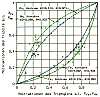
Born 24 Oct 1854; died 8 Feb 1907 at age 52.
Dutch physical chemist who publicized Gibbs's phase rule throughout Europe. Having originally heard about it from Van der Waals, Bakhuis-Roozeboom converted Gibbs theory into practice. Whereas Gibbs had rarely experimented, Bakhuis-Roozeboom made all sorts of measurements that served to prove the validity of the phase rule, and in addition, worked out the details of its application to many individual cases. The modern chemistry of alloys benefits greatly from his amplification of the understanding of the phase rule*. In 1899, he and Albert Ladenburg demonstrated, independently of each other, when an inactive separable substance will be a racemic compound or mixture of the inactive compounds.[Image: a Roozeboom diagram]
Dutch physical chemist who publicized Gibbs's phase rule throughout Europe. Having originally heard about it from Van der Waals, Bakhuis-Roozeboom converted Gibbs theory into practice. Whereas Gibbs had rarely experimented, Bakhuis-Roozeboom made all sorts of measurements that served to prove the validity of the phase rule, and in addition, worked out the details of its application to many individual cases. The modern chemistry of alloys benefits greatly from his amplification of the understanding of the phase rule*. In 1899, he and Albert Ladenburg demonstrated, independently of each other, when an inactive separable substance will be a racemic compound or mixture of the inactive compounds.[Image: a Roozeboom diagram]
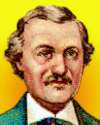
Born 24 Oct 1817; died 31 May 1880 at age 62.
French inventor of margerine who began his science career at age 16 as a chemist's assistant. By the 1840s he had improved the syphilis drug, Copahin. He recieved various patents, including tanning, effervescent tablets, paper paste and sugar extraction. By the 1850s he had turned to food research and developed a health chocolate with his calcium phosphate protein. He also developed a method that gained 14% more white bread from a given quantity of wheat, for which he was awarded two gold medals. After 1862, he concentrated his research on fats. His margerine process was based on the cold saponifiation of milk in fat emulsions (French patent No. 86489, 15 Jul 1869). Another patent he held was for canned meat (1875)*.
French inventor of margerine who began his science career at age 16 as a chemist's assistant. By the 1840s he had improved the syphilis drug, Copahin. He recieved various patents, including tanning, effervescent tablets, paper paste and sugar extraction. By the 1850s he had turned to food research and developed a health chocolate with his calcium phosphate protein. He also developed a method that gained 14% more white bread from a given quantity of wheat, for which he was awarded two gold medals. After 1862, he concentrated his research on fats. His margerine process was based on the cold saponifiation of milk in fat emulsions (French patent No. 86489, 15 Jul 1869). Another patent he held was for canned meat (1875)*.
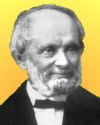
Born 24 Oct 1804; died 23 Jun 1891 at age 86. quotes
German physicist who investigated terrestrial magnetism. For six years, from 1831, Weber worked in close collaboration with Carl Gauss. Weber developed sensitive magnetometers, an electromagnetic telegraph (1833) and other magnetic instruments during this time. His later work (1855) on the ratio between the electrodynamic and electrostatic units of charge proved extremely important and was crucial to James Clerk Maxwell in his electromagnetic theory of light. (Weber found the ratio was 3.1074 x 10⁸ m/sec but failed to take any notice of the fact that this was close to the speed of light.) Weber's later years were devoted to work in electrodynamics and the electrical structure of matter. The magnetic unit, weber, is named after him.
German physicist who investigated terrestrial magnetism. For six years, from 1831, Weber worked in close collaboration with Carl Gauss. Weber developed sensitive magnetometers, an electromagnetic telegraph (1833) and other magnetic instruments during this time. His later work (1855) on the ratio between the electrodynamic and electrostatic units of charge proved extremely important and was crucial to James Clerk Maxwell in his electromagnetic theory of light. (Weber found the ratio was 3.1074 x 10⁸ m/sec but failed to take any notice of the fact that this was close to the speed of light.) Weber's later years were devoted to work in electrodynamics and the electrical structure of matter. The magnetic unit, weber, is named after him.
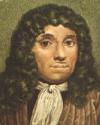
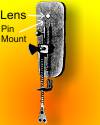
Microscope
Dutch biologist and microscopist who by skilled use of microscopy first discovered bacteria, protists, sperm cells, blood cells and various structures in animal and plant tissues. Published translations of his letters to the Royal Society were widely read. Researching microorganisms was a new frontier for science, that refuted the doctrine of spontaneous generation. Leeuwenhoek has been called the “Father of Microbiology.” Microscopes had been invented before he was born, but the lenses he ground were significantly better for detailed examination of microscopic life. He may have been inspired by illustrations in Robert Hooke’s book, Micrographia. Fewer than 10 of his 500 microscopes have survived.« more
Antonie Van Leeuwenhoek and His “Little Animals”, by Antonie Van Leeuwenhoek. - book suggestion.

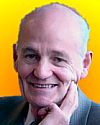
Died 24 Oct 2003 at age 70 (born 10 Dec 1932).
(Robert Murray) Ross Taylor was a Scottish transplant surgeon who pioneered the technique of kidney transplantation in the U.K. and made more than 2,000 kidney transplants since 1967 when he was part of the team that completed the first kidney transplant to be undertaken in the north of England. Acknowledged worldwide as an expert in his field, he trained many of the leading practitioners. At the time of his death, five of the principal transplant centres in Britain were led by surgeons he had mentored. Taylor was active not only in the ethical and moral aspects, but also in fundraising and developing support for transplant recipients. For 15 years he was chairman of the annual Transplant Games, 3-day sports competition for transplant recipients.
(Robert Murray) Ross Taylor was a Scottish transplant surgeon who pioneered the technique of kidney transplantation in the U.K. and made more than 2,000 kidney transplants since 1967 when he was part of the team that completed the first kidney transplant to be undertaken in the north of England. Acknowledged worldwide as an expert in his field, he trained many of the leading practitioners. At the time of his death, five of the principal transplant centres in Britain were led by surgeons he had mentored. Taylor was active not only in the ethical and moral aspects, but also in fundraising and developing support for transplant recipients. For 15 years he was chairman of the annual Transplant Games, 3-day sports competition for transplant recipients.
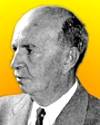
Died 24 Oct 1963 at age 84 (born 27 May 1879).
German psychiatrist and psychologist who was known chiefly for his studies of the thought process. While a professor at the University of Vienna (1922-38), his views were influenced by the thinking of Trubetzkoy and other members of the Prague School. His Sprachtheorie (1934) presented a sign theory with particular emphasis on the functions of language, and a distinction between two "fields" which form the context in which a sign is used. The "symbolic field" (Symbolfeld) is formed by the other signs that make up an utterance; the "deictic field" (Zeigfeld) is formed by the context in which it is uttered and is the origin of modern conceptions of deixis. Bühler emigrated to the USA in 1939, practising as a clinical psychologist from 1945.
German psychiatrist and psychologist who was known chiefly for his studies of the thought process. While a professor at the University of Vienna (1922-38), his views were influenced by the thinking of Trubetzkoy and other members of the Prague School. His Sprachtheorie (1934) presented a sign theory with particular emphasis on the functions of language, and a distinction between two "fields" which form the context in which a sign is used. The "symbolic field" (Symbolfeld) is formed by the other signs that make up an utterance; the "deictic field" (Zeigfeld) is formed by the context in which it is uttered and is the origin of modern conceptions of deixis. Bühler emigrated to the USA in 1939, practising as a clinical psychologist from 1945.
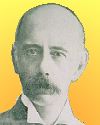
Died 24 Oct 1956 at age 100 (born 10 Dec 1855).
English botanist who was largely responsible for establishing the rubber industry in the Malay Peninsula. At the turn of century (1888-1912), as the first Director of the Singapore Botanic Gardens Ridley conducted experiments with Para rubber trees (Hevea brasiliensis) that convinced him of the enormous economic potential of rubber as a plantation crop. After developing a more efficient tapping method, he began a campaign to establish a rubber industry. Despite considerable initial opposition among planters, he persisted, and by 1896 Malaya's planters were convinced, and the first rubber estates were planted using his seeds. Ridley also carried out an extensive study of plants of the Malay Peninsula, especially monocotyledons.
English botanist who was largely responsible for establishing the rubber industry in the Malay Peninsula. At the turn of century (1888-1912), as the first Director of the Singapore Botanic Gardens Ridley conducted experiments with Para rubber trees (Hevea brasiliensis) that convinced him of the enormous economic potential of rubber as a plantation crop. After developing a more efficient tapping method, he began a campaign to establish a rubber industry. Despite considerable initial opposition among planters, he persisted, and by 1896 Malaya's planters were convinced, and the first rubber estates were planted using his seeds. Ridley also carried out an extensive study of plants of the Malay Peninsula, especially monocotyledons.
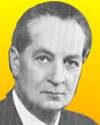
Died 24 Oct 1955 at age 74 (born 17 Jan 1881). quotes
Alfred Reginald Radcliffe-Brown was an English social anthropologist of the 20th century, who developed a systematic framework of concepts and generalizations relating to the social structures of relatively simple societies. Radcliffe-Brown did much of his early work among traditional people. His first trip to Australia was in 1910; he joined Grant-Watson and D. Bates on an expedition to study Aboriginal tribes. He believed scientific methods should be applied to the study of a society and its common values, this is also known as “collective consciousness.” He also contributed to the study of kinship. (Kinship is a relationship between persons by blood or marriage.) His functional analysis advanced social anthropology as a science.
Alfred Reginald Radcliffe-Brown was an English social anthropologist of the 20th century, who developed a systematic framework of concepts and generalizations relating to the social structures of relatively simple societies. Radcliffe-Brown did much of his early work among traditional people. His first trip to Australia was in 1910; he joined Grant-Watson and D. Bates on an expedition to study Aboriginal tribes. He believed scientific methods should be applied to the study of a society and its common values, this is also known as “collective consciousness.” He also contributed to the study of kinship. (Kinship is a relationship between persons by blood or marriage.) His functional analysis advanced social anthropology as a science.
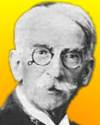
Died 24 Oct 1940 at age 75 (born 25 Mar 1865).
French physicist who investigated magnetism and determined the Weiss magneton unit of magnetic moment. Weiss's chief work was on ferromagnetism. Hypothesizing a molecular magnetic field acting on individual atomic magnetic moments, he was able to construct mathematical descriptions of ferromagnetic behaviour, including an explanation of such magnetocaloric phenomena as the Curie point. His theory succeeded also in predicting a discontinuity in the specific heat of a ferromagnetic substance at the Curie point and suggested that spontaneous magnetization could occur in such materials; the latter phenomenon was later found to occur in very small regions known as Weiss domains. His major published work was Le magnetisme ( 1926).
French physicist who investigated magnetism and determined the Weiss magneton unit of magnetic moment. Weiss's chief work was on ferromagnetism. Hypothesizing a molecular magnetic field acting on individual atomic magnetic moments, he was able to construct mathematical descriptions of ferromagnetic behaviour, including an explanation of such magnetocaloric phenomena as the Curie point. His theory succeeded also in predicting a discontinuity in the specific heat of a ferromagnetic substance at the Curie point and suggested that spontaneous magnetization could occur in such materials; the latter phenomenon was later found to occur in very small regions known as Weiss domains. His major published work was Le magnetisme ( 1926).
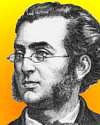
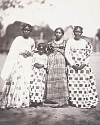
French explorer and archaeologist who pioneered the use of photography to document his expeditions, especially of Pre-Columbian sites in Mexico and Central America. Using the newly invented wet collodion process, he expertly produced many large plates, certainly a remarkable accomplishment in difficult field conditions. He thus created a photographic scientific record of various cultures around the world. With Le Plongeon, Charnay was among the first to publish photographs of Mesoamerican sites. He made early plaster molds of Maya sculptures. In Mexico, much of his work was concentrated in the archeological sites of Chichén-Itza, Uxmal, Palenque and Mitla. He also travelled as far as Australia, Oceania, and Madagascar.«[Image right: Madagascar Women, 1863, from wet collodion-on-glass]
Died 24 Oct 1870 at age 89 (born 27 Mar 1781).
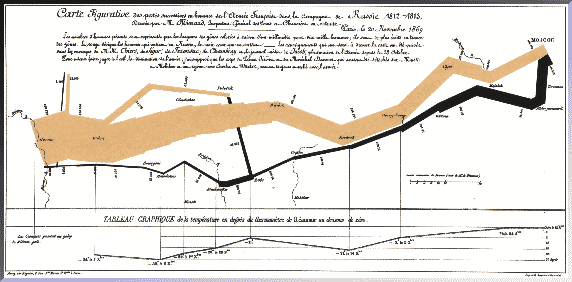
French civil engineer who made significant contributions to the graphical representations of data. His best-known work, Carte figurative des pertes successives en hommes de l'Armee Français dans la campagne de Russe 1812-1813, dramatically displays the number of Napoleon's soldiers by the width of an ever-reducing band drawn across a map from France to Moscow. At its origin, a wide band shows 442,000 soldiers left France, narrowing across several hundred miles to 100,000 men reaching Moscow. With a parallel temperature graph displaying deadly frigid Russian winter temperatures along the way, the band shrinks during the retreat to a pathetic thin trickle of 10,000 survivors returning to their homeland.«
French civil engineer who made significant contributions to the graphical representations of data. His best-known work, Carte figurative des pertes successives en hommes de l'Armee Français dans la campagne de Russe 1812-1813, dramatically displays the number of Napoleon's soldiers by the width of an ever-reducing band drawn across a map from France to Moscow. At its origin, a wide band shows 442,000 soldiers left France, narrowing across several hundred miles to 100,000 men reaching Moscow. With a parallel temperature graph displaying deadly frigid Russian winter temperatures along the way, the band shrinks during the retreat to a pathetic thin trickle of 10,000 survivors returning to their homeland.«
c. 1830s
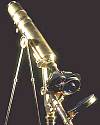
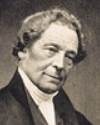
English optician, wine merchant and microscopist who, as an amateur, carried out research into the nature of red corpuscles in mammalian blood. In 1826, he designed possibly the most important optical microscope ever made. It used an achromatic objective lens corrected for chromatic and spherical aberrations, the resulting image was at the time the clearest produced by any microscope. In 1834, for instance, he succeeded in seeing the true biconcave form of red blood corpuscles for the first time. He was a founder member of the Microscopical Society. In 1832, Lister became a fellow of the Royal Society. His son, Sir Joseph Lister (1827-1912) is remembered for pioneering the use of antiseptics, improving the survival rates from surgery.
Died 24 Oct 1667 at age 87 (born 6 Jun 1580).
Flemish astronomer and clergyman who was known as the Ptolemy of his time. Despite going against the tenets of his Church, he was an audacious proponent of the Copernican theory that the planets orbit around the sun. He made more accurate measurements of the distance to the sun as previously made by Aristachus (2,000 years earlier) from the geometrical relationships at the exact time of a half-moon. His result was a third smaller than now accepted, but still indicated the order of magnitude. From his studies the motion of a pendulum, he observed that as amplitude is increased, there is some increase the period of the swings. He noted a temperature effect on the period of a pendulum: more oscillations in winter than in summer. Wendelin is regarded as first to formulate a law for the variation of the obliquity of the ecliptic. Newton cited him in his Principia.«[Latinized name: Vendelinus. First name variations: Godefroid or Gottfried.]
Flemish astronomer and clergyman who was known as the Ptolemy of his time. Despite going against the tenets of his Church, he was an audacious proponent of the Copernican theory that the planets orbit around the sun. He made more accurate measurements of the distance to the sun as previously made by Aristachus (2,000 years earlier) from the geometrical relationships at the exact time of a half-moon. His result was a third smaller than now accepted, but still indicated the order of magnitude. From his studies the motion of a pendulum, he observed that as amplitude is increased, there is some increase the period of the swings. He noted a temperature effect on the period of a pendulum: more oscillations in winter than in summer. Wendelin is regarded as first to formulate a law for the variation of the obliquity of the ecliptic. Newton cited him in his Principia.«[Latinized name: Vendelinus. First name variations: Godefroid or Gottfried.]
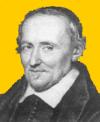
Died 24 Oct 1655 at age 63 (born 22 Jan 1592). quotes
French mathematician and philosopher who revived Epicureanism as a substitute for Aristotelianism, attempting in the process to reconcile Atomism's mechanistic explanation of nature with Christian belief in immortality, free will, an infinite God, and creation. Johannes Kepler had predicted a transit of Mercury would occur in 1631. Gassendi used a Galilean telescope to observed the transit, by projecting the sun's image on a screen of paper. He wrote on astronomy, his own astronomical observations and on falling bodies.
French mathematician and philosopher who revived Epicureanism as a substitute for Aristotelianism, attempting in the process to reconcile Atomism's mechanistic explanation of nature with Christian belief in immortality, free will, an infinite God, and creation. Johannes Kepler had predicted a transit of Mercury would occur in 1631. Gassendi used a Galilean telescope to observed the transit, by projecting the sun's image on a screen of paper. He wrote on astronomy, his own astronomical observations and on falling bodies.
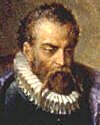
Died 24 Oct 1601 at age 54 (born 14 Dec 1546). quotes
Danish astronomer whose work in developing astronomical instruments and in measuring and fixing the positions of stars paved the way for future discoveries. He studied the nova of 1572 (“Tycho's star”) showed that it was a fixed star. His report, De nova...stella (1573), was taken by many as proof of the inadequacy of the traditional Aristotelian cosmology. In 1577, he moved to his own observatory on Hven Island (financed by King Frederick II). Before the invention of the telescope, using his nine-foot armillary sphere and his fourteen-foot mural quadrant, he charted the positions of 777 stars with an unparallelled accuracy. In 1599 he moved to Prague, with Johannes Kepler as his assistant.
Danish astronomer whose work in developing astronomical instruments and in measuring and fixing the positions of stars paved the way for future discoveries. He studied the nova of 1572 (“Tycho's star”) showed that it was a fixed star. His report, De nova...stella (1573), was taken by many as proof of the inadequacy of the traditional Aristotelian cosmology. In 1577, he moved to his own observatory on Hven Island (financed by King Frederick II). Before the invention of the telescope, using his nine-foot armillary sphere and his fourteen-foot mural quadrant, he charted the positions of 777 stars with an unparallelled accuracy. In 1599 he moved to Prague, with Johannes Kepler as his assistant.
Tycho & Kepler, by Kitty Ferguson. - book suggestion.
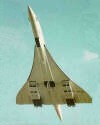
In 2003, the final scheduled flights of the British Airways Concorde brought an end to the era of supersonic passenger service that began on 21 Jan 1976. The Air France Concorde service had ended on 31 May 1976. The two airlines had previously made simultaneous announcements on 10 Apr 2003 that the SSTs were to be retired. Rising fuel and maintenance costs (in the shadow of a fatal crash of a French Concorde in 2000) at a time of declining passenger traffic and revenue had made the decision unavoidable.«
The Concorde Story: 21 Years in Service, by Christopher Orlebar. - book suggestion.
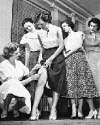
In 1939, nylon stockings went on sale in the U.S. for the first time to employees at DuPont's Wilmington, Delaware nylon factory. The modern materials revolution began in 1938 with DuPont's commercialization of their nylon product, which was the first man-made fibre to be made exclusively from mineral sources. The company specifically intended to compete with silk in the women's hosiery market. The fibre was strong, elastic, moth-proof and did not absorb moisture. Years of research led to enormous success. “Nylons,” as they were soon called, eventually replaced silk stockings. Covering only about two-thirds of a woman's leg, from the feet to mid-thigh, stockings were fastened with garters and a belt. Nationwide sales began on 15 May 1940.
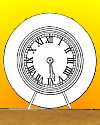
In 1876, a U.S. patent was issued for the metal case of a one-day back-winding alarm clock to the Seth E. Thomas of New York City, NY (No. 183,725), being the first American patent for an alarm clock of this familiar type. It was manufactured from that that year by the Seth Thomas Clock Company of Thomaston, Connecticut. Seth was born in 1816 and died in 1888 in Conneticut. His father Seth Thomas was also a clock maker in Plymouth Hollow, Connecticut, which was renamed Thomaston in his honor in about 1860. (The first alarm clock made in the U.S. appeared in Concord, NH, in 1787. That clock was made by Levi Hutchins with a pine case, 29-in high and 14-in wide, but the alarm was for a preset time that could not be altered.)
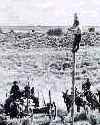
In 1861, the first transcontinental telegraph message was sent by Justice Stephen J. Field of California to President Abraham Lincoln, on the same day the first transcontinental telegraph system was completed. The section, built during 1861 by the Western Union Telegraph Co. and its associates, connected St. Joseph, Missouri and Sacramento, California. The Civil War had made obtaining labor and supplies difficult. Nature's obstacles had included the Rocky Mountains, the Sierra Nevada, and the Great Plains where timber for telephone poles was in short supply. Now it had become possible to transmit messages so rapidly from coast to coast, the Pony Express, previously the fastest communication between the East and the West, closed two days later.
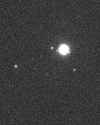
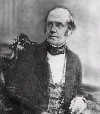
Lassell

In 1836, Alonzo Dwight Phillips of Springfield, Massachusetts, received the first U.S. patent for the phosphorous friction safety match (No. 68). The first friction matches, using a mixture of chemicals for their heads, were made and sold in England in 1827. Phillips' match, which could be struck on any rough surface, was the first genuine friction match made in America. Known as “loco focos,” and later as “lucifers,” these matches were made entirely by hand from a mixture of chalk, phosphorus, glue and brimstone (sulphur). The introduction of gas for lighting and cooking, and the spread of cigar smoking, made the lucifer almost a necessity. By the time of the Civil War, about a million matches a day were being manufactured.
more





