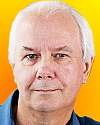
Born 24 Sep 1945. quotes
English mathematician and author of many books on mathematics for the lay reader, and others for academics or as textbooks. As a young teenager with a zeal for mathematics, he always read the “Mathematical Games” column in Scientific American. From this he not only expanded his knowledge of mathematics, but also acquired the skills needed to be an entertaining communicator. Now, he writes the “Mathematical Recreations” column in Scientific American. In his career at the University of Warwick, he is a professor of mathematics with special responsibility for public understanding of science. He gave the 1997 Royal Institute Christmas Lectures. On 8 Jun 2009, he was presented with the award at the Science Museum in London as the first recipient of the Christopher Zeeman medal for public engagement in mathematics.«
English mathematician and author of many books on mathematics for the lay reader, and others for academics or as textbooks. As a young teenager with a zeal for mathematics, he always read the “Mathematical Games” column in Scientific American. From this he not only expanded his knowledge of mathematics, but also acquired the skills needed to be an entertaining communicator. Now, he writes the “Mathematical Recreations” column in Scientific American. In his career at the University of Warwick, he is a professor of mathematics with special responsibility for public understanding of science. He gave the 1997 Royal Institute Christmas Lectures. On 8 Jun 2009, he was presented with the award at the Science Museum in London as the first recipient of the Christopher Zeeman medal for public engagement in mathematics.«
Professor Stewart's Cabinet of Mathematical Curiosities, by Ian Stewart. - book suggestion.
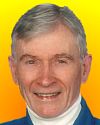
1986
Born 24 Sep 1930; died 5 Jan 2018 at age 87. quotes
John Watts Young was an American astronaut who was the commander of the first ever Space Shuttle mission (STS-1, 12 Apr 1981), walked on the Moon during the Apollo 16 mission (21 Apr 1972), made the first manned flight of the Gemini spacecraft with Virgil Grissom, and was on the aborted Apollo 13 flight. He became the first person to fly into space six times in a career that was one of the busiest of any NASA astronaut. He piloted four different classes of spacecraft: Gemini, Apollo Command and Service Module, Apollo Lunar Module and the Space Shuttle. Young worked for NASA for 42 years and retired on 31 Dec 2004 at the age of 74.«
John Watts Young was an American astronaut who was the commander of the first ever Space Shuttle mission (STS-1, 12 Apr 1981), walked on the Moon during the Apollo 16 mission (21 Apr 1972), made the first manned flight of the Gemini spacecraft with Virgil Grissom, and was on the aborted Apollo 13 flight. He became the first person to fly into space six times in a career that was one of the busiest of any NASA astronaut. He piloted four different classes of spacecraft: Gemini, Apollo Command and Service Module, Apollo Lunar Module and the Space Shuttle. Young worked for NASA for 42 years and retired on 31 Dec 2004 at the age of 74.«
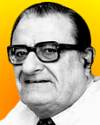
Born 24 Sep 1918; died 10 Oct 1997 at age 79. quotes
Michael James Steuart Dewar was a Scottish organic chemist who was born in India to Scottish parents in the Civil Service there, and attended boarding school in England. His career included both industrial and academic positions in England and the United States. As a theoretician, he was an early master of molecular orbital theory and wrote The Electronic Theory of Organic Chemistry (1949), the first book applying molecular orbital theory to organic chemistry. He experimental work, he studied carbenium ions, boron chemistry, superconductors, liquid crystals. the biosynthesis of fatty acids, and phenyl radicals. He developed sophisticated semi-empirical for quantitative molecular orbital methods on large organic molecules, novel ions, conjugated systems and sigma-bonded arrays He devoted much effort to the study of chemical reactivity.«
Michael James Steuart Dewar was a Scottish organic chemist who was born in India to Scottish parents in the Civil Service there, and attended boarding school in England. His career included both industrial and academic positions in England and the United States. As a theoretician, he was an early master of molecular orbital theory and wrote The Electronic Theory of Organic Chemistry (1949), the first book applying molecular orbital theory to organic chemistry. He experimental work, he studied carbenium ions, boron chemistry, superconductors, liquid crystals. the biosynthesis of fatty acids, and phenyl radicals. He developed sophisticated semi-empirical for quantitative molecular orbital methods on large organic molecules, novel ions, conjugated systems and sigma-bonded arrays He devoted much effort to the study of chemical reactivity.«
Semiempirical Life (autobiography), by Michael J.S. Dewar. - book suggestion.
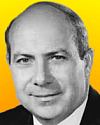
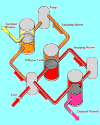
John Ray Dunning was an American nuclear physicist whose experiments in nuclear fission helped lay the groundwork for the development of the atomic bomb. After the fission of the rare U235 uranium isotope was verified in an experiment using a microscopic quantity, (0.02 millionths of a gram), great difficulty remained in separating U235 from the more abundant U238. Dunning led the research team at Columbia University which studied the gaseous diffusion method for uranium separation. This process was based on the slightly smaller size of the U235 isotope molecules. When pushed through a porous barrier, U235 would move through faster, and several repetitions would produce almost pure U235.
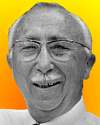
Born 24 Sep 1906; died 28 Oct 1983 at age 77.
Polidore F. F. Swings was a Belgian astrophysicist who made spectroscopic studies to identify elements and structure of stars and comets. He discovered the first interstellar molecule, the CH radical (1937). In comet atmospheres he studied the "Swings bands" - certain carbon emission lines. In 1941, with a slit spectrograph he identified a "Swings effect" in the violet CN bands (3875 A) - a fluorescence partly due to solar radiation that shows emmission line excitation differences dependant on the Doppler shift caused by a comet's motion relative to the Sun. He co-authored an Atlas of Cometary Spectra with Leo Haser in 1956.
Polidore F. F. Swings was a Belgian astrophysicist who made spectroscopic studies to identify elements and structure of stars and comets. He discovered the first interstellar molecule, the CH radical (1937). In comet atmospheres he studied the "Swings bands" - certain carbon emission lines. In 1941, with a slit spectrograph he identified a "Swings effect" in the violet CN bands (3875 A) - a fluorescence partly due to solar radiation that shows emmission line excitation differences dependant on the Doppler shift caused by a comet's motion relative to the Sun. He co-authored an Atlas of Cometary Spectra with Leo Haser in 1956.
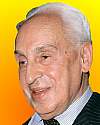
Born 24 Sep 1905; died 1 Nov 1993 at age 88.
Spanish-American biochemist and molecular biologist who shared the 1959 Nobel Prize for Physiology or Medicine with Arthur Kornberg for “for their discovery of the mechanisms in the biological synthesis of ribonucleic acid and deoxyribonucleic acid” Ochoa discovered an enzyme in bacteria that enabled him to synthesize ribonucleic acid (RNA), a substance of central importance to the synthesis of proteins by the cell. Ochoa's enzyme produces ribonucleic acids from ribonucleotides having twice the ratio of phosphoric acid residues as that contained in ribonucleic acid. The RNA is formed by splitting out half of the phosphoric acid residues, and linking the nucleotides together to form large molecules.
Spanish-American biochemist and molecular biologist who shared the 1959 Nobel Prize for Physiology or Medicine with Arthur Kornberg for “for their discovery of the mechanisms in the biological synthesis of ribonucleic acid and deoxyribonucleic acid” Ochoa discovered an enzyme in bacteria that enabled him to synthesize ribonucleic acid (RNA), a substance of central importance to the synthesis of proteins by the cell. Ochoa's enzyme produces ribonucleic acids from ribonucleotides having twice the ratio of phosphoric acid residues as that contained in ribonucleic acid. The RNA is formed by splitting out half of the phosphoric acid residues, and linking the nucleotides together to form large molecules.
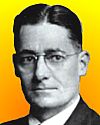
Born 24 Sep 1898; died 21 Feb 1968 at age 69. quotes
Australian pathologist, who, with Ernst Boris Chain, researched, isolated and purified penicillin for general clinical use. From 1939, he worked with Chain on natural antibacterial agents produced by microorganisms, leading to their isolation, purification and determination of the chemical structure of penicillin. They performed the first clinical trials of the antibiotic.They shared the 1945 Nobel Prize for Physiology or Medicine with Sir Alexander Fleming, who had discovered antibiotic penicillin in 1928. Florey was knighted in 1944.
Australian pathologist, who, with Ernst Boris Chain, researched, isolated and purified penicillin for general clinical use. From 1939, he worked with Chain on natural antibacterial agents produced by microorganisms, leading to their isolation, purification and determination of the chemical structure of penicillin. They performed the first clinical trials of the antibiotic.They shared the 1945 Nobel Prize for Physiology or Medicine with Sir Alexander Fleming, who had discovered antibiotic penicillin in 1928. Florey was knighted in 1944.
The Mold in Dr. Florey's Coat: The Story of the Penicillin Miracle, by Eric Lax. - book suggestion.
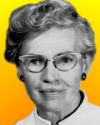
Born 24 Sep 1898; died 3 Mar 1990 at age 91.
American astrophysicist who organized, analyzed, and published definitive books on the solar spectrum and spectral line multiplets. From 1945 to age 90, she conducted this work at the U.S. National Bureau of Standards and the Naval Research Laboratory. She detected that technetium, an unstable element (previously known only as a result of laboratory experiments with nuclear reactions) exists in nature. She made major contributions to the compilation of tables for atomic-energy levels associated with optical spectra, which are now standard reference material. As instruments carried in space rockets provided new data in the ultraviolet, she extended these tables beyond the optical range. She was awarded the Bruce Medal in 1990.«
American astrophysicist who organized, analyzed, and published definitive books on the solar spectrum and spectral line multiplets. From 1945 to age 90, she conducted this work at the U.S. National Bureau of Standards and the Naval Research Laboratory. She detected that technetium, an unstable element (previously known only as a result of laboratory experiments with nuclear reactions) exists in nature. She made major contributions to the compilation of tables for atomic-energy levels associated with optical spectra, which are now standard reference material. As instruments carried in space rockets provided new data in the ultraviolet, she extended these tables beyond the optical range. She was awarded the Bruce Medal in 1990.«
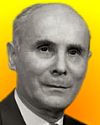
Born 24 Sep 1895; died 19 Feb 1988 at age 92.
André Frederic Cournand was a French-American physiologist and physician who was one of three who shared the 1956 Nobel Prize for Physiology or Medicine “for their discoveries concerning heart catheterization and pathological changes in the circulatory system.” Cournand extended the technique pioneered by Werner Forssmann, by which a flexible tube, known as a catheter, could be threaded through a vein into the heart to withdraw blood samples to determine cardiac abnormalities. In addition, it permits the measurement of blood pressure, blood flow or gas concentrations in various parts of the cardiac circulatory system (atrium, ventricles, or artery). This gives valuable information in the treatment of heart disease, defect or injury.«
André Frederic Cournand was a French-American physiologist and physician who was one of three who shared the 1956 Nobel Prize for Physiology or Medicine “for their discoveries concerning heart catheterization and pathological changes in the circulatory system.” Cournand extended the technique pioneered by Werner Forssmann, by which a flexible tube, known as a catheter, could be threaded through a vein into the heart to withdraw blood samples to determine cardiac abnormalities. In addition, it permits the measurement of blood pressure, blood flow or gas concentrations in various parts of the cardiac circulatory system (atrium, ventricles, or artery). This gives valuable information in the treatment of heart disease, defect or injury.«
From Roots to Late Budding: Adventures of a Medical Student, by Andre Cournand. - book suggestion.
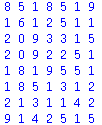
Born 24 Sep 1891; died 1969.
William F(rederick) Friedman was an American, one of the world's greatest cryptologists, who helped decipher enemy codes from World War I to World War II. He was born as Wolfe Friedman.in Kishinev, Russia. He emigrated to the U.S. in 1893. Originally trained as an agricultural geneticist, he had become interested in cryptology. During World War I, with his wife Elizebeth, he set up a cryptology school for military personnel, which led to appointment by the U.S. as head of the Signal Intelligence Service (1930). He broke the Japanese "Purple" code (1937-40), thus allowing Americans to read much of Japan's secret messages during World War II.
William F(rederick) Friedman was an American, one of the world's greatest cryptologists, who helped decipher enemy codes from World War I to World War II. He was born as Wolfe Friedman.in Kishinev, Russia. He emigrated to the U.S. in 1893. Originally trained as an agricultural geneticist, he had become interested in cryptology. During World War I, with his wife Elizebeth, he set up a cryptology school for military personnel, which led to appointment by the U.S. as head of the Signal Intelligence Service (1930). He broke the Japanese "Purple" code (1937-40), thus allowing Americans to read much of Japan's secret messages during World War II.

Born 24 Sep 1870; died 23 May 1960 at age 89.
French chemist, engineer and inventor who invented the neon light, which was the forerunner of the fluorescent light. Claude was the first to apply an electrical discharge to a sealed tube of neon gas, around 1902 and make a neon lamp (“Neon” from Greek neos, meaning “new gas.”) He first publicly displayed the neon lamp on 11 Dec 1910 in Paris. His French company Claude Neon, introduced neon signs to the U.S. with two “Packard” signs for a Packard car dealership in Los Angeles, purchased by Earle C. Anthony for $24,000.
French chemist, engineer and inventor who invented the neon light, which was the forerunner of the fluorescent light. Claude was the first to apply an electrical discharge to a sealed tube of neon gas, around 1902 and make a neon lamp (“Neon” from Greek neos, meaning “new gas.”) He first publicly displayed the neon lamp on 11 Dec 1910 in Paris. His French company Claude Neon, introduced neon signs to the U.S. with two “Packard” signs for a Packard car dealership in Los Angeles, purchased by Earle C. Anthony for $24,000.
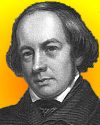
Born 24 Sep 1809; died 16 Feb 1890 at age 80. quotes
Irish chemist whose book, The Industrial Resources of Ireland (1844), provided a study of the scientific and potential economic value of developing the country’s natural resources. Kane began scientific research in his youth at his father’s industrial chemicals factory. His first papers were published as a teenager. By the age of 22, he had already written a book, Elements of Practical Pharmacy, and was a professor of chemistry at Dublin’s Apothecaries’ Hall. In 1833, age 24, he published a paper in which he was the first to propose the existence of the -C2H5 ethyl radical (Dublin Journal of Medical and Chemical Sciences, which he founded). His research spanned inorganic, organic, physical, biological and applied chemistry.«
Irish chemist whose book, The Industrial Resources of Ireland (1844), provided a study of the scientific and potential economic value of developing the country’s natural resources. Kane began scientific research in his youth at his father’s industrial chemicals factory. His first papers were published as a teenager. By the age of 22, he had already written a book, Elements of Practical Pharmacy, and was a professor of chemistry at Dublin’s Apothecaries’ Hall. In 1833, age 24, he published a paper in which he was the first to propose the existence of the -C2H5 ethyl radical (Dublin Journal of Medical and Chemical Sciences, which he founded). His research spanned inorganic, organic, physical, biological and applied chemistry.«
The Industrial Resources of Ireland, by Robert John Kane. - book suggestion.
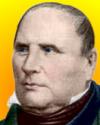
Born 24 Sep 1801; died 1 Jan 1862 at age 60.
Mikhail Vasilievich Ostrogradsky was a Russian mathematician who contributed in the fields of integral calculus and mathematical physics. He wrote textbooks that help improve the standard in the teaching of mathematics in Russia. From 1847, he also served as chief inspector of the mathematical sciences in military schools. He is regarded as the founder of the Russian school of theoretical mechanics, in a wide range of topics, including heat, elasticity, percussion theory, ballistics and probability theory. He developed methods of analysis, such as in boundary-value problems and separating variables. Most importantly, he dealt with variational principles.«
Mikhail Vasilievich Ostrogradsky was a Russian mathematician who contributed in the fields of integral calculus and mathematical physics. He wrote textbooks that help improve the standard in the teaching of mathematics in Russia. From 1847, he also served as chief inspector of the mathematical sciences in military schools. He is regarded as the founder of the Russian school of theoretical mechanics, in a wide range of topics, including heat, elasticity, percussion theory, ballistics and probability theory. He developed methods of analysis, such as in boundary-value problems and separating variables. Most importantly, he dealt with variational principles.«
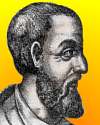
Born 24 Sep 1501; died 21 Sep 1576 at age 74. quotes
Italian physician, mathematician and astrologer (a.k.a. Geronimo, Gerolamo, or Anglicized as Jerome Cardan) who was the first to give a clinical description of typhus fever. His book, Ars magna (“Great Art,” 1545) was one of the great achievements in the history of algebra, in which he published the solutions to the cubic and quartic equations. His mechanical inventions included the combination lock, the compass gimbal consisting of three concentric rings, and the universal joint to transmit rotary motion at various angles (as used in present-day vehicles). He contributed to hydrodynamics and held that perpetual motion is impossible, except in celestial bodies. Cardano published two encyclopedias of natural science, introduced the Cardan grille, a cryptographic tool (1550), and was a life-long believer as an astrologer. He died by suicide.« more
Italian physician, mathematician and astrologer (a.k.a. Geronimo, Gerolamo, or Anglicized as Jerome Cardan) who was the first to give a clinical description of typhus fever. His book, Ars magna (“Great Art,” 1545) was one of the great achievements in the history of algebra, in which he published the solutions to the cubic and quartic equations. His mechanical inventions included the combination lock, the compass gimbal consisting of three concentric rings, and the universal joint to transmit rotary motion at various angles (as used in present-day vehicles). He contributed to hydrodynamics and held that perpetual motion is impossible, except in celestial bodies. Cardano published two encyclopedias of natural science, introduced the Cardan grille, a cryptographic tool (1550), and was a life-long believer as an astrologer. He died by suicide.« more
The Book of My Life, by Girolamo Cardano. - book suggestion.

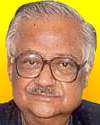
Died 24 Sep 2004 at age 79 (born 28 Jan 1925). quotes
Indian nuclear physicist who was picked by Homi Nhabha to help shape India’s nuclear physics and energy programs. Ramanna studied for his PhD at King's College, London, then joined (1 Dec 1949) the Tata Institute of Fundamental Research (TIFR), the root of India’s atomic energy program. While there, he contributed in different areas of neutron, nuclear, and reactor physics. In his later career, he was heading the Bhabha Atomic Research Centre when India carried out its first nuclear test at Pokhran in 1974. Ramanna also oversaw developments in advanced accelerators, lasers, and other technologies. He was a talented pianist, and wrote The Structure of Music in Raga and Western Systems.«
Indian nuclear physicist who was picked by Homi Nhabha to help shape India’s nuclear physics and energy programs. Ramanna studied for his PhD at King's College, London, then joined (1 Dec 1949) the Tata Institute of Fundamental Research (TIFR), the root of India’s atomic energy program. While there, he contributed in different areas of neutron, nuclear, and reactor physics. In his later career, he was heading the Bhabha Atomic Research Centre when India carried out its first nuclear test at Pokhran in 1974. Ramanna also oversaw developments in advanced accelerators, lasers, and other technologies. He was a talented pianist, and wrote The Structure of Music in Raga and Western Systems.«
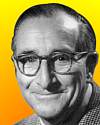
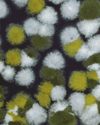
Italian geneticist who discovered the process of genetic recombination in the common soil fungus Aspergillus, and as a result of the discovery of the parasexual cycle, the originator of genetical studies in many other fungi. This cycle gives rise to genetic reassortment by means other than sexual reproduction and its discovery provided a method of genetically analyzing asexual fungi. Pontecorvo also put forward the idea of the gene as a unit of function, a theory substantiated by Seymour Benzer in 1955. He made significant contributions to modern genetics in elucidating the divisibility of the gene by recombination, and in his later years in the application of parasexual techniques to mammalian cell cultures.[Image right: Aspergillus plate.]
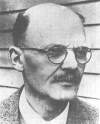
Died 24 Sep 1945 at age 62 (born 30 Sep 1882).
Hans Wilhelm Geiger was a German physicist who introduced the Geiger counter, the first successful detector of individual alpha particles and other ionizing radiations. After earning his Ph.D. at the University of Erlangen in 1906, he collaborated at the University of Manchester with Ernest Rutherford. He used the first version of his particle counter, and other detectors, in experiments that led to the identification of the alpha particle as the nucleus of the helium atom and to Rutherford's statement (1912) that the nucleus occupies a very small volume in the atom. The Geiger-Müller counter (developed with Walther Müller) had improved durability, performance and sensitivity to detect not only alpha particles but also beta particles (electrons) and ionizing electromagnetic photons. Geiger returned to Germany in 1912 and continued to investigate cosmic rays, artificial radioactivity, and nuclear fission.
Hans Wilhelm Geiger was a German physicist who introduced the Geiger counter, the first successful detector of individual alpha particles and other ionizing radiations. After earning his Ph.D. at the University of Erlangen in 1906, he collaborated at the University of Manchester with Ernest Rutherford. He used the first version of his particle counter, and other detectors, in experiments that led to the identification of the alpha particle as the nucleus of the helium atom and to Rutherford's statement (1912) that the nucleus occupies a very small volume in the atom. The Geiger-Müller counter (developed with Walther Müller) had improved durability, performance and sensitivity to detect not only alpha particles but also beta particles (electrons) and ionizing electromagnetic photons. Geiger returned to Germany in 1912 and continued to investigate cosmic rays, artificial radioactivity, and nuclear fission.
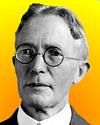
Died 24 Sep 1930 at age 59 (born 19 Feb 1871).
Canadian-American vertebrate paleontologist who made major contributions to the mammalian palaeontology of Asia and North America including his theory (195) that a majority of mammalian orders and families originated in Northern Hemisphere and subsequently spread southward. He also recognized that the early isolation of Australia's land mass explained the development of very different faunas there. He worked at the American Museum of Natural History from 1895 to 1927.«
Canadian-American vertebrate paleontologist who made major contributions to the mammalian palaeontology of Asia and North America including his theory (195) that a majority of mammalian orders and families originated in Northern Hemisphere and subsequently spread southward. He also recognized that the early isolation of Australia's land mass explained the development of very different faunas there. He worked at the American Museum of Natural History from 1895 to 1927.«
William Diller Matthew, Paleontologist, by Edwin H. Colbert. - book suggestion.
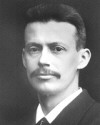
Died 24 Sep 1904 at age 43 (born 15 Dec 1860).
Danish physician who founded modern phototherapy, and was awarded the 1903 Nobel Prize for Physiology or Medicine "in recognition of his contribution to the treatment of diseases, especially lupus vulgaris, with concentrated light radiation, whereby he has opened a new avenue for medical science."«
Danish physician who founded modern phototherapy, and was awarded the 1903 Nobel Prize for Physiology or Medicine "in recognition of his contribution to the treatment of diseases, especially lupus vulgaris, with concentrated light radiation, whereby he has opened a new avenue for medical science."«
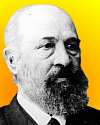
Died 24 Sep 1895 at age 63 (born 21 Oct 1831).
German chemist who directed agricultural research at the Bernburg experimental Station in Prussia concerned with determining optimum conditions for growing sugar beets, the primary source of sugar. He made the important discovery of the fixation of nitrogen by certain legumes which took converted nitrogen from the air into a form in the soil accessible for organic assimilation by plants. He identified that it was due to the symbiotic action of soil bacteria in nodules on the roots of the legumes. This improvement of the soil provided particular advantage in the annual rotation of grain crops (which used up nitrogen in the soil) with legumes like beans, peas and clover (which restored nitrogen to the soil).«
German chemist who directed agricultural research at the Bernburg experimental Station in Prussia concerned with determining optimum conditions for growing sugar beets, the primary source of sugar. He made the important discovery of the fixation of nitrogen by certain legumes which took converted nitrogen from the air into a form in the soil accessible for organic assimilation by plants. He identified that it was due to the symbiotic action of soil bacteria in nodules on the roots of the legumes. This improvement of the soil provided particular advantage in the annual rotation of grain crops (which used up nitrogen in the soil) with legumes like beans, peas and clover (which restored nitrogen to the soil).«
The World's Greatest Fix: a History of Nitrogen and Agriculture, by G.J. Leigh. - book suggestion.
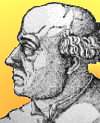
Died 24 Sep 1541 at age 48 (born 1 May 1493). quotes
Paracelsus (born Theophrastus Phillipus Aureolus Bombastus von Hohenheim) was a German-Swiss physician and alchemist who condemned medical teaching that was not based on observation and experience. He had travelled widely, gaining practical medical knowledge as surgeon to mercenary armies. In 1527, while a physician at Basel, he also lectured. He established the use of chemistry in medicine, gave the most up-to-date description of syphilis (1530), and was the first to argue that small doses of what makes people ill can also cure them. He introduced chemical remedies to replace traditional herbal ones, influenced the development of medicine during the Renaissance and gave alchemy a wider perspective. Paracelsus saw illness as having a specific external cause rather than being caused by an imbalance of the humours in the body (though he had an overall occultist perspective). He disputed that mental illness was caused by demons, and linked goitre with minerals in drinking water. In his major text, the Grosse Wundartzney ("Great Surgery Book", 1536) he discussed wounds, ulcers, and their cure with salves and balms, with a section on treating gunpowder wounds. His controversial views led to exile in 1538.[Sources disagree widely on day of birth. EB gives born 11 Nov or 17 Dec 1493. Enc. Occultism and Parapsychology states 24 Dec 1493. Enc. World Bio. and European Authors give 10 Nov 1493. DSB date is c.1493 or 1 May 1494(?).]
Paracelsus (born Theophrastus Phillipus Aureolus Bombastus von Hohenheim) was a German-Swiss physician and alchemist who condemned medical teaching that was not based on observation and experience. He had travelled widely, gaining practical medical knowledge as surgeon to mercenary armies. In 1527, while a physician at Basel, he also lectured. He established the use of chemistry in medicine, gave the most up-to-date description of syphilis (1530), and was the first to argue that small doses of what makes people ill can also cure them. He introduced chemical remedies to replace traditional herbal ones, influenced the development of medicine during the Renaissance and gave alchemy a wider perspective. Paracelsus saw illness as having a specific external cause rather than being caused by an imbalance of the humours in the body (though he had an overall occultist perspective). He disputed that mental illness was caused by demons, and linked goitre with minerals in drinking water. In his major text, the Grosse Wundartzney ("Great Surgery Book", 1536) he discussed wounds, ulcers, and their cure with salves and balms, with a section on treating gunpowder wounds. His controversial views led to exile in 1538.[Sources disagree widely on day of birth. EB gives born 11 Nov or 17 Dec 1493. Enc. Occultism and Parapsychology states 24 Dec 1493. Enc. World Bio. and European Authors give 10 Nov 1493. DSB date is c.1493 or 1 May 1494(?).]
The Hermetic and Alchemical Writings of Paracelus, by Paracelsus and Arthur Edward Waite (editor). - book suggestion.
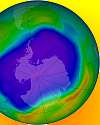
In 2006, NASA recorded the largest ozone hole in the atmosphere to date. From 21-30 Sep the average area was 10.6 million square miles, as measured by the Ozone Monitoring Instrument on NASA's Aura satellite. At the worst point, a record low of 1.2 Dobson Units compared to a 125 DU non-hole reading. For the past several decades, each year during the Southern Hemisphere Spring (Northern Hemisphere Autumn) chemical reactions due to chlorine and bromine man-made compounds in the atmosphere cause the destruction of ozone in the stratosphere over the southern polar region. This is a concern because this ozone, a very active triatomic form of oxygen (O3), absorbs the harmful ultraviolet-B rays (UV-B) present in light from the sun that damages plant and animal tissues, including humans.«[In the image, blue and purple shows where there is least ozone, and yellow and reds where there is more.]

In 1960, the first nuclear-powered aircraft carrier, the USS Enterprise, was launched in Newport, Virginia. It was the most astonishing vessel of its time and by far the largest warship in the world. Powered by eight nuclear reactors, it does not need to carry its own fuel oil and so has more room foor aviation fuel and weapons. In 1963, Enterprise and two similarly powered cruisers made a non-stop voyage around the world to demonstrate the viability of nuclear power. Length: 1120 ft, flight deck width: 250 ft, displacement: 93,970 tons. Speed: 33 knots. Range: 470,000 miles at 20 knots.Air wing: 86 aircraft. Crew: 5765
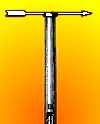
(USPTO)
In 1909, Thomas M. Flaherty filed for a U.S. patent, with an idea for a "Signal for Crossings" This was the first U.S. application for a traffic signal design, later issued as No. 991,964 on 9 May 1911. His signal used a large horizontal arrow pivoted on a post, which turned to indicate the right of way direction. It could be activated by an electric solenoid by a policeman beside the road. Although filed first, it was not the first patent actually issued for a traffic signal. Ernest E. Sirrine filed a different design seven months after Flaherty, but his patent was issued earlier, and thus he held the first U.S. patent for a "Street Traffic System" (No. 976,939 on 29 Nov 1910).
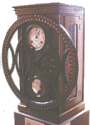
In 1889, Alexander Dey patented the dial time recorder. This style of time clock was first manufactured by the Dey Company and then as Industrial Time Recorders (ITR) after 1907. It used a dial that employees were required to point to their assigned number, and press to record the time of arrival and departure. The numbers of the employees and times were recorded on a sheet of paper wrapped around a drum.
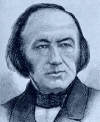
Bernard
In 1855, the discovery of glycogen stored in the liver was communicated to the Académie des Sciences by Claude Bernard, a French physiologist. He was not able to extract glycogen in a relatively pure state until Feb 1857. (At about the same time, Victor Hensen, a German physiologist, independently used a different process to successfully isolate glycogen.) As the storage form of glucose, glycogen is barely soluble in water, and is a kind of "animal starch." It can be readily converted into glucose as needed for use in the body to release energy. In this function, it acts as stored fuel for animals just as starch is stored in plants. In the word glycogen, glyco- = sugar; and -gen = forming.«*
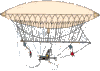
In 1852, a new invention, the dirigible - a semi-rigid airship - was demonstrated in a flight from Paris to Trappe. Henri Giffard (1825-82) installed a small (3 h.p.) steam engine of his own design in the gondola of a 147-foot-long spindle shaped coal-gas balloon. This engine turned a 11 ft propeller producing a speed of 5 mph against the wind over a distance of 17 mile on a 3 hour trip. This was the first powered and controlled flight ever achieved. (In 1858 he patented a steam injector which became widely used in locomotives, making him rich. Nevertheless, Giffard was depressive and died by suicide in 1882, but left his fortune for humanitarian and scientific purposes.)





