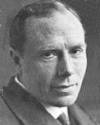
Born 20 Jun 1875; died 3 Jan 1967 at age 91. quotes
Reginald Crundall Punnett was an English geneticist who, with the English biologist William Bateson, were among the first English Mendelian geneticists. They reported the discovery of two new genetic principles: the first account of genetic linkage in sweet pea; and gene interaction (1905). Punnett devised the Punnett square to depict the number and variety of genetic combinations. Punnett had a role in connecting Mendelism with statistics. In 1908, Punnett was asked at a lecture to explain, “ if brown eyes were dominant, then why wasn't the whole country becoming brown-eyed?” Punnett in turn asked his friend the mathematician, G. H. Hardy. Out of this conversation came the Hardy-Weinberg Law which calculates how population affects genetic inheritance.
Reginald Crundall Punnett was an English geneticist who, with the English biologist William Bateson, were among the first English Mendelian geneticists. They reported the discovery of two new genetic principles: the first account of genetic linkage in sweet pea; and gene interaction (1905). Punnett devised the Punnett square to depict the number and variety of genetic combinations. Punnett had a role in connecting Mendelism with statistics. In 1908, Punnett was asked at a lecture to explain, “ if brown eyes were dominant, then why wasn't the whole country becoming brown-eyed?” Punnett in turn asked his friend the mathematician, G. H. Hardy. Out of this conversation came the Hardy-Weinberg Law which calculates how population affects genetic inheritance.
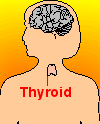
Born 20 Jun 1865; died 21 Sep 1939 at age 74.
English physician who pioneered in the treatment of endocrine disorders. He was one of the first to use extractions of animal thyroid to relieve myxedema (severe hypothyroidism) in humans. In 1891, Murray cut the thyroid out of a sheep, strained it through a handkerchief and prepared emulsions of dried sheep thyroid in glycerine. Despite being scoffed at by his colleagues, when he injected the thyroid extract into a patient with myxedema (the common form of hypothyroidism), he was completely successful on his first such attempt with the treatment. With continued use of thyroid extract, the patient lived in good health for over twenty-eight years after she had reached an advanced stage of myxoedema.
English physician who pioneered in the treatment of endocrine disorders. He was one of the first to use extractions of animal thyroid to relieve myxedema (severe hypothyroidism) in humans. In 1891, Murray cut the thyroid out of a sheep, strained it through a handkerchief and prepared emulsions of dried sheep thyroid in glycerine. Despite being scoffed at by his colleagues, when he injected the thyroid extract into a patient with myxedema (the common form of hypothyroidism), he was completely successful on his first such attempt with the treatment. With continued use of thyroid extract, the patient lived in good health for over twenty-eight years after she had reached an advanced stage of myxoedema.
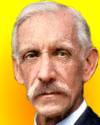
Born 20 Jun 1861; died 16 May 1947 at age 85. quotes
English biochemist who shared (with Christiaan Eijkman) the 1929 Nobel Prize for Physiology or Medicine for discovery of essential nutrient factors (now called vitamins), needed in animal diets to maintain health. Hopkins fed young rats on a basic diet with the necessary salts, in a carefully purified mixture of lard, starch, and casein (the most abundant protein in milk). After some time the animals ceased to grow. Then Hopkins showed that it was necessary to add only a very small daily amount of whole milk, 2-3 cc for each animal, for growth to renew. Thus seemingly sufficient food consumed without whole milk could not be fully utilized by the body, until a growth-promoting nutrient in milk was present.«
English biochemist who shared (with Christiaan Eijkman) the 1929 Nobel Prize for Physiology or Medicine for discovery of essential nutrient factors (now called vitamins), needed in animal diets to maintain health. Hopkins fed young rats on a basic diet with the necessary salts, in a carefully purified mixture of lard, starch, and casein (the most abundant protein in milk). After some time the animals ceased to grow. Then Hopkins showed that it was necessary to add only a very small daily amount of whole milk, 2-3 cc for each animal, for growth to renew. Thus seemingly sufficient food consumed without whole milk could not be fully utilized by the body, until a growth-promoting nutrient in milk was present.«
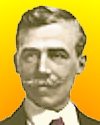
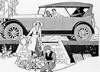
Scottish-born American pioneer automobile manufacturer who put thousands of "Winton Sixes" on the road. Beginning as a bicycle manufacturer on Cleveland's West Side, Winton became the designer and developer of high-end automobiles. He produced his first horseless carriage in 1896. Winton's legacy includes more than 100 patents instrumental in the early designs of automobiles and diesel engines. He was also generous in passing the technology along to competitors when safety was an issue.

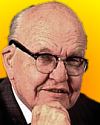
Died 20 Jun 2005 at age 81 (born 8 Nov 1923).
Jack St Clair Kilby was an American electrical engineer who invented the first integrated ciruit (IC), for which he shared the 2000 Nobel Prize in Physics. His interest in electronics grew out of his in school-age hobby of amateur radio. Year later, working at Texas Instruments, he devised a way to miniaturize a complicated transistor circuit by building its components on a block of silicon with internal connections that eliminated external wiring. On 12 Sep 1958, he demonstrated his first integrated circuit to his supervisor. A few months later, an IC device in an improved form was independently invented elsewhere by Robert Noyce. Geoffrey W.A. Dummer also had the concept years earlier, but not a working device. In Sep 1965, Kilby's team developed the first shirt-pocket electronic calculator using IC's.«
Jack St Clair Kilby was an American electrical engineer who invented the first integrated ciruit (IC), for which he shared the 2000 Nobel Prize in Physics. His interest in electronics grew out of his in school-age hobby of amateur radio. Year later, working at Texas Instruments, he devised a way to miniaturize a complicated transistor circuit by building its components on a block of silicon with internal connections that eliminated external wiring. On 12 Sep 1958, he demonstrated his first integrated circuit to his supervisor. A few months later, an IC device in an improved form was independently invented elsewhere by Robert Noyce. Geoffrey W.A. Dummer also had the concept years earlier, but not a working device. In Sep 1965, Kilby's team developed the first shirt-pocket electronic calculator using IC's.«
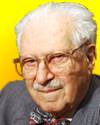
Died 20 Jun 2003 at age 89 (born 1 Mar 1914). quotes
American science historian who was the first American to receive a Ph.D. in history of science. He published many books on the history of science. His notable Principia: Mathematical Principles of Natural Philosophy (1999), the first English translation of Isaac Newton's Principia since 1729, took 15 years to complete, and comprised 974 pages. He also wrote about Benjamin Franklin and the computer pioneer, Howard Aiken.«
American science historian who was the first American to receive a Ph.D. in history of science. He published many books on the history of science. His notable Principia: Mathematical Principles of Natural Philosophy (1999), the first English translation of Isaac Newton's Principia since 1729, took 15 years to complete, and comprised 974 pages. He also wrote about Benjamin Franklin and the computer pioneer, Howard Aiken.«
The Triumph of Numbers: How Counting Shaped Modern Life, by Bernard Cohen. - book suggestion.
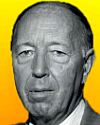
Died 20 Jun 1981 at age 75 (born 29 Dec 1905).
French-American electronics engineer whose invention (1936) of high-frequency direction finders (HF/DF, or "Huff Duff") permitted the U.S. Navy during World War II to detect enemy transmissions and quickly pinpoint the direction from which a radio transmission was coming. Busignies invented the radiocompass (1926) while still a student at Jules Ferry College in Versailles, France. In 1934, he started developing the direction finder based on his earlier radiocompass. Busignies developed the moving target indicator for wartime radar. It scrubbed off the radar screen every echo from stationary objects and left only echoes from moving objects, such as aircraft.«
French-American electronics engineer whose invention (1936) of high-frequency direction finders (HF/DF, or "Huff Duff") permitted the U.S. Navy during World War II to detect enemy transmissions and quickly pinpoint the direction from which a radio transmission was coming. Busignies invented the radiocompass (1926) while still a student at Jules Ferry College in Versailles, France. In 1934, he started developing the direction finder based on his earlier radiocompass. Busignies developed the moving target indicator for wartime radar. It scrubbed off the radar screen every echo from stationary objects and left only echoes from moving objects, such as aircraft.«
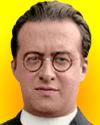
Died 20 Jun 1966 at age 71 (born 17 Jul 1894). quotes
Georges Henri Joseph Édouard Lemaître was a Belgian astronomer and cosmologist who was also a civil engineer, army officer, and ordained priest. He did research on cosmic rays and the three-body problem. Lemaître formulated (1927) the modern big-bang theory. He reasoned that if the universe was expanding now, then the further you go in the past, the universe's contents must have been closer together. He envisioned that at some point in the distant past, all the matter in the universe was in an exceedingly dense state, crushed into a single object he called the “primeval super-atom” which exploded, with all its constituent parts rushing away. This theory was later developed by Gamow and others.
Georges Henri Joseph Édouard Lemaître was a Belgian astronomer and cosmologist who was also a civil engineer, army officer, and ordained priest. He did research on cosmic rays and the three-body problem. Lemaître formulated (1927) the modern big-bang theory. He reasoned that if the universe was expanding now, then the further you go in the past, the universe's contents must have been closer together. He envisioned that at some point in the distant past, all the matter in the universe was in an exceedingly dense state, crushed into a single object he called the “primeval super-atom” which exploded, with all its constituent parts rushing away. This theory was later developed by Gamow and others.
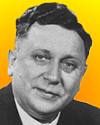
Died 20 Jun 1958 at age 55 (born 10 Jul 1902).
German chemist was the corecipient (with Otto Diels) of the Nobel Prize for Chemistry in 1950 for their development of the Diels-Alder reaction (1928), or diene synthesis, a widely used method of synthesizing cyclic organic compounds. In this type of reaction, a compound containing two double bonds separated by a single bond (i.e. a conjugated diene) adds to a suitable compound containing one double bond (dienophile) to give a ring compound. In the dienophile, the double bond must have a carbonyl group on each side. The reaction proceeds in the mildest conditions, is of general application, and hence of great utility in synthesis. It is used in the synthesis of natural products, such as sterols, vitamin K, cantharides, and synthetic polymers.
German chemist was the corecipient (with Otto Diels) of the Nobel Prize for Chemistry in 1950 for their development of the Diels-Alder reaction (1928), or diene synthesis, a widely used method of synthesizing cyclic organic compounds. In this type of reaction, a compound containing two double bonds separated by a single bond (i.e. a conjugated diene) adds to a suitable compound containing one double bond (dienophile) to give a ring compound. In the dienophile, the double bond must have a carbonyl group on each side. The reaction proceeds in the mildest conditions, is of general application, and hence of great utility in synthesis. It is used in the synthesis of natural products, such as sterols, vitamin K, cantharides, and synthetic polymers.
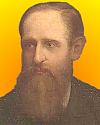
Died 20 Jun 1925 at age 83 (born 15 Jan 1842).
Austrian physician whose cathartic method was acknowledged by Sigmund Freud and others as the principal forerunner of psychoanalysis. Breuer found (1880) that he had relieved symptoms of hysteria in a patient, Bertha Pappenheim, (called Anna O. in his case study), after he had induced her to recall past unpleasant experiences under hypnosis. By describing her traumatic experiences and feelings about them to Breuer she seemed to get some relief from debilitating symptoms such as partial paralysis and hallucinations. Although Breuer's treatment was not nearly as successful as he and Freud claimed, she eventually overcame her symptoms to become an innovative social worker and a leader of the women's movement in Germany.
Austrian physician whose cathartic method was acknowledged by Sigmund Freud and others as the principal forerunner of psychoanalysis. Breuer found (1880) that he had relieved symptoms of hysteria in a patient, Bertha Pappenheim, (called Anna O. in his case study), after he had induced her to recall past unpleasant experiences under hypnosis. By describing her traumatic experiences and feelings about them to Breuer she seemed to get some relief from debilitating symptoms such as partial paralysis and hallucinations. Although Breuer's treatment was not nearly as successful as he and Freud claimed, she eventually overcame her symptoms to become an innovative social worker and a leader of the women's movement in Germany.
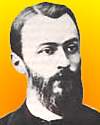
Died 20 Jun 1920 at age 55 (born 9 Nov 1864).
Russian microbiologist who, from his study of mosaic disease in tobacco, first reported the characteristics of the organisms that were later called viruses. (Although he is generally credited as the discoverer of viruses, they were also independently discovered and named by the Dutch botanist M.W. Beijerinck only a few years later.) Ivanovsky had been commissioned in 1890 to study a mysterious disease that was killing tobacco crops in the Crimea. He determined that some agent in sap could transfer disease from plant to plant. Through detailed filtering and microscope work, he concluded that some invisible parasite, much smaller than any known bacterium, was the culprit. In fact, his super-small bacterium was a new life form - the virus.[Also spelled Dmitri.]
Russian microbiologist who, from his study of mosaic disease in tobacco, first reported the characteristics of the organisms that were later called viruses. (Although he is generally credited as the discoverer of viruses, they were also independently discovered and named by the Dutch botanist M.W. Beijerinck only a few years later.) Ivanovsky had been commissioned in 1890 to study a mysterious disease that was killing tobacco crops in the Crimea. He determined that some agent in sap could transfer disease from plant to plant. Through detailed filtering and microscope work, he concluded that some invisible parasite, much smaller than any known bacterium, was the culprit. In fact, his super-small bacterium was a new life form - the virus.[Also spelled Dmitri.]
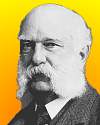
Died 20 Jun 1917 at age 78 (born 8 Mar 1839).
American chemist who with French chemist Charles Friedel, discovered an important organic carbon-chain addition to carbon-ring chemical synthesis techique, the Friedel-Crafts reaction (1877). This was a method of synthesizing hydrocarbons or ketones from aromatic hydrocarbons using aluminum chloride as a catalyst. Friedel and Crafts also did much work on the synthesis of organosilicon compounds.
American chemist who with French chemist Charles Friedel, discovered an important organic carbon-chain addition to carbon-ring chemical synthesis techique, the Friedel-Crafts reaction (1877). This was a method of synthesizing hydrocarbons or ketones from aromatic hydrocarbons using aluminum chloride as a catalyst. Friedel and Crafts also did much work on the synthesis of organosilicon compounds.
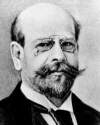
Died 20 Jun 1915 at age 76 (born 11 Dec 1838).
German industrialist and a leading figure in the early European electrical industry. In 1881, he met Thomas Edison in Paris at the international electricity exhibition. After lengthy negociations, in 1882, he purchased the rights for the economic use of Edison's patents in Germany. He founded a company to manufacture them (which became one of the two largest German electrical enterprises, Allgemeine Elektrizitats Gesellschaft (AEG)-the German General Electric Company). The product range included power stations, railways as well as electrical machines and devices. Rathenau was also the first to produce aluminium in Germany for industrial use.
German industrialist and a leading figure in the early European electrical industry. In 1881, he met Thomas Edison in Paris at the international electricity exhibition. After lengthy negociations, in 1882, he purchased the rights for the economic use of Edison's patents in Germany. He founded a company to manufacture them (which became one of the two largest German electrical enterprises, Allgemeine Elektrizitats Gesellschaft (AEG)-the German General Electric Company). The product range included power stations, railways as well as electrical machines and devices. Rathenau was also the first to produce aluminium in Germany for industrial use.
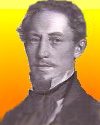
Died 20 Jun 1875 at age 52 (born 23 Dec 1822).
German inventor who was a pioneer of submarines. On 1 Feb 1851, in Kiel Harbour, he made a test-dive in his first submarine, Le Plongeur-Marin ("The Marine Diver"), only to sink 50-ft due to water leaks in the hull. He survived by waiting for the inside air pressure, compressed as more water leaked in, to match the water pressure outside. Seven hours later, he and his crew opened the hatch and rose to the surface to find funeral services in progress. In 1855, Bauer built a four-man treadmill-powered, 52-ft iron submarine, Le Diable-Marin ("The Marine Devil") carrying 11 crew. The photographs Bauer made through its windows are probably the first taken underwater. He also experimented on air purification and underwater sound signals.«
German inventor who was a pioneer of submarines. On 1 Feb 1851, in Kiel Harbour, he made a test-dive in his first submarine, Le Plongeur-Marin ("The Marine Diver"), only to sink 50-ft due to water leaks in the hull. He survived by waiting for the inside air pressure, compressed as more water leaked in, to match the water pressure outside. Seven hours later, he and his crew opened the hatch and rose to the surface to find funeral services in progress. In 1855, Bauer built a four-man treadmill-powered, 52-ft iron submarine, Le Diable-Marin ("The Marine Devil") carrying 11 crew. The photographs Bauer made through its windows are probably the first taken underwater. He also experimented on air purification and underwater sound signals.«
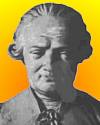
Died 20 Jun 1807 at age 80 (born 19 Mar 1727).
Swiss horologist and author of extensive treatises on timekeeping who became involved in the attempt to solve the problem of determining longitude at sea. His major achievement was his further development of an accurate and practical marine clock, or chronometer. (Such an instrument had previously been constructed in expensive and delicate prototypes by Pierre Leroy of France and John Harrison of England.) He made his first chronometer in 1754, which was sent for trial in 1761. Berthoud's improvements to the chronometer have been largely retained in present-day designs.
Swiss horologist and author of extensive treatises on timekeeping who became involved in the attempt to solve the problem of determining longitude at sea. His major achievement was his further development of an accurate and practical marine clock, or chronometer. (Such an instrument had previously been constructed in expensive and delicate prototypes by Pierre Leroy of France and John Harrison of England.) He made his first chronometer in 1754, which was sent for trial in 1761. Berthoud's improvements to the chronometer have been largely retained in present-day designs.
Died 20 Jun 1776 at age 72 (born 4 Jun 1704).
English inventor whose invention of the crucible method of producing fine or tool steel (c.1740) enabled production of steel on a commercial scale, with uniform composition. This solved the problems of irregular quality of imported blister steel. Huntsman’s steel had extreme hardness, combined with great toughness and ductility. He developed the crucial fire-resisting clay necessaryfor his crucibles. The location he chose for his factory was the city of Sheffield, now known for centuries as a great manufacturing centre of steel products. The first crucible steel was made for smaller items, including parts used in his clock-making business, which need inspired his invention. His clockmaking continued to 1751, when he began full-time steel production.«
English inventor whose invention of the crucible method of producing fine or tool steel (c.1740) enabled production of steel on a commercial scale, with uniform composition. This solved the problems of irregular quality of imported blister steel. Huntsman’s steel had extreme hardness, combined with great toughness and ductility. He developed the crucial fire-resisting clay necessaryfor his crucibles. The location he chose for his factory was the city of Sheffield, now known for centuries as a great manufacturing centre of steel products. The first crucible steel was made for smaller items, including parts used in his clock-making business, which need inspired his invention. His clockmaking continued to 1751, when he began full-time steel production.«
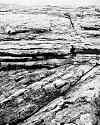
Rock strata
Died 20 Jun 1773 at age 51 (born 14 Feb 1722).
German geologist who originated the idea of stratigraphic formations. He was one of the first actually to make recorded measurements of sections of stratified rock. His major work, Historia terrae et maris, ex historia Thuringiae, per montium descriptionem, eruta (1861) is unusual for its purely geological orientation. It contains the general principles of historical geology, the extensive description of the Thüringen Wald, and explantions of the causes of dynamic changes in the earth's crust and the origin of veins and their minerals. He developed the concept of a strata, a rock formation as a depositional unit representing a certain epoch of time. Such formations were not thrown out at random, but deposited initially in a horizontal position as part of a clearly delineated, orderly succession under circumstances that may be inferred from the lithology and characteristic fossil assemblage. Recent deposits in his district with only terrestrial fossils, he thought, were from “the action of a great deluge.” He also made the first published geological map of Germany and adjacent areas.
German geologist who originated the idea of stratigraphic formations. He was one of the first actually to make recorded measurements of sections of stratified rock. His major work, Historia terrae et maris, ex historia Thuringiae, per montium descriptionem, eruta (1861) is unusual for its purely geological orientation. It contains the general principles of historical geology, the extensive description of the Thüringen Wald, and explantions of the causes of dynamic changes in the earth's crust and the origin of veins and their minerals. He developed the concept of a strata, a rock formation as a depositional unit representing a certain epoch of time. Such formations were not thrown out at random, but deposited initially in a horizontal position as part of a clearly delineated, orderly succession under circumstances that may be inferred from the lithology and characteristic fossil assemblage. Recent deposits in his district with only terrestrial fossils, he thought, were from “the action of a great deluge.” He also made the first published geological map of Germany and adjacent areas.

In 2005, a 41-yr-old wild bat was reported in an article received by the Journal of Gerontology. A male Brandt's bat (Myotis brandtii) was identified as the world's oldest known small mammal from a band attached during a project in the Biryusa karst region of Siberia in Russia. Over a number of years around 1962, 1544 individual M. brandtii bats in cave colonies had been banded. These bats are small - only about 6-g. A long annual hibernation is suggested as one cause of the exception longevity of bats. M. brandtii bats hibernate from late Sep until mid-Jun. Earlier age records include a 24-yr-old female little brown bat found 30 Apr 1960 in the U.S. and on 25 Aug 1999, a newspaper reported a 33-yr-old wild bat in Europe.«
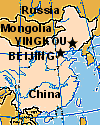
In 2002, an agreement was signed to establish a seawater desalination and heating plant - using atomic reactors - at the coastal city of Yingkou, China. It is designed to address severe water shortages in China. The deep-water reactor designed by Chinese scientists is to burn used fuel from nuclear power stations under normal pressure giving 200 megawatts. The initial phase, costing 35 million yuan ($4 million) would provide heating for a building area of 5 million sq. meters during winter. It can also desalinate 3,000 tons of sea water daily when no heating is required. The daily capacity is expected to amount to 80,000 tons. The reactor in theory is able to replace about 130,000 tons of coal burned every year, reducing immensely waste gases.

In 1986, because of fallout from the Chernobyl nuclear plant explosion in Russia on 26 Apr 1986, the slaughter and movement of lambs in parts of Cumbria, Scotland, was temporarily banned. Fallout in the UK from the Chernobyl accident was greatest where the passage of the cloud coincided with heavy rainfall in north Wales, Cumbria, parts of Scotland and northern Ireland. Caesium-137 activity concentrations in vegetation at one site in upland west Cumbria increased from 40 to 10,000 Bq kg–1 dry weight. Studies after the Chernobyl accident have shown that the transfer of radionuclides to sheep and goat products is greater than to cattle. Restrictions are imposed if any individual sheep in a flock exceeds the 1,000 Bq kg-1 (fresh weight) limit at which meat cannot enter the foodchain.[Image: Upland sheep in the area of Cumbria where movement and slaughter were still restricted 10 years after the Chernobyl accident.]
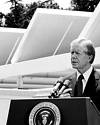
In 1979, 32 solar panels on the White House roof, installed by the Carter administration, were dedicated. President Carter wished to demonstrate a committment to renewable energy use, as a model for the nation. About 3m x 1m x 10cm deep, the dark surfaces of the panels absorbed energy from sunlight, heating water passing through pipes snaking below them. Carter stated, “In the year 2000 this solar water heater behind me, which is being dedicated today, will still be here supplying cheap, efficient energy.” That was not to be. The subsequent Republican President, Ronald Reagan, with one of the worst environmental records of any president, while the roof was being resurfaced in 1986, had them removed and sent to warehouse storage. In the same year he slashed the research and development budget for renewable energy, and eliminated tax breaks for wind turbines and solar projects.«
Keeping Faith: Memoirs of a President, by Jimmy Carter. - book suggestion.

In 1977, the $7.7 billion trans-Alaskan oil pipeline opened. The $7.7 billion project links oil fields in Prudhoe Bay to the shipping port of Valdez, where oil arrives 38 days later. Because of the earth's heat at greater depths, oil pumped from the Prudhoe Bay field, which is 10,000-to-20,000 feet deep, is at about 145 to 180 degrees F. Using heat exchangers that work like a car's radiator, the oil companies cool the oil to about 120 degrees before it enters the pipeline. The pipe is a tube of 1/2-inch thick steel with a diameter of 48 inches, wrapped with four inches of fiberglass insulation and a cover of aluminum sheet metal. Where it snakes over land, the pipeline is supported by posts designed to keep permafrost frozen.
800 Miles to Valdez: Building of the Alaska Pipeline, by James P. Roscow. - book suggestion.
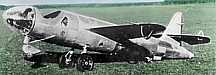
Heinkel
In 1918, the X-ray expert Dr. Eugene W. Caldwell, died of X-ray burns, in New York. Dr. Caldwell was Director of X-ray in New York City's Bellevue Hospital, and his book The Practical Application of Roentgen Rays in Therapeutics was an accepted textbook on the subject. He received the fatal burns in the course of his X-ray research.*
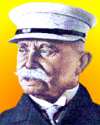
In 1908, Count Zeppelin boarded his fourth new airship, at Friedrichshafen, Germany, and took it out on a short first flight. The Luftschiff LZ4 had its first extended flight (12 hours) traveling to Switzerland on 1 Jul 1908. At the beginning of August, it embarked on an extended flight which included Basel, Straussberg, and many of the major cities of southern Germany. While moored at Echterdingen on 5 Aug 1908, it was torn from the mast by high winds and destroyed by fire. He was nearly bankrupted. But, as interest in the Zeppelins was running high in Germany, the incident was felt as a national disaster. Spontaneous donations resulted in approximately 5.5 million Marks and made it possible for Zeppelin to continue his work.«* more
Zeppelin: The Story of a Great Achievement, by Harry Vissering. - book suggestion.

(USPTO)

The Inventive Spirit of African Americans: Patented Ingenuity, by Patricia Carter Sluby. - book suggestion.
In 1893, Thomas A. Edison received one of his patents for a Phonograph (U.S. No. 499,879).
In 1893,a patent for a "Station Indicator" was granted to the black American inventor Thomas W. Stewart with William E. Johnson, of which they assigned a half interest to Levi and Albert Johnson, all of Detroit, Michigan (U.S. No. 499,895). The invention was for use in railway and street cars to indicate the different stations and streets the car is approaching. It was to automatically advance a belt of sign cards displaying the names of the stations and streets. This advance was activated by a lever on the outside of the car coming into contact with an inclined projection beside the track. An alarm would also sound. Another lever allowed the vehicle operator to reverse the movement of the belt for the return journey.
The Inventive Spirit of African Americans: Patented Ingenuity, by Patricia Carter Sluby. - book suggestion.
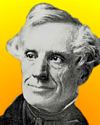
In 1840, Samuel F.B. Morse received a patent for telegraphy signals (U.S. No. 1,647).
Lightning Man: The Accursed Life of Samuel F. B. Morse, by Kenneth Silverman. - book suggestion.
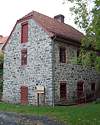
In 1754, the first municipal water pumping plant in America began operation at Bethlehem, Pennsylvania., built by Hans Christopher Christiansen, a Danish millwright. Although the first public water supply in America was installed at Boston, Mass. (1652), it was gravity that moved water piped from springs to a 12 foot square reservoir. The facility at Bethlehem was the first to use a pumping plant, which replaced carriers hauling water up the hill to the village. Water from a spring was piped for 350 feet to a cistern, from which a wooden pump, five inches in diameter, forced it up through bored hemlock logs to a wooden tank in the village square, 70 feet above the pumps. By 1761, operation was expanded to use three iron force pumps driven by an undershot water-wheel. Those pumps were used for 71 years.«[Image: The original frame structure was replaced with a 24-foot-square stone building for the enlarged operations in 1761. It still stands, has been restored, and is now a National Historic Landmark. This entry was previously given as 27 May 1755, based on one source (Kane, Famous First Facts). It has been moved to this page because further research found several books published before 1920 citing this earlier June date.]




