Born 27 Apr 1942.
Russian cosmonaut and doctor who established the record for the longest continuous stay in space of 438 days (8 Jan 1994 - 22 Mar 1995) aboard Russia's Mir Space Station. With a prior stay of 241 days on Mir (29 Aug 1988 - 27 Apr 1989), he also then held the cumulative space endurance record of 679 days. He left space service on 1 Jun 1995. His education included astronautics medicine. On 22 Mar 1972 he was selected as a biomedical specialist cosmonaut for a planned space station mission and began training in Oct 1972. The cumulative space stay record was subsequently broken by Sergei Avdeyev on 13 Aug 1999 (3 missions, total 748 days) and then on 16 Aug 2005 by Sergei Krikalev (6 missions, total 803 days).
Russian cosmonaut and doctor who established the record for the longest continuous stay in space of 438 days (8 Jan 1994 - 22 Mar 1995) aboard Russia's Mir Space Station. With a prior stay of 241 days on Mir (29 Aug 1988 - 27 Apr 1989), he also then held the cumulative space endurance record of 679 days. He left space service on 1 Jun 1995. His education included astronautics medicine. On 22 Mar 1972 he was selected as a biomedical specialist cosmonaut for a planned space station mission and began training in Oct 1972. The cumulative space stay record was subsequently broken by Sergei Avdeyev on 13 Aug 1999 (3 missions, total 748 days) and then on 16 Aug 2005 by Sergei Krikalev (6 missions, total 803 days).
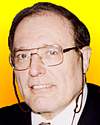
Born 27 Apr 1932; died 18 Apr 1999 at age 66. quotes
Italian-American mathematician, philosopher and author.[Also known as Juan Carlos Rota.]
Italian-American mathematician, philosopher and author.[Also known as Juan Carlos Rota.]
Indiscrete Thoughts, by Gian-Carlo Rota and Fabrizio Palombi. - book suggestion.
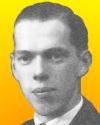
Born 27 Apr 1913; died 1 Aug 2004 at age 91. quotes
Philip Hauge Abelson was an American physical chemist who proposed the gas diffusion process for separating uranium-235 from uranium-238 which was essential to the development of the atomic bomb. In collaboration with the U.S. physicist Edwin M. McMillan, he discovered a new element, later named neptunium, produced by irradiating uranium with neutrons. At the end WW II, his report on the feasibility of building a nuclear-powered submarine gave birth to the U.S. program in that field. In 1946, Abelson returned to the Carnegie Institution and pioneered in utilizing radioactive isotopes. As director of the Geophysics Laboratory of the Carnegie Institution (1953-71), he found amino acids in fossils, and fatty acids in rocks more than 1,000,000,000 years old.
Philip Hauge Abelson was an American physical chemist who proposed the gas diffusion process for separating uranium-235 from uranium-238 which was essential to the development of the atomic bomb. In collaboration with the U.S. physicist Edwin M. McMillan, he discovered a new element, later named neptunium, produced by irradiating uranium with neutrons. At the end WW II, his report on the feasibility of building a nuclear-powered submarine gave birth to the U.S. program in that field. In 1946, Abelson returned to the Carnegie Institution and pioneered in utilizing radioactive isotopes. As director of the Geophysics Laboratory of the Carnegie Institution (1953-71), he found amino acids in fossils, and fatty acids in rocks more than 1,000,000,000 years old.
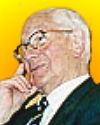
Born 27 Apr 1903; died 26 Oct 1996 at age 93.
German-born British pharmacologist who had already retired from the University of Aberdeen, Scotland, when he discovered (1975), with John Hughes, enkephalins, two potent naturally occurring opiates in the brain. Enkephin was the first known opioid produced by the human body. This opiate-like substance was produced by the brain in response to the perception of pain. Kosterlitz's discovery illuminated the brain's role in pain modulation and had direct clinical implications.
German-born British pharmacologist who had already retired from the University of Aberdeen, Scotland, when he discovered (1975), with John Hughes, enkephalins, two potent naturally occurring opiates in the brain. Enkephin was the first known opioid produced by the human body. This opiate-like substance was produced by the brain in response to the perception of pain. Kosterlitz's discovery illuminated the brain's role in pain modulation and had direct clinical implications.
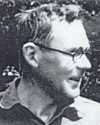
Born 27 Apr 1896; died 29 Apr 1937 at age 41. quotes
American chemist who developed nylon (1935), the first synthetic polymer fibre to be spun from a melt. He produced this polyamide, by condensation of adipic acid and hexamethylenediamine. He worked for the duPont chemical company as head of organic chemistry research from 1928. Through his study of long-chain molecules, now called polymers, he also developed the first successful synthetic rubber, neoprene (1931). He suffered from depression, and died by suicide at the age of 41 before nylon had been commercially exploited. DuPont produced nylon commercially from 1938 and laid the foundation of the synthetic-fibre industry. Nylon proved outstanding in its properties as a synthetic analog of silk.
American chemist who developed nylon (1935), the first synthetic polymer fibre to be spun from a melt. He produced this polyamide, by condensation of adipic acid and hexamethylenediamine. He worked for the duPont chemical company as head of organic chemistry research from 1928. Through his study of long-chain molecules, now called polymers, he also developed the first successful synthetic rubber, neoprene (1931). He suffered from depression, and died by suicide at the age of 41 before nylon had been commercially exploited. DuPont produced nylon commercially from 1938 and laid the foundation of the synthetic-fibre industry. Nylon proved outstanding in its properties as a synthetic analog of silk.
Enough for One Lifetime: Wallace Carothers, Inventor of Nylon, by Matthew E. Hermes. - book suggestion.
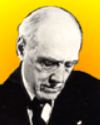
Born 27 Apr 1875; died 14 Jul 1960 at age 85.
(6th duke) (Louis-César-Victor-) Maurice de Broglie was a French physicist who made many contributions to the study of X rays. While in the navy (1895-1908), he first distinguished himself by installing the first French shipboard wireless. From 1912, his chief interest was X-ray spectroscopy. His “method of the rotating crystal” was an application of Bragg's “focussing effect” to eliminate spurious spectral lines. De Broglie discovered the third L absorption edge (1916), which led to the exploration of “corpuscular spectra.” During 1921-22, he worked with his brother Louis to refine Bohr's specification of the substructure of the various atomic shells. He also did pioneer work in nuclear physics and cosmic radiation. more
(6th duke) (Louis-César-Victor-) Maurice de Broglie was a French physicist who made many contributions to the study of X rays. While in the navy (1895-1908), he first distinguished himself by installing the first French shipboard wireless. From 1912, his chief interest was X-ray spectroscopy. His “method of the rotating crystal” was an application of Bragg's “focussing effect” to eliminate spurious spectral lines. De Broglie discovered the third L absorption edge (1916), which led to the exploration of “corpuscular spectra.” During 1921-22, he worked with his brother Louis to refine Bohr's specification of the substructure of the various atomic shells. He also did pioneer work in nuclear physics and cosmic radiation. more
Born 27 Apr 1865; died 10 May 1936 at age 71.
Russian anthropologist whose study of the Chukchi people of northeastern Siberia ranks among the classic works of ethnography. He published grammars, a dictionary, textbooks for Chukchi children, folklore collections, ethnographic and historical studies, and a novel about the Chukchis.
Russian anthropologist whose study of the Chukchi people of northeastern Siberia ranks among the classic works of ethnography. He published grammars, a dictionary, textbooks for Chukchi children, folklore collections, ethnographic and historical studies, and a novel about the Chukchis.
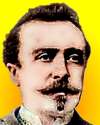
Born 27 Apr 1846; died 18 Mar 1892 at age 45.
Belgian-American inventor who was a pioneer in railway, electric lighting, and mining work, with more than 100 patents on electrical inventions. He emigrated to the U.S. in 1869. While experimenting with electric motors in Detroit (1874) he established the practicality of railway cars running on electricity. He invented an electric generator (1880), and exhibited an operating electric streetcar at the Chicago Exposition of Railway Appliances (1883). He designed electric streetcar systems for several cities. In 1888, he sold his electric railway patents to Thomson-Houston Electric Company of Lynn, Mass. He died four years later, at age 46. His other patents include: arc lamp (1870), coal-mining machine (1891), gearless electric locomotive (1894).« more
Belgian-American inventor who was a pioneer in railway, electric lighting, and mining work, with more than 100 patents on electrical inventions. He emigrated to the U.S. in 1869. While experimenting with electric motors in Detroit (1874) he established the practicality of railway cars running on electricity. He invented an electric generator (1880), and exhibited an operating electric streetcar at the Chicago Exposition of Railway Appliances (1883). He designed electric streetcar systems for several cities. In 1888, he sold his electric railway patents to Thomson-Houston Electric Company of Lynn, Mass. He died four years later, at age 46. His other patents include: arc lamp (1870), coal-mining machine (1891), gearless electric locomotive (1894).« more
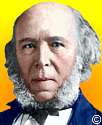
Born 27 Apr 1820; died 8 Dec 1903 at age 83. quotes
English sociologist and philosopher who was an early adherent of evolutionary theory. He regarded society as an organism which was evolving from a simple primitive state to a complex heterogeneous form according to the designs of an unknown and unknowable absolute force. Similarly, knowledge developed from an undifferentiated mass into the various separate sciences. Formulating his ideas independently of Darwin, Spencer coined the phrase “survival of the fittest” as early as 1852. He applied Darwin's theory of natural selection (proposed four years later) to social development and in A System of Synthetic Philosophy (1862-96) presented a philosophical system to the natural and social sciences, synthesizing metaphysics, biology, psychology, sociology, and ethics.
English sociologist and philosopher who was an early adherent of evolutionary theory. He regarded society as an organism which was evolving from a simple primitive state to a complex heterogeneous form according to the designs of an unknown and unknowable absolute force. Similarly, knowledge developed from an undifferentiated mass into the various separate sciences. Formulating his ideas independently of Darwin, Spencer coined the phrase “survival of the fittest” as early as 1852. He applied Darwin's theory of natural selection (proposed four years later) to social development and in A System of Synthetic Philosophy (1862-96) presented a philosophical system to the natural and social sciences, synthesizing metaphysics, biology, psychology, sociology, and ethics.
Herbert Spencer and the Invention of Modern Life, by Mark Francis. - book suggestion.
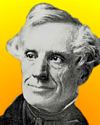
Born 27 Apr 1791; died 2 Apr 1872 at age 80. quotes
Samuel Finley Breese Morse was an American artist and inventor who is famous for developing the Morse Code (1838) and independently perfecting an electric telegraph (1832-35). He spent the first part of his life as a portrait artist, and did not turn to science until 1832, when he was past his 40th birthday. He was returning to America from a tour of Europe, when he met Charles T. Jackson on the boat, who inspired him about newly discovered electromagnets. From that point, Morse worked to develop apparatus for electrical communications. Backed by Congress, he erected a line spanning 40 miles between Baltimore, Maryland and Washington D.C. which had its first trial on 23 May 1843. It was ready for public use on 1 Apr 1845.« more
Samuel Finley Breese Morse was an American artist and inventor who is famous for developing the Morse Code (1838) and independently perfecting an electric telegraph (1832-35). He spent the first part of his life as a portrait artist, and did not turn to science until 1832, when he was past his 40th birthday. He was returning to America from a tour of Europe, when he met Charles T. Jackson on the boat, who inspired him about newly discovered electromagnets. From that point, Morse worked to develop apparatus for electrical communications. Backed by Congress, he erected a line spanning 40 miles between Baltimore, Maryland and Washington D.C. which had its first trial on 23 May 1843. It was ready for public use on 1 Apr 1845.« more
Lightning Man: The Accursed Life of Samuel F. B. Morse, by Kenneth Silverman. - book suggestion.
Born 27 Apr 1733; died 12 Nov 1806 at age 73.
German botanist who was a pioneer in the study of plant hybrids. He was first to develop a scientific application of the discovery, made in 1694 by the German botanist Rudolph Jacob Camerarius, of sex in plants. In his work with plants he was the first to use artificial fertilization. He was the first to cross plants of different species.
German botanist who was a pioneer in the study of plant hybrids. He was first to develop a scientific application of the discovery, made in 1694 by the German botanist Rudolph Jacob Camerarius, of sex in plants. In his work with plants he was the first to use artificial fertilization. He was the first to cross plants of different species.


Died 27 Apr 2004 at age 79 (born 29 Jun 1924).
Roy Lee Wolford, Jr. was an American pathologist and gerontologist who pioneered, and wrote books on, the idea of restricting food intake to extend life span. He practiced the concept rigorously personally with a diet limited to 1,600 calories per day, hoping to reach age 120. During his research in the 1960's at the University of California, he found that mice fed on a regimen restricting their caloric intake by about 40 percent resulted in nearly doubling their life span. He is also known as one of the eight people that lived from 1991 in Biosphere 2, in an experiment to see if humans could live for two years in the sealed, self-contained environment. He died at age 79 of complications from Lou Gehrig's disease, perhaps a result of low oxygen, high nitrous oxide levels in the Biosphere, causing loss of brain cells.«
Roy Lee Wolford, Jr. was an American pathologist and gerontologist who pioneered, and wrote books on, the idea of restricting food intake to extend life span. He practiced the concept rigorously personally with a diet limited to 1,600 calories per day, hoping to reach age 120. During his research in the 1960's at the University of California, he found that mice fed on a regimen restricting their caloric intake by about 40 percent resulted in nearly doubling their life span. He is also known as one of the eight people that lived from 1991 in Biosphere 2, in an experiment to see if humans could live for two years in the sealed, self-contained environment. He died at age 79 of complications from Lou Gehrig's disease, perhaps a result of low oxygen, high nitrous oxide levels in the Biosphere, causing loss of brain cells.«
Beyond the 120 Year Diet: How to Double Your Vital Years, by Roy L. Walford. - book suggestion.


Ruth Mosko Handler was an American inventor who created the Barbie Doll (1959), a teenage doll with a tiny waist and slender hips, and Ken, a boy doll (1961), which she named after her children. She co-founded the Mattel company in 1942. The business originally sold picture frames, and later dollhouse furniture which shortly led to specializing in toys. With a blonde ponytail and a zebra-striped swimsuit, the first "Barbie Teen-Age Fashion Model" sold over 350,000 the first year. The company soon made $100m annually. After being diagnosed with breast cancer in 1970, resulting in a mastectomy, she founded Ruthton Corporation to manufacture and market a prosthetic breast for women with a similar need.«[Image right: Original Barbie.]
Dream Doll: The Ruth Handler Story, by Ruth Handler, Jacqueline Shannon. - book suggestion.

Died 27 Apr 1999 at age 72 (born 4 Feb 1927).
German-born American physicist known for his formulation of Landauer's principle concerning the energy used during a computer's operation. Whenever the machine is resetting for another computation, bits are flushed from the computer's memory, and in that electronic operation, a certain amount of energy is lost. Thus, when information is erased, there is an inevitable "thermodynamic cost of forgetting," which governs the development of more energy-efficient computers. While engineers dealt with practical limitations of compacting ever more circuitry onto tiny chips, Landauer considered the theoretical limit, that if technology improved indefinitely, how soon will it run into the insuperable barriers set by nature?«
German-born American physicist known for his formulation of Landauer's principle concerning the energy used during a computer's operation. Whenever the machine is resetting for another computation, bits are flushed from the computer's memory, and in that electronic operation, a certain amount of energy is lost. Thus, when information is erased, there is an inevitable "thermodynamic cost of forgetting," which governs the development of more energy-efficient computers. While engineers dealt with practical limitations of compacting ever more circuitry onto tiny chips, Landauer considered the theoretical limit, that if technology improved indefinitely, how soon will it run into the insuperable barriers set by nature?«

Died 27 Apr 1999 at age 46 (born 23 Jul 1952). quotes
American computer scientist and visionary who was the chief technology officer at XEROX PARC, and is remembered for developed the pioneering idea for what he referred to as “ubiquitous computing.” He coined that term in 1988 to describe a future in which personal computers will be replaced with tiny computers embedded in everyday “smart” devices (everyday items such as coffeepots and copy machines) and their connection via a network. He said, “First were mainframes, each shared by lots of people. Now we are in the personal computing era, person and machine staring uneasily at each other across the desktop. Next comes ubiquitous computing, or the age of calm technology, when technology recedes into the background of our lives.” He died at age 46, only six weeks after being diagnosed as having gastric cancer.«
American computer scientist and visionary who was the chief technology officer at XEROX PARC, and is remembered for developed the pioneering idea for what he referred to as “ubiquitous computing.” He coined that term in 1988 to describe a future in which personal computers will be replaced with tiny computers embedded in everyday “smart” devices (everyday items such as coffeepots and copy machines) and their connection via a network. He said, “First were mainframes, each shared by lots of people. Now we are in the personal computing era, person and machine staring uneasily at each other across the desktop. Next comes ubiquitous computing, or the age of calm technology, when technology recedes into the background of our lives.” He died at age 46, only six weeks after being diagnosed as having gastric cancer.«
Died 27 Apr 1992 at age 65 (born 6 Feb 1927).
Gerard Kitchen O'Neill was an American physicist who invented the colliding-beam storage ring which increased the energy output of particle accelerators by utilizing beams of particles moving through a ring-shaped chamber in opposite directions. He constructed two storage rings at Stanford in 1959, and the technique soon was adopted for numerous high-energy installations. As a leading advocate of space colonization, he wrote in his book The High Frontier (1978), that space colonies could be the ultimate solution to such terrestrial problems as pollution, overpopulation, and the energy shortage. He designed a 1-km long sealed cylindrical space station to be built primarily of processed lunar materials and using solar energy. It would be capable of sustaining a human colony indefinitely in space between the Earth and the Moon.
Gerard Kitchen O'Neill was an American physicist who invented the colliding-beam storage ring which increased the energy output of particle accelerators by utilizing beams of particles moving through a ring-shaped chamber in opposite directions. He constructed two storage rings at Stanford in 1959, and the technique soon was adopted for numerous high-energy installations. As a leading advocate of space colonization, he wrote in his book The High Frontier (1978), that space colonies could be the ultimate solution to such terrestrial problems as pollution, overpopulation, and the energy shortage. He designed a 1-km long sealed cylindrical space station to be built primarily of processed lunar materials and using solar energy. It would be capable of sustaining a human colony indefinitely in space between the Earth and the Moon.
Died 27 Apr 1989 at age 94 (born 27 Nov 1894).
Japanese industrialist who founded the Matsushita Electric Industrial Co., Ltd., the largest manufacturer of consumer electric appliances in the world. His parents having died, Matsushita began work at age 9 as an errand boy. At age 16 he began working for the Osaka Electric Light Company, and he quit his job as an inspector there at age 23 to start a company that would sell electric plug attachments of his own design. His inventive marketing strategies helped the Matsushita Electric grow, and in 1935 he reorganized the company under the name it still holds.
Japanese industrialist who founded the Matsushita Electric Industrial Co., Ltd., the largest manufacturer of consumer electric appliances in the world. His parents having died, Matsushita began work at age 9 as an errand boy. At age 16 he began working for the Osaka Electric Light Company, and he quit his job as an inspector there at age 23 to start a company that would sell electric plug attachments of his own design. His inventive marketing strategies helped the Matsushita Electric grow, and in 1935 he reorganized the company under the name it still holds.

Died 27 Apr 1936 at age 79 (born 27 Mar 1857). quotes
English mathematician who was one of the founders of modern statistics. His lectures as professor of geometry evolved into The Grammar of Science (1892), his most widely read book and a classic in the philosophy of science. Stimulated by the evolutionary writings of Francis Galton and a personal friendship with Walter F.R. Weldon, Pearson became immersed in the problem of applying statistics to biological problems of heredity and evolution. The methods he developed are essential to every serious application of statistics. From 1893 to 1912 he wrote a series of 18 papers entitled Mathematical Contributions to the Theory of Evolution, which contained much of his most valuable work, including the chi-square test of statistical significance.
English mathematician who was one of the founders of modern statistics. His lectures as professor of geometry evolved into The Grammar of Science (1892), his most widely read book and a classic in the philosophy of science. Stimulated by the evolutionary writings of Francis Galton and a personal friendship with Walter F.R. Weldon, Pearson became immersed in the problem of applying statistics to biological problems of heredity and evolution. The methods he developed are essential to every serious application of statistics. From 1893 to 1912 he wrote a series of 18 papers entitled Mathematical Contributions to the Theory of Evolution, which contained much of his most valuable work, including the chi-square test of statistical significance.
Karl Pearson: The Scientific Life in a Statistical Age, by Theodore Porter. - book suggestion.
Died 27 Apr 1932 at age 77 (born 2 Jun 1854).
German physiologist who showed the available energy content of food was the same whether the material was consumed organically or merely burned (1894). He determined that no single type of food produced energy, but that the body variously made ready use of carbohydrates, fats and proteins. In 1883, he used geometry to compare metabolic rates of animals of different sizes. Thus, if an animal is N times taller than another, it has surface area N2 greater and mass N3 greater. Thus total metabolic rate (dependent on heat loss over surface area, N2), would be proportional to M2/3. Specific metabolic rate (the energy burnt M2/3, per unit of mass, M) would be proportional to M1/3. It took 50 years before this simple explanation was improved.
German physiologist who showed the available energy content of food was the same whether the material was consumed organically or merely burned (1894). He determined that no single type of food produced energy, but that the body variously made ready use of carbohydrates, fats and proteins. In 1883, he used geometry to compare metabolic rates of animals of different sizes. Thus, if an animal is N times taller than another, it has surface area N2 greater and mass N3 greater. Thus total metabolic rate (dependent on heat loss over surface area, N2), would be proportional to M2/3. Specific metabolic rate (the energy burnt M2/3, per unit of mass, M) would be proportional to M1/3. It took 50 years before this simple explanation was improved.

Died 27 Apr 1882 at age 83 (born 19 Feb 1799).
German mineralogist.
German mineralogist.
Died 27 Apr 1825 at age 78 (born 4 Jan 1747).
Dominique Vivant, Baron Denon was a French archaeologist, museum director and artist who played a pivotal role in expanding the Louvre’s collection. He joined Napoleon on his 1798 Egyptian expedition, sketching ancient monuments and sites, often amid battle. Denon became probably the first artist who discovered and drew the temples and ruins at Thebes, Esna, Edfu, and Philae. His “Voyage dans la basse et la haute Égypte” (“Travels in Lower and Upper Egypt”,1802) detailed these travels. Appointed by Napoleon as director general of museums (1804-1815), he advised the Emperor on art acquisitions from Austria, Spain, and Poland, including some pillaged from the various conquered countries. Eventually, these significantly enriched the Louvre.«
Dominique Vivant, Baron Denon was a French archaeologist, museum director and artist who played a pivotal role in expanding the Louvre’s collection. He joined Napoleon on his 1798 Egyptian expedition, sketching ancient monuments and sites, often amid battle. Denon became probably the first artist who discovered and drew the temples and ruins at Thebes, Esna, Edfu, and Philae. His “Voyage dans la basse et la haute Égypte” (“Travels in Lower and Upper Egypt”,1802) detailed these travels. Appointed by Napoleon as director general of museums (1804-1815), he advised the Emperor on art acquisitions from Austria, Spain, and Poland, including some pillaged from the various conquered countries. Eventually, these significantly enriched the Louvre.«
Died 27 Apr 1521 (born c. 1480).
Portuguese explorer.
Portuguese explorer.
In 1970, the synthesis of element 105, by fusing californium and nitrogen nuclei, was reported at the American Physical Society meeting in Washington, D.C., by Albert Ghiorso of the Lawrence Radiation Laboratory at UC Berkeley. The artificial element had atomic mass 260, half-life about 1.6 sec. and better proof than a tentative Russian claim in 1968, which the U.S. team regarded as unproven. The name hahnium was proposed, for the late Otto Hahn. Eventually, the International Union for Pure and Applied Chemistry decided that it would be named dubnium, and recognized the earlier claim of discovery in 1968 by a team led by Georgy Flerov at the Russian Joint Institute for Nuclear Research who bombarded americium with neon.«
In 1898, the first Weather Bureau kite was launched from Topeka, Kansas, and by the end of the year, 16 additional kite stations were attempting daily, early morning, simultaneous observations. The kites were large "box types" with dimensions of 8 feet long, 7 feet wide and 3 feet high. As many as seven kites would be attached to the kite wire during and observation. These kites were placed at regular intervals with the second 1500 feet behind the first, the third 2000 feet behind the second and from there on a spacing of 2500 feet.
In 1895, Professor Charles F. Marvin, a future chief of the Weather Bureau, began experimenting with kites for routine use in the Bureau. In 1896 he perfected his kite meteorograph, an instrument capable of measuring and recording temperature, pressure and humidity. These measurements were recorded by pens tracings on paper, or on a smoked copper sheet, which was attached to a clock rotated drum.
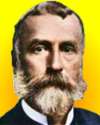
In 1887, in the U.S., George Thomas Morton performed a laparotomy operation to save the life of a 26-year-old paper-hanger, with perforative appendicitis, and removed his appendix (appendectomy). Morton described the case, with others, in a monograph, Inflammation of the Vermiform Appendix (1890), writing “which I believe represents the first successful operation for the removal of the vermiform appendix in a case of this kind, based upon correct diagnosis.” However, there had been earlier appendectomies. (G.T. Morton was the son of William Thomas Green Morton, who gave the first successful public demonstration of surgical anesthesia in 1846.)
In 1882, Mr A Stroh exhibited the attraction and repulsion (resembling magnetic) produced by sonorous vibrations in tubes to the Telegraph Engineers.*
(USPTO)
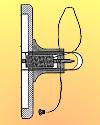
In 1880, the first U.S. patent for an electric hearing aid was issued to Francis D. Clarke and M.G. Foster, titled a Device for Aiding the Deaf to Hear (No. 226,902). The device employed bone conduction by which sound is passed through vibration of the skull bone. It was not until 1901 that the first commercially available hearing aid was produced, the Acousticon, invented by Miller Reese Hutchinson..
In 1871, the American Museum of Natural History opened to the public in New York City. With a series of exhibits, the Museum's collection Went on view for the first time in the Central Park Arsenal, the Museum's original home, on the eastern side of Central Park. The museum began from the efforts of Albert Smith Bickmore, one-time student of Harvard zoologist Louis Agassiz, who was successful in his proposal to create a natural history museum in Central Park, New York City, with the support of William E. Dodge, Jr., Theodore Roosevelt, Sr., Joseph Choate, and J. Pierpont Morgan. The Governor of New York, John Thompson Hoffman, signed a bill officially creating the American Museum of Natural History on 6 Apr 1869.
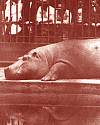
In 1828, London Zoological Gardens - Britain's first scientific zoo - opened in Regent's Park to the members of the Zoological Society of London.* The society was founded in Apr 1826 by Stamford Raffles and other scientists to research into animals kept in comparative freedom. Though Raffles became the society's first president, he died very shortly thereafter. His work was continued by the Marquess of Lansdowne, who obtained the Regent's Park land at a nominal rent from the Crown and supervised the construction of the original animal houses. The society received a Royal Charter from George IV on 27 Mar 1829. By 1831, the royal managerie had been presented by King William IV to the society. In 1847, the general public were first admitted as paying visitors to help provide funding for the zoo.«[Image: Visitors viewing Obaysch, photographed in 1852 at the London Zoo, the first hippopotamus seen in England since prehistoric times, and the first in Europe since Ancient Rome.] more
The Zoo: The Story of London Zoo, by J. Barrington-Johnson. - book suggestion.




