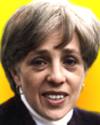
Born 15 Feb 1931; died 9 Jul 2024 at age 93.
Maxine Frank Singer was an American molecular biologist and science administrator known for her pivotal work on the genetic code and recombinant DNA technology. Her research on RNA structure and “nonsense” codons advanced understanding of protein synthesis. In the 1970s, she co-authored ethical guidelines for recombinant DNA research, shaping bioethics in molecular biology. Singer’s work on transposable genetic elements revealed insights into genome evolution and regulation. As president of the Carnegie Institution, she championed interdisciplinary research and promoted diversity in science. Her accolades, including the National Medal of Science, underscore her lasting impact on molecular biology, bioethics, and scientific leadership.«
Maxine Frank Singer was an American molecular biologist and science administrator known for her pivotal work on the genetic code and recombinant DNA technology. Her research on RNA structure and “nonsense” codons advanced understanding of protein synthesis. In the 1970s, she co-authored ethical guidelines for recombinant DNA research, shaping bioethics in molecular biology. Singer’s work on transposable genetic elements revealed insights into genome evolution and regulation. As president of the Carnegie Institution, she championed interdisciplinary research and promoted diversity in science. Her accolades, including the National Medal of Science, underscore her lasting impact on molecular biology, bioethics, and scientific leadership.«
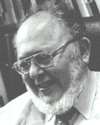
Born 15 Feb 1922; died 7 Jul 1983 at age 61.
American physicist who worked on nuclear strategy as a military analyst (1948-61). Later, he became known as a futurist making controversial studies of nuclear warfare in his books, including his provocative analysis of nuclear war in On Thermonuclear War (1960) and his predictions of the probability and survivability of nuclear war in Thinking About the Unthinkable (1962). He held that since it might be possible to survive a nuclear war, it was essential to plan to do just that. Kahn founded the influential Hudson Institute in New York in 1961 to study aspects of national security related to narcotics policy, international economics and trade, population, transportation, crime, medicine.«
American physicist who worked on nuclear strategy as a military analyst (1948-61). Later, he became known as a futurist making controversial studies of nuclear warfare in his books, including his provocative analysis of nuclear war in On Thermonuclear War (1960) and his predictions of the probability and survivability of nuclear war in Thinking About the Unthinkable (1962). He held that since it might be possible to survive a nuclear war, it was essential to plan to do just that. Kahn founded the influential Hudson Institute in New York in 1961 to study aspects of national security related to narcotics policy, international economics and trade, population, transportation, crime, medicine.«
The Worlds of Herman Kahn: The Intuitive Science of Thermonuclear War, by Sharon Ghamari-Tabrizi. - book suggestion.
Born 15 Feb 1884; died 24 Jan 1961 at age 76.
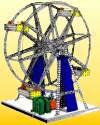
Albert Carlton Gilbert was an American inventor who patented the Erector set after he founded the A.C. Gilbert Co. New Haven, Connecticut (1908) to manufacture boxed magic sets. In 1913, he introduced Erector Sets. Similar construction toys then existed, such as Hornby's Meccano set made in England. Meccano sets included pulleys, gears, and several 1/2" wide strips of varying length with holes evenly spaced on them. Gilbert needed something unique for his Erector sets, so he created the square girder, made using several 1" wide strips with triangles cut in them. These had their edges bent over so 4 strips could be screwed together to form a very sturdy square girder. Over the next 40 years, some 30 million Erector Sets were sold.«
Albert Carlton Gilbert was an American inventor who patented the Erector set after he founded the A.C. Gilbert Co. New Haven, Connecticut (1908) to manufacture boxed magic sets. In 1913, he introduced Erector Sets. Similar construction toys then existed, such as Hornby's Meccano set made in England. Meccano sets included pulleys, gears, and several 1/2" wide strips of varying length with holes evenly spaced on them. Gilbert needed something unique for his Erector sets, so he created the square girder, made using several 1" wide strips with triangles cut in them. These had their edges bent over so 4 strips could be screwed together to form a very sturdy square girder. Over the next 40 years, some 30 million Erector Sets were sold.«
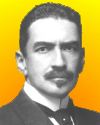
Born 15 Feb 1873; died 7 Nov 1964 at age 91.
Hans Karl August Simon von Euler-Chelpin was a German-Swedish biochemist who shared the 1929 Nobel Prize for Chemistry with Sir Arthur Harden for work on the role of enzymes in the alcoholic fermentation of sugar. In 1904 important work by Arthur Harden had shown that enzymes contain an easily removable nonprotein part, a coenzyme. In 1923 Euler-Chelpin worked out the structure of the yeast coenzyme. He showed that the molecule is made up from a nucleotide similar to that found in nucleic acid. It was named diphosphopyridine nucleotide (now known as NAD). He also worked on vitamins. His son, Ulf von Euler, was also a Nobel prizewinner.
Hans Karl August Simon von Euler-Chelpin was a German-Swedish biochemist who shared the 1929 Nobel Prize for Chemistry with Sir Arthur Harden for work on the role of enzymes in the alcoholic fermentation of sugar. In 1904 important work by Arthur Harden had shown that enzymes contain an easily removable nonprotein part, a coenzyme. In 1923 Euler-Chelpin worked out the structure of the yeast coenzyme. He showed that the molecule is made up from a nucleotide similar to that found in nucleic acid. It was named diphosphopyridine nucleotide (now known as NAD). He also worked on vitamins. His son, Ulf von Euler, was also a Nobel prizewinner.
Born 15 Feb 1861; died 13 Jun 1938 at age 77.
French physicist who studied ferronickel alloys and discovered invar (a nickel-steel alloy) which gained him the Nobel Prize for Physics in 1920. In 1883, Guillaume became an assistant at the newly established International Bureau of Weights and Measures at Sèvres, near Paris, and became director (1915-36). He was concerned with thermometry; and developing the international standards for the meter, kilogram, and liter. From 1890, he intensively investigated various alloys. After a methodical study of nickel-steel alloys he devised the alloy invar, having a very small expansion with temperature rise, and immediately adopted in springs of clocks and watches. He also produced elinvar, with an elasticity that remains nearly constant over a wide range of temperatures.
French physicist who studied ferronickel alloys and discovered invar (a nickel-steel alloy) which gained him the Nobel Prize for Physics in 1920. In 1883, Guillaume became an assistant at the newly established International Bureau of Weights and Measures at Sèvres, near Paris, and became director (1915-36). He was concerned with thermometry; and developing the international standards for the meter, kilogram, and liter. From 1890, he intensively investigated various alloys. After a methodical study of nickel-steel alloys he devised the alloy invar, having a very small expansion with temperature rise, and immediately adopted in springs of clocks and watches. He also produced elinvar, with an elasticity that remains nearly constant over a wide range of temperatures.
Born 15 Feb 1861; died 30 Dec 1947 at age 86. quotes
English mathematician and philosopher, who worked in logic, physics, philosophy of science and metaphysics. He is best known for his work with Bertrand Russellon one of probably the most famous books of the century, Principia Mathematica (1910-13) to demonstrate that logic is the basis for all mathematics. In physics (1910-24) his best known work was a theory of gravity, that competed with Einstein's general relativity for many decades. In his later life from 1924 onward at Harvard, he worked on more general issues in philosophy rather than mathematics, including the development of a comprehensive metaphysical system which has come to be known as process philosophy.«
English mathematician and philosopher, who worked in logic, physics, philosophy of science and metaphysics. He is best known for his work with Bertrand Russellon one of probably the most famous books of the century, Principia Mathematica (1910-13) to demonstrate that logic is the basis for all mathematics. In physics (1910-24) his best known work was a theory of gravity, that competed with Einstein's general relativity for many decades. In his later life from 1924 onward at Harvard, he worked on more general issues in philosophy rather than mathematics, including the development of a comprehensive metaphysical system which has come to be known as process philosophy.«
Science and the Modern World, by Alfred North Whitehead. - book suggestion.
Born 15 Feb 1858; died 16 Jan 1938 at age 79.
American astronomer who discovered Phoebe, the ninth moon of Saturn (1899). This was the first planetary satellite with retrograde motion to be detected, i.e., with orbital motion directed in an opposite sense to that of the planets. He set up a number of observing stations for Harvard. He made extensive observations of Mars and claimed, like Lowell, that he saw signs of life on the planet by observing what he took to be oases in 1892. He went further than Lowell however when in 1903 he claimed to observe signs of life on the Moon. By comparing descriptions of the Moon from Giovanni Riccioli’s 1651 chart onward, he thought he had detected changes that could have been due to the growth and decay of vegetation.[Image: Voyager Image of Phoebe.][DSB gives date of death 16 Jan 1938. EB gives 17 Jan 1938.]
American astronomer who discovered Phoebe, the ninth moon of Saturn (1899). This was the first planetary satellite with retrograde motion to be detected, i.e., with orbital motion directed in an opposite sense to that of the planets. He set up a number of observing stations for Harvard. He made extensive observations of Mars and claimed, like Lowell, that he saw signs of life on the planet by observing what he took to be oases in 1892. He went further than Lowell however when in 1903 he claimed to observe signs of life on the Moon. By comparing descriptions of the Moon from Giovanni Riccioli’s 1651 chart onward, he thought he had detected changes that could have been due to the growth and decay of vegetation.[Image: Voyager Image of Phoebe.][DSB gives date of death 16 Jan 1938. EB gives 17 Jan 1938.]
Born 15 Feb 1856; died 7 Oct 1926 at age 70.
German psychiatrist, one of the most influential of his time, who developed a classification system for mental illness that influenced subsequent classifications. Kraepelin made distinctions between schizophrenia and manic-depressive psychosis that remain valid today. Kraepelin employed Wundt's experimental techniques to study the effects of drugs, alcohol, and fatigue on psychological functioning and in 1881 published a study of the influence of infectious diseases on the onset of mental illness. In his first classification of disorders (1883) Kraepelin divided mental illnesses into exogenous disorders (treatable, caused by external conditions) and endogenous disorders (untreatable, from biological causes such as organic brain damage or hereditary factors).
German psychiatrist, one of the most influential of his time, who developed a classification system for mental illness that influenced subsequent classifications. Kraepelin made distinctions between schizophrenia and manic-depressive psychosis that remain valid today. Kraepelin employed Wundt's experimental techniques to study the effects of drugs, alcohol, and fatigue on psychological functioning and in 1881 published a study of the influence of infectious diseases on the onset of mental illness. In his first classification of disorders (1883) Kraepelin divided mental illnesses into exogenous disorders (treatable, caused by external conditions) and endogenous disorders (untreatable, from biological causes such as organic brain damage or hereditary factors).
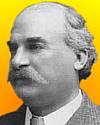
Born 15 Feb 1845; died 7 Feb 1910 at age 64.
American manufacturer who, with his two brothers, founded the Johnson & Johnson Corporation, to make surgical dressings (1885), and was its first President. In 1876, he had been inspired by a lecture by noted English surgeon Sir Joseph Lister, the pioneer of antiseptic surgery. Johnson set out to create a ready-made, surgical dressing that could be used without risk of contamination. He worked to develop a dressing that could remain as germ-free as practical between his factories and their medical uses around the country. He further worked to improve sanitary practices in the nineteenth century. Over time, the company diversified into many more consumer products, and now sells a comprehensive range of health care products worldwide.« more
American manufacturer who, with his two brothers, founded the Johnson & Johnson Corporation, to make surgical dressings (1885), and was its first President. In 1876, he had been inspired by a lecture by noted English surgeon Sir Joseph Lister, the pioneer of antiseptic surgery. Johnson set out to create a ready-made, surgical dressing that could be used without risk of contamination. He worked to develop a dressing that could remain as germ-free as practical between his factories and their medical uses around the country. He further worked to improve sanitary practices in the nineteenth century. Over time, the company diversified into many more consumer products, and now sells a comprehensive range of health care products worldwide.« more
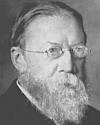
Born 15 Feb 1834; died 6 Nov 1913 at age 79. quotes
Welsh electrical engineer who was a major figure in the development and introduction of wireless telegraphy and the telephone in Great Britain. Preece's interest in applied electricity and telegraphic engineering was developed as a graduate student under Michael Faraday. For 29 years, from 1870, he was an engineer with the Post Office telegraphic system and contributed many inventions and improvements, including a railroad signaling system that increased railway safety. An early pioneer in wireless telegraphy, he originated his own system in 1892. He encouraged Guglielmo Marconi by obtaining assistance from the Post Office for his work. Preece also introduced into Great Britain the first Bell telephones. Preece was knighted in 1899.
Welsh electrical engineer who was a major figure in the development and introduction of wireless telegraphy and the telephone in Great Britain. Preece's interest in applied electricity and telegraphic engineering was developed as a graduate student under Michael Faraday. For 29 years, from 1870, he was an engineer with the Post Office telegraphic system and contributed many inventions and improvements, including a railroad signaling system that increased railway safety. An early pioneer in wireless telegraphy, he originated his own system in 1892. He encouraged Guglielmo Marconi by obtaining assistance from the Post Office for his work. Preece also introduced into Great Britain the first Bell telephones. Preece was knighted in 1899.
Telegraphy, by William Henry Preece. - book suggestion.
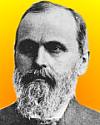
Born 15 Feb 1827; died 10 Feb 1902 at age 74.
American mechanical engineer and manufacturer of machine tools. In 1855 he produced the "Lincoln" milling machine which used a screw drive to improve on F.W. Howe's earlier rack and pinion design. Pratt formed a partnership with Amos Whitney in1860 and together developed the system of interchangeable parts that had been pioneered by Samuel Colt, Elisha Root, Amos' cousin Eli Whitney, and others. This, in turn, led to the need to establish national standards of measurement. The Pratt & Whitney Company was incorporated in 1869, making various types of gauges to enable such standards in manufacturing, making machine tools and tools particularly for the armament industry.«
American mechanical engineer and manufacturer of machine tools. In 1855 he produced the "Lincoln" milling machine which used a screw drive to improve on F.W. Howe's earlier rack and pinion design. Pratt formed a partnership with Amos Whitney in1860 and together developed the system of interchangeable parts that had been pioneered by Samuel Colt, Elisha Root, Amos' cousin Eli Whitney, and others. This, in turn, led to the need to establish national standards of measurement. The Pratt & Whitney Company was incorporated in 1869, making various types of gauges to enable such standards in manufacturing, making machine tools and tools particularly for the armament industry.«
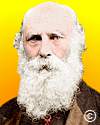
Born 15 Feb 1826; died 5 Jul 1911 at age 85. quotes
George Johnstone Stoney was an Irish physicist who coined the term electron for the fundamental unit of electricity. At the Belfast meeting of the British Association in Aug 1874, in a paper: On the Physical Units of Nature, Stoney called attention to a minimum quantity of electricity. He wrote, “I shall express ‘Faraday's Law’ in the following terms ... For each chemical bond which is ruptured within an electrolyte a certain quantity of electricity traverses the electrolyte which is the same in all cases.” Stoney subsequently offered the name electron for this minimum electric charge. When J.J. Thomson identified cathode rays as streams of negative particles (1897), each carrying probably Stoney's minimum quantity of charge, the name was applied to the particle rather than the quantity of charge. more
George Johnstone Stoney was an Irish physicist who coined the term electron for the fundamental unit of electricity. At the Belfast meeting of the British Association in Aug 1874, in a paper: On the Physical Units of Nature, Stoney called attention to a minimum quantity of electricity. He wrote, “I shall express ‘Faraday's Law’ in the following terms ... For each chemical bond which is ruptured within an electrolyte a certain quantity of electricity traverses the electrolyte which is the same in all cases.” Stoney subsequently offered the name electron for this minimum electric charge. When J.J. Thomson identified cathode rays as streams of negative particles (1897), each carrying probably Stoney's minimum quantity of charge, the name was applied to the particle rather than the quantity of charge. more
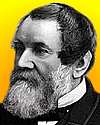
Born 15 Feb 1809; died 13 May 1884 at age 75.
American inventor of the first practical, commercially successful reaping machine. His father had worked unsuccessfully between 1809-1816 to design a reaping machine. He followed his father's lead and by 1831, Cyrus was able to publicly demonstrate a functional machine able to cut a 4-ft swathe. In 1834, he patented his design. To defend his patent against a competitor, in 1843, a widely publicized competition was held between their rival products in which McCormick's machine was judged the better. He sold 29 harvesters that year, 50 the next, and by 1848 he was in business with a factory in Chicago, Illinois, able to produce 500 machines. With production-line assembly, within a few years, McCormick dominated the market.«
American inventor of the first practical, commercially successful reaping machine. His father had worked unsuccessfully between 1809-1816 to design a reaping machine. He followed his father's lead and by 1831, Cyrus was able to publicly demonstrate a functional machine able to cut a 4-ft swathe. In 1834, he patented his design. To defend his patent against a competitor, in 1843, a widely publicized competition was held between their rival products in which McCormick's machine was judged the better. He sold 29 harvesters that year, 50 the next, and by 1848 he was in business with a factory in Chicago, Illinois, able to produce 500 machines. With production-line assembly, within a few years, McCormick dominated the market.«
Cyrus Hall McCormick: His Life and Work, by Herbert N. Casson. - book suggestion.
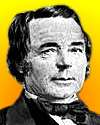
Born 15 Feb 1797; died 7 Feb 1871 at age 73.
German-born American inventor of the overstrung iron-frame grand piano (1859). He began business in Germany, building his first piano in 1836. The Revolution of 1848 caused him to emigrate to America with his wife and sons where they continued innovating and building these instruments. Creating an iron frame design permitted greater string tension without the twisting and stability problems of wood, and he incorporated longer bass strings by orienting them obliquely over the others in his overstrung design. He exhibited this at the N.Y. Industrial Exhibition of 1855, taking first prize, leading to new prosperity. By 1856 he produced his first grand, and in 1862 the first upright. In 1864 he Anglicized his family to become known as Steinway.«
German-born American inventor of the overstrung iron-frame grand piano (1859). He began business in Germany, building his first piano in 1836. The Revolution of 1848 caused him to emigrate to America with his wife and sons where they continued innovating and building these instruments. Creating an iron frame design permitted greater string tension without the twisting and stability problems of wood, and he incorporated longer bass strings by orienting them obliquely over the others in his overstrung design. He exhibited this at the N.Y. Industrial Exhibition of 1855, taking first prize, leading to new prosperity. By 1856 he produced his first grand, and in 1862 the first upright. In 1864 he Anglicized his family to become known as Steinway.«
Steinway & Sons, by Richard K. Lieberman. - book suggestion.
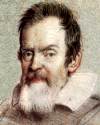
Born 15 Feb 1564; died 8 Jan 1642 at age 77. quotes
Italian natural philosopher who applied the new techniques of the scientific method to make significant discoveries in physics and astronomy. His great accomplishments include perfecting (though not inventing) the telescope and consequent contributions to astronomy. He studied the science of motion, inertia, the law of falling bodies, and parabolic trajectories. His formulation of the scientific method parallel the writings of Francis Bacon. His progress came at a price, when his ideas were in conflict with religious dogma.
Italian natural philosopher who applied the new techniques of the scientific method to make significant discoveries in physics and astronomy. His great accomplishments include perfecting (though not inventing) the telescope and consequent contributions to astronomy. He studied the science of motion, inertia, the law of falling bodies, and parabolic trajectories. His formulation of the scientific method parallel the writings of Francis Bacon. His progress came at a price, when his ideas were in conflict with religious dogma.
Galileo: A Life, by James Reston. - book suggestion.

Died 15 Feb 1999 at age 72 (born 9 Dec 1926).
American nuclear physicist who shared the 1990 Nobel Prize for Physics with Jerome Isaac Friedman and Richard E. Taylor for obtaining experimental evidence for the existence of the subatomic particles known as quarks. To study the internal structure of the proton, they worked with the 3-km linear accelerator recently opened at Stanford (SLAC). Electrons were accelerated to an energy of 20,000 million electronvolts and directed against a target of liquid hydrogen. In 1969 Kendall helped found the Union of Concerned Scientists. In 1997, in connection with the Kyoto Climate Summit, he helped produce a statement signed by 2,000 scientists calling for action on global warming.
American nuclear physicist who shared the 1990 Nobel Prize for Physics with Jerome Isaac Friedman and Richard E. Taylor for obtaining experimental evidence for the existence of the subatomic particles known as quarks. To study the internal structure of the proton, they worked with the 3-km linear accelerator recently opened at Stanford (SLAC). Electrons were accelerated to an energy of 20,000 million electronvolts and directed against a target of liquid hydrogen. In 1969 Kendall helped found the Union of Concerned Scientists. In 1997, in connection with the Kyoto Climate Summit, he helped produce a statement signed by 2,000 scientists calling for action on global warming.
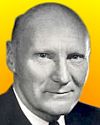
Died 15 Feb 1996 at age 94 (born 6 Sep 1901).
Austrian-American electrical engineer who contributed to the development of microwave technology, applied in radar and communications systems. During WWII, he led researchers solving the problems of accurately measuring very high frequency microwaves, essential for the calibration of radar. (This involved learning how to coat glass tubes with a very thin layer of conducting metal, which Weber derived from the ancient skill of decorating chinaware with gold and silver, followed by success using a mixture of platinum and palladium.). The team created other designs and production techniques that helped the overall development of radar during the war. His expertise later guided the growth of the Polytechnic Institute in New York City.«
Austrian-American electrical engineer who contributed to the development of microwave technology, applied in radar and communications systems. During WWII, he led researchers solving the problems of accurately measuring very high frequency microwaves, essential for the calibration of radar. (This involved learning how to coat glass tubes with a very thin layer of conducting metal, which Weber derived from the ancient skill of decorating chinaware with gold and silver, followed by success using a mixture of platinum and palladium.). The team created other designs and production techniques that helped the overall development of radar during the war. His expertise later guided the growth of the Polytechnic Institute in New York City.«
The Evolution of Electrical Engineering: A Personal Perspective, by Ernst Weber. - book suggestion.
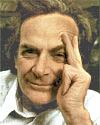
Died 15 Feb 1988 at age 69 (born 11 May 1918). quotes
Richard Philips Feynman was an American theoretical physicist who was probably the most brilliant, influential, and iconoclastic figure in his field in the post-WW II era. By age 15, he had mastered calculus. He took every physics course at MIT. His lifelong interest was in subatomic physics. In 1942, he went to Los Alamos where Hans Bethe made the 24 year old Feynman a group leader in the theoretical division, to work on estimating how much uranium would be needed to achieve critical mass for the Manhattan (atomic bomb) Project. After the war, he developed Feynman Diagrams, a simple notation to describe the complex behavior of subatomic particles. In 1965, he shared (with Julian Schwinger and Shin-ichiro Tomonaga) the Nobel Prize in Physics for work in quantum electrodynamics. more
Richard Philips Feynman was an American theoretical physicist who was probably the most brilliant, influential, and iconoclastic figure in his field in the post-WW II era. By age 15, he had mastered calculus. He took every physics course at MIT. His lifelong interest was in subatomic physics. In 1942, he went to Los Alamos where Hans Bethe made the 24 year old Feynman a group leader in the theoretical division, to work on estimating how much uranium would be needed to achieve critical mass for the Manhattan (atomic bomb) Project. After the war, he developed Feynman Diagrams, a simple notation to describe the complex behavior of subatomic particles. In 1965, he shared (with Julian Schwinger and Shin-ichiro Tomonaga) the Nobel Prize in Physics for work in quantum electrodynamics. more
Genius: The Life and Science of Richard Feynman, by James Gleick. - book suggestion.
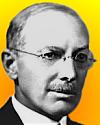
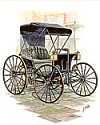
Duryea 1893
James Frank Duryea was an American inventor who with his brother Charles Duryea built the first automobile with multiple copies manufactured in the U.S. On 28 Nov 1895, Frank drove their car to win first prize in the first American Automobile Race in Chicago, held by the Chicago Times-Herald. At 8:55 am, six “motocycles” left Chicago’s Jackson Park for a 54 mile race to Evanston, Illinois and back through the snow. Duryeas’ No.5 took just over 10 hr (ave. 7.3 mph). Early in 1896, the Duryeas manufactured 13 copies of the car. Frank developed the “Stevens-Duryea,” an expensive limousine, which remained in production into the 1920s. The brothers are recognised as “Fathers of the American Automobile Industry.”« more
Charles E. Duryea: Automaker, by George W. May. - book suggestion.
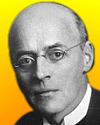
Died 15 Feb 1959 at age 79 (born 26 Apr 1879). quotes
English physicist who was awarded the Nobel Prize for Physics in 1928 for “his work on the thermionic phenomenon [electron emission by hot metals] and especially for the discovery of the law named after him.” This effect is why a heated filament in a vacuum tube releases a current of electrons to travel an anode, which was essential for the development of such applications as radio amplifiers or a TV cathode ray tube. Richardson's law mathematically relates how the electron emission increases as the absolute temperature of the metal surface is raised. He also conducted research on photoelectric effects, the gyromagnetic effect, the emission of electrons by chemical reactions, soft X-rays, and the spectrum of hydrogen.«
English physicist who was awarded the Nobel Prize for Physics in 1928 for “his work on the thermionic phenomenon [electron emission by hot metals] and especially for the discovery of the law named after him.” This effect is why a heated filament in a vacuum tube releases a current of electrons to travel an anode, which was essential for the development of such applications as radio amplifiers or a TV cathode ray tube. Richardson's law mathematically relates how the electron emission increases as the absolute temperature of the metal surface is raised. He also conducted research on photoelectric effects, the gyromagnetic effect, the emission of electrons by chemical reactions, soft X-rays, and the spectrum of hydrogen.«
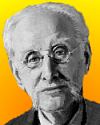
Died 15 Feb 1940 at age 94 (born 31 May 1845).
British engineer and inventor who, as a young man, made a steam road engine (1860) and worked on other steam road haulage projects. When his interests turned to electric lighting, importing then manufacturing arc lamps of his own improved design, he began a career pioneering in the electrical industry, establishing the Crompton Company. By 1883, he had provided public lighting for large buildings, markets and railway stations. His company expanded, making domestic electric appliances (such as for heating and cooking). He was the first important British manufacturer of generators and advocated electrical standardisation. His Kensington Court power station in London was one of the first in the city.« more
British engineer and inventor who, as a young man, made a steam road engine (1860) and worked on other steam road haulage projects. When his interests turned to electric lighting, importing then manufacturing arc lamps of his own improved design, he began a career pioneering in the electrical industry, establishing the Crompton Company. By 1883, he had provided public lighting for large buildings, markets and railway stations. His company expanded, making domestic electric appliances (such as for heating and cooking). He was the first important British manufacturer of generators and advocated electrical standardisation. His Kensington Court power station in London was one of the first in the city.« more
Children of Light: How Electrification Changed Britain Forever, by Gavin Weightman. - book suggestion.
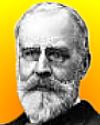
Died 15 Feb 1923 at age 76 (born 19 Feb 1846).
French archaeologist who exposed several archaeological frauds, including the forgeries of Hebrew texts offered (1883) to British Museum by the prolific swindler, Moses W.Shapira; the Moabite potteries in the Imperial Museum, Berlin, and the tiara of Saitarpharnes that had already been purchased by the Louvre, Paris, for 500,000 francs. He described these detective activities in Les Fraudes archeologiques ("Archaeological Frauds", 1885). He directed expeditions in Palestine (1874), Syria, Crete, Egypt, and discovered the site of Gezer (1873-74). In 1870 he discovered the stele of Mesha, a stone bearing the oldest inscription known at that time attributed to Semitic peoples, who left the region because of climatic change.«
French archaeologist who exposed several archaeological frauds, including the forgeries of Hebrew texts offered (1883) to British Museum by the prolific swindler, Moses W.Shapira; the Moabite potteries in the Imperial Museum, Berlin, and the tiara of Saitarpharnes that had already been purchased by the Louvre, Paris, for 500,000 francs. He described these detective activities in Les Fraudes archeologiques ("Archaeological Frauds", 1885). He directed expeditions in Palestine (1874), Syria, Crete, Egypt, and discovered the site of Gezer (1873-74). In 1870 he discovered the stele of Mesha, a stone bearing the oldest inscription known at that time attributed to Semitic peoples, who left the region because of climatic change.«
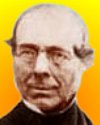
Died 15 Feb 1868 at age 68 (born 19 Mar 1799).
English amateur astronomer who set up a private observatory and made extensive measurements of binary stars and on 25 Nov 1850 discovered Saturn's inner Crepe Ring (independently of American William Bond). In 1864, he was the first to make an accurate map of Mars. He was called "Eagle-eyed Dawes" for the keenness of his sight with a telescope (though otherwise, he was very near-sighted). He devised a useful empirical formula by which the resolving power of a telescope - known as the Dawes limit - could be quickly determined. For a given telescope with an aperture of d cm, a double star of separation 11/d arcseconds or more can be resolved, that is, be visually recognized as two stars rather than one.«
English amateur astronomer who set up a private observatory and made extensive measurements of binary stars and on 25 Nov 1850 discovered Saturn's inner Crepe Ring (independently of American William Bond). In 1864, he was the first to make an accurate map of Mars. He was called "Eagle-eyed Dawes" for the keenness of his sight with a telescope (though otherwise, he was very near-sighted). He devised a useful empirical formula by which the resolving power of a telescope - known as the Dawes limit - could be quickly determined. For a given telescope with an aperture of d cm, a double star of separation 11/d arcseconds or more can be resolved, that is, be visually recognized as two stars rather than one.«
Died 15 Feb 1784 at age 65 (born 9 Oct 1718). quotes
French chemist who wrote the two-volume Dictionnaire de Chymie (1766), the first dictionary of theoretical and general chemistry. He chose to remain anonymous for the first edition as he thought his commission had caused him to write it too hastily, and it was not up to the standard he wanted. However, it was a great success, with reprintings and a revised new edition. Macquer extended Geoffroy’s concept of chemical affinity, and discovered potassium arsenate. He studied Prussian blue (an insoluble artists’ pigment), and devised a new method of dyeing with it, and also decomposed to yield a new acid. Later it was named (by others) as Prussic acid, and identified as hydrogen cyanide.«
French chemist who wrote the two-volume Dictionnaire de Chymie (1766), the first dictionary of theoretical and general chemistry. He chose to remain anonymous for the first edition as he thought his commission had caused him to write it too hastily, and it was not up to the standard he wanted. However, it was a great success, with reprintings and a revised new edition. Macquer extended Geoffroy’s concept of chemical affinity, and discovered potassium arsenate. He studied Prussian blue (an insoluble artists’ pigment), and devised a new method of dyeing with it, and also decomposed to yield a new acid. Later it was named (by others) as Prussic acid, and identified as hydrogen cyanide.«
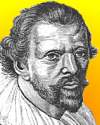
Died 15 Feb 1680 at age 43 (born 12 Feb 1637). quotes
Dutch naturalist, known for his skilled biological microscopical observations and accurate illustrations, who was the first to describe the red blood cells (1658). He studied and illustrated the life histories and anatomy of many species of insects, which he classified on the basis of development. He demonstrated the presence of butterfly wings in caterpillars about to undergo pupation. To facilitate the study of human anatomy, he developed better methods for injecting wax and dyes into cadavers. He was one of the first to dissect under water and to remove fat by organic solvents. He demonstrated experimentally that whereas muscles alter in shape during contraction, their volume is not thereby increased, which contradicted beliefs of the time. «
Dutch naturalist, known for his skilled biological microscopical observations and accurate illustrations, who was the first to describe the red blood cells (1658). He studied and illustrated the life histories and anatomy of many species of insects, which he classified on the basis of development. He demonstrated the presence of butterfly wings in caterpillars about to undergo pupation. To facilitate the study of human anatomy, he developed better methods for injecting wax and dyes into cadavers. He was one of the first to dissect under water and to remove fat by organic solvents. He demonstrated experimentally that whereas muscles alter in shape during contraction, their volume is not thereby increased, which contradicted beliefs of the time. «

In 2013, a meteor exploded in the sky over Russia's Ural Mountains. The intense shock wave injured a reported 1,000 people, most by flying glass fragments. Many people had been at their windows viewing the meteor when the sonic boom shattered the glass panes. It was estimated to be—very approximately—65-ft (20 m) in diameter, with a mass of about 11,000 tons. It entered the Earth's atmosphere at a hypersonic speed of over 42,500 mph (68,400 kph) when it was viewed by residents of Chelyabinsk (a city of 1 million about 930 miles east of Moscow) at about 9:20 am local time, just after sunrise. They saw a thick, white contrail and an intense flash of light ending with a very loud thundering sound. The meteor blew apart with about 440 kilotons of total impact energy (as much as a large atomic bomb).«
In 1972, a U.S. patent was issued for a "Soft Shell Mushroom Shaped Heart" to the inventor Willem J Kolff of Salt Lake City, Utah (No. 3,641,591). He also invented an artificial kidney dialysis machine.«
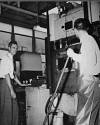
In 1955, the General Electric Co. announced their successful synthesis of 1/16" diamonds using the first reproducible process. The GE Super Pressure Project research team had worked since 1951 to create a special pressure vessel to subject carbon compounds to pressures of up to 1,500,000 lb/sq.in. at temperatures of up to 5,000 °F. They created the first diamonds on 16 Dec 1954, beginning GE’s man-made industrial diamond business. Manufactured diamonds are used as abrasives in masonry saws, mining drill bits, polishing machinery, and cutting tools. (On 16 Feb 1953, a Swedish scientist was the first to create diamonds in an experiment—that was not repeated—and held secret prior to GE's news.)«[Image: Watson-Stillman press used to make GE’s first diamonds]
The Diamond Makers, by Robert M. Hazen. - book suggestion.

In 1954, an ocean exploration depth record of 13,287 feet (4,050 meters, over 2,000 fathoms, or over 2-1/2 miles) in FNRS III was set when two French Navy officers, Lt. Commander Georges Houot and Lt. Pierre Willm, reached the Atlantic Ocean floor, 120 miles southwest of Dakar, Senegal, Africa, in the tropical Atlantic Ocean.The French research submersible they used was untethered and self-propelled, designed by Auguste Piccard, and built by the French Navy. This exceeded Otis Barton's 1948 diving record of 4,500 feet (1,372 meters) off the coast of California in a tethered modified bathysphere.[Image: cutaway view of FNRSIII]
2000 Fathoms Down, by Georges Houot. - book suggestion.

In 1951, the first atomic reactor to be used in medical therapy treated its first patient at the Brookhaven National Laboratory, Upton, NY. The Brookhaven Graphite Research Reactor (BGRR) began the experimental treatment of brain cancer using neutrons from the reactor. In the following two years, ten patients were treated with boron neutron capture therapy (BNCT). The BGRR also supplied radioisotopes for use by other research organizations, including medical uses, among others. The reactor, the world's first dedicated to peaceful exploration of atomic energy operated 1950-68, and was used for research other than medical uses. It was followed by the Brookfield Medical Research Reactor, which reached critically 15 Mar 1959.«
Making Physics: A Biography of Brookhaven National Laboratory, 1946-1972, by Robert P. Crease. - book suggestion.
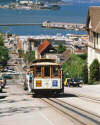
In 1942, operation ceased at the landmark eastern terminus of the original San Francisco street cars, first in the world to be propelled by cable. It had been in use since 1 Aug 1873, having been installed by its English-American inventor, Andrew Smith Hallidie (1836-1900), a pioneer manufacturer of wire cables.
Cable Car Days in San Francisco, by Edgar Myron Kahn. - book suggestion.
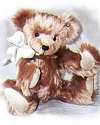
In 1903, the first teddy bear was introduced in America. It was made by Morris and Rose Michtom, Russian immigrants and owners of a toy novelty store in Brooklyn, New York. In the U.S., it is said they connected teddy bear name with President Theodore Roosevelt (also nicknamed “Teddy”). While bear hunting in Mississippi in 1902, Roosevelt decided to spare the life of a bear cub which had been orphaned during the hunt. The event was the subject of a cartoon in the Washington Post seen by the Michtoms. Inspired by the cartoon, Mrs Michtom made a toy bear and upon being displayed as “Teddy's Bear” in the shop window, the bear proved enormously popular with the public.
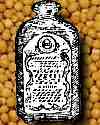
In 1758, mustard was first advertised for sale in America, by Benjamin Jackson who had set up business in Globe Mills, Germantown, Philadelphia, selling mustard packed in glass bottles with his label on them. In the Philadelphia Chronicle, Penn., he claimed to be "the original establisher of the mustard manufactory in American, and ... at present, the only manufacturer on the continent," and that he had brought the art with him from London to America. In his further advertisements he said he "Prepares the genuine Flour of Mustard-seed, of all Degrees of Fineness, in a Manner that renders it preferable to the European, ...and it will keep perfectly good any reasonable Time, even in the hottest Climates, and is not bitter when fresh made."




