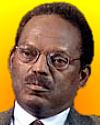
Born 20 Dec 1935.
Black-American sociologist who is a leading scholar of urban poverty. In 1978, in his book The Declining Significance of Race he articulated that class and economics are more important factors than race in the plight of the black urban poor. He cites crime, family dissolution, welfare, and low levels of social organization as fundamental consequences of the disappearance of worthwhile jobs in the inner cities, leading to despair and deterioration. Thus ghetto pathologies are the result of jobless poverty, and he rejects claims that the inner-city poor do not share the same basic values as other Americans. He believes in aggressive solutions such as government jobs, national health care, renewed affirmative action, and suburban-urban consolidation.«
Black-American sociologist who is a leading scholar of urban poverty. In 1978, in his book The Declining Significance of Race he articulated that class and economics are more important factors than race in the plight of the black urban poor. He cites crime, family dissolution, welfare, and low levels of social organization as fundamental consequences of the disappearance of worthwhile jobs in the inner cities, leading to despair and deterioration. Thus ghetto pathologies are the result of jobless poverty, and he rejects claims that the inner-city poor do not share the same basic values as other Americans. He believes in aggressive solutions such as government jobs, national health care, renewed affirmative action, and suburban-urban consolidation.«
The Declining Significance of Race: Blacks and Changing American Institutions, by William Julius Wilson. - book suggestion.
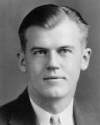
Born 20 Dec 1901; died 16 Jan 1967 at age 65.
American physicist and inventor of the Van de Graaff generator, a type of high-voltage electrostatic generator that can be used as a particle accelerator in atomic research. The potential differences achieved in modern Van de Graaff generators can be up to 5 MV. It is a principle of electric fields that charges on a surface can leap off at points where the curvature is great, that is, where the radius is small. Thus, a dome of great radius will inhibit the electric discharge and added charge can reach a high voltage. This generator has been used in medical (such as high-energy X-ray production) and industrial applications (sterilization of food). In the 1950s, Van de Graaff invented the insulating core transformer able to produce high voltage direct current.«
American physicist and inventor of the Van de Graaff generator, a type of high-voltage electrostatic generator that can be used as a particle accelerator in atomic research. The potential differences achieved in modern Van de Graaff generators can be up to 5 MV. It is a principle of electric fields that charges on a surface can leap off at points where the curvature is great, that is, where the radius is small. Thus, a dome of great radius will inhibit the electric discharge and added charge can reach a high voltage. This generator has been used in medical (such as high-energy X-ray production) and industrial applications (sterilization of food). In the 1950s, Van de Graaff invented the insulating core transformer able to produce high voltage direct current.«
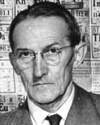
Born 20 Dec 1890; died 27 Mar 1967 at age 76.
Czech chemist who received the 1959 Nobel Prize for Chemistry "for his discovery and development of the polarographic methods of analysis" (1922), which is one of the most versatile analytical techniques. It applies the principle that in electrolysis the ions are discharged at an electrode and, if the electrode is small, the current may be limited by the rate of movement of ions to the electrode surface. In polarography the cathode is a small drop of mercury (constantly forming and dropping to keep the surface clean). The voltage is increased slowly and the current plotted against voltage. The current increases in steps, each corresponding to a particular type of positive ion in the solution. The height of the steps indicates the concentration of the ion.«
Czech chemist who received the 1959 Nobel Prize for Chemistry "for his discovery and development of the polarographic methods of analysis" (1922), which is one of the most versatile analytical techniques. It applies the principle that in electrolysis the ions are discharged at an electrode and, if the electrode is small, the current may be limited by the rate of movement of ions to the electrode surface. In polarography the cathode is a small drop of mercury (constantly forming and dropping to keep the surface clean). The voltage is increased slowly and the current plotted against voltage. The current increases in steps, each corresponding to a particular type of positive ion in the solution. The height of the steps indicates the concentration of the ion.«
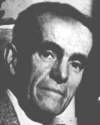
Born 20 Dec 1876; died 11 May 1956 at age 79.
Walter Sydney Adams was an American astronomer who is best known for his spectroscopic studies of sunspots, the rotation of the Sun, the velocities and distances of thousands of stars, and planetary atmospheres. He found (with Arnold Kohlschütter) that the relative intensities of stallar spectral lines depend on the absolute luminosities of the star, which in turn provides a spectroscopic method of determining stellar distances.By this method, he measured distances to hundreds of giant and main sequence stars. Adams identified Sirius B as the first white dwarf star known, and his measurement of its gravitational redshift was confirming evidence for the general theory of relativity. He was director of Mount Wilson (1923-46).«
Walter Sydney Adams was an American astronomer who is best known for his spectroscopic studies of sunspots, the rotation of the Sun, the velocities and distances of thousands of stars, and planetary atmospheres. He found (with Arnold Kohlschütter) that the relative intensities of stallar spectral lines depend on the absolute luminosities of the star, which in turn provides a spectroscopic method of determining stellar distances.By this method, he measured distances to hundreds of giant and main sequence stars. Adams identified Sirius B as the first white dwarf star known, and his measurement of its gravitational redshift was confirming evidence for the general theory of relativity. He was director of Mount Wilson (1923-46).«
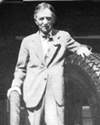
Born 20 Dec 1868; died 7 Feb 1938 at age 69.
Harvey S(amuel) Firestone was an American industrialist who developed straight-side pneumatic tyres used on the Model T Fords. In his early career, from 1893, he had made his living selling buggies in Detroit, Michigan. Subsequently he moved to Akron, Ohio, and started the Firestone Tire and Rubber Company in 1900. His success grew when, in 1906, he teamed up with Henry Ford to provide tyres for his popular Model T cars. By the late 1930's, nearly a quarter of all tyres being used in the United States were made by Firestone. His innovations in the industry changed the design and production of pneumatic tyres, including nonskid tyre treads, low-pressure balloon tyres, and farm tractor tyres.«
Harvey S(amuel) Firestone was an American industrialist who developed straight-side pneumatic tyres used on the Model T Fords. In his early career, from 1893, he had made his living selling buggies in Detroit, Michigan. Subsequently he moved to Akron, Ohio, and started the Firestone Tire and Rubber Company in 1900. His success grew when, in 1906, he teamed up with Henry Ford to provide tyres for his popular Model T cars. By the late 1930's, nearly a quarter of all tyres being used in the United States were made by Firestone. His innovations in the industry changed the design and production of pneumatic tyres, including nonskid tyre treads, low-pressure balloon tyres, and farm tractor tyres.«
Men and Rubber: The Story of Business, by Harvey S. Firestone. - book suggestion.
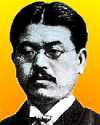
Born 20 Dec 1852; died 13 Jun 1931 at age 78.
Japanese bacteriologist who, with Alexandre Yersin, co-discovered the infectious agent of bubonic plague, Pasteurella pestis (now called Yersinia pestis), during an epidemic in Hong Kong (1894). During 1885-91, as a bacteriologist at Robert Koch's laboratory in Germany, he worked with Emil von Behring on tetanus and diphtheria, demonstrating the value of antitoxin in conferring passive immunity. They showed that nonimmune animals, injected with increasing sublethal doses of tetanus toxin, became resistant to the disease. Their milestone paper laid the basis for all future treatment with antitoxins and founded the new field of serology. In 1898, he isolated the microorganism that causes dysentery.«Name also spelled Kitazato. Date of birth: DSB gives 20 Dec 1852; Enc. Brit. gives 29 Jan 1853.
Japanese bacteriologist who, with Alexandre Yersin, co-discovered the infectious agent of bubonic plague, Pasteurella pestis (now called Yersinia pestis), during an epidemic in Hong Kong (1894). During 1885-91, as a bacteriologist at Robert Koch's laboratory in Germany, he worked with Emil von Behring on tetanus and diphtheria, demonstrating the value of antitoxin in conferring passive immunity. They showed that nonimmune animals, injected with increasing sublethal doses of tetanus toxin, became resistant to the disease. Their milestone paper laid the basis for all future treatment with antitoxins and founded the new field of serology. In 1898, he isolated the microorganism that causes dysentery.«Name also spelled Kitazato. Date of birth: DSB gives 20 Dec 1852; Enc. Brit. gives 29 Jan 1853.
Plague: A Story of Rivalry, Science, and the Scourge That Won't Go Away, by Edward Marriott. - book suggestion.
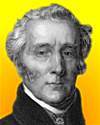
Born 20 Dec 1847; died 17 May 1895 at age 47. quotes
American civil engineer, writer and editor whose fame was based on writing The Economic Theory of the Location of Railways, which was issued in book form in 1887, but was first published as series of articles in the Railway Gazette beginning in 1876. He had acquired his engineering skills beginning as an apprentice at age 16. His first employment was with the engineering corps of the Brooklyn Park Department under Frederick Law Olmsted. From 1868, he turned to railway work, and over a number of years rose from being a transitman for the Blue Ridge R.R. to engineer-in-charge of the Toledo, Canada Southern and Detroit railroad. He gained futher public recognition from his work and writings on the editorial staff of the Railway Gazette (1884-87) and thereafter an industrious editor-in-chief and part-owner of The Engineering News.«
American civil engineer, writer and editor whose fame was based on writing The Economic Theory of the Location of Railways, which was issued in book form in 1887, but was first published as series of articles in the Railway Gazette beginning in 1876. He had acquired his engineering skills beginning as an apprentice at age 16. His first employment was with the engineering corps of the Brooklyn Park Department under Frederick Law Olmsted. From 1868, he turned to railway work, and over a number of years rose from being a transitman for the Blue Ridge R.R. to engineer-in-charge of the Toledo, Canada Southern and Detroit railroad. He gained futher public recognition from his work and writings on the editorial staff of the Railway Gazette (1884-87) and thereafter an industrious editor-in-chief and part-owner of The Engineering News.«
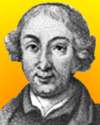
Born 20 Dec 1648; died 3 Feb 1737 at age 88.
Italian mathematician, poet, and brother of the mathematician Giovanni Ceva. At the age of fifteen he entered the Society of Jesus. His education was entirely within the Jesuit Order and he obtained a degree in theology. His first scientific work, De natura gravium (1669), dealt with physical subjects, such as gravity and free fall, in a philosophical way. Tommaso Ceva's mathematical work is summed up in Opuscula Mathematica (1699) which examines geometry (geometric-harmonic means, the cycloid, and conic sections), gravity and arithmetic. He also designed an instrument to divide a right angle into a given number of equal parts. He gave the greater part of his time to writing Latin prose. His poem Jesus Puer was translated into many languages.«
Italian mathematician, poet, and brother of the mathematician Giovanni Ceva. At the age of fifteen he entered the Society of Jesus. His education was entirely within the Jesuit Order and he obtained a degree in theology. His first scientific work, De natura gravium (1669), dealt with physical subjects, such as gravity and free fall, in a philosophical way. Tommaso Ceva's mathematical work is summed up in Opuscula Mathematica (1699) which examines geometry (geometric-harmonic means, the cycloid, and conic sections), gravity and arithmetic. He also designed an instrument to divide a right angle into a given number of equal parts. He gave the greater part of his time to writing Latin prose. His poem Jesus Puer was translated into many languages.«
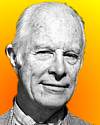
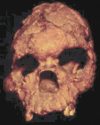
U.S. physical anthropologist who specialized in the establishment of population relationships through physical measurement. During World War II, Howells served in the U.S. Office of Naval Intelligence. Howells pioneered the use of quantitative methods in the formulation and solution of morphological problems, particularly his use of cranial measurements in world population studies. His authoritative book, Cranial Variation in Man, compared skull measurements from 17 distinct world populations. He is also known for his work in developing anthropological curricula and his popular books in the field, which have been widely translated and are extensively used in the classroom.[Image: Australian hominid fossil skull.]
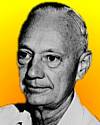
Died 20 Dec 2002 at age 90 (born 22 Dec 1911). quotes
U.S. amateur astronomer and radio engineer who self-financed and built the first radio telescope. He pioneered the new field of radio astronomy, and was the first to systematically study the sky by observing non-visible radiation. After reading about Jansky's discovery (1932) of natural radio emissions from space, Reber constructed a 9-meter dish antenna in his back yard and built three different detectors before finding 160 MHz signals (1939). In 1940 and 1944 he published articles titled Cosmic Static in the Astrophysical Journal. He was the first to express received radio signals in terms of flux density and brightness, first to find evidence that galactic radiation is non-thermal, and first to produce radio maps of the sky (1941).«
U.S. amateur astronomer and radio engineer who self-financed and built the first radio telescope. He pioneered the new field of radio astronomy, and was the first to systematically study the sky by observing non-visible radiation. After reading about Jansky's discovery (1932) of natural radio emissions from space, Reber constructed a 9-meter dish antenna in his back yard and built three different detectors before finding 160 MHz signals (1939). In 1940 and 1944 he published articles titled Cosmic Static in the Astrophysical Journal. He was the first to express received radio signals in terms of flux density and brightness, first to find evidence that galactic radiation is non-thermal, and first to produce radio maps of the sky (1941).«
It Doesn't Take a Rocket Scientist: Great Amateurs of Science, by John Malone. - book suggestion.
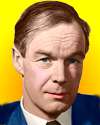
Died 20 Dec 1998 at age 84 (born 5 Feb 1914). quotes
Alan Lloyd Hodgkin was an English physiologist and biophysicist who shared (with his countryman Sir Andrew Huxley and Australian scientist Sir John Eccles) the Nobel Prize for Physiology or Medicine in 1963, for the discovery of the chemical processes involved in nerve conduction, more specifically, discoveries concerning the ionic mechanisms involved in excitation and inhibition in the peripheral and central portions of the nerve cell membrane. Hodgkin and Huxley performed their work on the so-called giant axon of Atlantic squid, Loligo pealei, which enabled them to record ionic currents, which would otherwise have not been possible in almost any other neuron, such cells being too small to study by the techniques of the time.«
Alan Lloyd Hodgkin was an English physiologist and biophysicist who shared (with his countryman Sir Andrew Huxley and Australian scientist Sir John Eccles) the Nobel Prize for Physiology or Medicine in 1963, for the discovery of the chemical processes involved in nerve conduction, more specifically, discoveries concerning the ionic mechanisms involved in excitation and inhibition in the peripheral and central portions of the nerve cell membrane. Hodgkin and Huxley performed their work on the so-called giant axon of Atlantic squid, Loligo pealei, which enabled them to record ionic currents, which would otherwise have not been possible in almost any other neuron, such cells being too small to study by the techniques of the time.«
Chance and Design: Reminiscences of Science in Peace and War, by Alan Hodgkin. - book suggestion.

Died 20 Dec 1996 at age 62 (born 9 Nov 1934). quotes
U.S. astronomer and exobiologist and writer of popular science books. His studies were far-ranging. He coauthored a scientific paper about the dangers of nuclear winter. He researched the atmosphere of Venus, seasonal changes on Mars, surface conditions on planets, and created popular interest in the universe with his television series Cosmos. Sagan was a leading figure in the search for extraterrestrial intelligence. He urged the scientific community to listen with large radio telescopes for signals from intelligent extraterrestrial lifeforms. Sagan also played a prominent role in the U.S. space program, with his involvement in the Mariner, Viking, and Voyager spacecraft expeditions.«
U.S. astronomer and exobiologist and writer of popular science books. His studies were far-ranging. He coauthored a scientific paper about the dangers of nuclear winter. He researched the atmosphere of Venus, seasonal changes on Mars, surface conditions on planets, and created popular interest in the universe with his television series Cosmos. Sagan was a leading figure in the search for extraterrestrial intelligence. He urged the scientific community to listen with large radio telescopes for signals from intelligent extraterrestrial lifeforms. Sagan also played a prominent role in the U.S. space program, with his involvement in the Mariner, Viking, and Voyager spacecraft expeditions.«
Carl Sagan: A Life in the Cosmos, by William Poundstone. - book suggestion.
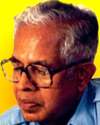
Died 20 Dec 1994 at age 71 (born 16 Oct 1923). quotes
Ceylonese-American chemist and exobiologist, who was a leading authority on the chemical origins of life. He built on the work of Miller and Clayton Urey studying chemical reactions in “primordial soup” experiments. Ponnamperuma focused on producing compounds related to the nucleic acids and offered a convincing theory about series of chemical reactions that gave rise to precursors of life on earth. He demonstrated that nucleotides and dinucleotides can be formed by random processes alone. In another achievement, he showed the formation of ATP, a compound critical to the use of energy within a cell. He was also active in the growing field of exobiology, the study of possible extraterrestrial life and studied lunar soil and meteorites.«
Ceylonese-American chemist and exobiologist, who was a leading authority on the chemical origins of life. He built on the work of Miller and Clayton Urey studying chemical reactions in “primordial soup” experiments. Ponnamperuma focused on producing compounds related to the nucleic acids and offered a convincing theory about series of chemical reactions that gave rise to precursors of life on earth. He demonstrated that nucleotides and dinucleotides can be formed by random processes alone. In another achievement, he showed the formation of ATP, a compound critical to the use of energy within a cell. He was also active in the growing field of exobiology, the study of possible extraterrestrial life and studied lunar soil and meteorites.«
Origins of Life, by Cyril Ponnamperuma. - book suggestion.
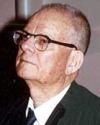
c. 1980
Died 20 Dec 1993 at age 93 (born 14 Oct 1900). quotes
William Edwards Deming was an American statistician, known as the father of “Total Quality Management.” After WW II, he contributed to Japan’s economic recovery by recommending statistical methods of quality control in industrial production. His method embraced carefully tallying product defects, examining their causes, correcting the problems, and then tracking the results of these changes on subsequent product quality. In his career before the war, he had developed statistical sampling techniques that were first used in the 1940 U.S. census. From the 1980s in the U.S. Deming taught quality control through the statistical control of manufacturing processes for companies such as Ford, Xerox, and GM.«
William Edwards Deming was an American statistician, known as the father of “Total Quality Management.” After WW II, he contributed to Japan’s economic recovery by recommending statistical methods of quality control in industrial production. His method embraced carefully tallying product defects, examining their causes, correcting the problems, and then tracking the results of these changes on subsequent product quality. In his career before the war, he had developed statistical sampling techniques that were first used in the 1940 U.S. census. From the 1980s in the U.S. Deming taught quality control through the statistical control of manufacturing processes for companies such as Ford, Xerox, and GM.«
The Man Who Discovered Quality, by Andrea Gabor. - book suggestion.
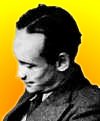
Died 20 Dec 1962 at age 64 (born 3 Mar 1898). quotes
Austro-German mathematician who worked in algebraic number theory, made a major contribution to field theory, and stated a law of reciprocity which included all previously known laws of reciprocity (1927). He also worked on the theory of braids (1925), and on rings with the minimum condition on right ideals, now called Artinian rings (1944). Artin has the distinction of solving (1927) one of the famous 23 problems previously posed by Hilbert in 1900. With his Jewish wife, he left Nazi Germany in 1937, and worked at universities in the U.S. until 1956, when he returned to his home country.«
Austro-German mathematician who worked in algebraic number theory, made a major contribution to field theory, and stated a law of reciprocity which included all previously known laws of reciprocity (1927). He also worked on the theory of braids (1925), and on rings with the minimum condition on right ideals, now called Artinian rings (1944). Artin has the distinction of solving (1927) one of the famous 23 problems previously posed by Hilbert in 1900. With his Jewish wife, he left Nazi Germany in 1937, and worked at universities in the U.S. until 1956, when he returned to his home country.«
Galois Theory (Notre Dame Mathematical Lectures), by Emil Artin, et al. - book suggestion.
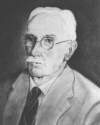
Died 20 Dec 1953 at age 84 (born 19 May 1869).
Irish botanist who, with John Joly, investigated plant transpiration and originated the tension theory of sap ascent in trees (1894) building on the work of Eduard Strasburger, François Donny and Berthelot. Dixon's earlier work was in cytology and had developed sterile culture methods for seedlings (1892). After the 1894 publication, he made further transpiration experiments to consolidate his theory which he published in 1909 and 1914. He resolved the debate over the mechanism of xylem transport by proposing a compromise between the pulling power of the leaf and the tensile strength of the water columns. From 1910, he was curator of a new herbarium at Trinity College Dublin.«
Irish botanist who, with John Joly, investigated plant transpiration and originated the tension theory of sap ascent in trees (1894) building on the work of Eduard Strasburger, François Donny and Berthelot. Dixon's earlier work was in cytology and had developed sterile culture methods for seedlings (1892). After the 1894 publication, he made further transpiration experiments to consolidate his theory which he published in 1909 and 1914. He resolved the debate over the mechanism of xylem transport by proposing a compromise between the pulling power of the leaf and the tensile strength of the water columns. From 1910, he was curator of a new herbarium at Trinity College Dublin.«
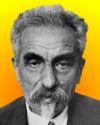
Died 20 Dec 1934 at age 69 (born 6 Jan 1865).
Russian archaeologist, ethnographer and linguist, who contributed to the language studies and archaeology of the Caucasus. In the 1930s, his "theory of the staging" (1929) led the archaeology of the USSR. This theory held that it is possible to reconstruct a social and an economical situation in the ancient societies by investigating only material finds on the base of the marxists so called "rise method". In this method the material is investigated by separation of groups which have social and functional meaning, (by these investigations). In his study of the Caucasian, Afro-Asiatic and Basque languages, his nonsensical Japhetic Theory that all languages of the world derived from an original set of four monosyllables: sal, ber, yon, rosh.«
Russian archaeologist, ethnographer and linguist, who contributed to the language studies and archaeology of the Caucasus. In the 1930s, his "theory of the staging" (1929) led the archaeology of the USSR. This theory held that it is possible to reconstruct a social and an economical situation in the ancient societies by investigating only material finds on the base of the marxists so called "rise method". In this method the material is investigated by separation of groups which have social and functional meaning, (by these investigations). In his study of the Caucasian, Afro-Asiatic and Basque languages, his nonsensical Japhetic Theory that all languages of the world derived from an original set of four monosyllables: sal, ber, yon, rosh.«
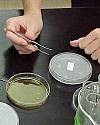
Died 20 Dec 1921 at age 69 (born 31 May 1852).
German physician and bacteriologist, remembered for his name given to the Petri dish. This is a shallow, cylindrical dish made of plastic or glass with a cover, used for tissue cultures and to hold solid media for culturing and sub-culturing bacteria. Petri developed it for a technique for cloning bacterial strains using an agar slope and sub-culturing onto his dish, recognizing different bacterial colonies and again sub-culturing. He was in his later days a rather vain, overweight man, who dressed in the uniform of chief army doctor whenever the opportunity presented itself. One observer remarked that the sash around his protuberant abdomen reminded him of the equator around the globe.«
German physician and bacteriologist, remembered for his name given to the Petri dish. This is a shallow, cylindrical dish made of plastic or glass with a cover, used for tissue cultures and to hold solid media for culturing and sub-culturing bacteria. Petri developed it for a technique for cloning bacterial strains using an agar slope and sub-culturing onto his dish, recognizing different bacterial colonies and again sub-culturing. He was in his later days a rather vain, overweight man, who dressed in the uniform of chief army doctor whenever the opportunity presented itself. One observer remarked that the sash around his protuberant abdomen reminded him of the equator around the globe.«
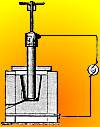
Patent diagram
Died 20 Dec 1915 at age 55 (born 14 Mar 1860).
Thomas Leopold Willson was a Canadian-American chemist and inventor who discovered a commercial production method for calcium carbide using an electric arc furnace. In 1893, he started a company with John Motley Morehead III in Spray, North Carolina, to try his ideas to obtain aluminium metal from its oxide. On 2 May 1892, he was using an electric arc furnace with coal tar and burnt chalk (lime). An unexpected dark, solid mass was formed. On cooling with water, a gas was given off. This burned with a bright yellow, smoky flame. Analysis showed these were calcium carbide and acetylene. Unlike the earlier method of Wöhler that made calcium carbide in an amorphous form, Willson had a hard, aggregated crystalline form. He obtained (and defended) patents on his process. He assigned them to the Electro Gas Co. (which became Union Carbide Corp.) His other inventions included gas navigational buoys and electric arc lighting. He established calcium carbide manufacturing in Canada.«
Thomas Leopold Willson was a Canadian-American chemist and inventor who discovered a commercial production method for calcium carbide using an electric arc furnace. In 1893, he started a company with John Motley Morehead III in Spray, North Carolina, to try his ideas to obtain aluminium metal from its oxide. On 2 May 1892, he was using an electric arc furnace with coal tar and burnt chalk (lime). An unexpected dark, solid mass was formed. On cooling with water, a gas was given off. This burned with a bright yellow, smoky flame. Analysis showed these were calcium carbide and acetylene. Unlike the earlier method of Wöhler that made calcium carbide in an amorphous form, Willson had a hard, aggregated crystalline form. He obtained (and defended) patents on his process. He assigned them to the Electro Gas Co. (which became Union Carbide Corp.) His other inventions included gas navigational buoys and electric arc lighting. He established calcium carbide manufacturing in Canada.«
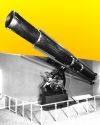
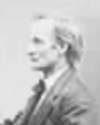
Elder son in the American family of telescope makers and astronomers, Alvan Clark & Sons of Cambridge, Mass., who figured importantly in the great expansion of astronomical facilities which occurred during the second half of the 19th century. Before the family business began, George made a telescope in 1844 out of the melted-down brass of his school's broken dinner bell. His father, Alvan Clark, was at the time an established portrait painter, but his son's interest also spurred his father to begin making refractor telescopes. (Refractor telescopes use paired lenses to focus light.) The father taught himself to be a master optician, and eventually in business with his sons made the finest refractor telescopes of their time including five of the world's largest.«Images (left) Dearborn Telescope, circa 1864; (right): George Bassett Clark
Alvan Clark & Sons, Artists in Optics, by Warner and Ariail. - book suggestion.
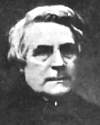
c. 1850
Died 20 Dec 1877 at age 74 (born 15 Jan 1803).
German mechanic, instrument maker and inventor who devised the Ruhmkorff coil, his version of the induction coil (after Nicholas Joseph Callan's earlier invention of 1836). Ruhmkorff's induction coil could produce sparks over 1 ft (30 cm) in length, and became popular for energizing discharge tubes, especially those for generating X-rays (discovered by Wilhelm Röntgen, on 8 Nov 1895). The device uses a primary coil and iron core concentric with a secondary coil with a large number of turns. By using a contact breaker giving abrupt and rapid interruptions in the primary coil current, a concentrated, changing magnetic field produced a high voltage in the secondary coil. He also invented a thermo-electric battery in 1844.«
German mechanic, instrument maker and inventor who devised the Ruhmkorff coil, his version of the induction coil (after Nicholas Joseph Callan's earlier invention of 1836). Ruhmkorff's induction coil could produce sparks over 1 ft (30 cm) in length, and became popular for energizing discharge tubes, especially those for generating X-rays (discovered by Wilhelm Röntgen, on 8 Nov 1895). The device uses a primary coil and iron core concentric with a secondary coil with a large number of turns. By using a contact breaker giving abrupt and rapid interruptions in the primary coil current, a concentrated, changing magnetic field produced a high voltage in the secondary coil. He also invented a thermo-electric battery in 1844.«
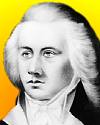
Died 20 Dec 1792 (born Mar 1743).
American inventor who designed one of the earliest steam-powered boats. He used a steam engine to drive a great force pump to thrust a stream of water aft, thus propelling the boat forward (as proposed earlier by Daniel Bernoulli). George Washington was impressed upon viewing one of Rumsey's early models on the Potomac River. Washington wrote a certificate as an eye-witness dated 7 Sep 1784. Rumsey continued development, and made his work public with a demonstration on 3 Dec 1787. In 1788 he moved to England to seek patrons and patents there, leaving his friends to obtain U.S. patents for him (1791). With limited funds he spent four years building his Columbia Maid, but died in London a few months before its completion.«
American inventor who designed one of the earliest steam-powered boats. He used a steam engine to drive a great force pump to thrust a stream of water aft, thus propelling the boat forward (as proposed earlier by Daniel Bernoulli). George Washington was impressed upon viewing one of Rumsey's early models on the Potomac River. Washington wrote a certificate as an eye-witness dated 7 Sep 1784. Rumsey continued development, and made his work public with a demonstration on 3 Dec 1787. In 1788 he moved to England to seek patrons and patents there, leaving his friends to obtain U.S. patents for him (1791). With limited funds he spent four years building his Columbia Maid, but died in London a few months before its completion.«
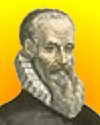
Died 20 Dec 1590 (born 1510). quotes
French physician, one of the greatest surgeons of the European Renaissance, known as the "father of modern surgery" for his many innovations in operative methods. While an army surgeon, he introduced the method of treating wounds by ligature of arteries instead of cauterisation with red-hot irons or boiling oil. Paré also invented prostheses. "Le Petit Lorrain" was a hand, operated by springs and catches, for a French Army Captain, which he then used in battle. Paré also invented a kneeling peg leg and foot prosthesis. It had an adjustable harness, knee lock control, and other engineering features used today. He was surgeon to Henry II and his three successors. He wrote books on anatomy, surgery, plague, obstetrics, and deformities.« more
French physician, one of the greatest surgeons of the European Renaissance, known as the "father of modern surgery" for his many innovations in operative methods. While an army surgeon, he introduced the method of treating wounds by ligature of arteries instead of cauterisation with red-hot irons or boiling oil. Paré also invented prostheses. "Le Petit Lorrain" was a hand, operated by springs and catches, for a French Army Captain, which he then used in battle. Paré also invented a kneeling peg leg and foot prosthesis. It had an adjustable harness, knee lock control, and other engineering features used today. He was surgeon to Henry II and his three successors. He wrote books on anatomy, surgery, plague, obstetrics, and deformities.« more
Ambroise Pare: Surgeon of the Renaissance, by Wallace B. Hamby. - book suggestion.
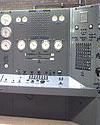
In 1951, at 1:50 p.m., the first electricity ever generated by atomic power began flowing from the EBR-1 turbine generator when Walter Zinn and his Argonne National Laboratory staff of scientists brought EBR-1 to criticality (a controlled, self-sustaining chain reaction) with a core about the size of a football. The reactor was started up and the power gradually increased over several hours. The next day, Experimental Breeder Reactor-1 generated enough electricity to supply all the power for its own building. Additional power and core experiments were then conducted until its decommissioning in Dec 1963. Construction began in 1949, between Idaho Falls and Arco, Idaho. Today, EBR-1 is a Registered National Historic Landmark. Other reactors are at the site.Image: part of the EBR-1 control room.
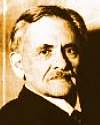
In 1907, the first U.S. scientist to receive the Nobel Prize was Albert Michelson, a German-born American physicist who received the Nobel Prize for Physics “for his optical precision instruments and the spectroscopic and metrological investigations.” He designed the highly accurate Michelson interferometer and used it to accurately measure the speed of light and establish it as a fundamental constant. In 1887, with Edward Morley, he also used it in an attempt to measure the velocity of the earth through the ether (yielding null results that later led Albert Einstein to his theory of relativity). He measured the standard meter bar in Paris to be 1,553,163.5 wavelengths of the red cadmium line (1892-3).«
The Master of Light: A biography of Albert A. Michelson, by Dorothy Michelson Livingston. - book suggestion.
1998
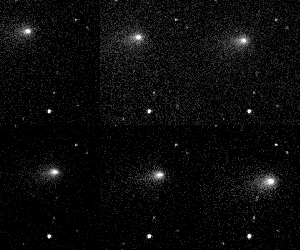
In 1900, Michel Giacobini in France discovered a comet, which was rediscovered by a German, Ernst Zinner, on 23 Oct 1913, and since named the Giacobini-Zinner comet. It returns to the vicinity of the earth every six and two-thirds years. This comet became the first to be visited by a spacecraft. On 11 Sep 1985, the International Cometary Explorer (ICE) flew through its gas tail, 7,800-km downstream from the nucleus, at a speed of 21 km/sec. The nucleus was estimated to be 2.5-km across at its widest diameter. Instruments detected carbon monosulfide and hydroxyl molecules in the comet. The comet is the progenitor of the Draconid meteor shower, visible annually in early October, which produced intense meteor displays in 1933 and 1946.

In 1900, Nature reported the Musical Arcs invented by William Du Bois Duddell, an English physicist. By means of an arrangement of electric currents he produced a musical note from an arc lamp that could be altered to any pitch is obtained and a tune played. This may be regarded as the first fully electric instrument. While investigating the noise produced by the operation of carbon arc lamps - anything from a low hum to a high-pitched whistle - he found that adding resonance circuits adjusted the pitch of the sounds. His Singing Arc demonstrated this phenomenon using a keyboard connected to an arc lamp, giving audible results without any amplifier. He toured the country with his Singing Arc, as a novelty performance.«* more
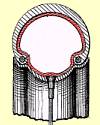
In 1892, the first U.S. patent issued for a pneumatic automobile tire that could readily and easily be detached or mounted to the rim of a wheel. The inventors were Alexander T. Brown and George Stillman of Syracuse, New York (No. 488494). They claimed as their improvement a wheel with an exterior grooved rim with flanges to retain a tire with an inflatable tube. Peripheral metal bands embedded in the tire are designed to form a bead that will be forced by air pressure upon inflation to be seated and retained in the grooved rim. Thus no permanent connection between the tire and the wheel is necessary, and no tools for tightening are required, other than those used for inflation.[Image: a cross section of the tire and wheel]
1894
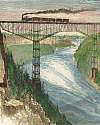
In 1883, the international cantilever railway bridge at Niagara Falls was opened with a ceremony before a gathered crowd estimated at more than 10,000 persons. Atop each of two steel towers, two cantilever arms were built, one reaching the shore while the other reached over the gorge, then an ordinary truss bridged the gap between the cantilevers. The bridge span was 495-ft, carrying a double track railway 240-ft above the Niagara River, with weight capacity for two trains. Construction took from 15 Apr 1883 to 1 Dec 1883. This Michigan Central Railway Bridge remained in operation for more than 40 years until replaced by the present stronger steel arch bridge to carry heavier modern trains.«
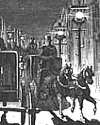
In 1880, New York's Broadway was first lighted by electricity and became known as the “Great White Way.” Charles F. Brush successfully demonstrated his arc lamps along Broadway. His arc lights preceded Edison's incandescent light bulb in commercial use. Arc lights were suited to applications where a bright light was needed, such as street lights and lighting in commercial and public buildings.[Image: detail from the cover of the Scientific American issue of 2 Apr 1881.]
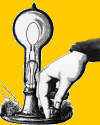
In 1879, Thomas A. Edison privately demonstrated his incandescent light at Menlo Park, New Jersey. He had invented the lamp on 21 Oct 1879 after 13 months of experimentation to discover a suitable material for the filament. He found carbonized cotton filaments could operate for 40 hours in a vacuum inside a glass bulb. When the first public demonstration was given at Menlo Park on 31 Dec 1879, the Pennsylvania Railroad Company ran special trains there to enable the public to view the demonstration.
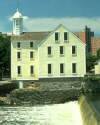
In 1790, the first successful cotton spinning machines built using American resources began production of cotton yarn in Pawtucket, Rhode Island. Samuel Slater was first in the U.S. to reliably duplicate British cotton spinning machines. Slater had emigrated secretly from England (1789) with details of Richard Arkwight's machines memorized while an apprentice in a mill. His partner, who supplied the capital, was Moses Brown, a Rhode Island manufacturer, who needed to replace deteriorating English equipment. This success led to more expansion. They opened another new mill in Jul 1793 on the Blackstone River [left]. A new dam provided water power. This is Samuel Slater Day in Mass., to recognize the beginnings of America's own textile industry.
Slater Mill, RI (Images of America), by Sarah Leavitt. - book suggestion.





