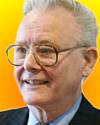
Born 9 Oct 1933; died 8 Feb 2017 at age 83.
English physicist who, at age 70, shared the 2003 Nobel Prize in Physiology or Medicine with Paul Lauterbur for discoveries leading to magnetic resonance imaging (MRI). His work transformed MRI from theory to a practical diagnostic tool that revolutionized medicine. Mansfield developed rapid imaging techniques that made scans of the brain and other organs possible, and he was the first person to undergo an MRI scan himself. In MRI, patients lie within a strong magnetic field while radio waves excite atomic nuclei; the re-emitted signals, mainly from hydrogen in water, reveal the body’s blood vessels, muscles, organs and other internal structures. Differences in water content allow doctors to detect diseaed tissue, tumors and brain abnormalities with remarkable precision.«
English physicist who, at age 70, shared the 2003 Nobel Prize in Physiology or Medicine with Paul Lauterbur for discoveries leading to magnetic resonance imaging (MRI). His work transformed MRI from theory to a practical diagnostic tool that revolutionized medicine. Mansfield developed rapid imaging techniques that made scans of the brain and other organs possible, and he was the first person to undergo an MRI scan himself. In MRI, patients lie within a strong magnetic field while radio waves excite atomic nuclei; the re-emitted signals, mainly from hydrogen in water, reveal the body’s blood vessels, muscles, organs and other internal structures. Differences in water content allow doctors to detect diseaed tissue, tumors and brain abnormalities with remarkable precision.«
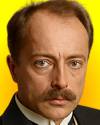
(1929)
Born 9 Oct 1879; died 23 Apr 1960 at age 80. quotes
Max Theodor Felix von Laue was a German physicist whose discovery of X-ray diffraction in crystals earned him the 1914 Nobel Prize in Physics. His experiment proved that X-rays are waves, and that crystals have a regular atomic lattice capable of diffracting them. This achievement opened the way for determining atomic structures, founding modern crystallography and laying the cornerstone for solid-state physics and materials science. Laue also made contributions to relativity theory, optics, and superconductivity. A principled opponent of Nazism, he defended scientific integrity, supported persecuted colleagues, and later helped rebuild and guide German science after World War II, inspiring a new generation of physicists worldwide.«
Max Theodor Felix von Laue was a German physicist whose discovery of X-ray diffraction in crystals earned him the 1914 Nobel Prize in Physics. His experiment proved that X-rays are waves, and that crystals have a regular atomic lattice capable of diffracting them. This achievement opened the way for determining atomic structures, founding modern crystallography and laying the cornerstone for solid-state physics and materials science. Laue also made contributions to relativity theory, optics, and superconductivity. A principled opponent of Nazism, he defended scientific integrity, supported persecuted colleagues, and later helped rebuild and guide German science after World War II, inspiring a new generation of physicists worldwide.«
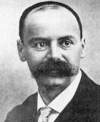
Born 9 Oct 1873; died 11 May 1916 at age 42.
German theoretical astrophysicist who made both practical and theoretical contributions to 20th-century astronomy. He developed the use of photography for measuring variable stars. He also investigated the geometrical aberrations of optical systems using ray optics by introducing a perturbation equation which he called the Seidel Eikonal. While on the Russian front during military service, he computed the first two exact solutions of the Einstein Field Equations of General Relativity, one in static isotropic empty space surrounding a massive body (such as a "black hole"), and one inside a spherically symmetric body of constant density - work which led directly to modern research on black holes.
German theoretical astrophysicist who made both practical and theoretical contributions to 20th-century astronomy. He developed the use of photography for measuring variable stars. He also investigated the geometrical aberrations of optical systems using ray optics by introducing a perturbation equation which he called the Seidel Eikonal. While on the Russian front during military service, he computed the first two exact solutions of the Einstein Field Equations of General Relativity, one in static isotropic empty space surrounding a massive body (such as a "black hole"), and one inside a spherically symmetric body of constant density - work which led directly to modern research on black holes.
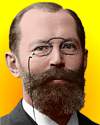
Born 9 Oct 1852; died 15 Jul 1919 at age 66. quotes
Hermann Emil Louis Fischer was a German chemist, awarded the 1902 Nobel Prize in Chemistry, transformed organic and biological chemistry through his studies of purines, sugars, and proteins. He identified the structures of uric acid, xanthine, caffeine, and theobromine, proving they are derivatives of a single compound he named purine. His research on carbohydrates established the stereochemical relationships among sugars like glucose and fructose, and he introduced the Fischer projection still used today. Fischer also synthesized short peptide chains, laying the groundwork for protein and enzyme chemistry. During World War I, he organized chemical production in Germany. He died by suicide after the death of his two sons.«
Hermann Emil Louis Fischer was a German chemist, awarded the 1902 Nobel Prize in Chemistry, transformed organic and biological chemistry through his studies of purines, sugars, and proteins. He identified the structures of uric acid, xanthine, caffeine, and theobromine, proving they are derivatives of a single compound he named purine. His research on carbohydrates established the stereochemical relationships among sugars like glucose and fructose, and he introduced the Fischer projection still used today. Fischer also synthesized short peptide chains, laying the groundwork for protein and enzyme chemistry. During World War I, he organized chemical production in Germany. He died by suicide after the death of his two sons.«
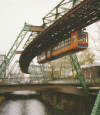
Born 9 Oct 1833; died 2 Oct 1895 at age 61.
German engineer who pioneered in building internal-combustion engines. In 1866 Eugen Langen, who owned a a sugar refining company, financed Nikolaus August Otto (1832-91), developed a more efficient gas engine. The Otto & Langen company produced stationary gas engines (usually powered by coal gas). Otto went on to build, in 1876, the prototype of the so-called Otto-cycle engines used in most modern automobiles, fueled primarily with gasoline, alcohol or benzene. Langen also devised the Wuppertaler suspension railway which opened in 1901. His Schwebebahn (swinging railway) has operated successfully along the Wupper river for almost 100 years. It has survived two world wars and continues to operate profitably and safely today.
German engineer who pioneered in building internal-combustion engines. In 1866 Eugen Langen, who owned a a sugar refining company, financed Nikolaus August Otto (1832-91), developed a more efficient gas engine. The Otto & Langen company produced stationary gas engines (usually powered by coal gas). Otto went on to build, in 1876, the prototype of the so-called Otto-cycle engines used in most modern automobiles, fueled primarily with gasoline, alcohol or benzene. Langen also devised the Wuppertaler suspension railway which opened in 1901. His Schwebebahn (swinging railway) has operated successfully along the Wupper river for almost 100 years. It has survived two world wars and continues to operate profitably and safely today.
Born 9 Oct 1801; died 27 Nov 1873 at age 72.
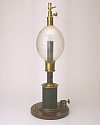
Swiss physicist who was one of the founders of the electrochemical theory of batteries. He began experimenting with the voltaic cell (1836) and supported the idea of Michael Faraday that the electricity was the result of chemical reactions in the cell. He invented a prize-winning electroplating method to apply gold onto brass and silver. He determined the specific heat of various gases, examined the temperature of the Earth's crust, and made ozone from electrical discharge through oxygen gas. He was a contemporary of Faraday, Ampere and Oersted, with whom he exchanged correspondance on electricity.Image: As a demonstration to explain the rotatory movements observed at the time of the aurorae boreales by the influence of the terrestrial magnetism, De La Rive assembled an apparatus using an egg-shaped evacuated glass chamber on an electromagnet.
Swiss physicist who was one of the founders of the electrochemical theory of batteries. He began experimenting with the voltaic cell (1836) and supported the idea of Michael Faraday that the electricity was the result of chemical reactions in the cell. He invented a prize-winning electroplating method to apply gold onto brass and silver. He determined the specific heat of various gases, examined the temperature of the Earth's crust, and made ozone from electrical discharge through oxygen gas. He was a contemporary of Faraday, Ampere and Oersted, with whom he exchanged correspondance on electricity.Image: As a demonstration to explain the rotatory movements observed at the time of the aurorae boreales by the influence of the terrestrial magnetism, De La Rive assembled an apparatus using an egg-shaped evacuated glass chamber on an electromagnet.
Born 9 Oct 1718; died 15 Feb 1784 at age 65. quotes
French chemist who wrote the two-volume Dictionnaire de Chymie (1766), the first dictionary of theoretical and general chemistry. He chose to remain anonymous for the first edition as he thought his commission had caused him to write it too hastily, and it was not up to the standard he wanted. However, it was a great success, with reprintings and a revised new edition. Macquer extended Geoffroy’s concept of chemical affinity, and discovered potassium arsenate. He studied Prussian blue (an insoluble artists’ pigment), and devised a new method of dyeing with it, and also decomposed to yield a new acid. Later it was named (by others) as Prussic acid, and identified as hydrogen cyanide.«
French chemist who wrote the two-volume Dictionnaire de Chymie (1766), the first dictionary of theoretical and general chemistry. He chose to remain anonymous for the first edition as he thought his commission had caused him to write it too hastily, and it was not up to the standard he wanted. However, it was a great success, with reprintings and a revised new edition. Macquer extended Geoffroy’s concept of chemical affinity, and discovered potassium arsenate. He studied Prussian blue (an insoluble artists’ pigment), and devised a new method of dyeing with it, and also decomposed to yield a new acid. Later it was named (by others) as Prussic acid, and identified as hydrogen cyanide.«
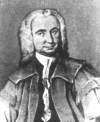
Born 9 Oct 1704; died 5 Oct 1777 at age 72.
German physicist and mathematician who recognized the surface tension of liquids. He discovered that every solid body has 3 axes of symmetry. He used Daniel Bernoulli's theoretical work on the “reaction effect” to produce a horizontal waterwheel the same principle which drives a modern lawn sprinkler, which influenced Euler to work on turbines. In 1751 Segner introduced the concept of the surface tension of liquids, likening it to a stretched membrane. His view that minute and imperceptible attractive forces maintain surface tension laid the foundation for the subsequent development of surface tension theory. He made an unsuccessful attempt to give a mathematical description of capillary action.
German physicist and mathematician who recognized the surface tension of liquids. He discovered that every solid body has 3 axes of symmetry. He used Daniel Bernoulli's theoretical work on the “reaction effect” to produce a horizontal waterwheel the same principle which drives a modern lawn sprinkler, which influenced Euler to work on turbines. In 1751 Segner introduced the concept of the surface tension of liquids, likening it to a stretched membrane. His view that minute and imperceptible attractive forces maintain surface tension laid the foundation for the subsequent development of surface tension theory. He made an unsuccessful attempt to give a mathematical description of capillary action.

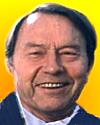
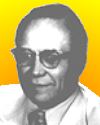
Died 9 Oct 2006 at age 82 (born 19 Jun 1924).
American electrical engineer, known as "the father of computer networking" because he was primarily responsible for making widespread the business use of networked personal computers (PC's). He did not invent the local area network (LAN) by which computers share files and printers through interlinked nodes. However, as chief executive of Novell Inc (1983-94), his organization and marketing turned the company's NetWare brand software into the first major PC network operating system. It linked even previously incompatible computers, whether IBM-compatible, Apple or Unix. To establish standardization in the industry, he believed in working with competitors, for which he coined the term "co-opetition."«
American electrical engineer, known as "the father of computer networking" because he was primarily responsible for making widespread the business use of networked personal computers (PC's). He did not invent the local area network (LAN) by which computers share files and printers through interlinked nodes. However, as chief executive of Novell Inc (1983-94), his organization and marketing turned the company's NetWare brand software into the first major PC network operating system. It linked even previously incompatible computers, whether IBM-compatible, Apple or Unix. To establish standardization in the industry, he believed in working with competitors, for which he coined the term "co-opetition."«
Died 9 Oct 1996 at age 83 (born 13 Apr 1913).
American anesthesiologist and inventor known for three major inventions that continue to relieve pain and suffering worldwide today. One is a very portable respirator anesthesia gas machine and resuscitator, called the Western Reserve Midget, used to deliver a short-term, general anesthetic A second came from extensive experiments in the use of anesthesia to prevent pain during childbirth, leading to the invention of the continuous caudal anesthesia techniques. Best known is his "peace gun," a pistol-shaped jet injector that enabled efficient, mass, needle-less inoculation worldwide against such diseases as small pox, measles, tuberculosis, tetanus, leprosy, polio and influenza. It can inoculate 1,000 persons per hour with several simultaneous vaccines.
American anesthesiologist and inventor known for three major inventions that continue to relieve pain and suffering worldwide today. One is a very portable respirator anesthesia gas machine and resuscitator, called the Western Reserve Midget, used to deliver a short-term, general anesthetic A second came from extensive experiments in the use of anesthesia to prevent pain during childbirth, leading to the invention of the continuous caudal anesthesia techniques. Best known is his "peace gun," a pistol-shaped jet injector that enabled efficient, mass, needle-less inoculation worldwide against such diseases as small pox, measles, tuberculosis, tetanus, leprosy, polio and influenza. It can inoculate 1,000 persons per hour with several simultaneous vaccines.
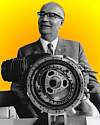
Died 9 Oct 1988 at age 86 (born 13 Aug 1902).
German engineer who invented the first rotary internal combustion engine. His first job (1921-4), was with a scientific book publisher, but Wankel preferred tinkering. In 1924, he opened his own workshop and conceived the idea of a rotary engine. By 1927 he had drawn up the shape of his rotary piston engine. Although he received his first patent in 1929 (DRP 507,584), it was Feb 1957 before the first truly functional Wankel rotary engine was ready. Instead of moving pistons, the Wankel engine uses an orbiting rotor shaped as a curved equilateral triangle. Thus it needs few moving parts, is lightweight and compact. He stayed active throughout his life, filing a patent in 1987, a year before his death.«
German engineer who invented the first rotary internal combustion engine. His first job (1921-4), was with a scientific book publisher, but Wankel preferred tinkering. In 1924, he opened his own workshop and conceived the idea of a rotary engine. By 1927 he had drawn up the shape of his rotary piston engine. Although he received his first patent in 1929 (DRP 507,584), it was Feb 1957 before the first truly functional Wankel rotary engine was ready. Instead of moving pistons, the Wankel engine uses an orbiting rotor shaped as a curved equilateral triangle. Thus it needs few moving parts, is lightweight and compact. He stayed active throughout his life, filing a patent in 1987, a year before his death.«
Wankel Rotary Engine: A History, by John B. Hege. - book suggestion.
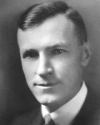
Died 9 Oct 1987 at age 95 (born 6 Feb 1892).
American physician who with George R. Minot in 1926 reported success in the treatment of pernicious anemia with a liver diet. The two men shared the Nobel Prize for Physiology or Medicine in 1934 with George H. Whipple, whose research they had built upon. Anaemia is seen as a loss of red blood corpuscles, effectively a dilution of the blood. With the liver diet, it became clear that anemia was not (as then supposed) due to the presence of a supposed poisonous substance, but rather to the absence of a substance needed to produce red blood corpuscles. Such a substance must be present in liver, since the patient's condition became normal when liver was supplied as a food. Thus these researchers had discovered a new function of the liver.
American physician who with George R. Minot in 1926 reported success in the treatment of pernicious anemia with a liver diet. The two men shared the Nobel Prize for Physiology or Medicine in 1934 with George H. Whipple, whose research they had built upon. Anaemia is seen as a loss of red blood corpuscles, effectively a dilution of the blood. With the liver diet, it became clear that anemia was not (as then supposed) due to the presence of a supposed poisonous substance, but rather to the absence of a substance needed to produce red blood corpuscles. Such a substance must be present in liver, since the patient's condition became normal when liver was supplied as a food. Thus these researchers had discovered a new function of the liver.
1927
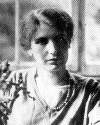
Died 9 Oct 1982 at age 86 (born 3 Dec 1895).
Austrian psychoanalyst, who was Sigmund Freud's daughter. As a founder of child psychoanalysis, she was one of its foremost practitioners. She also made fundamental contributions to understanding how the ego, or consciousness, functions in averting painful ideas, impulses, and feelings. Important in her own right, but diverging from her father in emphasizing the role of the ego (as opposed to id forces) in psychological functioning. Her book The Ego and Mechanisms of Defense (1936) laid the groundwork for ego psychology. She was one of the first psychoanalysts to work primarily with children.
Austrian psychoanalyst, who was Sigmund Freud's daughter. As a founder of child psychoanalysis, she was one of its foremost practitioners. She also made fundamental contributions to understanding how the ego, or consciousness, functions in averting painful ideas, impulses, and feelings. Important in her own right, but diverging from her father in emphasizing the role of the ego (as opposed to id forces) in psychological functioning. Her book The Ego and Mechanisms of Defense (1936) laid the groundwork for ego psychology. She was one of the first psychoanalysts to work primarily with children.
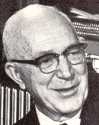
Died 9 Oct 1967 at age 69 (born 11 Nov 1897). quotes
Gordon Willard Allport was an American humanistic psychologist and educator who developed trait theory in an original theory of personality. Allport thought the uniqueness of each personality was one of the most important things to understand. Part of this uniqueness is due to the many, many parts of our personality. He and many other psychologists considered reflexes, habits, drives or needs, beliefs, our particular view of our environment, goals or intentions, values, attitudes, and traits as being the kind of factors that determine what we do. Thus, “personality” becomes very complex. Unlike Sigmund Freud, he did not see us as slavishly controlled by innate or external factors because humans have the ability to make conscious choices about how to behave.
Gordon Willard Allport was an American humanistic psychologist and educator who developed trait theory in an original theory of personality. Allport thought the uniqueness of each personality was one of the most important things to understand. Part of this uniqueness is due to the many, many parts of our personality. He and many other psychologists considered reflexes, habits, drives or needs, beliefs, our particular view of our environment, goals or intentions, values, attitudes, and traits as being the kind of factors that determine what we do. Thus, “personality” becomes very complex. Unlike Sigmund Freud, he did not see us as slavishly controlled by innate or external factors because humans have the ability to make conscious choices about how to behave.
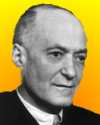
Died 9 Oct 1967 at age 70 (born 19 Jun 1897). quotes
English physical chemist who worked on reaction rates and reaction mechanisms, particularly that of the combination of hydrogen and oxygen to form water, one of the most fundamental combining reactions in chemistry. For this work he shared the 1956 Nobel Prize for Chemistry with Soviet scientist Nikolay Semyonov. Other important chain reactions are the combustion of carbon monoxide and of hydrocarbons. When it seemed that almost all reactions were chain reactions, one might believe the simpler mechanisms previously thought of were exceptions. But Hinshelwood found substances which could simultaneously react in two ways, one part reacting by a chain mechanism and at the same time the rest reacting in the old-fashioned way.
English physical chemist who worked on reaction rates and reaction mechanisms, particularly that of the combination of hydrogen and oxygen to form water, one of the most fundamental combining reactions in chemistry. For this work he shared the 1956 Nobel Prize for Chemistry with Soviet scientist Nikolay Semyonov. Other important chain reactions are the combustion of carbon monoxide and of hydrocarbons. When it seemed that almost all reactions were chain reactions, one might believe the simpler mechanisms previously thought of were exceptions. But Hinshelwood found substances which could simultaneously react in two ways, one part reacting by a chain mechanism and at the same time the rest reacting in the old-fashioned way.
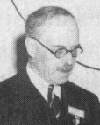
Died 9 Oct 1959 at age 74 (born 23 Aug 1885). quotes
English chemist, inventor and administrator. Around 1920, with David Pye, his work on aircraft fuels ultimately led to the octane rating system, which expresses the anti-knocking characteristics of the fuel. In the 1930-40s he advised the British government in the scientific aspects of air defence, particularly radar. He led a mission of leading British and Canadian scientists to the USA (29 Aug 1940) to brief official American representatives on devices under active development for war use and to enlist the support of American scientists. Thus began a close cooperation of Anglo-American scientists in such fields as aeronautics and rocketry. His influence probably made the difference between defeat or victory at the Battle of Britain in 1940.
English chemist, inventor and administrator. Around 1920, with David Pye, his work on aircraft fuels ultimately led to the octane rating system, which expresses the anti-knocking characteristics of the fuel. In the 1930-40s he advised the British government in the scientific aspects of air defence, particularly radar. He led a mission of leading British and Canadian scientists to the USA (29 Aug 1940) to brief official American representatives on devices under active development for war use and to enlist the support of American scientists. Thus began a close cooperation of Anglo-American scientists in such fields as aeronautics and rocketry. His influence probably made the difference between defeat or victory at the Battle of Britain in 1940.
Died 9 Oct 1949 at age 74 (born 16 Jan 1875).
German-American chemist.
German-American chemist.
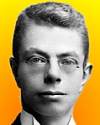
Died 9 Oct 1943 at age 78 (born 25 May 1865). quotes
Dutch physicist who was an authority on magneto-optics. In 1896, he discovered the "Zeeman effect," the "phenomena produced in spectroscopy by the splitting up of spectral lines in a magnetic field." He shared (with Hendrik A. Lorentz) the Nobel Prize for Physics in 1902 for his discovery of the Zeeman effect.
Dutch physicist who was an authority on magneto-optics. In 1896, he discovered the "Zeeman effect," the "phenomena produced in spectroscopy by the splitting up of spectral lines in a magnetic field." He shared (with Hendrik A. Lorentz) the Nobel Prize for Physics in 1902 for his discovery of the Zeeman effect.
Died 9 Oct 1932 at age 77 (born 8 Mar 1855).
Karl (Immanuel Eberhard) von Goebel was a German botanist whose Organographie der Pflanzen (1898-1901; Organography of Plants, 1900-05) clarified the principles of the science of plant morphology in relation to form and structure.
Karl (Immanuel Eberhard) von Goebel was a German botanist whose Organographie der Pflanzen (1898-1901; Organography of Plants, 1900-05) clarified the principles of the science of plant morphology in relation to form and structure.
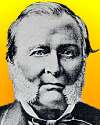
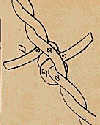
American inventor who was an Illinois farmer when he developed the design of the first commercial barbed wire, patented 24 Nov 1874, a product that would transform the West. Before this innovation, settlers on the treeless plains had no easy way to fence livestock away from cropland, and ranchers had no way to prevent their herds from roaming far and wide. Glidden's barbed wire opened the plains to large-scale farming, and closed the open range, bringing the era of the cowboy and the round-up to an end. With his partner, Isaac L. Ellwood, Glidden formed the Barb Fence Company of De Kalb, Illinois, and quickly became one of the wealthiest men in the nation.[Image right: detail from patent application diagram. source]
Barbs, Prongs, Points, Prickers, and Stickers... Barbed Wire, by Robert T. Clifton. - book suggestion.
Died 9 Oct 1806 at age 74 (born 9 Nov 1731). quotes
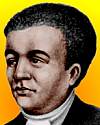
Black-American astronomer, inventor and mathematician, compiler of almanacs and one of the first important black American intellectuals who was the self-educated son of a freed slave. He was the first to record the arrival of the "seventeen-year locusts" or periodical cicadas. In 1753, Banneker built a wooden clock that kept accurate time even though he had only previously seen a sundial and a pocket watch. He calculated the clock's gear ratios and carved them with a pocket knife. In 1789, he successfully predicted an eclipse. He helped survey the site of Washington D.C. (1791-3). Banneker was also an early antislavery publicist who worked to improve the lot of black people in the U.S.«[Note: some sources give date of death as 25 Oct 1806] more
Black-American astronomer, inventor and mathematician, compiler of almanacs and one of the first important black American intellectuals who was the self-educated son of a freed slave. He was the first to record the arrival of the "seventeen-year locusts" or periodical cicadas. In 1753, Banneker built a wooden clock that kept accurate time even though he had only previously seen a sundial and a pocket watch. He calculated the clock's gear ratios and carved them with a pocket knife. In 1789, he successfully predicted an eclipse. He helped survey the site of Washington D.C. (1791-3). Banneker was also an early antislavery publicist who worked to improve the lot of black people in the U.S.«[Note: some sources give date of death as 25 Oct 1806] more
The Life of Benjamin Banneker: The First African-American Man of Science, by Silvio A. Bedini. - book suggestion.
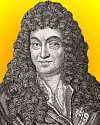
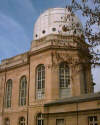
French architect, physician and physicist who was the architect of the oldest building of the Paris Observatory when it was funded in 1667 by King Louis XIV. Its centre line defined the meridian line of Paris (from 1667 to 1884 when France then adopted the international meridian line which passes through Greenwich close to London). Perrault presented a memoir to the Académie concerning a pendulum clock driven by water, some time before 1669 when he wrote to Christiaan Huygens on the subject of a hydraulic pendulum clock.. In 1673, he translated the Ten Books of Architecture by the Roman architect Vitruvius.[Image right: (source)]
Died 9 Oct 1562 (born 1523).
Italian anatomist who was first educated for the church and became a canon, but later studied and became a teacher of medicine. He made many careful dissection of human bodies, including, fetuses, babies and young children. He discovered the oviducts known by his name as the Fallopian tubes between the ovaries and the uterus. He coined other terms describing female reproductive anatomy: ovarium tubes, vagina, clitoris, placenta; as well as palate and cochlea. He is also noted for his work describing the semi-circular canals of the inner ear. He contributed to knowledge of the primary and secondary centres of ossification, the anatomy of the kidney and bladder, the stages of dentition. (a.k.a. Gabriele Falloppio.)«
Italian anatomist who was first educated for the church and became a canon, but later studied and became a teacher of medicine. He made many careful dissection of human bodies, including, fetuses, babies and young children. He discovered the oviducts known by his name as the Fallopian tubes between the ovaries and the uterus. He coined other terms describing female reproductive anatomy: ovarium tubes, vagina, clitoris, placenta; as well as palate and cochlea. He is also noted for his work describing the semi-circular canals of the inner ear. He contributed to knowledge of the primary and secondary centres of ossification, the anatomy of the kidney and bladder, the stages of dentition. (a.k.a. Gabriele Falloppio.)«
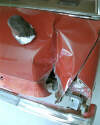
In 1992, a great meteor, seen from Kentucky to New York, was observed at 7:50 pm EDT. It landed as a stone (chondrite, Olivine-Bronzite, H6, brecciated) meteorite. Its 12.37 kg mass crashed onto the Chevrolet Malibou car of Michelle Knapp (age 18), of Wells Street, Peekskill, NY. The fireball was first seen over West Virginia and traveled about 700 km NE, before smashing into the parked car with a velocity of about 80 m/s. It is only the 4th recovered meteorite for which detailed data exist on its trajectory. Dark flight began about 30 km high, when the velocity dropped below 3 km/s and it continued an additional 50 km without ablation. Since getting hit by the meteorite, the car has toured Germany, Switzerland, Japan, France and the US.
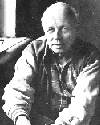
In 1975, Andrei Sakharov, often called father of the Soviet hydrogen bomb, became the first Soviet citizen to win the Nobel Peace Prize for his work as an outspoken dissident to the Soviet regime. In 1957 his concern with the radioactive hazards of nuclear testing inspired him to write a pioneering article on the effects of low-level radiation. This might be considered his first step towards dissent. The Nobel Committee citation called him “the conscience of mankind” saying he “has fought not only against the abuse of power and violations of human dignity in all its forms, but has in equal vigor fought for the ideal of a state founded on the principle of justice for all.” The Soviet authorities denied him permission to go to Norway to receive his award.
In 1956, a successful new silicone valve to drain "water on the brain" in cases of hydrocephalus, was reported by Dr. Eugene B. Spitz at the American Academy of Pediatrics meeting in New York City. John Holter, an engineer, invented the shunt using a silicone one-way, pressure-sealing valve which avoided the clogging problems experienced with the earlier metal valves previously tried by surgeons Spitz and Nulsen. The shunt drained fluid and controlled cranial pressure. In the 8 months since the first installation in Feb 1956, the Holter valve was implanted in 68 cases of which 57 were successful in decompressing the brain. Previous means had a success rate of only 16 out of 122 cases. The device has since saved many thousands of lives.«
In 1946, the Simmons Company of Petersburg, Va., manufactured the first electric blanket. Its price was $39.50. The temperature was regulated by an "electronic" thermostatic control.
In 1938, the radio altimeter was first demonstrated in New York by Bell Labs, in the first public display of the device that gives pilots the height of an aircraft above the local terrain by bouncing radio signals off the ground to give a reliable altitude reading, thus changing aviation forever.
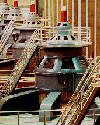
In 1936, the first generator at Boulder (later Hoover) Dam began transmitting electricity to Los Angeles. From 1939 to 1949, Hoover Powerplant was the world's largest hydroelectric installation; with an installed capacity of 2.08 million kilowatts, it is still one of the country's largest. There are 17 main turbines in Hoover Powerplant. The original turbines were all replaced through an uprating program between 1986 and 1993. With a rated capacity of 2,991,000 horsepower, and two station-service units rated at 3,500 horsepower each, for a plant total of 2,998,000 horsepower. The plant has a total nameplate capacity of 2,074,000 kilowatts, and generates more than 4 billion kilowatt-hours a year - enough to serve 1.3 million people.
1988
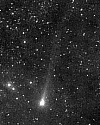
In 1933, a great unpredicted meteor shower was seen from Europe that surprised astronomers. Dr. W.J. Fisher, a Harvard astronomer, identified the Giacobini-Zinner comet as the cause. This minor periodic comet was only sparsely the cause of meteors in the past, and would otherwise be little noticed by the astronomical observers. A hundred "shooting stars" a minute were reported from the Soviet observatory at Pulkovo, near Leningrad. Though short-lived, this exceeded in brilliance the showers of 1833 and 1866, Lasting only a few hours, its maximum came at about 20:00 GMT. It was regarded as one of the major meteoric displays of history, resulting from stray fragments of comet burning up in Earth's upper atmosphere.
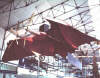
Eole-3
In 1890, it is reported, however without evidence, French electrical engineer Clément Ader was the first person to actually fly an airplane, but his steam-powered bat-like plane, "Eole", only rose a few inches off the ground. (It was not a sustained flight like the Wright Brothers later flight.) Ader's 50 meter flight was cut short, said eye witnesses, by trees at the end of the field. The plane's design flaw didn't show up in that minimal flight - Ader hadn't provided adequate control. He coined the french word "avion" for aircraft. It is said to mean Appareil Volant Imitant les Oisaux Naturels: Flying Machine Imitating Natural Birds. At the Paris Electrical Exhibition (1881), Ader showed a closed-circuit stereo audio system to a listening booth.
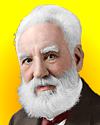
In 1876, the first two-way telephone conversation occurred over outdoor wires. Alexander Graham Bell had a two-way conversation with Thomas Watson over the telegraph line linking Boston and East Cambridge. Three days earlier in Boston, 6 Oct 1876, Bell's two-way telephone test of conversation with Watson had been the world's first two-way telephone conversation.
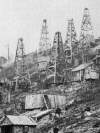
In 1865, the first underground oil pipeline was laid between Oil Creek and Pithole, Pa. Samuel Van Syckel, who came to the creek in 1864 with some money hoping to make more, had handled quantities of oil produced at Pithole, several miles from a shipping point, only to see his profits eaten up by the tyranny of teamsters. With determination, he built a mostly buried, two-inch pipeline with three relay pumps, 5.5 miles between the wells and the railroad. Carrying eighty barrels of oil an hour, the day that the Van Syckel pipe-line began to run oil, a revolution began in the business. The teamsters turned out in fury, digging up and cutting the pipe so that the oil would be lost. It was only by stationing an armed guard that they were held in check.[Image: Oil Creek, Pa., 1865]
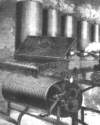
In 1855, Joshua C. Stoddard of Worcester, Massachusetts, received a patent for his calliope. The first instrument consisted of 15 whistles, of graduated sizes, attached in a row to the top of a small steam boiler. A long cylinder with pins of different shapes driven into it ran the length of the boiler. The pins were so arranged that when the cylinder revolved, they pressed the valves and blew the whistles in proper sequence. The different shapes enabled the operator to play notes of varying length. Later, Stoddard replaced the cylinder with a keyboard. Wires running from the keys to the valves enabled the operator to play the instrument like a piano. He patented a successful hay rake in 1879 and a fire escape in 1884. He died on April 4, 1902.
In 1855, the first U.S. patent was issued for a sewing machine motor to Isaac Merritt Singer of New York City. It covered a spring and cone pulley device. (No. 13,661)
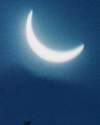
In 1780, the first U.S. astronomy expedition to record an eclipse of the sun left on this day from Harvard College, Cambridge, Mass., for Penobscot Bay, led by Samuel Williams. A boat was supplied by the Commonwealth of Massachusetts with four professors and six students. Although the country was at war with Britain, the British officer in charge of Penobscot Bay permitted the expedition to land and observe the eclipse of 27 Oct 1780. The eclipse began at 11:11 am and ended at 1:50 pm. They set up equipment to observe the predicted total eclipse of the sun. A solar eclipse occurred, but the expedition was shocked to find itself outside the path of totality. They saw a thin arc of the sun instead of its complete obscuration by the moon.
more
In 1604, Johannes Kepler and other observers saw the appearance of a “new” star in the constellation of Ophiuchus in the western sky, rivaling the brilliance of the nearby planets.





