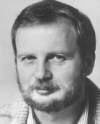
Born 18 Jul 1948.
German biochemist who, along with Johann Deisenhofer and Robert Huber, received the Nobel Prize for Chemistry in 1988 for their determination of the three-dimensional structure of certain proteins that are essential for photosynthesis. They are the first to succeed in unravelling the full details of how a membrane-bound protein is built up, revealing the structure of the molecule atom by atom. The protein is taken from a bacterium which, like green plants and algae, uses light energy from the sun to build organic substances. All our nourishment has its origin in this process, which is called photosynthesis and which is a condition for all life on earth.
German biochemist who, along with Johann Deisenhofer and Robert Huber, received the Nobel Prize for Chemistry in 1988 for their determination of the three-dimensional structure of certain proteins that are essential for photosynthesis. They are the first to succeed in unravelling the full details of how a membrane-bound protein is built up, revealing the structure of the molecule atom by atom. The protein is taken from a bacterium which, like green plants and algae, uses light energy from the sun to build organic substances. All our nourishment has its origin in this process, which is called photosynthesis and which is a condition for all life on earth.
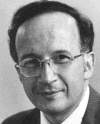
Born 18 Jul 1937. quotes
Polish-born American chemist, corecipient, with Fukui Kenichi of Japan, of the Nobel Prize for Chemistry in 1981 for their independent investigations of the mechanisms of chemical reactions. His work aims at theoretically anticipating the course of chemical reactions. It is based on quantum mechanics (the theory whose starting point is that the smallest building blocks of matter may be regarded both as particles and as waves), which attempts to explain how atoms behave. Orbital interaction and symmetry relations between molecules or parts of molecules are fundamental to this theory of conservation of orbital symmetry in chemical reactions.
Polish-born American chemist, corecipient, with Fukui Kenichi of Japan, of the Nobel Prize for Chemistry in 1981 for their independent investigations of the mechanisms of chemical reactions. His work aims at theoretically anticipating the course of chemical reactions. It is based on quantum mechanics (the theory whose starting point is that the smallest building blocks of matter may be regarded both as particles and as waves), which attempts to explain how atoms behave. Orbital interaction and symmetry relations between molecules or parts of molecules are fundamental to this theory of conservation of orbital symmetry in chemical reactions.
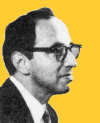
Born 18 Jul 1922; died 17 Jun 1996 at age 73. quotes
Thomas Samuel Kuhn was an American science historian and science philosopher was a MIT professor, noted for his highly influential The Structure of Scientific Revolutions (1962). He held that science was not a steady, cumulative acquisition of knowledge, but it is “a series of peaceful interludes punctuated by intellectually violent revolutions.” Then appears a Lavoisier or an Einstein, often a young scientist not indoctrinated in the accepted theories, to sweep the old paradigm away. Such revolutions, he said, came only after long periods of tradition-bound normal science. He pointed out that scientific research and thought are defined by “paradigms,” or trusted theories, concepts, methods and experiments. Such paradigms are accepted by scientists, who continue to extend, refine, explain and measure results until they meet an problem that cannot be resolved within the established framework. Such anomaly or contradiction eventually requires an intellectual revolution, such as the paradigm shifts from Ptolemaic cosmology to Copernican heliocentrism. “Frameworks must be lived with and explored before they can be broken.”
Thomas Samuel Kuhn was an American science historian and science philosopher was a MIT professor, noted for his highly influential The Structure of Scientific Revolutions (1962). He held that science was not a steady, cumulative acquisition of knowledge, but it is “a series of peaceful interludes punctuated by intellectually violent revolutions.” Then appears a Lavoisier or an Einstein, often a young scientist not indoctrinated in the accepted theories, to sweep the old paradigm away. Such revolutions, he said, came only after long periods of tradition-bound normal science. He pointed out that scientific research and thought are defined by “paradigms,” or trusted theories, concepts, methods and experiments. Such paradigms are accepted by scientists, who continue to extend, refine, explain and measure results until they meet an problem that cannot be resolved within the established framework. Such anomaly or contradiction eventually requires an intellectual revolution, such as the paradigm shifts from Ptolemaic cosmology to Copernican heliocentrism. “Frameworks must be lived with and explored before they can be broken.”
The Structure of Scientific Revolutions, by Thomas S. Kuhn. - book suggestion.
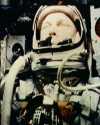
Born 18 Jul 1921; died 8 Dec 2016 at age 95. quotes
John Herschel Glenn Jr. was an American astronaut and statesman who was the first American astronaut to orbit Earth, on 20 Feb 1962, making three orbits in about five hours aboard his Friendship 7 capsule. He was a Marine pilot during WW II. By 1957, he was an airplane test pilot, and set a speed record in 1957 flying from Los Angeles to New York in less than 3½ hours. In 1959, Glenn was picked as one of the “Mercury Seven,” the first group of NASA astronauts. Another was Alan Shepard who was the first launched for a five minute flight in suborbital space on 5 May 1961. Glenn retired from NASA in 1964. From 1974 to 1999, he was a U.S. Senator for Ohio. In 1998, he returned to space at age 77, flying on Space Shuttle Discovery.«
John Herschel Glenn Jr. was an American astronaut and statesman who was the first American astronaut to orbit Earth, on 20 Feb 1962, making three orbits in about five hours aboard his Friendship 7 capsule. He was a Marine pilot during WW II. By 1957, he was an airplane test pilot, and set a speed record in 1957 flying from Los Angeles to New York in less than 3½ hours. In 1959, Glenn was picked as one of the “Mercury Seven,” the first group of NASA astronauts. Another was Alan Shepard who was the first launched for a five minute flight in suborbital space on 5 May 1961. Glenn retired from NASA in 1964. From 1974 to 1999, he was a U.S. Senator for Ohio. In 1998, he returned to space at age 77, flying on Space Shuttle Discovery.«
John Glenn: A Memoir, by John Glenn. - book suggestion.
Born 18 Jul 1891; died 10 Sep 1966 at age 75. quotes
Emil Julius Gumbel was an American mathematician and statistician is known for his work in reliability theory and order statistics. His name remains on the Type 1 extreme value distribution, known as the Gumbel distribution. In his early life, during WW I, he militantly advocated for pacifism. Gumbel acted as a historian and statistician recording the political murders in the early Weimar Republic. His activities caused ostracization and political harassment. When he moved to France (1932), he could better concentrate on his mathematical work, most notably examining the statistical distributions most used by actuaries. He also applied his skills in the fields of hydrology (floods) and meteorology (drought). Eight years later, due to WW II, he moved to the U.S. (1940) and continue this work.«
Emil Julius Gumbel was an American mathematician and statistician is known for his work in reliability theory and order statistics. His name remains on the Type 1 extreme value distribution, known as the Gumbel distribution. In his early life, during WW I, he militantly advocated for pacifism. Gumbel acted as a historian and statistician recording the political murders in the early Weimar Republic. His activities caused ostracization and political harassment. When he moved to France (1932), he could better concentrate on his mathematical work, most notably examining the statistical distributions most used by actuaries. He also applied his skills in the fields of hydrology (floods) and meteorology (drought). Eight years later, due to WW II, he moved to the U.S. (1940) and continue this work.«
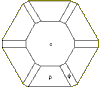
Born 18 Jul 1869; died 5 Dec 1954 at age 85.
American mineralogist who was one of the most eminent crystallographers and mineralogists of the world, he lived in a period of revolutionary developments in mineralogical science. At the University of California (PhD 1887), he did the field work for the first geologic maps of the San Francisco Peninsula and the Berkley area. In 1895, while at Heidelberg taking courses in petrography, he was introduced to morphological crystallography by Victor Goldschmidt. Palache threw himself with enthusiasm into the study of crystals, and laid the foundation for the work he pursued vigorously for the next fifty-five years.Image: Crystal drawing of usual graphite crystal from Sterling Hill, NJ, from Palache's 1941 paper in American Mineralogist.
American mineralogist who was one of the most eminent crystallographers and mineralogists of the world, he lived in a period of revolutionary developments in mineralogical science. At the University of California (PhD 1887), he did the field work for the first geologic maps of the San Francisco Peninsula and the Berkley area. In 1895, while at Heidelberg taking courses in petrography, he was introduced to morphological crystallography by Victor Goldschmidt. Palache threw himself with enthusiasm into the study of crystals, and laid the foundation for the work he pursued vigorously for the next fifty-five years.Image: Crystal drawing of usual graphite crystal from Sterling Hill, NJ, from Palache's 1941 paper in American Mineralogist.
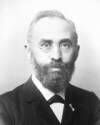
Born 18 Jul 1853; died 4 Feb 1928 at age 74.
Dutch physicist who shared (with Pieter Zeeman) the Nobel Prize for Physics in 1902 for his theory of the influence of magnetism upon electromagnetic radiation phenomena. The theory was confirmed by findings of Zeeman and gave rise to Albert Einstein's special theory of relativity. From the start, Lorentz made it his task to extend James Clerk Maxwell's theory of electricity and of light. Already in his doctor's thesis, he treated the reflection and refraction phenomena of light from this new standpoint. His fundamental work in the fields of optics and electricity revolutionized conceptions of the nature of matter. In 1878, he published an essay relating the velocity of light in a medium, to its density and composition.
Dutch physicist who shared (with Pieter Zeeman) the Nobel Prize for Physics in 1902 for his theory of the influence of magnetism upon electromagnetic radiation phenomena. The theory was confirmed by findings of Zeeman and gave rise to Albert Einstein's special theory of relativity. From the start, Lorentz made it his task to extend James Clerk Maxwell's theory of electricity and of light. Already in his doctor's thesis, he treated the reflection and refraction phenomena of light from this new standpoint. His fundamental work in the fields of optics and electricity revolutionized conceptions of the nature of matter. In 1878, he published an essay relating the velocity of light in a medium, to its density and composition.
The Einstein Theory of Relativity: A Concise Statement, by Hendrik Antoon Lorentz. - book suggestion.
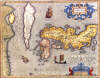
Early map of Japan
Born 18 Jul 1769; died 17 Feb 1850 at age 80.
Japanese scientist and an early advocate of Westernization in Japan. He favoured the development of an authoritarian type of government based on Western science and political institutions. As an agronomist, Satô Nobuhiro wrote in Keizai yôryaku (The Epitome of Economy), "The rationale of economy is to manage the realm, develop goods, make domains affluent, and succor everyone." In short, economy was the know-how to succour people. Sato Nobuhiro, held the European powers to be a threat, and advocated economic reform so that Japan could build up its military to stave off the Western menace. Even this contrary perspective advocated expansionism much like the Imperialism of the European nations. Also prevalent in his writings are the call for urgent and drastic change in the Japanese system. He advocated for the development of transportation and for a government agency to fund such developments in order to encourage the nation's commerce.
Japanese scientist and an early advocate of Westernization in Japan. He favoured the development of an authoritarian type of government based on Western science and political institutions. As an agronomist, Satô Nobuhiro wrote in Keizai yôryaku (The Epitome of Economy), "The rationale of economy is to manage the realm, develop goods, make domains affluent, and succor everyone." In short, economy was the know-how to succour people. Sato Nobuhiro, held the European powers to be a threat, and advocated economic reform so that Japan could build up its military to stave off the Western menace. Even this contrary perspective advocated expansionism much like the Imperialism of the European nations. Also prevalent in his writings are the call for urgent and drastic change in the Japanese system. He advocated for the development of transportation and for a government agency to fund such developments in order to encourage the nation's commerce.
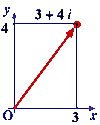
Born 18 Jul 1768; died 13 Aug 1822 at age 54.
Swiss accountant and mathematician who was one of the earliest to use complex numbers, which he applied to show that all algebraic equations have roots. His name is associated with the Argand diagram, a geometrical representation of complex numbers as points in a Cartesian plane, with the real portion of the number on the x axis and the imaginary part on the y axis. He self-published this concept in an anonymous monograph (1806). Though talented in mathematics, he remained an amateur; his livelihood was as an accountant and bookkeeper. Although Argand's name became associated with this idea, the geometrical interpretation of complex numbers appeared earliest in work by Caspar Wessel (1787), first presented on 10 Mar 1797 to a the Royal Danish Academy of Sciences and published in 1799.«
Swiss accountant and mathematician who was one of the earliest to use complex numbers, which he applied to show that all algebraic equations have roots. His name is associated with the Argand diagram, a geometrical representation of complex numbers as points in a Cartesian plane, with the real portion of the number on the x axis and the imaginary part on the y axis. He self-published this concept in an anonymous monograph (1806). Though talented in mathematics, he remained an amateur; his livelihood was as an accountant and bookkeeper. Although Argand's name became associated with this idea, the geometrical interpretation of complex numbers appeared earliest in work by Caspar Wessel (1787), first presented on 10 Mar 1797 to a the Royal Danish Academy of Sciences and published in 1799.«
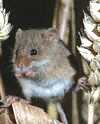
Harvest mouse
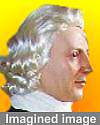
English clergyman and naturalist known as the “father of English natural history.” Over the course of 20 years of his observations and two colleagues' letters, he studied a wide range of flora and fauna seen around his hometown of Selborne, Hampshire. Among other careful observations, he was the first to accurately describe the harvest mouse. In 1789, he published this studious work. The text of his book The Natural History and Antiquities of Selborne is the collection of his letters to friends describing his local observations. The book is a classic work of natural history, has been in print continuously since 1789, and is one of the most published books in the English language.[Image shows mannequin representing White in a Gilbert White’s House display. No authentic picture of White is known, although there are portraits of his father and grandfather.] more
The Natural History of Selborne, by Gilbert White. - book suggestion.
Born 18 Jul 1689; died 13 Apr 1728 at age 38.
British astronomer (Royal Observatory at Kew) and politician. Together with assistant James Bradley, he made measurements of abberation - the diversion of light from stars. They made observations of the star  Draconis with a vertical telescope. Starting in 1725 they had the proof of the movement of the earth giving support to the Copernican model of the earth revolving around the sun. The star oscillated with an excursion of 39 arcsecs between its lowest declination in May and its the highest point of its oscillation in September. He was unfortunate to fall ill in 1728 and into the care of the Anatomist to the Royal Family, Dr Nathaniel St Andre, whose qualifications were as a dancing master. Molyneux died shortly thereafter.
British astronomer (Royal Observatory at Kew) and politician. Together with assistant James Bradley, he made measurements of abberation - the diversion of light from stars. They made observations of the star  Draconis with a vertical telescope. Starting in 1725 they had the proof of the movement of the earth giving support to the Copernican model of the earth revolving around the sun. The star oscillated with an excursion of 39 arcsecs between its lowest declination in May and its the highest point of its oscillation in September. He was unfortunate to fall ill in 1728 and into the care of the Anatomist to the Royal Family, Dr Nathaniel St Andre, whose qualifications were as a dancing master. Molyneux died shortly thereafter.
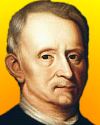
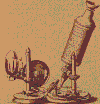
English physicist who discovered the law of elasticity, known as Hooke's law, and invented the balance spring for clocks. He was a virtuoso scientist whose scope of research ranged widely, including physics, astronomy, chemistry, biology, geology, architecture and naval technology. On 5 Nov 1662, Hooke was appointed the Curator of Experiments at the Royal Society, London. After the Great Fire of London (1666), he served as Chief Surveyor and helped rebuild the city. He also invented or improved meteorological instruments such as the barometer, anemometer, and hygrometer. Hooke authored the influential Micrographia (1665).«[Image left: No authentic image is known to exist of Hooke. This portrait was claimed by biographer Lisa Jardine to be Hooke, but was strongly disputed. Image right: Hooke's compound microscope (source).]
The Curious Life of Robert Hooke: The Man Who Measured London, by Lisa Jardine. - book suggestion.

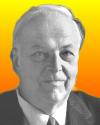
Died 18 Jul 2018 at age 87 (born 22 Mar 1931).
American physicist who shared (with independent researcher Samuel C. C. Ting) the 1976 Nobel Prize for Physics for the discovery (10 Nov 1974) of a new subatomic particle, the J/psi meson. It is a composite particle, made of more elementary particles—a bound state of one charm quark and one anticharm quark. That firmly established the quark model. Richter became a full professor at Stanford in 1967. There, he designed, arranged financing, and built a high-energy particle accelerator, which with an advanced particle detector, enabled the discovery of the new particle. Richter was director of the Department of Energy’s SLAC National Accelerator Laboratory at Stanford from 1984 to 1999.«
American physicist who shared (with independent researcher Samuel C. C. Ting) the 1976 Nobel Prize for Physics for the discovery (10 Nov 1974) of a new subatomic particle, the J/psi meson. It is a composite particle, made of more elementary particles—a bound state of one charm quark and one anticharm quark. That firmly established the quark model. Richter became a full professor at Stanford in 1967. There, he designed, arranged financing, and built a high-energy particle accelerator, which with an advanced particle detector, enabled the discovery of the new particle. Richter was director of the Department of Energy’s SLAC National Accelerator Laboratory at Stanford from 1984 to 1999.«
Died 18 Jul 1997 at age 69 (born 28 Apr 1928). quotes
Eugene Merle Shoemaker was an American planetary geologist. Shoemaker initiated and vigorously promoted the intensive geologic training of the astronauts that made them able scientific observers and reporters on moon landings. He was a major investigator of the imaging by unmanned Ranger and Surveyor satellites which, before any Apollo landing, revealed the nature of the Moon's cover of soil and broken rock that he named the regolith. He codiscovered Comet P/Shoemaker-Levy 9 which collided with Jupiter (1994), the first observed collision of two solar system bodies. He died in a car crash. In tribute, a small capsule of his ashes were launched in a memorial capsule aboard Lunar Prospector to the moon.
Eugene Merle Shoemaker was an American planetary geologist. Shoemaker initiated and vigorously promoted the intensive geologic training of the astronauts that made them able scientific observers and reporters on moon landings. He was a major investigator of the imaging by unmanned Ranger and Surveyor satellites which, before any Apollo landing, revealed the nature of the Moon's cover of soil and broken rock that he named the regolith. He codiscovered Comet P/Shoemaker-Levy 9 which collided with Jupiter (1994), the first observed collision of two solar system bodies. He died in a car crash. In tribute, a small capsule of his ashes were launched in a memorial capsule aboard Lunar Prospector to the moon.
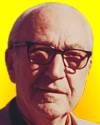
Died 18 Jul 1990 at age 96 (born 22 Jul 1893). quotes
American physician who co-founded the Menninger Foundation (1941) with his father, Charles Frederick Menninger and younger brother. They were pioneers of 20th century psychiatric treatment. They established the foundation to bring together not only the practice of psychiatry, but also education, training and research. Their approach stressed using a humane social environment for hospitalized patients as an important part of therapy. Karl believed that most crime was a stage of mental or emotional sickness to be treated as such and that imprisonment without treatment was useless to reform antisocial behavior. Karl was also active in causes concerning abused children, American Indians and wildlife.«
American physician who co-founded the Menninger Foundation (1941) with his father, Charles Frederick Menninger and younger brother. They were pioneers of 20th century psychiatric treatment. They established the foundation to bring together not only the practice of psychiatry, but also education, training and research. Their approach stressed using a humane social environment for hospitalized patients as an important part of therapy. Karl believed that most crime was a stage of mental or emotional sickness to be treated as such and that imprisonment without treatment was useless to reform antisocial behavior. Karl was also active in causes concerning abused children, American Indians and wildlife.«
Died 18 Jul 1968 at age 76 (born 28 Mar 1892).
Belgian physiologist who received the Nobel Prize for Physiology or Medicine in 1938 for his discovery of the regulatory effect on respiration of sensory organs associated with the carotid artery in the neck and with the aortic arch leading from the heart (1927-29).
Belgian physiologist who received the Nobel Prize for Physiology or Medicine in 1938 for his discovery of the regulatory effect on respiration of sensory organs associated with the carotid artery in the neck and with the aortic arch leading from the heart (1927-29).
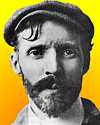
c.1907
Died 18 Jul 1958 at age 84 (born 26 May 1874).
French aviator and aircraft designer who developed ailerons (1908) to solve the enormously difficult and dangerous problems of lateral control. His an innovation subsequently came into general use on all planes. His first steps in aircraft design began in 1907 when he ordered his own aircraft incorporating his design modifications of a dihedral in the wings and the reduction of the tail to a single plane. These intuitive rather than scientific modifications were the beginning of a long career in which Farman diagnosed and solved a myriad of aircraft control and structural problems. The Farman “Goliath” was the first long-distance passenger airliner, beginning regular Paris–London flights on 8 Feb 1919. His younger brother Maurice Farman was also an aviator. They were born of English parents in Paris.
French aviator and aircraft designer who developed ailerons (1908) to solve the enormously difficult and dangerous problems of lateral control. His an innovation subsequently came into general use on all planes. His first steps in aircraft design began in 1907 when he ordered his own aircraft incorporating his design modifications of a dihedral in the wings and the reduction of the tail to a single plane. These intuitive rather than scientific modifications were the beginning of a long career in which Farman diagnosed and solved a myriad of aircraft control and structural problems. The Farman “Goliath” was the first long-distance passenger airliner, beginning regular Paris–London flights on 8 Feb 1919. His younger brother Maurice Farman was also an aviator. They were born of English parents in Paris.
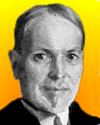
Died 18 Jul 1946 at age 73 (born 20 Feb 1873).
American psychologist who was a leader adopting the scientific method in the study and reform of education. His own research included the nature and development in reading, language, number ideas and their development, writing, and the higher mental processes. He examined the psychological issues of school curriculum and the pedagogical methods used in education. He believed an overarching educational objective was to developing the learner's social consciousness, rather than the expression of an individual's instinct, but to participate in a cooperative social experience. He filed an affidavit at the Scope's trial in strong support of the teaching of evolution in schools.«
American psychologist who was a leader adopting the scientific method in the study and reform of education. His own research included the nature and development in reading, language, number ideas and their development, writing, and the higher mental processes. He examined the psychological issues of school curriculum and the pedagogical methods used in education. He believed an overarching educational objective was to developing the learner's social consciousness, rather than the expression of an individual's instinct, but to participate in a cooperative social experience. He filed an affidavit at the Scope's trial in strong support of the teaching of evolution in schools.«
The Evolution of a Democratic School System, by Charles Hubbard Judd. - book suggestion.
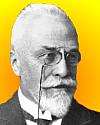
Died 18 Jul 1931 at age 73 (born 13 Jan 1858).
German physiologist and pathologist who introduced the concept that diabetes results from suppression of a pancreatic substance (later found to be the hormone insulin). After studying how fat is metabolized by the body, in 1889, Oskar Minkowski and Joseph von Mering uncovered the role of the pancreas in diabetes. In an experiment in which they removed the pancreas from a dog, it consequently developed diabetes. He was the brother of mathematician Hermann Minkowski (whose idea of a four-dimensional or "Minkowski space", laid the mathematical foundation of Albert Einstein's general theory of relativity). Oskar's son, Rudolf Minkowski was a physicist and astronomer.
German physiologist and pathologist who introduced the concept that diabetes results from suppression of a pancreatic substance (later found to be the hormone insulin). After studying how fat is metabolized by the body, in 1889, Oskar Minkowski and Joseph von Mering uncovered the role of the pancreas in diabetes. In an experiment in which they removed the pancreas from a dog, it consequently developed diabetes. He was the brother of mathematician Hermann Minkowski (whose idea of a four-dimensional or "Minkowski space", laid the mathematical foundation of Albert Einstein's general theory of relativity). Oskar's son, Rudolf Minkowski was a physicist and astronomer.
Died 18 Jul 1900 at age 50 (born 16 Aug 1849).
who originated the Kjeldahl method for the laboratory determination of the nitrogen content in organic compounds. This was of great value for applications in agriculture, medicine and drug manufacture. It replaced the former procedure that were inexact and time-consuming, and remains in use to the present time. From 1876 until his death, he was the director of the Carlsberg laboratory (a research institution of the Carslberg brewery). He developed his method of measuring nitrogen content to investigate the amount of protein in grain, which was relevant to protein transformation during beer fermentation. The method was reported to the Chemical Society of Copenhagen on 7 Mar 1883.«
who originated the Kjeldahl method for the laboratory determination of the nitrogen content in organic compounds. This was of great value for applications in agriculture, medicine and drug manufacture. It replaced the former procedure that were inexact and time-consuming, and remains in use to the present time. From 1876 until his death, he was the director of the Carlsberg laboratory (a research institution of the Carslberg brewery). He developed his method of measuring nitrogen content to investigate the amount of protein in grain, which was relevant to protein transformation during beer fermentation. The method was reported to the Chemical Society of Copenhagen on 7 Mar 1883.«
The Kjeldahl Method for Organic Nitrogen, by R.B. Bradstreet. - book suggestion.
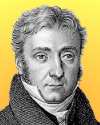
Died 18 Jul 1838 at age 53 (born 12 Feb 1785).
French chemist and physicist who helped formulate the Dulong-Petit law of specific heats (1819), which proved useful in determining atomic weights. He began in a medical career, but turned to botany and then chemistry. In 1811, he discovered nitrogen trichloride, losing a finger and the sight of one eye when it spontaneously exploded. Jointly with Alexis Petit (1815-20), they measured the specific heat of elements and related them to atomic weights. They discovered their new law that specific heat times atomic weight of an element is a constant, about six calories per gram atom, the same for all solid elements.«
French chemist and physicist who helped formulate the Dulong-Petit law of specific heats (1819), which proved useful in determining atomic weights. He began in a medical career, but turned to botany and then chemistry. In 1811, he discovered nitrogen trichloride, losing a finger and the sight of one eye when it spontaneously exploded. Jointly with Alexis Petit (1815-20), they measured the specific heat of elements and related them to atomic weights. They discovered their new law that specific heat times atomic weight of an element is a constant, about six calories per gram atom, the same for all solid elements.«
Died 18 Jul 1650 at age 74 (born 25 Jul 1575).
German astronomer.
German astronomer.
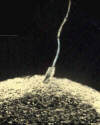
In 1994, Rosanna Della Corte, a 62-year-old Italian woman, gave birth to a healthy son, Riccardo. Her egg was artificially imseminated by the sperm of her 63-year-old husband, Mauro, at Dr. Severino Antinori's fertility clinic in Rome, Italy. Rosanna Della Corte had earlier lost her only son at 17 in a terrible car accident. She had often tried to adopt another son, but in vain. These were the reasons she turned to the procedure. In reaction, restrictions were introduced in the Italian legislature in the wake of a papal encyclical, Evangelium Vitae, condemning in vitro fertilization and many of other high-tech fertility procedures.
In 1990, the airlock hatch on the Soviet space station Mir could not be closed by the cosmonauts returning after a seven-hour space walk making an exterior inspection and repairs. The hatch had been damaged when it was pushed back on its hinges by residual air escaping when the cover was opened to begin the spacewalk. Instead, Anatoly Solovyov and Aleksandr Balandin stayed behind an interior airlock in another part of the station for eight days. After their next spacewalk to continue repairs on 26 Jul, they managed to secure the hatch and repressurize as normal.«*
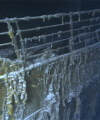
In 1986, videotapes, taken by the deep-sea Alvin submersible, showing Titanic's remains were released. Looking like huge stalagmites rusticles ("rust icicles"), are a byproduct of the bacteria slowly converting the iron in the hull. The colony of iron-eating bacteria flourish in the anaerobic (without oxygen) environment inside the hollow multi-layered rusticles while on the outside, porous layers support oxygen-dependent bacteria. In this eerie way, there is still life on the Titanic as the ship lies deep on the ocean floor.
In 1968, Intel Corporation was founded by Gordon E. Moore and Robert Noyce, originally incorporated as “NM Electronics.” The familiar short name, based on “Integrated Electronics” was adopted later in the year. In 1969, its first product was a RAM (random access memory) chip. By 1974, they introduced the 8080 microprocessor, which was quickly adopted in hundreds of products, including traffic lights, cash registers, and the earliest personal computers (such as the Altair 8800 hobbyist kit in 1975). Intel has grown to become the world's largest semiconductor chip maker (by revenue). «
Inside Intel: Andrew Grove and the Rise of the World's Most Powerful Chip Company, by Tim Jackson. - book suggestion.

In 1968, the Intel Corporation, inventor of the microchip, was incorporated. In 1968, a Hungarian immigrant by the name of Andy Grove co-founded Intel with a collaboration of colleagues with the same interest, to revolutionize the computer world. In 1971, Intel released its first microprocessor, the 4004 designed for a calculator. In 1972 came the more powerful 8008. With the introduction of the 8080 in 1974, the first personal computers were made possible.
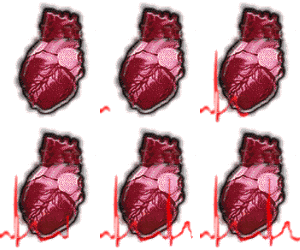
In 1963, the first implantation of an intrathoracic left artificial ventricle in a human being was made by Dr. E. Stanley Crawford, at the Baylor University College of Medicine, Methodist Hospital, Houston Tx. USA. The original prototype is kept and exhibited at the Smithsonian Institution, Washington, DC. Within a few years, on 4 Apr 1969, the first total artificial heart was implanted, used as a bridge to heart transplantation by Dr. Denton A. Cooley, at the Texas Heart Institute, Houston Tx. USA.
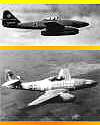
In 1942, Messerschmitt Me 262 Schwalbe, Germany's first operational jet fighter, takes first flight. The Me262 surprised the Allies with its speed advantage - around 100 or more miles per hour. Although it could still be intercepted by Allied piston-engine fighters, when the Nazi jet was at speed it could escape an enemy. However, introduced near the end of World War II, and with limited numbers available, the Me 262 had limited effect on the progress of the war.
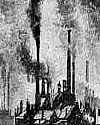
In 1876, a Royal Commission on Noxious Vapours was appointed by the British government to inquire into the management of chemical works, to determine the effects of certain gases and vapours emitted, and investigate means of prevention. The Commission inspected alkali works, cement works, chemical manure works, copper, glass, lead, salt and metal works, coke ovens and potteries. In their report, issued in Aug 1878, they recommended increasing the number of visits by inspectors, recording any escapes of gases, the publication of inspectors' reports, and more stringent regulations, despite witnesses arguing that noxious vapours were the inevitable and unalterable cost of national prosperity.[* p.251]
In 1860, a series of photographs of a total solar eclipse was made by Warren De la Rue (1815-1889) in Spain, and by Father Angelo Secchi at another location 500-km away. The value of photography as a means of investigating the solar appendages was demonstrated when the images were compared at various stages of the eclipse. The moon was clearly seen to advance over the “red protuberances” and settle forever that they belonged to the sun and and not the moon.

In 1853, trains begin running over the first North American international railroad between Portland, Maine and Montreal, Quebec. St. Lawrence & Atlantic Railroad/ Canadian National Railroad was first proposed in 1843, when John A. Poor of Portland advocated building a railway from Montreal to Portland in conjunction with a railroad through Maine east to Saint John, New Brunswick and Halifax, Nova Scotia. This resulted in the formation of the Atlantic & St. Lawrence Railroad in Maine which is today known as the St. Lawrence & Atlantic Railroad. The railroad was opened for traffic on 18 Jul 1853 and was taken over by the Grand Trunk the same year.
In 1627, French explorers noticed oil seeping out of the ground near Cuba, New York. The phenomenon was described by the Franciscan Missionary Joseph DeLa Roch D'Allion, which was the first recorded mention of oil on the North American Continent. The Seneca Oil Spring is located near the spillway end of Cuba Lake on the Oil Spring Indian Reservation.




