
 Short Stories of Science and InventionA Collection of Radio Talks byCharles F. KetteringINDEXWeekly, from September 1942 to July 1945, Charles F. Kettering gave five-minute intermission talks about Science and Invention during the radio broadcasts of the General Motors Symphony of the Air. Kettering invented the first automobile self-starter, and for 31 years directed a research laboratory for General Motors. These radio talks are a fascinating legacy from the mind of a prolific inventor. The obvious anachronisms now add a historical perspective of the war-time period in which they were written. These web pages now preserve some of the most popular stories for a new generation to read The text and art come from a General Motors booklet of selected talks. (Reprint, March 1959) |
A Radio Talk by Charles F. Kettering 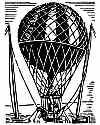 The Italian Leonardo da Vinci was
one of the first to experiment with flying machines in about 1500, but
for nearly 300 years no progress was made until in the Montgolfier
brothers constructed a balloon which rose to a height of 6000 feet.
The Italian Leonardo da Vinci was
one of the first to experiment with flying machines in about 1500, but
for nearly 300 years no progress was made until in the Montgolfier
brothers constructed a balloon which rose to a height of 6000 feet. A short time later another Frenchman, de Rozier, made the first human flight; and only two years after the first flight, Blanchard crossed the English channel in a balloon. Ten years later Blanchard came to America and flew from Philadelphia, across the Delaware River into New Jersey. He carried and delivered the first air mail. 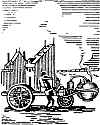 French inventors also contributed much to transportation on the ground.
In nearly every history dealing with self-propelled road vehicles, you
will find the name Nicholas Cugnot.
Cugnot was a French artillery officer and built a three-wheeled steam
propelled vehicle to pull artillery. Its chief difficulties were that
it had to be refueled every 15 miles and turned over very easily.
Because of these faults, the inventor was driven into exile.
French inventors also contributed much to transportation on the ground.
In nearly every history dealing with self-propelled road vehicles, you
will find the name Nicholas Cugnot.
Cugnot was a French artillery officer and built a three-wheeled steam
propelled vehicle to pull artillery. Its chief difficulties were that
it had to be refueled every 15 miles and turned over very easily.
Because of these faults, the inventor was driven into exile. |







