Born 15 Apr 1931; died 15 Nov 2006 at age 75.
Indonesian electronics engineer who was one of the founders of the Indonesian Academy of Sciences. He is known especially for his contributions in microelectronics research, but also worked on payload instrumentation for space programs. From 1978-1983, he was the Director General of Energy, Ministry of Mining and Energy for the Indonesian government. With co-inventor Kensall D Wise, he held a US Patent (No. 3,888,708, 10 Jun 1975) for his “Method for Forming Regions of Predetermined Thickness in Silicon” for pressure sensors. It was his vision to bring integrated chip (IC) fabrication to Indonesia. Though that was not accomplished before his death, he was active in planning Bandung High Tech Valley inspired by the success of California’s Silicon Valley.«
Indonesian electronics engineer who was one of the founders of the Indonesian Academy of Sciences. He is known especially for his contributions in microelectronics research, but also worked on payload instrumentation for space programs. From 1978-1983, he was the Director General of Energy, Ministry of Mining and Energy for the Indonesian government. With co-inventor Kensall D Wise, he held a US Patent (No. 3,888,708, 10 Jun 1975) for his “Method for Forming Regions of Predetermined Thickness in Silicon” for pressure sensors. It was his vision to bring integrated chip (IC) fabrication to Indonesia. Though that was not accomplished before his death, he was active in planning Bandung High Tech Valley inspired by the success of California’s Silicon Valley.«
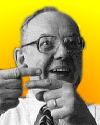
Born 15 Apr 1927; died 27 Oct 1999 at age 72.
American physicist who shared the 1980 Rumford Premium Prize with his colleague Chen Ning Yang for their “development of a generalized gauge invariant field theory” in 1954. They proposed a tensor equation for what are now called Yang-Mills fields. Their mathematical work was aimed at understanding the strong interaction holding together nucleons in atomic nuclei. They constructed a more generalized view of electromagnetism, thus Maxwell's Equations can be derived as a special case from their tensor equation. Quantum Yang-Mills theory is now the foundation of most of elementary particle theory, and its predictions have been tested at many experimental laboratories.«
American physicist who shared the 1980 Rumford Premium Prize with his colleague Chen Ning Yang for their “development of a generalized gauge invariant field theory” in 1954. They proposed a tensor equation for what are now called Yang-Mills fields. Their mathematical work was aimed at understanding the strong interaction holding together nucleons in atomic nuclei. They constructed a more generalized view of electromagnetism, thus Maxwell's Equations can be derived as a special case from their tensor equation. Quantum Yang-Mills theory is now the foundation of most of elementary particle theory, and its predictions have been tested at many experimental laboratories.«
50 Years Of Yang-Mills Theory, by Gerardus 't Hooft. - book suggestion.

Born 15 Apr 1923; died 5 Oct 2015 at age 92. quotes
Anthony Francis Clarke Wallace was a Canadian-American psychological anthropologist and historian who analyzed the processes of social and cultural change. He was also interested in the cognitive process involved in technological creativity and the transfer of technological information. His particular interests included the effects on individual communities of the Industrial Revolution of the eighteenth and nineteenth centuries. He also wrote ethnohistorical accounts of native American lives. His list of books has been called “a primer for practitioners of the ethnohistorical craft.” It includes The Social Context of Innovation (1982) and the Bancroft Prize-winning Rockdale: The Growth of an American Village in the Early Industrial Revolution (2005). He retired Prof. Emeritus of Anthropology at UPenn.«
Anthony Francis Clarke Wallace was a Canadian-American psychological anthropologist and historian who analyzed the processes of social and cultural change. He was also interested in the cognitive process involved in technological creativity and the transfer of technological information. His particular interests included the effects on individual communities of the Industrial Revolution of the eighteenth and nineteenth centuries. He also wrote ethnohistorical accounts of native American lives. His list of books has been called “a primer for practitioners of the ethnohistorical craft.” It includes The Social Context of Innovation (1982) and the Bancroft Prize-winning Rockdale: The Growth of an American Village in the Early Industrial Revolution (2005). He retired Prof. Emeritus of Anthropology at UPenn.«
Rockdale: The Growth of an American Village in the Early Industrial Revolution, by Anthony F.C. Wallace. - book suggestion.
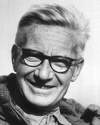
Born 15 Apr 1907; died 21 Dec 1988 at age 81. quotes
Dutch-born English ethologist, a zoologist who studied the behaviour of animals in their natural habitats, who shared (with Konrad Lorenz and Karl von Frisch) the Nobel Prize for Physiology or Medicine in 1973 for "for their discoveries concerning "organization and elicitation of individual and social behaviour patterns." He is known for his long-term field observations of the social patterns, courtship and mating behaviour of seagulls, made in their natural habitat. Having constructed experiments to test sociobiological responses and animal aggression, he interpreted the results to explain that human violence is rooted in an animal instinct for survival. Though gulls were a primary interest, his diverse studies also encompassed sand wasps and stickleback fish.«
Dutch-born English ethologist, a zoologist who studied the behaviour of animals in their natural habitats, who shared (with Konrad Lorenz and Karl von Frisch) the Nobel Prize for Physiology or Medicine in 1973 for "for their discoveries concerning "organization and elicitation of individual and social behaviour patterns." He is known for his long-term field observations of the social patterns, courtship and mating behaviour of seagulls, made in their natural habitat. Having constructed experiments to test sociobiological responses and animal aggression, he interpreted the results to explain that human violence is rooted in an animal instinct for survival. Though gulls were a primary interest, his diverse studies also encompassed sand wasps and stickleback fish.«
Animal in Its World: Field Studies, by Niko Tinbergen, Nikolaas Tinbergen. - book suggestion.

Born 15 Apr 1902; died 26 Jun 1995 at age 93.
Samuel Kurtz Hoffman was an American engineer who led the development of the liquid fuel rocket engines used in America's early space programs. His career began as an aeronautical-design engineer (1932-45) and then he spent four years teaching in that field. By 1949, he joined the Propulsion Section of North American Aviation which he later headed as its president (1960-70). (That division, renamed Rocketdyne, later became part of Rockwell International Corp.) He supervised the development of the first-stage Redstone propulsion system, which launched Explorer I, America's first satellite (31 Jan 1958). His work continued with the high-thrust engines used for the Mercury rockets that propelled the first U.S. astronauts into space, and the F-1 rocket engines used in the first stage of the Saturn V rockets of the Apollo moonshot program.«
Samuel Kurtz Hoffman was an American engineer who led the development of the liquid fuel rocket engines used in America's early space programs. His career began as an aeronautical-design engineer (1932-45) and then he spent four years teaching in that field. By 1949, he joined the Propulsion Section of North American Aviation which he later headed as its president (1960-70). (That division, renamed Rocketdyne, later became part of Rockwell International Corp.) He supervised the development of the first-stage Redstone propulsion system, which launched Explorer I, America's first satellite (31 Jan 1958). His work continued with the high-thrust engines used for the Mercury rockets that propelled the first U.S. astronauts into space, and the F-1 rocket engines used in the first stage of the Saturn V rockets of the Apollo moonshot program.«
Rocketdyne: Powering Humans Into Space, by Robert S Kraemer. - book suggestion.
Born 15 Apr 1896; died 25 Sep 1986 at age 90.
Russian physical chemist who shared the 1956 Nobel Prize for Chemistry with Sir Cyril Hinshelwood for “their researches into the mechanism of chemical reactions.” He was the first Soviet scientist to receive a Nobel Prize. In 1926, with his coworkers, Semyonov first discovered branched-chain reactions in the oxidation of phosphorus. Whereas his intent for the investigation began as a study of the light output of that reaction, he was surprised to find there is a critical pressure of oxygen gas below which no activity would take place. The theoretical explanations he developed for how a process can initiate by a chain mechanism are also applicable in a wide range of chemical reactions, including oxidation, cracking, halogenation, polymerization and explosions. The chain mechanism creates an avalanche of interactions.«[Name also written as Nikolai Nikolaevic Semenov. Birthdate 3 Apr 1896 by old style calendar.]
Russian physical chemist who shared the 1956 Nobel Prize for Chemistry with Sir Cyril Hinshelwood for “their researches into the mechanism of chemical reactions.” He was the first Soviet scientist to receive a Nobel Prize. In 1926, with his coworkers, Semyonov first discovered branched-chain reactions in the oxidation of phosphorus. Whereas his intent for the investigation began as a study of the light output of that reaction, he was surprised to find there is a critical pressure of oxygen gas below which no activity would take place. The theoretical explanations he developed for how a process can initiate by a chain mechanism are also applicable in a wide range of chemical reactions, including oxidation, cracking, halogenation, polymerization and explosions. The chain mechanism creates an avalanche of interactions.«[Name also written as Nikolai Nikolaevic Semenov. Birthdate 3 Apr 1896 by old style calendar.]
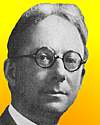
Born 15 Apr 1885; died 8 Mar 1975 at age 89.
Emory Leon Chaffee was an American physicist whose invention of the “Chaffee Gap” spark-type method to produce continuous high-frequency electrical oscillations for radio transmission was an outcome of research work for his Ph.D. thesis (1911). The spark gap was between the end faces of metal rods (a copper anode and an alumium cathode), in an atmosphere of moist hydrogen in a sealed chamber. The d.c. source circuit included choke coils. The rods were cooled by external radiating fins. He also specialized in the field of thermionic vacuum tubes and test measurements, such as an accurate direct determination of the value of e/m, the ratio of electron charge and its mass. Later he became interested in the eye, doing experimental work with William T. Bovie on the electrical response of the retina, which Chaffee amplified with a vacuum tube circuit.«
Emory Leon Chaffee was an American physicist whose invention of the “Chaffee Gap” spark-type method to produce continuous high-frequency electrical oscillations for radio transmission was an outcome of research work for his Ph.D. thesis (1911). The spark gap was between the end faces of metal rods (a copper anode and an alumium cathode), in an atmosphere of moist hydrogen in a sealed chamber. The d.c. source circuit included choke coils. The rods were cooled by external radiating fins. He also specialized in the field of thermionic vacuum tubes and test measurements, such as an accurate direct determination of the value of e/m, the ratio of electron charge and its mass. Later he became interested in the eye, doing experimental work with William T. Bovie on the electrical response of the retina, which Chaffee amplified with a vacuum tube circuit.«
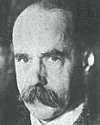
Born 15 Apr 1880; died 12 Oct 1943 at age 63. quotes
Czech psychologist who co-founded the Gestalt movement in psychology (with two younger men, Kurt Koffka and Wolfgang Köhler). The prevailing approach had been to reduce a complex psychological phenomenon into the sum of its parts, and focus separately on the component elements rather than the whole. In a sense, that would ignore a melody but study its notes. He disagreed with that piecemeal form of analysis. Instead, in Gestalt thinking, he took an overall landscape psychological view. He maintained that wholes have their own properties and tendancies which are not evident from looking too closely at their isolated parts. He had moved to Germany for study and then teaching there, but with the rise of Hitler in 1933, Wertheimer, being of Jewish heritage, decided to emigrate with his family to the U.S.A.«
Czech psychologist who co-founded the Gestalt movement in psychology (with two younger men, Kurt Koffka and Wolfgang Köhler). The prevailing approach had been to reduce a complex psychological phenomenon into the sum of its parts, and focus separately on the component elements rather than the whole. In a sense, that would ignore a melody but study its notes. He disagreed with that piecemeal form of analysis. Instead, in Gestalt thinking, he took an overall landscape psychological view. He maintained that wholes have their own properties and tendancies which are not evident from looking too closely at their isolated parts. He had moved to Germany for study and then teaching there, but with the rise of Hitler in 1933, Wertheimer, being of Jewish heritage, decided to emigrate with his family to the U.S.A.«
(EB)

Born 15 Apr 1874; died 28 Sep 1954 at age 80.
American botanist and geneticist known as the father of hybrid corn (maize). A leader in developing the multiple allele concept of genes, Shull's work with maize led him to develop the first hybrid corn, ancestor of today's sweet corn and a boon to commercial farmers. Shull's approach was to study the effects of inbreeding and subsequent cross-fertilization in corn. In 1909, he published A Pure Line Method of Corn Breedingin which he outlined – with remarkable insight – the basics of breeding hybrid corn. As a result of his researches, corn yields per acre were increased 25 to 50 percent. He developed a method of corn breeding that made possible the production of seed capable of thriving under various soil and climatic conditions.
American botanist and geneticist known as the father of hybrid corn (maize). A leader in developing the multiple allele concept of genes, Shull's work with maize led him to develop the first hybrid corn, ancestor of today's sweet corn and a boon to commercial farmers. Shull's approach was to study the effects of inbreeding and subsequent cross-fertilization in corn. In 1909, he published A Pure Line Method of Corn Breedingin which he outlined – with remarkable insight – the basics of breeding hybrid corn. As a result of his researches, corn yields per acre were increased 25 to 50 percent. He developed a method of corn breeding that made possible the production of seed capable of thriving under various soil and climatic conditions.
Born 15 Apr 1858; died 15 Nov 1917 at age 59. quotes
French sociologist whose recognition as “father of sociology” rests on his pioneering works and influence on a generation of scholars. He did not engage in firsthand fieldwork, but did collate much information on tribes of Australia and New Guinea as well as Eskimos. From anthropologists, travelers and missionaries, he gathered a wealth of facts, which he organized into types and laws. His book Le Suicide is regarded as the first to make a methodological case study of an aspect of society, and shaped sociological thought as we know it today. He drew conclusions comparing suicide rates among various pairs of groups, such as soldiers or civilians. The psychological causes of suicide, he identified in four kinds: egoistic, altruistic, anomic or fatalistic.«
French sociologist whose recognition as “father of sociology” rests on his pioneering works and influence on a generation of scholars. He did not engage in firsthand fieldwork, but did collate much information on tribes of Australia and New Guinea as well as Eskimos. From anthropologists, travelers and missionaries, he gathered a wealth of facts, which he organized into types and laws. His book Le Suicide is regarded as the first to make a methodological case study of an aspect of society, and shaped sociological thought as we know it today. He drew conclusions comparing suicide rates among various pairs of groups, such as soldiers or civilians. The psychological causes of suicide, he identified in four kinds: egoistic, altruistic, anomic or fatalistic.«
A Study In Sociology Reissue Edition, by Émile Durkheim, John A. Spaulding (trans.) and George Simpson (ed.). - book suggestion.
Born 15 Apr 1856; died 14 Mar 1928 at age 71.
(Akiba Horowitz) After emigrating from Russia to the U.S., he later founded the Everready Flashlight Co. He first developed electric novelties after receiving rights to the battery-powered lighted flowerpots invented by Joshua L. Cowen, and electrically illuminated scarf pins. In Mar 1898, he founded the American Electrical Novelty and Manufacturing Company to make bicycle lights. He then introduced the first tubular Flash Light (now known as a flashlight in the U.S. and a torch in Britain) based on the patent he bought from inventor David Misell (U.S. No 617,592 issued 10 Jan 1899). From his business activities, he became a millionaire.
(Akiba Horowitz) After emigrating from Russia to the U.S., he later founded the Everready Flashlight Co. He first developed electric novelties after receiving rights to the battery-powered lighted flowerpots invented by Joshua L. Cowen, and electrically illuminated scarf pins. In Mar 1898, he founded the American Electrical Novelty and Manufacturing Company to make bicycle lights. He then introduced the first tubular Flash Light (now known as a flashlight in the U.S. and a torch in Britain) based on the patent he bought from inventor David Misell (U.S. No 617,592 issued 10 Jan 1899). From his business activities, he became a millionaire.
Born 15 Apr 1801; died 28 Jan 1871 at age 69.
Édouard Armand Isidore Hippolyte Lartet was a French paleontologist and archaeologist who was a pioneer of Paleolithic archaeology, the emerging science of human paleontology. He first trained as a lawyer, but developed instead an interest in the natural sciences, and pursued discoveries in fossil beds. From 1863, he collaborated with Henry Christy to systematically explore and excavate cave deposits for evidence of early humans. Carved and sculpted relics thus uncovered represent man’s earliest art objects. His most striking cave discovery was a mammoth tusk engraved with a drawing of a mammoth—clear proof that man lived at the same time as the mammoth. His son, Louis Lartet also studied prehistory, but eventually became a professor of geology.«
Édouard Armand Isidore Hippolyte Lartet was a French paleontologist and archaeologist who was a pioneer of Paleolithic archaeology, the emerging science of human paleontology. He first trained as a lawyer, but developed instead an interest in the natural sciences, and pursued discoveries in fossil beds. From 1863, he collaborated with Henry Christy to systematically explore and excavate cave deposits for evidence of early humans. Carved and sculpted relics thus uncovered represent man’s earliest art objects. His most striking cave discovery was a mammoth tusk engraved with a drawing of a mammoth—clear proof that man lived at the same time as the mammoth. His son, Louis Lartet also studied prehistory, but eventually became a professor of geology.«
Born 15 Apr 1800; died 3 Apr 1862 at age 61.
British naval officer who carried out important magnetic surveys in the Arctic and Antarctic and discovered the Ross Sea and the Victoria Land region of Antarctica.
British naval officer who carried out important magnetic surveys in the Arctic and Antarctic and discovered the Ross Sea and the Victoria Land region of Antarctica.
Born 15 Apr 1794; died 6 Dec 1867 at age 73.
French physiologist who was the first to demonstrate the general functions of the major portions of the vertebrate brain.
French physiologist who was the first to demonstrate the general functions of the major portions of the vertebrate brain.
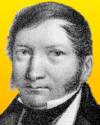
Born 15 Apr 1793; died 23 Nov 1864 at age 71.
German-Russian astronomer, one of the greatest 19th-century astronomers and the first in a line of four generations of distinguished astronomers. He founded the modern study of binary (double) stars. In 1817, he became director of the Dorpat Observatory, which he equipped with a 9.5-inch (24-cm) refractor that he used in a massive survey of binary stars from the north celestial pole to 15°S. He measured 3112 binaries—discovering well over 2000—and cataloged his results in Stellarum Duplicium Mensurae Micrometricae (1837). In 1835, Czar Nicholas I persuaded Struve to set up a new observatory at Pulkovo, near St. Petersburg. There in 1840 Struve became, with Friedrich Bessel and Thomas Henderson, one of the first astronomers to detect parallax. Astronomer Otto Struve was his great-grandson.
German-Russian astronomer, one of the greatest 19th-century astronomers and the first in a line of four generations of distinguished astronomers. He founded the modern study of binary (double) stars. In 1817, he became director of the Dorpat Observatory, which he equipped with a 9.5-inch (24-cm) refractor that he used in a massive survey of binary stars from the north celestial pole to 15°S. He measured 3112 binaries—discovering well over 2000—and cataloged his results in Stellarum Duplicium Mensurae Micrometricae (1837). In 1835, Czar Nicholas I persuaded Struve to set up a new observatory at Pulkovo, near St. Petersburg. There in 1840 Struve became, with Friedrich Bessel and Thomas Henderson, one of the first astronomers to detect parallax. Astronomer Otto Struve was his great-grandson.
Born 15 Apr 1786; died 27 Jul 1876 at age 90.
U.S. physician and one of the founders of the Boston Lying-In Hospital (1832), brother of the clergyman William Ellery Channing; he was the first (1847) to use ether as an anesthetic in obstetrics and the first professor of obstetrics at Harvard University (1815).
U.S. physician and one of the founders of the Boston Lying-In Hospital (1832), brother of the clergyman William Ellery Channing; he was the first (1847) to use ether as an anesthetic in obstetrics and the first professor of obstetrics at Harvard University (1815).
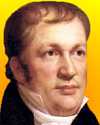
Born 15 Apr 1772; died 19 Jun 1844 at age 72. quotes
French zoologist who held to his idea of unity of composition, by which all animals are formed of the same elements, in the same number, and with the same connections. He regarded this single structural plan to be fundamental to comparative anatomy. Thereby, he did not accept the modification of existing species. Although he collaborated with Georges Cuvier in other projects, Cuvier rejected this idea. The Museum of Natural History in Paris, was new Geoffroy joined it in 1793. He accompanied Napoleon on his Egyptian campaign (1798-1801). He spent a 47 year career at the museum, teaching, and building its collection. Another of his interests was teratology, the study of animal malformations. From 1840, Geoffroy lost his sight and became paralysed, but his work was carried on by his son, Isidore.«
French zoologist who held to his idea of unity of composition, by which all animals are formed of the same elements, in the same number, and with the same connections. He regarded this single structural plan to be fundamental to comparative anatomy. Thereby, he did not accept the modification of existing species. Although he collaborated with Georges Cuvier in other projects, Cuvier rejected this idea. The Museum of Natural History in Paris, was new Geoffroy joined it in 1793. He accompanied Napoleon on his Egyptian campaign (1798-1801). He spent a 47 year career at the museum, teaching, and building its collection. Another of his interests was teratology, the study of animal malformations. From 1840, Geoffroy lost his sight and became paralysed, but his work was carried on by his son, Isidore.«
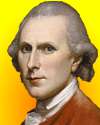
Born 15 Apr 1741; died 22 Feb 1827 at age 85. quotes
American artist and naturalist who opened the first U.S. popular Museum of Natural Science and Art. Alongside fame as a portraitist, Peale maintained a diverse interest in science. He used a physiognotrace machine used to record profiles and make silhouettes. He patented a fireplace, porcelain false teeth, and a new kind of wooden bridge. He invented a technique to put motion with pictures and wrote papers on engineering and hygiene. He perfected a kind of portable writing desk, named the polygraph, which reproduced several copies of a manuscript at once. In 1786, he established the first U.S. scientific museum with both living and stuffed specimens, and later a complete mastodon skeleton he helped excavate (1801).« more
American artist and naturalist who opened the first U.S. popular Museum of Natural Science and Art. Alongside fame as a portraitist, Peale maintained a diverse interest in science. He used a physiognotrace machine used to record profiles and make silhouettes. He patented a fireplace, porcelain false teeth, and a new kind of wooden bridge. He invented a technique to put motion with pictures and wrote papers on engineering and hygiene. He perfected a kind of portable writing desk, named the polygraph, which reproduced several copies of a manuscript at once. In 1786, he established the first U.S. scientific museum with both living and stuffed specimens, and later a complete mastodon skeleton he helped excavate (1801).« more
Mr. Peale's Museum, by Charles Coleman Sellers. - book suggestion.
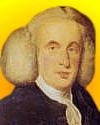
Born 15 Apr 1710; died 5 Feb 1790 at age 79. quotes
Scottish physician and chemist who held the first independent university lectureship designated for chemistry (founded 1747) in the British Isles at Glasgow University. The university also provided a modest sum for a laboratory. (An earlier chair at Edinburgh was entitled chemistry and medicine.) Cullen extended the subject of chemistry beyond medicine by connecting it to many "arts" including agriculture, bleaching, brewing, mining, and the manufacture of vinegar and alkalies. He moved to the University of Edinburgh in 1755. Cullen was active in the founding of the Royal Society of Edinburgh and the Royal Medical Society (Edinburgh). His sole paper (1756) was on his investigation of the cold produced by the evaporation of various fluids.«*
Scottish physician and chemist who held the first independent university lectureship designated for chemistry (founded 1747) in the British Isles at Glasgow University. The university also provided a modest sum for a laboratory. (An earlier chair at Edinburgh was entitled chemistry and medicine.) Cullen extended the subject of chemistry beyond medicine by connecting it to many "arts" including agriculture, bleaching, brewing, mining, and the manufacture of vinegar and alkalies. He moved to the University of Edinburgh in 1755. Cullen was active in the founding of the Royal Society of Edinburgh and the Royal Medical Society (Edinburgh). His sole paper (1756) was on his investigation of the cold produced by the evaporation of various fluids.«*
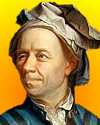
Born 15 Apr 1707; died 18 Sep 1783 at age 76. quotes
Leonhard Paul Euler was a Swiss mathematician and physicist, one of the founders of pure mathematics. He not only made decisive and formative contributions to the subjects of geometry, calculus, mechanics, and number theory but also developed methods for solving problems in observational astronomy and demonstrated useful applications of mathematics in technology. At age 28, he blinded one eye by staring at the sun while working to invent a new way of measuring time.
Leonhard Paul Euler was a Swiss mathematician and physicist, one of the founders of pure mathematics. He not only made decisive and formative contributions to the subjects of geometry, calculus, mechanics, and number theory but also developed methods for solving problems in observational astronomy and demonstrated useful applications of mathematics in technology. At age 28, he blinded one eye by staring at the sun while working to invent a new way of measuring time.
Euler: The Master of Us All, by William Dunham. - book suggestion.
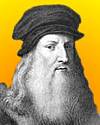
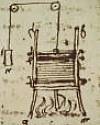
Italian painter, sculptor, draftsman, physicist, engineer and architect who was also a ingenious inventor. DaVinci designed buildings, bridges, canals, forts and war machines. His ideas have been preserved in his huge notebooks with sketches of his insights. Among these, he was fascinated by birds and flying so his sketches include such fantastic designs as flying machines. These drawings demonstrate a genius for mechanical invention. DaVinci’s understanding of scientific inquiry was truly centuries ahead of its time. His greater fame lies in being one of the greatest painters of all times, best known for such paintings as the Mona Lisa and The Last Supper.«[Image: Codex Leicester]
The Science of Leonardo: Inside the Mind of the Great Genius of the Renaissance, by Fritjof Capra. - book suggestion.

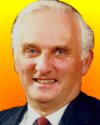
Died 15 Apr 2020 at age 88 (born 30 Dec 1931). quotes
Welsh metereologist who began in the late 1960s drawing attention to the buildup of carbon dioxide in the earth’s atmosphere and its result of global warming, now known as the greenhouse effect. As director-general (1983) of the British Meteorological Office, he began tracking changing climate patterns. In 1990, he co-chaired a team of scientists working for the United Nations that produced the first comprehensive report on the science of climate change. This led to the 1997 U.N. Conference on Climate Change, in Kyoto, Japan. The Kyoto Protocol that resulted there was a treaty among industrialized and developed nations to combat global warming by voluntarily adhering to progressively stiffening emissions-reduction standards.«
Welsh metereologist who began in the late 1960s drawing attention to the buildup of carbon dioxide in the earth’s atmosphere and its result of global warming, now known as the greenhouse effect. As director-general (1983) of the British Meteorological Office, he began tracking changing climate patterns. In 1990, he co-chaired a team of scientists working for the United Nations that produced the first comprehensive report on the science of climate change. This led to the 1997 U.N. Conference on Climate Change, in Kyoto, Japan. The Kyoto Protocol that resulted there was a treaty among industrialized and developed nations to combat global warming by voluntarily adhering to progressively stiffening emissions-reduction standards.«
Global Warming: The Complete Briefing, by John T. Houghton. - book suggestion.
Died 15 Apr 1993 at age 84 (born 24 Oct 1908). quotes
John Tuzo Wilson was a Canadian geologist and geophysicist who determined the underlying structure of faults, continents across the globe. From the early 1960s, Wilson revolutionized the emerging field of plate tectonics. He coined the word “plate” for the rigid subdivisions of the Earth's crust of both land and ocean beds. By 1963, he identified some of the earliest evidence supporting the sea-floor spreading hypothesis of Harry H. Hess. Wilson showed the relationship that islands were older for those further away from mid-ocean ridge. One of his important new ideas (1965) was for transform faults, where plate boundaries meet in a series of of offsets, and the plates slide alongside past each other without any creation or destruction of the crust. It is a conservative plate boundary beecause neither plate slides under the other.«
John Tuzo Wilson was a Canadian geologist and geophysicist who determined the underlying structure of faults, continents across the globe. From the early 1960s, Wilson revolutionized the emerging field of plate tectonics. He coined the word “plate” for the rigid subdivisions of the Earth's crust of both land and ocean beds. By 1963, he identified some of the earliest evidence supporting the sea-floor spreading hypothesis of Harry H. Hess. Wilson showed the relationship that islands were older for those further away from mid-ocean ridge. One of his important new ideas (1965) was for transform faults, where plate boundaries meet in a series of of offsets, and the plates slide alongside past each other without any creation or destruction of the crust. It is a conservative plate boundary beecause neither plate slides under the other.«
Died 15 Apr 1948 at age 85 (born 29 Jan 1863).
U.S. geologist and educator who, as chairman of committee on measurement of geologic time of the National Research Council (1922-46), originated, promoted, and directed research on the determination of the age of the Earth. He was petrographer, assistant state geologist, and state geologist for the Michigan State Geological Survey from 1889 to 1909.
U.S. geologist and educator who, as chairman of committee on measurement of geologic time of the National Research Council (1922-46), originated, promoted, and directed research on the determination of the age of the Earth. He was petrographer, assistant state geologist, and state geologist for the Michigan State Geological Survey from 1889 to 1909.
Died 15 Apr 1935 at age 79 (born 11 Dec 1855).
English chemist who, with Edward Bevan and Clayton Beadle, discovered cellulose could be produced (1891) by the dissolution of cellulose xanthate in dilute sodium hydroxide. Although cellulose had previously been made by others, this type of cellulose is the most popular type in use today. It was a syrupy yellow liquid. In 1892, Cross worked out a method for dissolving cellulose in carbon disulphide (producing a solution he called viscose) which could be squirted out of fine holes. As the solvent evaporated, a fine fibre was formed which became known as viscose rayon (or simply viscose). By 1908, the viscose was also used extruded through a narrow slit to produce thin, transparent sheets of cellophane.
English chemist who, with Edward Bevan and Clayton Beadle, discovered cellulose could be produced (1891) by the dissolution of cellulose xanthate in dilute sodium hydroxide. Although cellulose had previously been made by others, this type of cellulose is the most popular type in use today. It was a syrupy yellow liquid. In 1892, Cross worked out a method for dissolving cellulose in carbon disulphide (producing a solution he called viscose) which could be squirted out of fine holes. As the solvent evaporated, a fine fibre was formed which became known as viscose rayon (or simply viscose). By 1908, the viscose was also used extruded through a narrow slit to produce thin, transparent sheets of cellophane.
Died 15 Apr 1894 at age 76 (born 24 Apr 1817).
Swiss chemist whose life work consisted of making many precise determinations of atomic weights suggested the possibility of isotopes and the packing fraction of nuclei. He began a study of the rare-earth elements in 1840, when barely 23 years old. In 1878, he heated until it decomposed some erbium nitrate obtained from gadolinite. Extracting the product with water he obtained two oxides: a red one he named erbia and a colourless one he named ytterbia. Thus he discovered ytterbium, and later was a codiscover of gadolinium (1880). By separating tantalic and columbic acids, he also proved that tantalum and colubium (niobium) were not identical. The last 10 years of his life he lay prostrate, suffering intensely from heart disease.
Swiss chemist whose life work consisted of making many precise determinations of atomic weights suggested the possibility of isotopes and the packing fraction of nuclei. He began a study of the rare-earth elements in 1840, when barely 23 years old. In 1878, he heated until it decomposed some erbium nitrate obtained from gadolinite. Extracting the product with water he obtained two oxides: a red one he named erbia and a colourless one he named ytterbia. Thus he discovered ytterbium, and later was a codiscover of gadolinium (1880). By separating tantalic and columbic acids, he also proved that tantalum and colubium (niobium) were not identical. The last 10 years of his life he lay prostrate, suffering intensely from heart disease.
Died 15 Apr 1892 at age 60 (born 7 Jun 1831). quotes
Amelia Ann Blanford Edwards was an English novelist, traveller and Egyptologist whose account of her travels in Egypt, A Thousand Miles Up the Nile (1877), was an immediate success. During the last two decades of her life, she became concerned by threats to Egyptian monuments and antiquities, raised funds for archaeological excavations and increased public awareness by lecturing at home and abroad. She also wrote a huge number of popular articles. She establish the Egyptian Exploration Fund (1882). By the 1883 season, the Fund sponsored the young Flinders Petrie who went on to make substantial contributions to Egyptology. Edwards recognized his genius, and provided in her will the endowing of a university chair for him. For this, she chose London's University College (UCL), which was the only school then admitting women. This extended her active work for women's rights. Petrie was made Edwards professor of Egyptology at UCL upon her death in 1892.« more
Amelia Ann Blanford Edwards was an English novelist, traveller and Egyptologist whose account of her travels in Egypt, A Thousand Miles Up the Nile (1877), was an immediate success. During the last two decades of her life, she became concerned by threats to Egyptian monuments and antiquities, raised funds for archaeological excavations and increased public awareness by lecturing at home and abroad. She also wrote a huge number of popular articles. She establish the Egyptian Exploration Fund (1882). By the 1883 season, the Fund sponsored the young Flinders Petrie who went on to make substantial contributions to Egyptology. Edwards recognized his genius, and provided in her will the endowing of a university chair for him. For this, she chose London's University College (UCL), which was the only school then admitting women. This extended her active work for women's rights. Petrie was made Edwards professor of Egyptology at UCL upon her death in 1892.« more
Amelia Edwards: Traveller, Novelist & Egyptologist, by Joan Rees. - book suggestion.

Died 15 Apr 1873 at age 88 (born 26 Sep 1784).
Norwegian astronomer and physicist who is noted for his research in geomagnetism. In 1701, Edmond Halley had already published a map of magnetic declinations, and the subject was studied by Humboldt, de Borda, and Gay-Lussac, among others. Hansteen collected available data and also mounted an expedition to Siberia, where he took many measurements for an atlas of magnetic strength and declination.
Norwegian astronomer and physicist who is noted for his research in geomagnetism. In 1701, Edmond Halley had already published a map of magnetic declinations, and the subject was studied by Humboldt, de Borda, and Gay-Lussac, among others. Hansteen collected available data and also mounted an expedition to Siberia, where he took many measurements for an atlas of magnetic strength and declination.
Died 15 Apr 1840 at age 42 (born 10 Oct 1797).
Scottish civil engineer who invented the Drummond light (similar to limelight illumination in theatres). As a Royal Engineer he worked on the ordnance survey and attended chemistry lectures by Faraday at the Royal Institution. In the autumn of 1825, while mapping Ireland, Drummond applied limelight to enable surveying by night as well as day and designed an improved Heliostat. To produce a bright light, using an oxygenated alcohol flame, he heated a small ball of lime to incandescent in front of a reflector. From 1828, he attempted to adapt the Drummond light for use in lighthouses, but it was expensive to operate, and by 1831, he instead turned to politics, and by 1835 was Under Secretary of Ireland. His early death was caused by overwork.« more
Scottish civil engineer who invented the Drummond light (similar to limelight illumination in theatres). As a Royal Engineer he worked on the ordnance survey and attended chemistry lectures by Faraday at the Royal Institution. In the autumn of 1825, while mapping Ireland, Drummond applied limelight to enable surveying by night as well as day and designed an improved Heliostat. To produce a bright light, using an oxygenated alcohol flame, he heated a small ball of lime to incandescent in front of a reflector. From 1828, he attempted to adapt the Drummond light for use in lighthouses, but it was expensive to operate, and by 1831, he instead turned to politics, and by 1835 was Under Secretary of Ireland. His early death was caused by overwork.« more
Thomas Drummond: Under-secretary in Ireland, 1835-40; Life and Letters, by R. Barry O'Brien. - book suggestion.
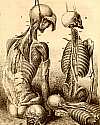
Died 15 Apr 1820 at age 56 (born 12 May 1763).
Scottish surgeon, anatomist and artist whose anatomical etchings are harshly realistic because he criticized the approach of artists in his day to beautify the body and their “vitious practice of drawing from imagination.” He believed that unlike the painter “striving for elegance of form” the anatomist must focus on “accuracy of representation.” Bell began his medical training at age 17 (1779) in Edinburgh. By 1790, Bell set up his own anatomy school to present the subject more effectively for the practicing surgeon than offered at the established Royal Infirmary. Meeting opposition from other surgeons caused by his outspokenness, he ceased teaching after 13 years, and for the next 20 years limited himself to surgical practice and consulting.«
Scottish surgeon, anatomist and artist whose anatomical etchings are harshly realistic because he criticized the approach of artists in his day to beautify the body and their “vitious practice of drawing from imagination.” He believed that unlike the painter “striving for elegance of form” the anatomist must focus on “accuracy of representation.” Bell began his medical training at age 17 (1779) in Edinburgh. By 1790, Bell set up his own anatomy school to present the subject more effectively for the practicing surgeon than offered at the established Royal Infirmary. Meeting opposition from other surgeons caused by his outspokenness, he ceased teaching after 13 years, and for the next 20 years limited himself to surgical practice and consulting.«
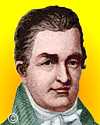
Died 15 Apr 1819 at age 63 (born 13 Sep 1755). quotes
American millwright and inventor who designed the first automatic corn mill (patented 18 Dec 1790), pioneered the high-pressure steam engine, and created the first continuous production line (1784). By about age 19, he invented a machine for bending and cutting off the wires in textile carding combs. His ideas for an automatic corn mill began in 1782, but the invention’s development was not completed until 1790. The ingenious mill used bucket elevators to raise the grain, conveying devices including a horizontal screw conveyor, and a “hopper boy” to cool and dry the meal before gathering it into a hopper feeding the bolting cylinder. Together, this took incoming wheat and delivered flour packed in barrels. more
American millwright and inventor who designed the first automatic corn mill (patented 18 Dec 1790), pioneered the high-pressure steam engine, and created the first continuous production line (1784). By about age 19, he invented a machine for bending and cutting off the wires in textile carding combs. His ideas for an automatic corn mill began in 1782, but the invention’s development was not completed until 1790. The ingenious mill used bucket elevators to raise the grain, conveying devices including a horizontal screw conveyor, and a “hopper boy” to cool and dry the meal before gathering it into a hopper feeding the bolting cylinder. Together, this took incoming wheat and delivered flour packed in barrels. more
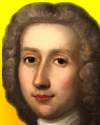
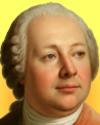
Died 15 Apr 1765 at age 53 (born 19 Nov 1711). quotes
Mikhail Vasilyevich Lomonosov was a Russian chemist, writer, poet and grammarian who pioneered modern science in Russia (hence “Father of Russian Science”). He advanced chemistry by proposing the conservation of matter in reactions and rejecting phlogiston theory. In physics, he explored heat, electricity, and corpuscular theory. As an astronomer, he discovered Venus’s atmosphere during the 1761 transit. Lomonosov reorganized the St. Petersburg Imperial Academy of Sciences, adding there Russia’s first modern scientific laboratory, improved meteorology, and advocated Arctic geography. His broad vision helped establish Russian scientific education and research. As a polymath, he was also a Russian linguistic reformer and helped establish the M.V. Lomonosov Moscow State University.«
Mikhail Vasilyevich Lomonosov was a Russian chemist, writer, poet and grammarian who pioneered modern science in Russia (hence “Father of Russian Science”). He advanced chemistry by proposing the conservation of matter in reactions and rejecting phlogiston theory. In physics, he explored heat, electricity, and corpuscular theory. As an astronomer, he discovered Venus’s atmosphere during the 1761 transit. Lomonosov reorganized the St. Petersburg Imperial Academy of Sciences, adding there Russia’s first modern scientific laboratory, improved meteorology, and advocated Arctic geography. His broad vision helped establish Russian scientific education and research. As a polymath, he was also a Russian linguistic reformer and helped establish the M.V. Lomonosov Moscow State University.«
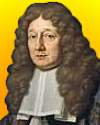
Died 15 Apr 1704 at age 75 (born 23 Apr 1628).
Dutch mathematician and statesman who, after an education in law, became interested in mathematics, though for a limited time (1654-63). He worked on improving the algebraic methods of René Descartes, seeking to extend them to the solution of equations of a higher degree by applying an algorithm. He also developed an algorithm based on Fermat's method to deal with the maxima, minima and tangents to curves of algebraic functions. Later, he served as burgomaster of Amsterdam for 30 years. During this time time he made a mathematical study of annuities. Hudde continued with an interest in physics and astronomy, producing lenses and microscopes. He collaborated with Baruch Spinoza, of Amsterdam, on telescopes. Hudde determine that in a telescope, a plano-convex lenses were better than concavo-convex .«
Dutch mathematician and statesman who, after an education in law, became interested in mathematics, though for a limited time (1654-63). He worked on improving the algebraic methods of René Descartes, seeking to extend them to the solution of equations of a higher degree by applying an algorithm. He also developed an algorithm based on Fermat's method to deal with the maxima, minima and tangents to curves of algebraic functions. Later, he served as burgomaster of Amsterdam for 30 years. During this time time he made a mathematical study of annuities. Hudde continued with an interest in physics and astronomy, producing lenses and microscopes. He collaborated with Baruch Spinoza, of Amsterdam, on telescopes. Hudde determine that in a telescope, a plano-convex lenses were better than concavo-convex .«
Died 15 Apr 1446 (born 1377).
Italian architect and engineer who was one of the pioneers of early Renaissance architecture in Italy. His major work is the dome of the Florence Cathedral (1420-36), constructed with the aid of machines that Brunelleschi invented expressly for the project.
Italian architect and engineer who was one of the pioneers of early Renaissance architecture in Italy. His major work is the dome of the Florence Cathedral (1420-36), constructed with the aid of machines that Brunelleschi invented expressly for the project.
In 2008, the first procedure in Britain to implant "bionic" eyes was carried out at Moorfields Eye Hospital, London, on two blind patients with retinal pigmentosa but intact optic nerves. In 4-hr operations, surgeons implanted a tiny electrode panel into the back of the eye and an ultra-thin receiver under the skin near the ear to pick up a wireless signal from a tiny camera on sunglasses and a signal processor worn on a belt. The patients can then perceive an array of spots of light showing crude shapes and movements. This international test with three other European hospitals followed clinical trials around the U.S. by the Californian firm, Second Sight, founded in 1998 to develop the Argus II retinal implant.«
In 1966, the first X-ray three-dimensional stereo fluoroscopic system was installed for use in heart catherization by Richard J Kuhn. The $30,000 machine, developed by Joseph Quinn was put into use at the University of Oregon Medical Center, Portland, Oregon, U.S. The X-ray tube had one anode but two cathodes, an image intensifier with polarizers, and a synchronized analyzer. This produced a 3D image that could be seen through a viewing mirror without the use of special glasses.
In 1964, Chesapeake Bay Bridge-Tunnel opened to traffic, joining Virginia's Eastern shore with the Norfolk/Virginia Beach area. It became the longest bridge-tunnel complex in the world, spanning a shore to shore distance of 17½ miles, after just 42 months of construction. It replaced the ferries, and made a direct road route across the bay 95 miles shorter than a road trip around the coast. The project included more than 12 miles of low-level roadway trestle, two one-mile tunnels, two bridges, almost two miles of causeway, and four manmade islands. Each tunnel ran between a pair of manmade islands in the middle of the bay, designed to provide a wide water surface openings above for large ship traffic. Lucius J. Kellam, Jr. is recognised as the key member of the Commission responsible for its undertaking.«
In 1952, the hydrogen thryatron was patented in the U.S. by K. Germeshausen (No. 2,591,556). The thryatron is an electronic switching tube filled with gas. Application of a voltage to the control grid turns on the current. It is normally used for high voltage switches.
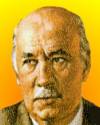
In 1941, Igor Ivor Sikorsky made the first helicopter flight over one-hour duration in his Vought-Sikorsky VS-300. It used a three-bladed main propeller 28-feet in diameter, and stayed in the air for 65 minutes and 14.5 seconds.
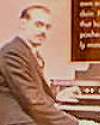
In 1935, the first pipeless organ was exhibited at the Industrial Arts Exhibition, New York City in Radio City's RCA Building. Pietro A. Yon, organist of St. Patrick's Cathedral, and Fritz Reiner, who later became conductor of the Chicago Symphony Orchestra, took turns at the keyboard. When George Gershwin performed on the new instrument, he was so impressed that he immediately ordered one. Critical acclaim at the debut was virtually unanimous. It was the invention of Laurens Hammond, patented 24 Apr 1934, and made by the Hammond Clock Company. The organ had two manuals and pedals, and weighed 275 pounds. The vast range of sounds it could produce contributed its success despite its $1,250 price.«
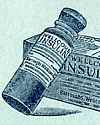
In 1923, insulin became generally available for diabetics' use on this day. It was first discovered in 1922. Today, insulin, is used daily in the treatment of diabetes. Insulin, a natural and vital hormone for carbohydrate metabolism in the body, is manufactured by the pancreas. An overabundance of insulin causes insulin shock and leads to a variety of symptoms, including coma. It is extracted from the pancreas of sheep, oxen and other means, including synthesis in the laboratory.
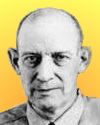
In 1920, Robert Stroud, the "Birdman of Alcatraz", was able to continue his research into bird diseases in prison, when President Woodrow Wilson commuted his death sentence.
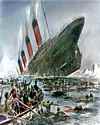
In 1912, at 2:20 a.m. the R.M.S. Titanic sank after hitting an iceberg four hours earlier. It was on its maiden voyage in the North Atlantic ocean, four days out from Southampton, England, on its way to New York City, U.S.A. Although the White Star liner design had been intended to make it unsinkable, built with a series of water-tight compartments, the iceberg had penetrated the hull with a long slice. Water flooded into so many compartments that had been gashed open, it could not remain afloat. Of an estimated 2,224 people aboard, 1,517 died. Only 866 were rescued by the Carpathia when it reached the area at daybreak. About two out of each three people perished in the icy water. The ship had carried a grossly insufficient number of lifeboats.«
In 1912, the fourth dimension was spoken of by Albert Einstein as time.
Subtle Is the Lord: The Science and the Life of Albert Einstein, by Abraham Pais. - book suggestion.
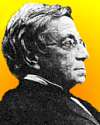
Balmer
In 1895, a mathematical relationship between the frequencies of the hydrogen light spectrum was reported by a Swiss school teacher, Johann Balmer, in Annalen der Physik. Its significance was overlooked until Niels Bohr realized this showed a structure of energy levels of the electron in the hydrogen atom.

In 1892, the General Electric Company was incorporated in NY state, formed by the merger of the Edison General Electric Co. of Schenectady, NY and Thomson-Houston Electric Company of Lynn, MA. The Edison General Electric Company was formed in 1889 by merging several Edison business interests, including Edison Lamp Company, Edison Machine Works (dynamos and motors), Bergmann & Company (lighting fixtures, sockets, etc.) and Edison Electric Light Company (patent holding). The Thomson-Houston Electric Company had been formed in 1883 by investors led by Charles A. Coffin that bought out Elihu Thomson and Edwin Houston’s American Electric Company.
In 1878, Harley Procter developed Ivory Soap, which when marketed later, made Procter and Gamble a multi-million dollar business.
In 1877, a steam-engine driven helicopter model built by Enrico Forlanini rose 40 ft (12 m). The machine weighed 3.5 kg (7.7 lbs). Its coaxial rotors were powered by a two-cylinder steam engine. Just before takeoff the spherical steam accumlator was charged with 10 atmospheres of pressure, enabling the craft to rise and remain aloft for 20 seconds. Forlanini (1848-1930) was an Italian pioneer of scientific aviation. He built a hydroplane, which could take off on water (1905) and a new type of semirigid aircraft in1914. He also invented the hydrofoil boat. Alexander Graham Bell secured the Italian's patents to pursue his own interest in hydrofoil development.
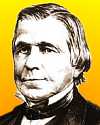
In 1854, the state of New York was the first American state to finance the study of insects harmful to plants when $1,000 was budgeted by the legislature for research. The following month, Asa Fitch became the country's first publicly funded entomologist. His first report (1855) covered fruit-damaging insects.
In 1817, the Erie Canal was authorized. It was the first canal of importance in the U.S. and linked Buffalo on Lake Erie with the Hudson River at Albany New York, a distance of 360 miles.
more
Wedding of the Waters: The Erie Canal and the Making of a Great Nation, by Peter L. Bernstein. - book suggestion.
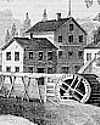
In 1788, the first U.S. worsted mill to use water power, the Hartford Woolen Manufactory was opened in Hartford, Conn. It was also the first strictly commercial worsted mill. Earlier industrial use of water power in America included fulling mills in the shrinking and thickening of cloth. Worsted yarns are more tightly twisted than are the bulkier woolen yarns. The Hartford Wool Manufactory was built using subscriptions from nearby towns, a contribution of £1,250. The wish was to establish production independence from Britain, but the factory lacked their own satisfactory equipment. Britain did not export the machines—just finished goods. The Hartford mill could not compete, was poorly managed, and by 1795, it failed.« [Image: a different water-powered industry in Connecticut, at Salisbury ironworks.]
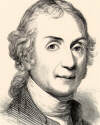
In 1770, Dr. Joseph Priestley made the first mention in English that a piece of a rubber substance could erase marks from black-lead pencils. At the end of the Preface to his work, Familiar Introduction to the Theory and Practice of Perspective, he described it: “Since this Work was printed off, I have seen a substance excellently adapted to the purpose of wiping from paper the mark of a black-lead-pencil. It must, therefore, be of singular use to those who practise drawing. It is sold by Mr Nairne, Mathematical Instrument Maker, opposite the Royal Exchange. He sells a cubical piece of about half an inch for three shillings; and he says it will last several years.”*
Joseph Priestley: Adventurer in Science and Champion of Truth, by F W. Gibbs. - book suggestion.
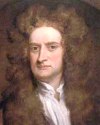
In 1726, writer William Stukeley held a conversation with Isaac Newton in Kensington during which Newton recalled “when formerly, the notion of gravitation came into his mind.” Later, Stukeley writing in his Memoirs of Sir Isaac Newton's Life, recorded that Newton said, “It was occasioned by the fall of an apple, as he sat in contemplative mood. Why should that apple always descend perpendicularly to the ground, thought he to himself. Why should it not go sideways or upwards, but constantly to the earth's centre.”
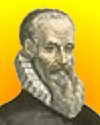
In 1561, Ambroise Paré published Anatomie universelle du corps humain (Universal Anatomy of the Human Body) based on the authoritative work on anatomy written by Belgian anatomist Andreas Vesalius (1514-1564). Paré had decided to publish this small handbook of anatomy, written in French (he couldn't read Latin) to make the knowledge accessible for study by surgeon-barbers. Although the French translation of Estienne (1546) was otherwise available, it was of a large size and very expensive. Paré's own important contributions included reintroducing the midwifery technique of podalic version. The 49 wood engravings of anatomy encompassed both some inspired by Vesalius, and illustrations of Paré's own innovations. more
more
more Ambroise Pare: Surgeon of the Renaissance, by Wallace B. Hamby. - book suggestion.




