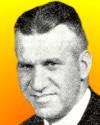
Born 20 Sep 1894; died 9 Dec 1940 at age 46.
Gladwyn Kingsley Noble was an American biologist and zoologist. After WW I, he began his life's work at the American Museum of Natural History, specializing in herpetology (the study of reptiles and amphibians) and experimental biology investigations using techniques of endocrinology and neurology. In an article published in Nature on 7 Aug 1926, Noble debunked Paul Kammerer's claim that he had induced nuptial pads on midwife toads that were hereditary. After Noble examined a preserved specimen, he revealed the pad was simulated with injected Indian ink. This set off an academic bombshell. He died at the very height of his ability, at age 47, from a streptococcus infection of the throat.
Gladwyn Kingsley Noble was an American biologist and zoologist. After WW I, he began his life's work at the American Museum of Natural History, specializing in herpetology (the study of reptiles and amphibians) and experimental biology investigations using techniques of endocrinology and neurology. In an article published in Nature on 7 Aug 1926, Noble debunked Paul Kammerer's claim that he had induced nuptial pads on midwife toads that were hereditary. After Noble examined a preserved specimen, he revealed the pad was simulated with injected Indian ink. This set off an academic bombshell. He died at the very height of his ability, at age 47, from a streptococcus infection of the throat.
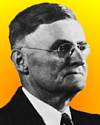
Born 20 Sep 1888; died 6 Nov 1976 at age 88. quotes
American pathologist whose substantial research on the treatment of goitre with iodine led to the iodizing of table salt. During 1917-22 he ran a trial on a large group of schoolgirls to show that an iodine supplement dramatically reduced the incident of goitre (a major swelling of the thyroid gland in the neck). His results clearly showed the important of iodine in the diet. Dr. David. M. Cowie promoted the production of iodized table salt, first sold on 1 May 1924, and later throughout the U.S., greatly reducing the incidence of goitre. Marine worked on salt iodization for the World Health Organization, further spreading its benefits. (As early as 1821 French chemist Jean-Baptiste Boussingault had observed that iodine-rich salt could treat goiter.)« more
American pathologist whose substantial research on the treatment of goitre with iodine led to the iodizing of table salt. During 1917-22 he ran a trial on a large group of schoolgirls to show that an iodine supplement dramatically reduced the incident of goitre (a major swelling of the thyroid gland in the neck). His results clearly showed the important of iodine in the diet. Dr. David. M. Cowie promoted the production of iodized table salt, first sold on 1 May 1924, and later throughout the U.S., greatly reducing the incidence of goitre. Marine worked on salt iodization for the World Health Organization, further spreading its benefits. (As early as 1821 French chemist Jean-Baptiste Boussingault had observed that iodine-rich salt could treat goiter.)« more
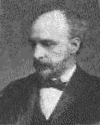
Born 20 Sep 1842; died 27 Mar 1923 at age 80. quotes
Scottish chemist and physicist who blurred the line between physics and chemistry and advanced the research frontier in several fields at the turn of the century. He gave dazzling lectures and his study of low-temperature phenomena entailed making the Dewar flask, an insulating double-walled flask of his own design by creating a vacuum between the two silvered layers of steel or glass (1892), which led to the domestic Thermos bottle. In Jun 1897, The Scientific American reported that “Dewar has just succeeded in liquefying fluorine gas at a temperature of -185 ºC.” He obtained liquid hydrogen in 1898. Dewar also invented cordite, the first smokeless powder. more
Scottish chemist and physicist who blurred the line between physics and chemistry and advanced the research frontier in several fields at the turn of the century. He gave dazzling lectures and his study of low-temperature phenomena entailed making the Dewar flask, an insulating double-walled flask of his own design by creating a vacuum between the two silvered layers of steel or glass (1892), which led to the domestic Thermos bottle. In Jun 1897, The Scientific American reported that “Dewar has just succeeded in liquefying fluorine gas at a temperature of -185 ºC.” He obtained liquid hydrogen in 1898. Dewar also invented cordite, the first smokeless powder. more
Born 20 Sep 1784; died 22 Sep 1878 at age 94.
(1st Baronet) Irish geologist and civil engineer who has sometimes been called the "father of Irish geology." He studied civil engineering in London and Edinburgh, returned to Ireland in 1808, and became mining engineer to the Royal Dublin Society in 1812 and a government inspector of mines. He published a geological map of Ireland in 1835.
(1st Baronet) Irish geologist and civil engineer who has sometimes been called the "father of Irish geology." He studied civil engineering in London and Edinburgh, returned to Ireland in 1808, and became mining engineer to the Royal Dublin Society in 1812 and a government inspector of mines. He published a geological map of Ireland in 1835.

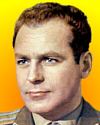
Died 20 Sep 2000 at age 65 (born 11 Sep 1935). quotes
Russian cosmonaut who was pilot of the Vostok 2 spacecraft on its 6-7 Aug 1961 orbital flight of 25 hrs 18 min. His spacecraft carried life-support equipment, radio and television for monitoring the condition of the cosmonaut, tape recorder, telemetry system, biological experiments, and automatic and manual control equipment. After Yuri Gagarin, Titov was the second human to orbit the Earth but was the first person to orbit more than once, the first to spend more than a day in space, and the first to sleep in space. He died holding the record as the youngest person in space (age 25). Titov was selected for cosmonaut training in 1960. After his spaceflight, Titov held senior positions in the Soviet space programme until his retirement in 1992.«
Russian cosmonaut who was pilot of the Vostok 2 spacecraft on its 6-7 Aug 1961 orbital flight of 25 hrs 18 min. His spacecraft carried life-support equipment, radio and television for monitoring the condition of the cosmonaut, tape recorder, telemetry system, biological experiments, and automatic and manual control equipment. After Yuri Gagarin, Titov was the second human to orbit the Earth but was the first person to orbit more than once, the first to spend more than a day in space, and the first to sleep in space. He died holding the record as the youngest person in space (age 25). Titov was selected for cosmonaut training in 1960. After his spaceflight, Titov held senior positions in the Soviet space programme until his retirement in 1992.«
I am Eagle, by Gherman S. Titov. - book suggestion.
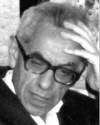
Died 20 Sep 1996 at age 83 (born 26 Mar 1913). quotes
Hungarian mathematician, who was one of the century's top math experts and pioneered the fields of number theory and combinatorics. The type of mathematics he worked on were beautiful problems that were simple to understand, but notoriously difficult to solve. At age 20, he discovered a proof for a classic theorem of number theory that states that there is always at least one prime number between any positive integer and its double. In the 1930s, he studied in England and moved to the USA by the late 1930s when his Jewish origins made a return to Hungary impossible. Affected by McCarthyism in the 1950s, he spent much of the next ten years in Israel. Writing his many hundreds of papers made him one of history's most prolific mathematicians.
Hungarian mathematician, who was one of the century's top math experts and pioneered the fields of number theory and combinatorics. The type of mathematics he worked on were beautiful problems that were simple to understand, but notoriously difficult to solve. At age 20, he discovered a proof for a classic theorem of number theory that states that there is always at least one prime number between any positive integer and its double. In the 1930s, he studied in England and moved to the USA by the late 1930s when his Jewish origins made a return to Hungary impossible. Affected by McCarthyism in the 1950s, he spent much of the next ten years in Israel. Writing his many hundreds of papers made him one of history's most prolific mathematicians.
The Man Who Loved Only Numbers: The Story of Paul Erdos, by Paul Hoffman. - book suggestion.
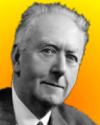
Died 20 Sep 1965 at age 75 (born 14 Jan 1890).
English geologist and petrologist was one of the foremost geologists of the twentieth century, who made major contributions to the geochronology of Africa, the genesis of igneous rocks, and physical geology. He developed a method of determining the age of the earth based on measurement of uranium decay in igneous rocks (which invalidated William Thomson Kelvin's hypothesis that the earth's age can be established on the basis of the planet's cooling from a initial molten state). Holmes' method proved to be remarkably accurate and laid the foundation of isotope geology. This was the first quantitative time scale for geology based on measuring the radioactive constituents of rocks.
English geologist and petrologist was one of the foremost geologists of the twentieth century, who made major contributions to the geochronology of Africa, the genesis of igneous rocks, and physical geology. He developed a method of determining the age of the earth based on measurement of uranium decay in igneous rocks (which invalidated William Thomson Kelvin's hypothesis that the earth's age can be established on the basis of the planet's cooling from a initial molten state). Holmes' method proved to be remarkably accurate and laid the foundation of isotope geology. This was the first quantitative time scale for geology based on measuring the radioactive constituents of rocks.
The Dating Game: One Man's Search for the Age of the Earth, by Cherry Lewis. - book suggestion.
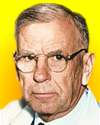
Died 20 Sep 1960 at age 73 (born 17 Oct 1886).
Ernest (William) Goodpasture was an American research scientist, the founder of mumps vaccine, Professor of Pathology, Vanderbilt University School of Medicine. Noted for research in virology, particularly the isolation and identification of viruses, the pathogenesis and pathology of viral diseases. He discovered the first practical method for developing uncontaminated viruses in chick embryos, which made possible the mass-production of vaccines for such diseases as smallpox, influenza, yellow fever, typhus, Rocky Mountain spotted fever, and other illnesses caused by agents that can be propagated only in living tissue. Also known for describing Goodpasture's disease (1919), an uncommon condition which typically causes rapid destruction of the kidneys.
Ernest (William) Goodpasture was an American research scientist, the founder of mumps vaccine, Professor of Pathology, Vanderbilt University School of Medicine. Noted for research in virology, particularly the isolation and identification of viruses, the pathogenesis and pathology of viral diseases. He discovered the first practical method for developing uncontaminated viruses in chick embryos, which made possible the mass-production of vaccines for such diseases as smallpox, influenza, yellow fever, typhus, Rocky Mountain spotted fever, and other illnesses caused by agents that can be propagated only in living tissue. Also known for describing Goodpasture's disease (1919), an uncommon condition which typically causes rapid destruction of the kidneys.
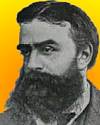
Died 20 Sep 1873 at age 46 (born 16 Dec 1826).
Italian astronomer who, on 5 Aug 1864, was first to observe the spectrum of a comet (Tempel 1864 II), showing not merely reflected sunlight but also spectral lines from luminous gas forming the comet tail when near the Sun. Earlier, he discovered the comet known as Donati's Comet at Florence, on 2 Jun 1858. When the comet was nearest the earth, its triple tail had an apparent length of 50°, more than half the distance from the horizon to the zenith and corresponding to the enormous linear figure of more than 72 million km (about 45 million mi). With an orbital period estimated at more than 2000 years, it will not return until about the year 4000.«
Italian astronomer who, on 5 Aug 1864, was first to observe the spectrum of a comet (Tempel 1864 II), showing not merely reflected sunlight but also spectral lines from luminous gas forming the comet tail when near the Sun. Earlier, he discovered the comet known as Donati's Comet at Florence, on 2 Jun 1858. When the comet was nearest the earth, its triple tail had an apparent length of 50°, more than half the distance from the horizon to the zenith and corresponding to the enormous linear figure of more than 72 million km (about 45 million mi). With an orbital period estimated at more than 2000 years, it will not return until about the year 4000.«
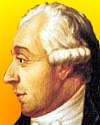
Died 20 Sep 1804 at age 60 (born 16 Aug 1744).
Pierre (-François-André) Méchain was a French astronomer and hydrographer at the naval map archives in Paris recruited by Jean Delambre. He was a mathematical progidy. In 1790, they were chosen by the National Assembly to establish a decimal system of measurement based on the meter. Since this was defined to be one ten-millionth of the distance between the Earth's pole and the equator, Mechain led a survey of the meridian arc from Dunkirk, France, to Barcelona, Spain. Through his astronomical observations, Mechain discovered 11 comets and provided 26 additions to Messier's catalog. He calculated the orbits of the two comets he found in 1781. Mechain died of yellow fever while making further surveys for the meridian measurement.«
Pierre (-François-André) Méchain was a French astronomer and hydrographer at the naval map archives in Paris recruited by Jean Delambre. He was a mathematical progidy. In 1790, they were chosen by the National Assembly to establish a decimal system of measurement based on the meter. Since this was defined to be one ten-millionth of the distance between the Earth's pole and the equator, Mechain led a survey of the meridian arc from Dunkirk, France, to Barcelona, Spain. Through his astronomical observations, Mechain discovered 11 comets and provided 26 additions to Messier's catalog. He calculated the orbits of the two comets he found in 1781. Mechain died of yellow fever while making further surveys for the meridian measurement.«
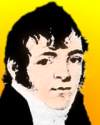
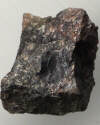
Spanish chemist and mineralogist who, assisted his younger brother Faustus, separated tungsten metal from its wolframite ore (1783). Two years earlier, Swedish chemist Carl Scheele discovered tungstic acid, though did not isolate the elemental form, from a mineral known since about 1758 as tung sten (Swedish, heavy stone; which is now known as scheelite). The Elhuyar brothers, working at the Seminary of Bergara, succeeded in extracting the metal by reducing tungstic acid with charcoal. For the first time, Basque scientists entered the history of science. Each became a director of a school of mines, but in different countries. Although Juan José discovered tungsten metal, Fausto became better known.«[Image right: wolframite]
The Life and Times of Juan José D'Elhuyar: Discoverer of Tungsten in 18th-century New Granada, by Bernardo J Caycedo. - book suggestion.
In 2013, the Deep Impact spacecraft was declared dead by NASA after nine productive years making fly-bys of comets. Radio contact was suddenly and permanently lost on 8 Aug 2013, perhaps caused by a failure causing the solar panels and antenna to point in the wrong direction. Without power, it likely froze up. It had been launched on 12 Jan 2005 to release a special impactor spacecraft to crash (3 Jul 2005) into comet Tempel 1, so after the impact (4 Jul 2005), the ejecta plume could be studied spectroscopically to reveal its composition. Deep Impact continued as the EPOXI mission and took images during fly-bys of comet Hartley 2 (4 Nov 2010) and comet Garradd (Jan 2012). Towards its end of life, it was studying comet Ison.«
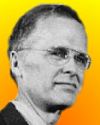
In 1954, the first successful test compilation and execution of a computer program using what became FORTRAN was run by Harlan Herrick at IBM. It took until 1957 to develop into a fully-operational, commercial product. As implied by its name (FORMula TRANslator), Fortran was designed as a high-level language for technical and scientific applications which primarily needed calculation, rather than working with characters. John Backus at IBM supervised the development of the programming language that would allow users to express their problems in commonly understood mathematical formulae. By 1958 the language was expanded to Fortran II, which included subroutines, functions and common blocks, and in 1962 IBM introduced the extended Fortran IV.«

In 1952, Alfred Hershey and Martha Chase published a report confirming DNA holds hereditary data. Their experiment used the T2 bacteriophage, which, like other viruses, is just a crystal of DNA and protein. It can reproduce when inside a bacterium such as E. coli. When the new T2 viruses are ready to leave the host E. coli cell (and go infect others), they burst the E. coli cell open, killing it (hence the name "bacteriophage"). Hershey and Chase were seeking an answer to the question, "Is it the viral DNA or viral protein coat (capsid) that is the viral genetic code material which gets injected into the E. coli?" Their results indicated that the viral DNA, not the protein, is its genetic code material.
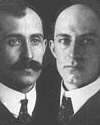
In 1904, the first circular flight in an airplane was made by Orville Wright at Huffman Prairie, near Dayton, Ohio. He travelled about 4,080-ft (1244-m) in about 1½ minutes in the Flyer II. The Wright brothers' first Flyer which made the historic flight and three more on 17 Dec 1903 in North Carolina, had been overturned by the wind and damaged after those flights. The Wrights chose not to repair it but to start with a new, heavier and stronger machine with a more powerful motor, constructed where it would be used, at the Huffman Prairie Flying Field. On 15 Sep 1904, Wilbur was able to fly a half-circle. As the brothers improved the control of their airplane's flight, a few days later, a complete circuit was accomplished.«
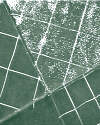
In 1892, wire glass was patented by Frank Schulman. Wire glass, as the name suggests, is simply a wire mesh inserted during the plate glass manufacturing process to create a single monolithic glass with properties useful where fire safety requirements apply.
In 1862, a revolving turret for battleships was patented by its inventor, Theodore Ruggles Timby. The patent described “a revolving tower for defensive and offensive warfare, whether placed on land or water.” He had been working for some years on this idea, had made a model in 1841, and filed a caveat in 1843. John Ericsson incorporated this design when building the ironclad ship, Monitor, the world’s first turret battleship. Timby was paid a royalty for the use of his patent. The great military value of this invention was proven in wartime, and it was soon adopted by other nations.«
In 1859, the electric range, invented by George B. Simpson of Washington, D.C., was patented on this date. Mr. Simpson called his invention, an "electroheater." Heat was generated by passing electricity through wire coils
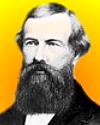
In 1853, Elisha Graves Otis sold his first safety elevator equipment, having started his business earlier in the year to sell the safety elevator system he had invented the year before. His customer was Benjamin Newhouse in New York City who used it for moving freight. Shortly thereafter, in May 1854, at the Crystal Palace in New York City, Otis created public interest with a daring demonstration. He was hoisted high in the air on a platform fitted with his safety feature. When he called for the rope to be cut, the safety device stopped his fall. By 1857, he installed the first department store passenger elevator at E.V. Haughwout & Co. in New York City. In 1889 he applied the electric motor to power elevators.«
In 1848, the first meeting of the American Association for the Advancement of Science was held at noon, in the library of the Academy of Natural Science, Philadelphia, Pennsylvania. The organization superceded the Association of American Geologists and Naturalists, as many of its members formed the new society. The first president to be elected was William Redfield, a New York, meteorologist and geologist also interested in the development of railways and steamships. The goal of the Association recorded in its original Rules and Objects included “to give a stronger and more general impulse, and a more systematic direction to scientific research in our country; and to procure for the labours of scientific men, increased facilities and a wider usefulness.” Later in the day, the members began five days of scientific sessions.«
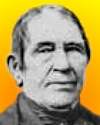
In 1819, the first patent leather manufactured in the U.S. was produced in Newark, N.J., by Seth Boyden (17 Nov 1788-31 Mar 1870) at the tannery he had established in 1813. At first, the varnish was dried in the heat of the sun, but was later dried in a wam room. In 1820, Boyden made an oven able to hold 16 skins. This leather, treated with a coating based on linseed-oil to give it a high gloss finish, was mostly used for fancy work and for shoes. Boyden is remembered for a variety of other inventions, including malleable cast iron, a nail-making machine, a cut-off switch for steam engines, a method for producing zinc from its ore and developed a hybrid strawberry.«




