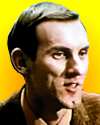
Born 17 Jun 1939.
Frederick John Vine is an English marine geologist and geophysicist whose postgraduate research (working with Drummond Hoyle Matthews) was into the magnetic properties of the crustal rocks on the ocean floor. This led to studying the variation in the polarity in the rocks at different distances from a mid-ocean ridge. Because they could identify symmetrical distribution of magnetic reversals on each side of the ridge, they helped confirm the theory of sea floor spreading caused by separating tectonic plates. “Magnetic Anomalies Over Ocean Ridges,” published in Nature (1963), gave results of their magnetic survey of the Carlsberg Ridge in the Indian Ocean.«
Frederick John Vine is an English marine geologist and geophysicist whose postgraduate research (working with Drummond Hoyle Matthews) was into the magnetic properties of the crustal rocks on the ocean floor. This led to studying the variation in the polarity in the rocks at different distances from a mid-ocean ridge. Because they could identify symmetrical distribution of magnetic reversals on each side of the ridge, they helped confirm the theory of sea floor spreading caused by separating tectonic plates. “Magnetic Anomalies Over Ocean Ridges,” published in Nature (1963), gave results of their magnetic survey of the Carlsberg Ridge in the Indian Ocean.«
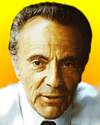
Born 17 Jun 1920; died 19 Apr 2013 at age 92. quotes
French biologist who, (with André Lwoff and Jacques Monod), was awarded the 1965 Nobel Prize for Physiology or Medicine for discoveries concerning in molecular genetics that showed how the production of protiens from DNA is regulated. Through experiments with the bacterium Escherichia coli cultured in various media, it was possible to discover the effect of the medium on enzyme production. Jacob and his team found that a regulator (R-gene) produces a repressor substance that prevents an operator (O-gene) from providing messenger RNA, blocking production of protein.
French biologist who, (with André Lwoff and Jacques Monod), was awarded the 1965 Nobel Prize for Physiology or Medicine for discoveries concerning in molecular genetics that showed how the production of protiens from DNA is regulated. Through experiments with the bacterium Escherichia coli cultured in various media, it was possible to discover the effect of the medium on enzyme production. Jacob and his team found that a regulator (R-gene) produces a repressor substance that prevents an operator (O-gene) from providing messenger RNA, blocking production of protein.
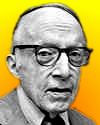
Born 17 Jun 1919; died 17 Aug 2011 at age 92.
William Kaye Estes was an American psychologist who was a leader in bringing mathematical methods into psychological research. In 1977, he was awarded the National Medal of Science for “his fundamental theories of cognition and learning that transformed the field of experimental psychology. His pioneering methods of quantitative modeling and an insistence on rigor and precision established the standard for modern psychological science.” In his early professional research he partnered with another pioneering psychologist B. F. Skinner in studying animal learning and behavior. The quantitative method they devised to measure emotional reactions is still widely used today. From 1979, Estes focussed on investigating human memory and classification learning.
William Kaye Estes was an American psychologist who was a leader in bringing mathematical methods into psychological research. In 1977, he was awarded the National Medal of Science for “his fundamental theories of cognition and learning that transformed the field of experimental psychology. His pioneering methods of quantitative modeling and an insistence on rigor and precision established the standard for modern psychological science.” In his early professional research he partnered with another pioneering psychologist B. F. Skinner in studying animal learning and behavior. The quantitative method they devised to measure emotional reactions is still widely used today. From 1979, Estes focussed on investigating human memory and classification learning.
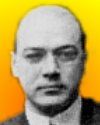
Born 17 Jun 1876; died 4 Sep 1922 at age 46. quotes
American anatomist and brain morphologist who assisted at the autopsy (29 Oct 1901) of the brain of Leon Franz Czolgosz, the assassin of U.S. president William McKinley. At the time, he had just published an exhaustive series of eight papers on the human brain, but was only in the fourth year of his medical training. Although he detected a few very minor variations in gyri and sulci patterns in the brain of Czolgosz, he reported in the New York Medical Journal (1902) that “nothing has been found in the brain of this assassin that would condone his crime.” He became editor of, and revised, American editions of Gray's Anatomy. Throughout his career he studied the brain morphology of groups of famous people, different races, and criminals, thought ultimately he was unable to link traits to brain structure.« more
American anatomist and brain morphologist who assisted at the autopsy (29 Oct 1901) of the brain of Leon Franz Czolgosz, the assassin of U.S. president William McKinley. At the time, he had just published an exhaustive series of eight papers on the human brain, but was only in the fourth year of his medical training. Although he detected a few very minor variations in gyri and sulci patterns in the brain of Czolgosz, he reported in the New York Medical Journal (1902) that “nothing has been found in the brain of this assassin that would condone his crime.” He became editor of, and revised, American editions of Gray's Anatomy. Throughout his career he studied the brain morphology of groups of famous people, different races, and criminals, thought ultimately he was unable to link traits to brain structure.« more
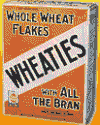
Born 17 Jun 1870; died Sep 1953.
Co-inventor of Wheaties cereal. In 1921, a health clinician in Minneapolis, while mixing a batch of bran gruel for his patients, spilled some of the mix on a hot stove where it sizzled into a crisp flake. After tasting the very first Wheaties prototype, he took the idea to the Washburn Crosby Company, where the head miller, George Cormack, took on the task of trying to strengthen the flakes to keep them from turning to dust inside a cereal box. Cormack tested 36 varieties of wheat before he developed the perfect flake. It was introduced in test marketing in Nov 1924. The name Wheaties was chosen by a company wide contest won by Jane Bausman, the wife of the export manager. Numerous other entries included Nutties and Gold Medal Wheat Flakes.*
Co-inventor of Wheaties cereal. In 1921, a health clinician in Minneapolis, while mixing a batch of bran gruel for his patients, spilled some of the mix on a hot stove where it sizzled into a crisp flake. After tasting the very first Wheaties prototype, he took the idea to the Washburn Crosby Company, where the head miller, George Cormack, took on the task of trying to strengthen the flakes to keep them from turning to dust inside a cereal box. Cormack tested 36 varieties of wheat before he developed the perfect flake. It was introduced in test marketing in Nov 1924. The name Wheaties was chosen by a company wide contest won by Jane Bausman, the wife of the export manager. Numerous other entries included Nutties and Gold Medal Wheat Flakes.*
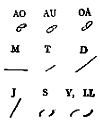
Examples of Gregg alphabet.
Irish-American inventor of a popular shorthand system named for him. He first introduced his system in 1888 in the pamphlet Light-Line Phonography published in Liverpool, England. By 1893, he had published Gregg Shorthand in America where it was soon taught in public schools throughout the U.S., and adapted to several languages. The Gregg system modeled the mechanics and positioning of traditional writing. He published dozens of textbooks on the subject from 1880-1920.
Born 17 Jun 1847; died 28 Dec 1927 at age 80.
American physicist.
American physicist.
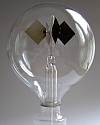
English physicist and chemist who discovered the element thallium and showed that cathode-rays were fast-moving, negatively-charged particles. The Crookes dark space is the dark region around a cathode making electrical discharges at low pressure. He invented the radiometer (1875) in which four vanes suspended on a needle in a vacuum with one side black and the other side white are observed to rotate by the effect of incident light. He also invented the spinthariscope (1903) which reveals alpha particles emitted by radium as light flashes when they impact a zinc sulphide screen viewed under magnification. His interests included spiritualism, but provided more practical guidance for improving sanitation and artifical fertilizers.«[Image right: radiometer]
William Crookes (1832-1919) and the Commercialization of Science, by William H. Brock. - book suggestion.
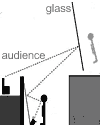
English chemist and lecturer who invented the “Pepper’s Ghost” illusion used on stage to provide the effect of an actor appearing as a transparent image and disappearing by fading away. It used a large sheet of plate glass on stage, inclined at a 45 degree angle to the floor. The use of special lighting enabled the audience to see the reflection of an actor placed offstage, out of the direct view of the audience. Pepper first learned to use showmanship to audiences at London's Royal Polytechnic Institution to present fast-paced, amazing experimental demonstrations to increase the public’s understanding of phenomena in physics and chemistry. In the 1870s, he expanded his activities to a global audience by touring Australia, Canada, and the United States.«
The Boy's Playbook of Science, by John Henry Pepper. - book suggestion.
Born 17 Jun 1821; died 17 Apr 1888 at age 66.
Ephraim George Squier was an American newspaper editor, diplomat and archaeologist was a newspaper editor, diplomat, and archaeologist who, with the physician and archaeologist Edwin H. Davis, conducted the first major study of the remains of the pre-Columbian North American Mound Builders. Their book, Ancient Monuments (1848, more familiarly known as "Squire and Davis") was the undisputed primary reference source of their time on Indian mounds in the eastern US. It gave the grandest illustrations of what remained of the unbelievable civilizations that inhabited this continent. While hundreds of mounds have been plowed flat, theirs is a guide to what was lost. He also explored in Central America, Peru, and Bolivia in an effort to find the origins of the Mound Builder civilization.
Ephraim George Squier was an American newspaper editor, diplomat and archaeologist was a newspaper editor, diplomat, and archaeologist who, with the physician and archaeologist Edwin H. Davis, conducted the first major study of the remains of the pre-Columbian North American Mound Builders. Their book, Ancient Monuments (1848, more familiarly known as "Squire and Davis") was the undisputed primary reference source of their time on Indian mounds in the eastern US. It gave the grandest illustrations of what remained of the unbelievable civilizations that inhabited this continent. While hundreds of mounds have been plowed flat, theirs is a guide to what was lost. He also explored in Central America, Peru, and Bolivia in an effort to find the origins of the Mound Builder civilization.
Ancient Monuments of the Mississippi Valley, by E. H. Davis, E. G. Squier, Charles Sullivan.(illustrator). - book suggestion.
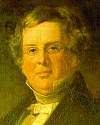

William Parsons, 3rd Earl of Rosse was an Irish astronomer who built the largest reflecting telescope of the 19th century. He learned to polish metal mirrors (1827) and spent the next few years building a 36-inch telescope. He later completed a giant 72-inch telescope (1845) which he named "Leviathan," It remained the largest ever built until decades after his death. He was the first to resolve the spiral shape of objects - previously seen as only clouds - which were much later identified as galaxies independent of our own Milky Way galaxy and millions of light-years away. His first such sighting was made in 1845, and by 1850 he had discovered 13 more. In 1848, he found and named the Crab Nebula (because he thought it resembled a crab), by which name it is still known.**[Image right: people standing in front of Leviathan]
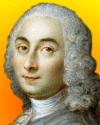
Born 17 Jun 1714; died 4 Sep 1784 at age 70.
French astronomer and geodesist (Cassini III), who continued surveying work he began while assisting his father, Jacques Cassini (Cassini II), resulting in the first topographical map of France produced by modern principles. His grandfather, Giovanni Domenico Cassini (Cassini I) discovered four satellites of Saturn, a band on planet's surface, and that its ring was subdivided. Cassini I was the first to assume effective direction (1671) of the new observatory established by the Académie Royale des Sciences in Paris, which his descendants in turn continued. Cassini III was the first official director of the observatory when the post was created by the king in 1771. His son was Jean-Dominique Cassini (Cassini IV).«
French astronomer and geodesist (Cassini III), who continued surveying work he began while assisting his father, Jacques Cassini (Cassini II), resulting in the first topographical map of France produced by modern principles. His grandfather, Giovanni Domenico Cassini (Cassini I) discovered four satellites of Saturn, a band on planet's surface, and that its ring was subdivided. Cassini I was the first to assume effective direction (1671) of the new observatory established by the Académie Royale des Sciences in Paris, which his descendants in turn continued. Cassini III was the first official director of the observatory when the post was created by the king in 1771. His son was Jean-Dominique Cassini (Cassini IV).«

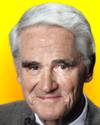
Died 17 Jun 2001 at age 82 (born 22 Apr 1919). quotes
Donald James Cram was an American chemist who shared the 1987 Nobel Prize for Chemistry (with Charles J. Pedersen and Jean-Marie Lehn) for his creation of molecules that mimic the chemical behaviour of molecules found in living systems.
Donald James Cram was an American chemist who shared the 1987 Nobel Prize for Chemistry (with Charles J. Pedersen and Jean-Marie Lehn) for his creation of molecules that mimic the chemical behaviour of molecules found in living systems.
Donald J. Cram: From Design to Discovery, by Donald J. Cram. - book suggestion.
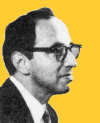
Died 17 Jun 1996 at age 73 (born 18 Jul 1922). quotes
Thomas Samuel Kuhn was an American science historian and science philosopher was a MIT professor, noted for his highly influential The Structure of Scientific Revolutions (1962). He held that science was not a steady, cumulative acquisition of knowledge, but it is “a series of peaceful interludes punctuated by intellectually violent revolutions.” Then appears a Lavoisier or an Einstein, often a young scientist not indoctrinated in the accepted theories, to sweep the old paradigm away. Such revolutions, he said, came only after long periods of tradition-bound normal science. He pointed out that scientific research and thought are defined by “paradigms,” or trusted theories, concepts, methods and experiments. Such paradigms are accepted by scientists, who continue to extend, refine, explain and measure results until they meet an problem that cannot be resolved within the established framework. Such anomaly or contradiction eventually requires an intellectual revolution, such as the paradigm shifts from Ptolemaic cosmology to Copernican heliocentrism. “Frameworks must be lived with and explored before they can be broken.”
Thomas Samuel Kuhn was an American science historian and science philosopher was a MIT professor, noted for his highly influential The Structure of Scientific Revolutions (1962). He held that science was not a steady, cumulative acquisition of knowledge, but it is “a series of peaceful interludes punctuated by intellectually violent revolutions.” Then appears a Lavoisier or an Einstein, often a young scientist not indoctrinated in the accepted theories, to sweep the old paradigm away. Such revolutions, he said, came only after long periods of tradition-bound normal science. He pointed out that scientific research and thought are defined by “paradigms,” or trusted theories, concepts, methods and experiments. Such paradigms are accepted by scientists, who continue to extend, refine, explain and measure results until they meet an problem that cannot be resolved within the established framework. Such anomaly or contradiction eventually requires an intellectual revolution, such as the paradigm shifts from Ptolemaic cosmology to Copernican heliocentrism. “Frameworks must be lived with and explored before they can be broken.”
The Structure of Scientific Revolutions, by Thomas S. Kuhn. - book suggestion.
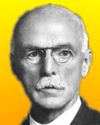
Died 17 Jun 1940 at age 74 (born 12 Oct 1865).
English biochemist who shared (with Hans von Euler-Chelpin) the 1929 Nobel Prize for Chemistry for work on the fermentation of sugar and the enzyme action involved. Harden continued the work of Eduard Buchner who had discovered that such reactions can take place in the absence of living cells. Harden demonstrated that the activity of yeast enzymes included both large protein molecules and essential coenzymes - small nonprotein molecules. This was the first evidence for the existence of coenzymes. Harden also discovered that yeast enzymes are not broken down and lost with time, but that the gradual loss of activity with time can be reversed by the addition of phosphates, which are now known to play a vital part in biochemical reactions.
English biochemist who shared (with Hans von Euler-Chelpin) the 1929 Nobel Prize for Chemistry for work on the fermentation of sugar and the enzyme action involved. Harden continued the work of Eduard Buchner who had discovered that such reactions can take place in the absence of living cells. Harden demonstrated that the activity of yeast enzymes included both large protein molecules and essential coenzymes - small nonprotein molecules. This was the first evidence for the existence of coenzymes. Harden also discovered that yeast enzymes are not broken down and lost with time, but that the gradual loss of activity with time can be reversed by the addition of phosphates, which are now known to play a vital part in biochemical reactions.
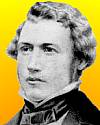
age 23
Died 17 Jun 1881 at age 51 (born 21 Apr 1830).
British inventor and manufacturer, known as the father of the bicycle industry. Starley left the family farm as a teenager and after initially working as a gardener, he turned to mechanical interests. He improved the early sewing machine, and by about 1861, was in business with Josiah Turner as the Coventry Sewing Machine Company. Within a few years, their factory began producing bicycles. In 1870, he went into business for himself, producing his Europa sewing machines and Ariel bicycles, "penny-farthing" and tricycles. The Ariel, a lightweight all-metal bicycle (1871), is regarded as the first true bicycle, the first self-propelled two-wheeler to use pivot-center steering. His tangent-tension spoke wheel (1876) is still used.« more
British inventor and manufacturer, known as the father of the bicycle industry. Starley left the family farm as a teenager and after initially working as a gardener, he turned to mechanical interests. He improved the early sewing machine, and by about 1861, was in business with Josiah Turner as the Coventry Sewing Machine Company. Within a few years, their factory began producing bicycles. In 1870, he went into business for himself, producing his Europa sewing machines and Ariel bicycles, "penny-farthing" and tricycles. The Ariel, a lightweight all-metal bicycle (1871), is regarded as the first true bicycle, the first self-propelled two-wheeler to use pivot-center steering. His tangent-tension spoke wheel (1876) is still used.« more
In 1970, Edwin Land patented the Polaroid camera.
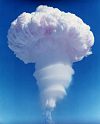
In 1967, China tested its first hydrogen bomb. This was China's sixth nuclear test, and its first full scale radiation implosion (Teller-Ulam) weapon test. The device contained U-235, lithium-6 deuteride, and U-238. It was detonated at 2960 m over the Lop Nur Test Ground after being dropped from an airplane, and had a yield of 3.3 megatons. (It was conducted only 32 months after Chinas's first atomic test, 16 Oct 1964, the shortest elapsed time for any nuclear weapons state. The country's first test was an atomic bomb, a pure-fission U-235 implosion fission device named "596." That device weighed 1550 kg with a 22 kiloton yield. No plutonium was available at the time of this first bomb was tested.)
Dark Sun: The Making of the Hydrogen Bomb, by Richard Rhodes. - book suggestion.
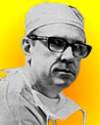
In 1950, the first kidney transplant operation was undertaken at Little Company of Mary Hospital in Evergreen Park, Chicago, Illinois. Dr. Richard H. Lawler performed the operation in about an hour on Ruth Tucker, age 44. He decided upon the surgery because of her medical need. A kidney became available from another patient that had just died of cirrhosis of the liver. The transplanted kidney worked for at least 53 days. But at ten months, it was found to be shrunken, discolored and rejected. It was removed. Tucker died five years after the transplant of an unrelated coronary occlusion. Lawler had no further interest in becoming a transplant surgeon. It was four years before there was another successful result elsewhere.«
In 1947, the first globe-circling passenger airline was inaugurated by Pan Am Airways as it left New York. The fare to travel around the world was $1700.
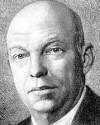
In 1936, Edwin H. Armstrong demonstrated his invention of FM radio in Washington D.C. to a fact-finding investigation by the Federal Communications Commission into the future of radio and TV. His method modulated the frequency of a broadcast radio wave to carry the audio signal (FM), instead of the existing amplitude modulation (AM). Armstrong's system used a higher frequency band than existing commercial radio. It eliminated all static and outside interference. Several hundred representatives of the radio industry were present. Armstrong compared the old and new methods with a series of recordings of the same program under the different conditions. FM was clear of the hissing, buzzing and crackling static noises of AM.«
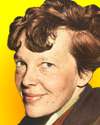
In 1928, Amelia Earhart embarked on a trans-Atlantic flight from Newfoundland to Wales to become the first woman to fly across the Atlantic Ocean, though as a passenger. The plane was piloted by Wilmer Stultz and landed the next day, 18 Jun 1928, after about a 21- hour flight. Nearly four years later, on 20 May 1932, she became the first woman to fly solo across that ocean.
more
Amelia Earhart: The Truth at Last, by Mike Campbell. - book suggestion.
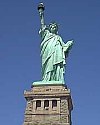
In 1885, the Statue of Liberty arrived in New York Harbor from France. The hand and torch of the Statue of Liberty had been displayed at the 1876 Centennial Exhibition, in Philadelphia, ten years before the rest of the statue was completed by French sculptor Frédéric Auguste Bartholdi. The engineer for the framework was Gustave Eiffel (also known for his Eiffel Tower). In 1884, work on the statue was finished, and it was displayed in Paris while the U.S. prepared the pedestal. It was then shipped, dismantled, in 214 enormous crates, on the steam-and-sail gunboat Isère to the U.S. Its reassembly took a year, and it was finally dedicated on 28 Oct 1886, by President Cleveland in the presence of its sculptor.«
more
The Statue of Liberty, by Barry Moreno. - book suggestion.
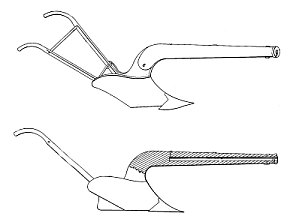
(USPTO)
In 1862, during the American Civil War period (1861-1865), W.H. Fancher and C.M. French of Waterloo, N.Y. received a U.S. patent for a combined plow and gun (No. 35,600). To the metal plow with wooden handles of ordinary construction, the inventors added the elements of light ordinance, designed for "especially when used in border localities, subject to savage fueds and guerrilla warfare." The share serves as an anchor in the ground to resist recoil, the wooden handles being used to set direction. Projectiles could be grape shot or balls of one to three pounds weight. The combination was proposed to give those in agricultural pursuits to have at hand an "efficient weapon of defense at very slight expense in addition" to that of a plow.
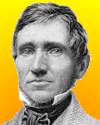
In 1837, Charles Goodyear obtained his first rubber-processing patent (U.S. No. 240). At this time, the original india-rubber would become sticky melt in the summer heat. Goodyear resolved to solve this problem. After various unsuccessful methods, he devised a process to treat the India rubber with metallic solutions such as copper nitrate and strong acid for a few minutes, followed by washing with water. Such process treated both rubber on the surface and below the surface to a useful condition. His patent explained this method, and also the use of a water paste of quicklime to bleach the rubber for which he listed various new purposes. He obtained additional patents as he continued to revised his process by using sulphur and oil of turpentine.
more
Trials of an Inventor: Life and Discoveries of Charles Goodyear, by Bradford Peirce. - book suggestion.
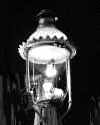
In 1816, the laying of pipes by the Gas Light Company of Baltimore was approved by the City Council in the first city ordinance of its kind in the U.S. That year, artist and entrepreneur Rembrandt Peale went to England to learn about gas lighting, then displayed his “Ring of Fire” gas-powered light in his Baltimore museum on the corner of Baltimore and Holiday Streets. Peale's successful demonstration of the power and value of gas led to a plan to light the streets of the city, and the first gas company in America was born: the Gas Light Company of Baltimore. The first public gas street lamp was lit on 7 Feb 1817.[Image: A lamp (from 1920-30s) kept burning on the site that Peale first constructed his in 1817. This site previously listed passing of ordinance on 19 Jun, but checking further sources indicated 17 Jun.] more




