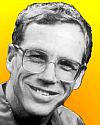
Born 21 Apr 1951.
American mathematician who was awarded the Fields Medal in 1986 for his proof of the conjecture in four dimensions (1982). The Poincaré conjecture, one of the famous problems of 20th-century mathematics, asserts that a simply connected closed 3-dimensional manifold is a 3-dimensional sphere. The higher dimensional Poincaré conjecture claims that any closed n-manifold which is homotopy equivalent to the n-sphere must be the n-sphere. For values of n at least 5, a solution was given by Smale in 1961. Two decades later, Freedman proved the conjecture for n = 4. However, the original conjecture for n=3 the remained open. Grigori Perelman gave a complete proof in 2003.«
American mathematician who was awarded the Fields Medal in 1986 for his proof of the conjecture in four dimensions (1982). The Poincaré conjecture, one of the famous problems of 20th-century mathematics, asserts that a simply connected closed 3-dimensional manifold is a 3-dimensional sphere. The higher dimensional Poincaré conjecture claims that any closed n-manifold which is homotopy equivalent to the n-sphere must be the n-sphere. For values of n at least 5, a solution was given by Smale in 1961. Two decades later, Freedman proved the conjecture for n = 4. However, the original conjecture for n=3 the remained open. Grigori Perelman gave a complete proof in 2003.«
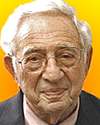
Born 21 Apr 1920; died 15 Jun 2008 at age 88. quotes
Arthur William Galston was an American biologist, plant physiologist and bioethicist whose work with herbicides led to the development by others of Agent Orange. It was extensively used by the American military as a defoliant during the Vietnam war. The purpose was to expose Viet Cong positions and movement when viewed from the air. Galston's warnings had been ignored about the high toxicity of the chemical to both animal and human life, and also destructiveness to the land and waterways. The substance had potential persistence for an unknown time, perhaps decades. When toxicological studies determined that compounds in Agent Orange caused birth defects in laboratory rats, Galston lobbied with other scientists, and eventually President Nixon ordered an immediate halt to spraying. Galston continued to strongly promote bioethics.«
Arthur William Galston was an American biologist, plant physiologist and bioethicist whose work with herbicides led to the development by others of Agent Orange. It was extensively used by the American military as a defoliant during the Vietnam war. The purpose was to expose Viet Cong positions and movement when viewed from the air. Galston's warnings had been ignored about the high toxicity of the chemical to both animal and human life, and also destructiveness to the land and waterways. The substance had potential persistence for an unknown time, perhaps decades. When toxicological studies determined that compounds in Agent Orange caused birth defects in laboratory rats, Galston lobbied with other scientists, and eventually President Nixon ordered an immediate halt to spraying. Galston continued to strongly promote bioethics.«

1966
Born 21 Apr 1915; died 14 Sep 2003 at age 88. quotes
American ecologist, microbiologist and author known for his classic essay on ecology and social ethics Tragedy of the Commons (published in Science, 13 Dec 1968), a parable about farmers who, allowed to graze their cattle in one field as much as they wanted to, each acted in their own self-interest, and the field was destroyed. He extended the idea of self-interest beyond the individual to households, villages, companies or nations. His concept of the commons includes ecosystems, rivers, oceans, organisms or mineral resources with actions such as over-fishing, deforestation and greenhouse gas emissions. He concluded that the Earth will likewise be destroyed by overpopulation. Hardin was a founding member of Planned Parenthood. He died by suicide when in frail health.«
American ecologist, microbiologist and author known for his classic essay on ecology and social ethics Tragedy of the Commons (published in Science, 13 Dec 1968), a parable about farmers who, allowed to graze their cattle in one field as much as they wanted to, each acted in their own self-interest, and the field was destroyed. He extended the idea of self-interest beyond the individual to households, villages, companies or nations. His concept of the commons includes ecosystems, rivers, oceans, organisms or mineral resources with actions such as over-fishing, deforestation and greenhouse gas emissions. He concluded that the Earth will likewise be destroyed by overpopulation. Hardin was a founding member of Planned Parenthood. He died by suicide when in frail health.«
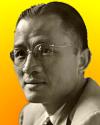
Born 21 Apr 1913; died 28 Nov 1987 at age 74.
Chinese-American biochemist and experimental endocrinologist who with his co-workers isolated in pure form six of the eight hormones known to be secreted by the anterior pituitary gland. Located at the base of the brain, its homones govern reproduction, growth, maturation, and metabolism. Among the hormones Li isolated are ACTH (the adrenocorticotropic hormone and adrenal booster, used in the treatment of arthritis) and HGH (the human growth hormone or somatotropin, which is vital for human growth). He also discovered ß-endorphin, a naturally secreted painkiller (1976) and was first to synthesize the insulin-like growth factor 1, which promotes the growth of cartilage and bones. He was the first to synthesize HGH, in 1970.
Chinese-American biochemist and experimental endocrinologist who with his co-workers isolated in pure form six of the eight hormones known to be secreted by the anterior pituitary gland. Located at the base of the brain, its homones govern reproduction, growth, maturation, and metabolism. Among the hormones Li isolated are ACTH (the adrenocorticotropic hormone and adrenal booster, used in the treatment of arthritis) and HGH (the human growth hormone or somatotropin, which is vital for human growth). He also discovered ß-endorphin, a naturally secreted painkiller (1976) and was first to synthesize the insulin-like growth factor 1, which promotes the growth of cartilage and bones. He was the first to synthesize HGH, in 1970.
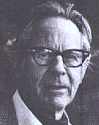
Born 21 Apr 1909; died 22 Oct 1994 at age 85. quotes
American psychologist who is the best known of the American existential psychologists. Much of his thinking can be understood by reading about existentialism in general, and the overlap between his ideas and the ideas of Ludwig Binswanger is great. Nevertheless, he is a little off of the mainstream in that he was more influenced by American humanism than the Europeans, and more interested in reconciling existential psychology with other approaches, especially that of Sigmund Freud. In 1958, he edited, with Ernest Angel and Henri Ellenberger, the book Existence, which introduced existential psychology to the US.
American psychologist who is the best known of the American existential psychologists. Much of his thinking can be understood by reading about existentialism in general, and the overlap between his ideas and the ideas of Ludwig Binswanger is great. Nevertheless, he is a little off of the mainstream in that he was more influenced by American humanism than the Europeans, and more interested in reconciling existential psychology with other approaches, especially that of Sigmund Freud. In 1958, he edited, with Ernest Angel and Henri Ellenberger, the book Existence, which introduced existential psychology to the US.
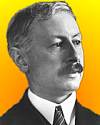
Born 21 Apr 1889; died 18 Jun 1971 at age 82. quotes
Swiss chemist who investigated the constitution of carotenoids, flavins, and vitamins A and B2, for which he shared the 1937 Nobel Prize for Chemistry (with Sir Norman Haworth of Great Britain). He studied plant pigments, particularly the yellow carotenoids, which are related to the pigment in carrots. He determined the chemical structure of the carotenoids (1930), showed that some of these substances are transformed into vitamin A in the animal body, then determined the structure of vitamin A itself. He also confirmed the constitution of vitamin C proposed by Albert Szent-Györgyi, showed lactoflavin to be part of the complex originally described as vitamin B2 , and studied vitamin E.
Swiss chemist who investigated the constitution of carotenoids, flavins, and vitamins A and B2, for which he shared the 1937 Nobel Prize for Chemistry (with Sir Norman Haworth of Great Britain). He studied plant pigments, particularly the yellow carotenoids, which are related to the pigment in carrots. He determined the chemical structure of the carotenoids (1930), showed that some of these substances are transformed into vitamin A in the animal body, then determined the structure of vitamin A itself. He also confirmed the constitution of vitamin C proposed by Albert Szent-Györgyi, showed lactoflavin to be part of the complex originally described as vitamin B2 , and studied vitamin E.
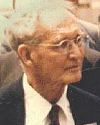
Born 21 Apr 1882; died 20 Aug 1961 at age 79. quotes
Percy Williams Bridgman was an American experimental physicist noted for his studies of materials at high temperatures and pressures. He was awarded the Nobel Prize for Physics in 1946 for his “invention of an apparatus to produce extremely high pressures, and for the discoveries he made therewith in the field of high pressure physics.” He was the first Harvard physicist to receive a Nobel Prize in Physics. In 1908, he began his first experimental work with static high pressures of about 6,500 atmospheres. Eventually, he reached about 400,000 atmospheres. During studies of the phase changes of solids under pressure, he discovered several high-pressure forms of ice. Bridgman also wrote eloquently on matters of general interest in the physics of his day.
Percy Williams Bridgman was an American experimental physicist noted for his studies of materials at high temperatures and pressures. He was awarded the Nobel Prize for Physics in 1946 for his “invention of an apparatus to produce extremely high pressures, and for the discoveries he made therewith in the field of high pressure physics.” He was the first Harvard physicist to receive a Nobel Prize in Physics. In 1908, he began his first experimental work with static high pressures of about 6,500 atmospheres. Eventually, he reached about 400,000 atmospheres. During studies of the phase changes of solids under pressure, he discovered several high-pressure forms of ice. Bridgman also wrote eloquently on matters of general interest in the physics of his day.
1908
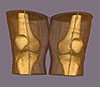
English osteopath and manipulative surgeon who treated knee pain and cartilage problems in top sports players as well as the general public. Barker treated patients on his yacht in the Channel Isles. He maintained that a knee cartilage operation was unnecessary in a very large proportion of cases and he claimed that manipulation was sufficient without any surgery. The community of Montego Bay, Jamaica, credits the genesis of its tourist trade to the famous chiropractor Sir Herbert Barker in England because he promoted the sea water as having curative powers at the Doctor's Cave bathing club there. (That location had been donated to the town in 1906 for that purpose by the eccentric physician, Dr. Alexander McCatty.)«[Image right (source) ]
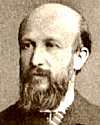
Born 21 Apr 1849; died 25 Oct 1922 at age 73. quotes
Oskar (Wilhelm August) Hertwig was a German embryologist and cytologist who did extensive work on the nuclear transmission of heredity. He was the first to recognize that the essential event in fertilization is the fusion of the nuclei of the sperm and ovum. In 1875, he observed all the steps in fertilization, including the union of egg and sperm chromosomes in sea urchins. These animals are particularly suitable for microscopic studies because of their transparency. He saw there was a single nucleus before fertilization and two nuclei immediately afterwards. He realized the second nucleus had come from the spermatazoon, and thus a single spermatazoon can fertilize an egg. He also investigated malformations of vertebrate embryos.
Oskar (Wilhelm August) Hertwig was a German embryologist and cytologist who did extensive work on the nuclear transmission of heredity. He was the first to recognize that the essential event in fertilization is the fusion of the nuclei of the sperm and ovum. In 1875, he observed all the steps in fertilization, including the union of egg and sperm chromosomes in sea urchins. These animals are particularly suitable for microscopic studies because of their transparency. He saw there was a single nucleus before fertilization and two nuclei immediately afterwards. He realized the second nucleus had come from the spermatazoon, and thus a single spermatazoon can fertilize an egg. He also investigated malformations of vertebrate embryos.
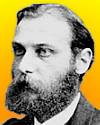
Born 21 Apr 1843; died 4 Aug 1905 at age 62. quotes
German anatomist who was the first to observe and describe systematically the behaviour of chromosomes in the cell nucleus during normal cell division (mitosis, a term he coined in 1882). Thus, he was a founder of cytogenetics as a branch of science to study chromosomes, the cell's hereditary material. Flemming coined other terms: spireme, aster, chromatin, achromatin, monocentric and dicentric phases. Chromatin (Gr. chroma = colour) referred to certain fragments of the cell nucleus that took on a strong colour from the dyes he used during microscopic study. Flemming did not know of Mendel's work, so 20 years passed before the genetic implications were realized. Chromosomes, formed from cromatin, were named in 1888 by Waldeyer-Hartz. more
German anatomist who was the first to observe and describe systematically the behaviour of chromosomes in the cell nucleus during normal cell division (mitosis, a term he coined in 1882). Thus, he was a founder of cytogenetics as a branch of science to study chromosomes, the cell's hereditary material. Flemming coined other terms: spireme, aster, chromatin, achromatin, monocentric and dicentric phases. Chromatin (Gr. chroma = colour) referred to certain fragments of the cell nucleus that took on a strong colour from the dyes he used during microscopic study. Flemming did not know of Mendel's work, so 20 years passed before the genetic implications were realized. Chromosomes, formed from cromatin, were named in 1888 by Waldeyer-Hartz. more
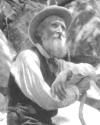
Yosemite 1907
Born 21 Apr 1838; died 24 Dec 1914 at age 76. quotes
Scottish-American naturalist, farmer, explorer, writer and conservationist who championed the establishment of Sequoia and Yosemite national parks in California. In 1849, the Muir family emigrated to the U.S. As an inventor, he carved clocks and curious but practical mechanisms (like a device that tipped him out of bed before dawn), that won Wisconsin State Fair prizes (1860). He had begun travelling the U.S. by 1867. In his later years he wrote extensively: 300 articles and 10 major books that recounted his travels, his beloved Sierra Nevada, and expounded his naturalist philosophy. Muir drew attention to the devastation of mountain meadows and forests by sheep and cattle, leading to his role as “Father of the National Park System.” more
Scottish-American naturalist, farmer, explorer, writer and conservationist who championed the establishment of Sequoia and Yosemite national parks in California. In 1849, the Muir family emigrated to the U.S. As an inventor, he carved clocks and curious but practical mechanisms (like a device that tipped him out of bed before dawn), that won Wisconsin State Fair prizes (1860). He had begun travelling the U.S. by 1867. In his later years he wrote extensively: 300 articles and 10 major books that recounted his travels, his beloved Sierra Nevada, and expounded his naturalist philosophy. Muir drew attention to the devastation of mountain meadows and forests by sheep and cattle, leading to his role as “Father of the National Park System.” more
John Muir: The Eight Wilderness Discovery Books, by John Muir. - book suggestion.
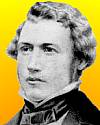
age 23
Born 21 Apr 1830; died 17 Jun 1881 at age 51.
British inventor and manufacturer, known as the father of the bicycle industry. Starley left the family farm as a teenager and after initially working as a gardener, he turned to mechanical interests. He improved the early sewing machine, and by about 1861, was in business with Josiah Turner as the Coventry Sewing Machine Company. Within a few years, their factory began producing bicycles. In 1870, he went into business for himself, producing his Europa sewing machines and Ariel bicycles, "penny-farthing" and tricycles. The Ariel, a lightweight all-metal bicycle (1871), is regarded as the first true bicycle, the first self-propelled two-wheeler to use pivot-center steering. His tangent-tension spoke wheel (1876) is still used.« more
British inventor and manufacturer, known as the father of the bicycle industry. Starley left the family farm as a teenager and after initially working as a gardener, he turned to mechanical interests. He improved the early sewing machine, and by about 1861, was in business with Josiah Turner as the Coventry Sewing Machine Company. Within a few years, their factory began producing bicycles. In 1870, he went into business for himself, producing his Europa sewing machines and Ariel bicycles, "penny-farthing" and tricycles. The Ariel, a lightweight all-metal bicycle (1871), is regarded as the first true bicycle, the first self-propelled two-wheeler to use pivot-center steering. His tangent-tension spoke wheel (1876) is still used.« more
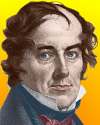
Born 21 Apr 1774; died 3 Feb 1862 at age 87. quotes
French physicist and mathematician who, with Felix Savart, developed the Biot-Savart law, that the intensity of the magnetic field produced by current flow through a wire varies inversely with the distance from the wire. He did work in astronomy, elasticity, heat, optics, electricity and magnetism. In pure mathematics, he contibuted to geometry. In 1804 he made a 13,000-feet (5-km) high hot-air balloon ascent with Joseph Gay-Lussac to investigate the atmosphere. In 1806, he accompanied François Arago to Spain to complete earlier work there to measure of the arc of the meridian. Biot discovered optical activity in 1815, the ability of a substance to rotate the plane of polarization of light, which laid the basis for saccharimetry, a useful technique of analyzing sugar solutions.«
French physicist and mathematician who, with Felix Savart, developed the Biot-Savart law, that the intensity of the magnetic field produced by current flow through a wire varies inversely with the distance from the wire. He did work in astronomy, elasticity, heat, optics, electricity and magnetism. In pure mathematics, he contibuted to geometry. In 1804 he made a 13,000-feet (5-km) high hot-air balloon ascent with Joseph Gay-Lussac to investigate the atmosphere. In 1806, he accompanied François Arago to Spain to complete earlier work there to measure of the arc of the meridian. Biot discovered optical activity in 1815, the ability of a substance to rotate the plane of polarization of light, which laid the basis for saccharimetry, a useful technique of analyzing sugar solutions.«


Died 21 Apr 2013 at age 83 (born 4 Nov 1929).
Indian computer and astrologer who demonstrated her gift as an arithmetical prodigy in public performances (beginning at age 6 years old), rapidly computing answers to addition of several up to 13-digit numbers. Using her mental skills, she applied shortcuts using mathematical algorithms, though she could not explain that ability. Her calculations included using large numbers in multiplication and division of large numbers. She also quickly gave square and cube roots, and could name the day of the week for any date in the last century. Examples include taking the cube root of 188,132,517 or naming which days of the week the 14th of each month occurred in 1935. Her skill was one of computation, but she did not have a photographic memory for other facts, and could have memory lapses such as recognizing people met in years past.«
Indian computer and astrologer who demonstrated her gift as an arithmetical prodigy in public performances (beginning at age 6 years old), rapidly computing answers to addition of several up to 13-digit numbers. Using her mental skills, she applied shortcuts using mathematical algorithms, though she could not explain that ability. Her calculations included using large numbers in multiplication and division of large numbers. She also quickly gave square and cube roots, and could name the day of the week for any date in the last century. Examples include taking the cube root of 188,132,517 or naming which days of the week the 14th of each month occurred in 1935. Her skill was one of computation, but she did not have a photographic memory for other facts, and could have memory lapses such as recognizing people met in years past.«
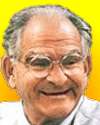
Died 21 Apr 2002 at age 93 (born 19 Sep 1908). quotes
Viktor Frederick Weisskopf was an Austrian-American theoretical physicist and administrator who was a doctoral student of Max Born at Göttingen. Weisskopf was a major contributor in the golden age of quantum mechanics. In following years, he worked with Heisenberg, Schrödinger, Bohr and Pauli. To escape Nazism, he moved to the U.S. (1937). He joined the Manhattan Project at Los Alamos in 1943, where he became associate head of the theoretical division. His postwar career was spent at M.I.T. (Murray Gell-Mann was one of his students.) In the 1950s, Weisskopf developed the “clouded crystal ball” model of the atomic nucleus. He served as director-general of CERN, the high-energy particle research center (1961-65), then returned to M.I.T. until he retired in 1973.«
Viktor Frederick Weisskopf was an Austrian-American theoretical physicist and administrator who was a doctoral student of Max Born at Göttingen. Weisskopf was a major contributor in the golden age of quantum mechanics. In following years, he worked with Heisenberg, Schrödinger, Bohr and Pauli. To escape Nazism, he moved to the U.S. (1937). He joined the Manhattan Project at Los Alamos in 1943, where he became associate head of the theoretical division. His postwar career was spent at M.I.T. (Murray Gell-Mann was one of his students.) In the 1950s, Weisskopf developed the “clouded crystal ball” model of the atomic nucleus. He served as director-general of CERN, the high-energy particle research center (1961-65), then returned to M.I.T. until he retired in 1973.«
The Joy Of Insight: The Passions of a Physicist, by Victor Weisskopf. - book suggestion.
Died 21 Apr 1990 at age 90 (born 15 Jan 1900). quotes
Richard Bevan Braithwaite was an English philosopher who trained in physics and mathematics, but turned to the philosophy of science. He examined the logical features common to all the sciences. Each science proceeds by inventing general principles from which are deduced the consequences to be tested by observation and experiment. Braithwaite was concerned with the impact of science on our beliefs about the world and the responses appropriate to that. He wrote on the statistical sciences, theories of belief and of probability, decision theory and games theory. He was interested in particular with the laws of probability as they apply to the physical and biological sciences.«
Richard Bevan Braithwaite was an English philosopher who trained in physics and mathematics, but turned to the philosophy of science. He examined the logical features common to all the sciences. Each science proceeds by inventing general principles from which are deduced the consequences to be tested by observation and experiment. Braithwaite was concerned with the impact of science on our beliefs about the world and the responses appropriate to that. He wrote on the statistical sciences, theories of belief and of probability, decision theory and games theory. He was interested in particular with the laws of probability as they apply to the physical and biological sciences.«
Scientific Explanation: A Study of the Function of Theory, Probability and Law in Science, by R.B. Braithwaite. - book suggestion.
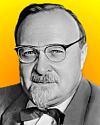
Died 21 Apr 1980 at age 86 (born 18 Feb 1894).
Russian biochemist who is noted for his studies on the origin of life from chemical matter. By drawing on the insights of chemistry, he extended the Darwinian theory of evolution backward in time to explain how simple organic and inorganic materials might have combined into complex organic compounds. In 1938, Oparin suggested that organic molecules could be formed in the presence of outside energy sources.First name seen as Alexander. Birth date 18 Feb, O.S. in EB, or 2 Mar, N.S. in DSB.
Russian biochemist who is noted for his studies on the origin of life from chemical matter. By drawing on the insights of chemistry, he extended the Darwinian theory of evolution backward in time to explain how simple organic and inorganic materials might have combined into complex organic compounds. In 1938, Oparin suggested that organic molecules could be formed in the presence of outside energy sources.First name seen as Alexander. Birth date 18 Feb, O.S. in EB, or 2 Mar, N.S. in DSB.
The Origin of Life, by Aleksandr Ivanovich Oparin. - book suggestion.

Died 21 Apr 1967 at age 77 (born 6 Apr 1890).
French astronomer who devised a now standard five-point scale for rating the darkness and colour of a total lunar eclipse, which is known as the Danjon Luminosity Scale. He studied Earth's rotation, and developed astronomical instruments, including a photometer to measure Earthshine - the brightness of a dark moon due to light reflected from Earth. It consisted of a telescope in which a prism split the Moon's image into two identical side-by-side images. By adjusting a diaphragm to dim one of the images until the sunlit portion had the same apparent brightness as the earthlit portion on the unadjusted image, he could quantify the diaphragm adjustment, and thus had a real measurement for the brightness of Earthshine.«
French astronomer who devised a now standard five-point scale for rating the darkness and colour of a total lunar eclipse, which is known as the Danjon Luminosity Scale. He studied Earth's rotation, and developed astronomical instruments, including a photometer to measure Earthshine - the brightness of a dark moon due to light reflected from Earth. It consisted of a telescope in which a prism split the Moon's image into two identical side-by-side images. By adjusting a diaphragm to dim one of the images until the sunlit portion had the same apparent brightness as the earthlit portion on the unadjusted image, he could quantify the diaphragm adjustment, and thus had a real measurement for the brightness of Earthshine.«
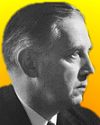
Died 21 Apr 1965 at age 72 (born 6 Sep 1892). quotes
Sir Edward Victor Appleton was an English physicist who was awarded the 1947 Nobel Prize for Physics for his discovery of the Appleton layer of the ionosphere. From 1919, he devoted himself to scientific problems in atmospheric physics, using mainly radio techniques. He proved the existence of the ionosphere, and found a layer 60 miles above the ground that reflected radio waves. In 1926, he found another layer 150 miles above ground, higher than the Heaviside Layer, electrically stronger, and able to reflect short waves round the earth. This Appleton layer is a dependable reflector of radio waves and more useful in communication than other ionospheric layers that reflect radio waves sporadically, depending upon temperature and time of day.«
Sir Edward Victor Appleton was an English physicist who was awarded the 1947 Nobel Prize for Physics for his discovery of the Appleton layer of the ionosphere. From 1919, he devoted himself to scientific problems in atmospheric physics, using mainly radio techniques. He proved the existence of the ionosphere, and found a layer 60 miles above the ground that reflected radio waves. In 1926, he found another layer 150 miles above ground, higher than the Heaviside Layer, electrically stronger, and able to reflect short waves round the earth. This Appleton layer is a dependable reflector of radio waves and more useful in communication than other ionospheric layers that reflect radio waves sporadically, depending upon temperature and time of day.«
Sir Edward Appleton, by Ronald William Clark. - book suggestion.
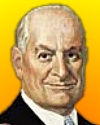
Died 21 Apr 1962 at age 76 (born 15 Nov 1885).
British aircraft designer who built the Handley Page 0/400, the world's first twin-engine bomber for the Royal Flying Corps, one of the largest planes used in WW I, which carried out their first large-scale bombing raids on enemy military installations and submarine bases in Nov 1916. By 1918, he had produced a four-engine bomber that could attack the industrial zones of the Saar and the Ruhr in Germany. In 1930, he produced the first 40-seat civilian airliner, the Hercules. For WW II, Page returned to producing military aircraft, the most important being the Halifax bomber. The government purchased 7,000 of these planes. He was knighted for his contribution to the war effort. After the war Page designed the four-engine jet bomber, the Victor.
British aircraft designer who built the Handley Page 0/400, the world's first twin-engine bomber for the Royal Flying Corps, one of the largest planes used in WW I, which carried out their first large-scale bombing raids on enemy military installations and submarine bases in Nov 1916. By 1918, he had produced a four-engine bomber that could attack the industrial zones of the Saar and the Ruhr in Germany. In 1930, he produced the first 40-seat civilian airliner, the Hercules. For WW II, Page returned to producing military aircraft, the most important being the Halifax bomber. The government purchased 7,000 of these planes. He was knighted for his contribution to the war effort. After the war Page designed the four-engine jet bomber, the Victor.
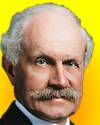
Died 21 Apr 1957 at age 87 (born 18 Sep 1869).
Sir John Graham Kerr was an English embryologist whose research added knowledge of the evolution of vertebrates. He also promoted ideas in naval camouflage for WWI. Early in his career, pursuing his zoological interests, Kerr went on two expeditions to the Pilcomayo River in South America, collecting samples for his subsequent research. He referenced his observation of animal camouflage in South America in a letter to Winston Churchill, (24 Sep 1914), and recommended painting war ships with graduated shading. He also communicated with Ernest Bevin and Clement Atlee on his camouflage ideas. He deserves credit his pioneering efforts, although often overshadowed by later “dazzle” scheme of camouflage.« more
Sir John Graham Kerr was an English embryologist whose research added knowledge of the evolution of vertebrates. He also promoted ideas in naval camouflage for WWI. Early in his career, pursuing his zoological interests, Kerr went on two expeditions to the Pilcomayo River in South America, collecting samples for his subsequent research. He referenced his observation of animal camouflage in South America in a letter to Winston Churchill, (24 Sep 1914), and recommended painting war ships with graduated shading. He also communicated with Ernest Bevin and Clement Atlee on his camouflage ideas. He deserves credit his pioneering efforts, although often overshadowed by later “dazzle” scheme of camouflage.« more
Zoology for Medical Students (reprint), by J. Graham Kerr. - book suggestion.
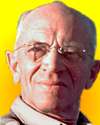
Died 21 Apr 1948 at age 61 (born 11 Jan 1887). quotes
Rand Aldo Leopold was an American conservationist as well as a forester, philosopher, educator, writer, outdoor enthusiast and co-founder (in 1935) of the Wilderness Society. By the keen observations and land ethic expressed in his prolific essay writings, he has been recognized as the natural successor to Henry Thoreau. Leopold’s philosophy is found throughout the seminal work, A Sand County Almanac. His boyhood explorations of the outdoors led to a Master’s Degree in Forestry from Yale. He worked with timber management in U.S. Forest Service for several years, and his nascent passion for protecting wilderness blossomed. In 1924, the Gila Wilderness he proposed was established in the Gila National Forest.«
Rand Aldo Leopold was an American conservationist as well as a forester, philosopher, educator, writer, outdoor enthusiast and co-founder (in 1935) of the Wilderness Society. By the keen observations and land ethic expressed in his prolific essay writings, he has been recognized as the natural successor to Henry Thoreau. Leopold’s philosophy is found throughout the seminal work, A Sand County Almanac. His boyhood explorations of the outdoors led to a Master’s Degree in Forestry from Yale. He worked with timber management in U.S. Forest Service for several years, and his nascent passion for protecting wilderness blossomed. In 1924, the Gila Wilderness he proposed was established in the Gila National Forest.«
A Sand County Almanac: With Essays on Conservation from Round River, by Aldo Leopold. - book suggestion.
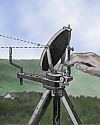
Died 21 Apr 1926 (born 1840).
British scientist and engineer whose invention of a heliograph provided a portable signaling device that used a tripod with a mirror to reflect sunlight (British patent Feb 1876). A second mirror could direct sunlight onto the first which was tilted using a telegraph-type finger key to transmit a coded series of short and long flashes to a distant station, up to 100 miles away. After its successful use in the second Anglo-Afghan War (1878-80), it became an important part of British military communications. Mance worked for the Persian Gulf Telegraph Department in India from 1863, and helped lay the first submarine telegraph cables in the Persian Gulf. He invented the Mance method to detect defects in submarine cables and locate their position.«
British scientist and engineer whose invention of a heliograph provided a portable signaling device that used a tripod with a mirror to reflect sunlight (British patent Feb 1876). A second mirror could direct sunlight onto the first which was tilted using a telegraph-type finger key to transmit a coded series of short and long flashes to a distant station, up to 100 miles away. After its successful use in the second Anglo-Afghan War (1878-80), it became an important part of British military communications. Mance worked for the Persian Gulf Telegraph Department in India from 1863, and helped lay the first submarine telegraph cables in the Persian Gulf. He invented the Mance method to detect defects in submarine cables and locate their position.«
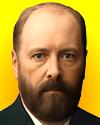
Died 21 Apr 1911 at age 72 (born 16 Oct 1838).
Swedish geologist and pioneer in study and analysis of the mountain structure of the Scandinavian Caledonides. With detailed maps he argued (1888) that the Caledonian mountain belt was built by great overthrust sheets (nappes) driven southeast over the foreland. By 1896 he showed the overthrusting involved the entire range and exceeded ~130 km, illustrated with a large regional map. He coined the ore-geology term “skarn” (1875), published an early crystalline-phase account of Portland cement (1897), and his studies of Sweden’s iron ores yielded nine maps of principal locations (1879-82). He was a co-founder (15 May 1871) of the Geological Survey of Sweden, becoming its director (1897-1906); and was a professor at the Royal Institute of Technology (1878-97).«
Swedish geologist and pioneer in study and analysis of the mountain structure of the Scandinavian Caledonides. With detailed maps he argued (1888) that the Caledonian mountain belt was built by great overthrust sheets (nappes) driven southeast over the foreland. By 1896 he showed the overthrusting involved the entire range and exceeded ~130 km, illustrated with a large regional map. He coined the ore-geology term “skarn” (1875), published an early crystalline-phase account of Portland cement (1897), and his studies of Sweden’s iron ores yielded nine maps of principal locations (1879-82). He was a co-founder (15 May 1871) of the Geological Survey of Sweden, becoming its director (1897-1906); and was a professor at the Royal Institute of Technology (1878-97).«
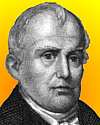
Died 21 Apr 1835 at age 66 (born 9 Jun 1768).
English-American mechanical engineer who foundedthe American cotton-textile industry. Before he left Nottingham and immigrating to the U.S. in 1789, Slater apprenticed with Jedediah Strutt (partner of Richard Arkwright) in England. Once in the U.S., he found backing to build Arkwright's spinning and carding machinery, with which he established the first successful cotton mill in the U.S. in Pawtucket, Rhode Island, as well as many others in the New England region.
English-American mechanical engineer who foundedthe American cotton-textile industry. Before he left Nottingham and immigrating to the U.S. in 1789, Slater apprenticed with Jedediah Strutt (partner of Richard Arkwright) in England. Once in the U.S., he found backing to build Arkwright's spinning and carding machinery, with which he established the first successful cotton mill in the U.S. in Pawtucket, Rhode Island, as well as many others in the New England region.
Memoir of Samuel Slater, the Father of American Manufactures, by George White. - book suggestion.
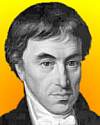
Died 21 Apr 1825 at age 59 (born 22 Dec 1765).
German mathematician who proposed the first general method of integrating partial differential equations of the first order. Pfaff did important work on special functions and the theory of series. He developed Taylor's Theorem using the form with remainder as given by Lagrange. In 1810 he contributed to the solution of a problem due to Gauss concerning the ellipse of greatest area which could be drawn inside a given quadrilateral. His most important work on Pfaffian forms was published in 1815 when he was nearly 50, but its importance was not recognised until 1827 when Jacobi published a paper on Pfaff's method.«
German mathematician who proposed the first general method of integrating partial differential equations of the first order. Pfaff did important work on special functions and the theory of series. He developed Taylor's Theorem using the form with remainder as given by Lagrange. In 1810 he contributed to the solution of a problem due to Gauss concerning the ellipse of greatest area which could be drawn inside a given quadrilateral. His most important work on Pfaffian forms was published in 1815 when he was nearly 50, but its importance was not recognised until 1827 when Jacobi published a paper on Pfaff's method.«
Died 21 Apr 1800 at age 58 (born 28 Oct 1741). quotes
French physicist and priest who is remembered for his studies of electricity, including its atmospheric phenomena, application to the growth of plants, in classifying human ailments according to their positive or negative electrical reactions and for therapies. His work in more diverse fields included urban public health, agriculture, aerostatics and fires, volcanoes and earthquakes. He was influenced by his friendship with Benjamin Franklin, and promoted the use of lightning rods in southern France. Bertholon invented the electrovegetometer to use in his investigation of the application of electricity to the growth of plants.«
French physicist and priest who is remembered for his studies of electricity, including its atmospheric phenomena, application to the growth of plants, in classifying human ailments according to their positive or negative electrical reactions and for therapies. His work in more diverse fields included urban public health, agriculture, aerostatics and fires, volcanoes and earthquakes. He was influenced by his friendship with Benjamin Franklin, and promoted the use of lightning rods in southern France. Bertholon invented the electrovegetometer to use in his investigation of the application of electricity to the growth of plants.«
Died 21 Apr 1793 (born 1724). quotes
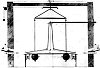
British geologist and astronomer who was first to devise a realistic estimate of the distance to the stars, discovered physical double stars, and is considered the father of seismology. After the Lisbon earthquake of 1755 (which killed 70,000 people), he suggested that earthquakes set up wave motion in the earth. He noted the increased frequency of earthquakes in volcanic areas. Michell realized that by comparing the time at which earthquakes are felt, the epicentre could be calculated. He invented a torsion balance, a device to measure very small forces, though died before carrying out its purpose to determine the density of the Earth. His rebuilt apparatus was used by Cavendish to make that measurement, which also gives the gravitational constant).«[Image: Michell torsion balance as used by Cavendish]
British geologist and astronomer who was first to devise a realistic estimate of the distance to the stars, discovered physical double stars, and is considered the father of seismology. After the Lisbon earthquake of 1755 (which killed 70,000 people), he suggested that earthquakes set up wave motion in the earth. He noted the increased frequency of earthquakes in volcanic areas. Michell realized that by comparing the time at which earthquakes are felt, the epicentre could be calculated. He invented a torsion balance, a device to measure very small forces, though died before carrying out its purpose to determine the density of the Earth. His rebuilt apparatus was used by Cavendish to make that measurement, which also gives the gravitational constant).«[Image: Michell torsion balance as used by Cavendish]
Died 21 Apr 1793 (born 1724).
English geologist.
English geologist.
Died 21 Apr 1552 at age 57 (born 16 Apr 1495).
German astronomer and geographer, also known as Petrus Apianus, whose major work was Instrumentum sinuum sivi primi mobilis (1534), in which he gave tables of his calculations of sines for every minute, with a decimal division of the radius.
German astronomer and geographer, also known as Petrus Apianus, whose major work was Instrumentum sinuum sivi primi mobilis (1534), in which he gave tables of his calculations of sines for every minute, with a decimal division of the radius.
Died 21 Apr 1142 (born 1079). quotes
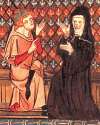
French scholar, perhaps the finest academic and boldest thinker of the twelfth century, is noted for controversial writings included Sic et Non (Yes or No), which explained theories of logic. He is best known for having a tragic love affair with French nun and writer, Heloise d’Argenteuil. She was the niece of secular canon Fulbert, who severely disapproved.«[a.k.a Pierre Abailard, Pierre Abélard. Image: Abelard and Héloïse, a miniature portrait from the book Roman de la Rose (The Romance of the Rose) by French poet, Jean de Meun, (c.1250-1305) who also wrote a rhyming treatise on alchemy.]
French scholar, perhaps the finest academic and boldest thinker of the twelfth century, is noted for controversial writings included Sic et Non (Yes or No), which explained theories of logic. He is best known for having a tragic love affair with French nun and writer, Heloise d’Argenteuil. She was the niece of secular canon Fulbert, who severely disapproved.«[a.k.a Pierre Abailard, Pierre Abélard. Image: Abelard and Héloïse, a miniature portrait from the book Roman de la Rose (The Romance of the Rose) by French poet, Jean de Meun, (c.1250-1305) who also wrote a rhyming treatise on alchemy.]
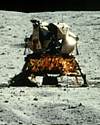
In 1972, Apollo 16 astronauts landed for a fifth manned mission to the moon's surface. The Lunar Module Orion with John W. Young and Charles M. Duke set down in the central lunar highlands to explore a different terrain than any previous astronauts had seen. The crew travelled almost 27-km using their lunar rover. They deployed or performed nine experiments, collected lunar material samples at 11 sites, and took photographs. The two remained for 71 hours on the moon's surface, before returning, lifting off on 24 Apr. Thomas K. Mattingly remained in orbit as the pilot of the Command Module Casper. They had launched on 16 Apr 1972 from the Kennedy Space Center, and reached earth again on 27 Apr. Later the same year Apollo 17, the last manned lunar landing mission was launched on 7 Dec 1972.«
1962
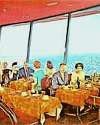
In 1962, the Seattle World’s Fair on a 74-acre site, Seattle, Washington, was opened by remote control by President John F. Kennedy from Palm Beach, Florida. The Space Needle—a 600-ft steel and glass tower—was erected as its dominant central structure. When built in 1962, it was the tallest building west of the Mississippi River. The first revolving restaurant in the mainland U.S., the “Eye of the Needle,” was located at the 500-ft level. A 14-foot ring next to the windows carrying 260 seats rotates 360 degrees in one hour on a track and wheel system driven by a 1 horsepower motor. The restaurant has since been renamed “SkyCity.”«[Image from a postcard.]
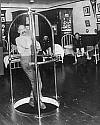
In 1878, the first U.S. firehouse pole was installed in New York City, by Capt. David B. Kenyon to reduce the time for men to travel to the ground floor from the second floor at Engine Company 21*. Fire stations had added a second floor for a sleeping and relaxation area. Although some stations had sliding chutes, Kenyon thought a pole would be faster. With the chief's permission, a hole was cut in the floor for a 3-inch diameter wooden pole, which Kenyon had sanded carefully and oiled. Following its success, in 1880, the first brass pole was installed in Worchester, Mass. by Charles Allen of Engine Company No. 1.«[Image: Fireman ready to slide down the pole in the dormitory of Fire Hall No. 7, Calgary, Alberta, c.1910]
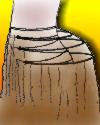
(USPTO)
In 1857, the first U.S. patent for a bustle was issued to Alexander Douglas (No. 17,082). The design had adjustments so that the size could be increased or decreased. It described the construction of the bustle from elastic material such as strips of whalebone and strips of flexible material such as cloth or corset lacing, attached to the whalebone. "When in use the flexible part adapts itself to the form of the wearer and the elastic strips stand out therefrom." To make "the magnitude of the bustle adjustable at pleasure simply by shortening or lengthening the flexible parts," eyelets were provided at the extremities of the strips threaded in the same manner as corset lacings. By changing the length of the lacing, the wearer could adjust the size of the bustle.«
In 1703, Edinburgh Fire Brigade, one of the first in Scotland, was formed.




