Born 5 Mar 1934.
American psychologist (born in Tel Aviv, now in Israel) who was awarded a share of the Nobel Prize in Economics in 2002 "for having integrated insights from psychological research into economic science, especially concerning human judgment and decision-making under uncertainty." Since there is no Nobel Prize, per se, for psychology, he was only the second psychologist to become a Nobel Laureate. He pioneered theories of behavioral finance, which integrates economics and cognitive science to explain seemingly irrational risk management behavior in human beings. He collaborated with Amos Tversky and others in establishing a cognitive basis for common human errors using heuristics and in developing the Prospect Theory.
American psychologist (born in Tel Aviv, now in Israel) who was awarded a share of the Nobel Prize in Economics in 2002 "for having integrated insights from psychological research into economic science, especially concerning human judgment and decision-making under uncertainty." Since there is no Nobel Prize, per se, for psychology, he was only the second psychologist to become a Nobel Laureate. He pioneered theories of behavioral finance, which integrates economics and cognitive science to explain seemingly irrational risk management behavior in human beings. He collaborated with Amos Tversky and others in establishing a cognitive basis for common human errors using heuristics and in developing the Prospect Theory.
Born 5 Mar 1915.
French mathematician who was awarded the Fields Medal in 1950 for his work in functional analysis.
French mathematician who was awarded the Fields Medal in 1950 for his work in functional analysis.

Born 5 Mar 1910; died 5 Jan 2007 at age 96.
Taiwanese-Japanese businessman and inventor who invented instant noodles and Cup Noodles. He founded Nissin Food Products Co. In 1958, he developed the world’s first instant noodle product. At that time, his research was done a simple wooden shack in the back yard of his home in Ikeda-Shi, Osaka, Japan. His process mixed wheat flour into a dough that was stretched, steamed as noodles, flavored and dried by a flash-frying method. In 1971, he introduced the world’s first cup-type instant noodle, “Cup Noodles.” His products spread not only across the world, but in Jul 2005, Japanese astronaut Soichi Noguchi carried specially prepared “Space Ram” instant noodles when he traveled on the space shuttle Discovery.«
Taiwanese-Japanese businessman and inventor who invented instant noodles and Cup Noodles. He founded Nissin Food Products Co. In 1958, he developed the world’s first instant noodle product. At that time, his research was done a simple wooden shack in the back yard of his home in Ikeda-Shi, Osaka, Japan. His process mixed wheat flour into a dough that was stretched, steamed as noodles, flavored and dried by a flash-frying method. In 1971, he introduced the world’s first cup-type instant noodle, “Cup Noodles.” His products spread not only across the world, but in Jul 2005, Japanese astronaut Soichi Noguchi carried specially prepared “Space Ram” instant noodles when he traveled on the space shuttle Discovery.«
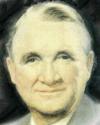
Born 5 Mar 1893; died 3 Jun 1970 at age 77.
American founder of a water treatment company. In 1936, Emmett J. Culligan launched the Culligan Zeolite Company (Water Softening) in Northbrook, Illinois. During WW II, Culligan built a facility to manufacture silica gel, a dehydrating material that protected metals from atmospheric corrosion that was greatly in demand during the war, and Culligan soon became one of the largest suppliers. He developed a novel process for manufacturing zeolite, the man-made mineral used in water softeners, and built a nationwide service industry in water conditioning and filtering, which then expanded internationally.
American founder of a water treatment company. In 1936, Emmett J. Culligan launched the Culligan Zeolite Company (Water Softening) in Northbrook, Illinois. During WW II, Culligan built a facility to manufacture silica gel, a dehydrating material that protected metals from atmospheric corrosion that was greatly in demand during the war, and Culligan soon became one of the largest suppliers. He developed a novel process for manufacturing zeolite, the man-made mineral used in water softeners, and built a nationwide service industry in water conditioning and filtering, which then expanded internationally.
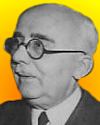
Born 5 Mar 1876; died 4 Mar 1963 at age 86.
French engineer whose invention (1907) made the first telephoto transmission by wire, from Paris to Lyon to Bordeaux and back to Paris. He further developed the Belinograph able to make the first transatlantic radio facsimile transmission, on 4 Aug 1921, between Annapolis, Md., and Belin's laboratories at La Malmaison, France. His invention scanned an image on a cylinder reflecting a light beam onto a photoelectric cell which converted varying reflected light intensity into electrical impulses. His equipment was adopted in Britain in 1928, and used almost exclusively by European news media in the 1930s -'40s, when the term "Belino" came into general use for all kinds of picture transmission. By 1923, he had dabbled in ideas for television.« more
French engineer whose invention (1907) made the first telephoto transmission by wire, from Paris to Lyon to Bordeaux and back to Paris. He further developed the Belinograph able to make the first transatlantic radio facsimile transmission, on 4 Aug 1921, between Annapolis, Md., and Belin's laboratories at La Malmaison, France. His invention scanned an image on a cylinder reflecting a light beam onto a photoelectric cell which converted varying reflected light intensity into electrical impulses. His equipment was adopted in Britain in 1928, and used almost exclusively by European news media in the 1930s -'40s, when the term "Belino" came into general use for all kinds of picture transmission. By 1923, he had dabbled in ideas for television.« more
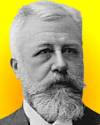
Born 5 Mar 1846; died 28 Apr 1910 at age 64. quotes
Édouard Joseph Louis-Marie van Beneden was a Belgian embryologist and cytologist best known for his discoveries concerning fertilization in sex cells and chromosome numbers in body cells. From 1883, he experimented with the worm Ascaris megalocephala, an intestinal worm found in horses. His studies showed that sexual fertilization results from the union of two different cell half-nuclei. Thus a new single cell is created with its number of chromosomes derived as one-half from the male sperm and the other half from the female egg. Van Beneden also determined that the chromosome number is constant for every body cell of a species. His theory of embryo formation in mammals became a standard scientific principle.
Édouard Joseph Louis-Marie van Beneden was a Belgian embryologist and cytologist best known for his discoveries concerning fertilization in sex cells and chromosome numbers in body cells. From 1883, he experimented with the worm Ascaris megalocephala, an intestinal worm found in horses. His studies showed that sexual fertilization results from the union of two different cell half-nuclei. Thus a new single cell is created with its number of chromosomes derived as one-half from the male sperm and the other half from the female egg. Van Beneden also determined that the chromosome number is constant for every body cell of a species. His theory of embryo formation in mammals became a standard scientific principle.
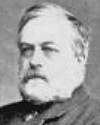
Born 5 Mar 1830; died 10 Mar 1882 at age 52.
Sir C(harles) Wyville Thomson was a Scottish naturalist who was one of the first marine biologists to describe life in the ocean depths. He led the famous 110,224-km (68,890 mile) scientific expedition of HMS Challenger in (1872-6) which trawled the depths of the oceans for new forms of life. This was the world's first foray into big science. The Expedition was to circumnavigate the world in the steam corvette, HMS Challenger, with a goal, as resolved by the British Association (1871) of "carrying the physical and biological Exploration of the deep-sea into all the great oceanic centres". The extensive biological collections, together with soundings, bottom samples, and chemical and physical observations, presented the first broad view of the character of the oceans.
Sir C(harles) Wyville Thomson was a Scottish naturalist who was one of the first marine biologists to describe life in the ocean depths. He led the famous 110,224-km (68,890 mile) scientific expedition of HMS Challenger in (1872-6) which trawled the depths of the oceans for new forms of life. This was the world's first foray into big science. The Expedition was to circumnavigate the world in the steam corvette, HMS Challenger, with a goal, as resolved by the British Association (1871) of "carrying the physical and biological Exploration of the deep-sea into all the great oceanic centres". The extensive biological collections, together with soundings, bottom samples, and chemical and physical observations, presented the first broad view of the character of the oceans.
1880
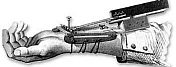
sphygmograph
French physiologist and chronophotographer who, while studying how blood moves in the body, invented the sphygmograph. This device made a graphical record of the pulse and variations in blood pressure. One end of a lever rested on the veins in the wrist, while a stylus on the other end inscribed the fluctuations of the heart onto a carbon-blacked strip of paper moving at a uniform speed. He took an interest in the flight of insects and birds. In 1869, Marey demonstrated how an insect flies by moving its wings in a figure-8 shape. Inspired by Muybridge's work, Marey studied the movement of animals by photographing multiple images on a single plate. He also used a high-speed motion camera to produce film to view in slow motion.«
Picturing Time: The Work of Etienne-Jules Marey, by Marta Braun. - book suggestion.
Born 5 Mar 1817; died 5 Jul 1894 at age 77.
English archaeologist whose excavations in Mesopotamia revealed the palaces of the great Assyrian kings, Sennacherib and Assurbanipal, yielding much evidence of both the antiquity and the cultural achievement of the ancient civilizations. He began excavations at Nimrud in 1845, aged 28, making detailed drawing of his discoveries. The artifacts he uncovered included huge winged bulls, hawk-winged lions with human heads, many other statuary reliefs, and alabaster slabs with cuneiform inscriptions. He shipped immense sculptures and other finds back to England. However, he was not a scholar. He wrote popular narrative books on his travels and discoveries. Later in life, he abandoned archaeology and turned to politics.«
English archaeologist whose excavations in Mesopotamia revealed the palaces of the great Assyrian kings, Sennacherib and Assurbanipal, yielding much evidence of both the antiquity and the cultural achievement of the ancient civilizations. He began excavations at Nimrud in 1845, aged 28, making detailed drawing of his discoveries. The artifacts he uncovered included huge winged bulls, hawk-winged lions with human heads, many other statuary reliefs, and alabaster slabs with cuneiform inscriptions. He shipped immense sculptures and other finds back to England. However, he was not a scholar. He wrote popular narrative books on his travels and discoveries. Later in life, he abandoned archaeology and turned to politics.«
The Man Who Found Nineveh: The Story of Austen Henry Layard, by Robert Silverberg. - book suggestion.
Born 5 Mar 1794; died 21 Oct 1872 at age 78.
French physicist who was the first to proposed the definition of the unit of length in terms of the wavelength of a spectral line. The red line in the spectrum of cadmium was chosen, and the angstrom was redefined as a fraction of this value.. He established a principle in diffraction theory (1837) that is named after him. The Babinet compensator was his invention to measure the polarization of light.«
French physicist who was the first to proposed the definition of the unit of length in terms of the wavelength of a spectral line. The red line in the spectrum of cadmium was chosen, and the angstrom was redefined as a fraction of this value.. He established a principle in diffraction theory (1837) that is named after him. The Babinet compensator was his invention to measure the polarization of light.«
Born 5 Mar 1575; died 30 Jun 1660 at age 85.
English mathematician and Episcopal minister who invented the earliest form of the slide rule, two identical linear or circular logarithmic scales held together and adjusted by hand. Improvements involving the familiar inner rule with tongue-in-groove linear construction came later. He introduced the familiar multiplication sign x in a 1631 textbook, along with the first use of the abbreviations sin, cos and tan.[DSB gives date of birth as 5 Mar 1575. EB gives 5 Mar 1574.]
English mathematician and Episcopal minister who invented the earliest form of the slide rule, two identical linear or circular logarithmic scales held together and adjusted by hand. Improvements involving the familiar inner rule with tongue-in-groove linear construction came later. He introduced the familiar multiplication sign x in a 1631 textbook, along with the first use of the abbreviations sin, cos and tan.[DSB gives date of birth as 5 Mar 1575. EB gives 5 Mar 1574.]
Born 5 Mar 1512; died 2 Dec 1594 at age 82.
Flemish cartographer whose most important innovation was a map, embodying what was later known as the Mercator projection, on which parallels and meridians are rendered as straight lines spaced so as to produce at any point an accurate ratio of latitude to longitude. He also introduced the term atlas for a collection of maps.
Flemish cartographer whose most important innovation was a map, embodying what was later known as the Mercator projection, on which parallels and meridians are rendered as straight lines spaced so as to produce at any point an accurate ratio of latitude to longitude. He also introduced the term atlas for a collection of maps.

Died 5 Mar 2008 at age 85 (born 8 Jan 1923). quotes
German engineer and computer scientist who is remembered for devising the computer program known as Eliza, which could mimic human conversation, in written communication, giving the user responses resembling an empathetic psychologist. It was named after the character in the play My Fair Lady, Eliza Doolittle. While a boy, he emigrated to the U.S. in the mid-1930s with his parents who were fleeing Nazi persecution of Jews in Germany. His career in computing led in 1955 to joining the team at General Electric that created the first computer system designed for banking applications. By 1976, in his book, Computer Power and Human Reason: From Judgment to Calculation, he was questioning what limits should be adopted in the implentation of artificial intelligence in computers.«
German engineer and computer scientist who is remembered for devising the computer program known as Eliza, which could mimic human conversation, in written communication, giving the user responses resembling an empathetic psychologist. It was named after the character in the play My Fair Lady, Eliza Doolittle. While a boy, he emigrated to the U.S. in the mid-1930s with his parents who were fleeing Nazi persecution of Jews in Germany. His career in computing led in 1955 to joining the team at General Electric that created the first computer system designed for banking applications. By 1976, in his book, Computer Power and Human Reason: From Judgment to Calculation, he was questioning what limits should be adopted in the implentation of artificial intelligence in computers.«
Computer Power and Human Reason: From Judgment to Calculation, by Joseph Weizenbaum. - book suggestion.
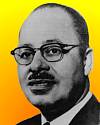
Died 5 Mar 1974 at age 69 (born 16 Jul 1904).
Black-American biochemist and college president, who was the first to synthesize the essential amino acid threonine. Although he is best known for his studies of amino acids, he conducted research in a wider field, including the biochemistry of various bacilli, the B vitamins, and antibiotics. He spent his career from 1937 as professor of biochemistry at Meharry Medical College, Nashville until his retirement in 1973 where he held also the position of college president (1952-63). He was plagued and often hospitalized by severe asthma, which contributed his death.
Black-American biochemist and college president, who was the first to synthesize the essential amino acid threonine. Although he is best known for his studies of amino acids, he conducted research in a wider field, including the biochemistry of various bacilli, the B vitamins, and antibiotics. He spent his career from 1937 as professor of biochemistry at Meharry Medical College, Nashville until his retirement in 1973 where he held also the position of college president (1952-63). He was plagued and often hospitalized by severe asthma, which contributed his death.
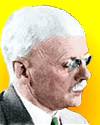
Died 5 Mar 1954 at age 80 (born 28 Sep 1873). quotes
American mathematician and educator noted for numerous published works in theoretical mathematics. He earned a B.A. degree at Harvard (1895), then a B.Sc. (1897) from Oxford, England, the first natural science degree ever awarded at Oxford. He began teaching at Groton School, Conn. (1897-99) where one of his pupils was Franklin D Roosevelt, the future U.S. president. Coolidge was an instructor at Harvard University, taking leave to study abroad (1902-04) with Corrado Segre at Turin and Eduard Study at the University of Bonn ( Ph.D. 1904). When he returned to Harvard, he remained there for the rest of his career. Later in life, he took an interest in his subject's history, writing Mathematics of the Great Amateurs (1949).«
American mathematician and educator noted for numerous published works in theoretical mathematics. He earned a B.A. degree at Harvard (1895), then a B.Sc. (1897) from Oxford, England, the first natural science degree ever awarded at Oxford. He began teaching at Groton School, Conn. (1897-99) where one of his pupils was Franklin D Roosevelt, the future U.S. president. Coolidge was an instructor at Harvard University, taking leave to study abroad (1902-04) with Corrado Segre at Turin and Eduard Study at the University of Bonn ( Ph.D. 1904). When he returned to Harvard, he remained there for the rest of his career. Later in life, he took an interest in his subject's history, writing Mathematics of the Great Amateurs (1949).«
The Mathematics of Great Amateurs, by Julian Lowell Coolidge. - book suggestion.
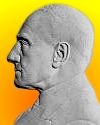
Died c. 5 Mar 1944 (born 7 Mar 1869).
Dutch chemist who researched piezochemistry, electrochemical thermodynamics, polymorphism of compounds and the allotropy of metals, especially tin. He examined the different properties of tin's allotropes: white tin which is the familiar stable form above 13.2ºC and the powdery gray tin stable below that temperature. (The crumbling transition at low temperature is slow and called tin pest by Cohen. Because the cold transformation can be initiated or accelerated by seeding white tin with traces of grey tin, it is also known as tin disease, as if infected.) Cohen's life ended in the Auschwitz death camp following his arrest as a Jew by Nazi occupation forces in 1944. The exact date of his death is uncertain.«
Dutch chemist who researched piezochemistry, electrochemical thermodynamics, polymorphism of compounds and the allotropy of metals, especially tin. He examined the different properties of tin's allotropes: white tin which is the familiar stable form above 13.2ºC and the powdery gray tin stable below that temperature. (The crumbling transition at low temperature is slow and called tin pest by Cohen. Because the cold transformation can be initiated or accelerated by seeding white tin with traces of grey tin, it is also known as tin disease, as if infected.) Cohen's life ended in the Auschwitz death camp following his arrest as a Jew by Nazi occupation forces in 1944. The exact date of his death is uncertain.«
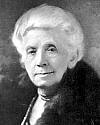
Died 5 Mar 1930 at age 82 (born 1 Dec 1847).
(née Ladd) American scientist and logician known for contributions to the theory of colour vision accounting for the development of man's color sense which countered the established views of Helmholtz, Young, and Hering. Her position was that color-sense developed in stages. Ladd- Franklin's conclusions were particularly useful in accounting for color-blindness in some individuals. In logic, she published an original method for reducing all syllogisms to a single formula (1883)
(née Ladd) American scientist and logician known for contributions to the theory of colour vision accounting for the development of man's color sense which countered the established views of Helmholtz, Young, and Hering. Her position was that color-sense developed in stages. Ladd- Franklin's conclusions were particularly useful in accounting for color-blindness in some individuals. In logic, she published an original method for reducing all syllogisms to a single formula (1883)
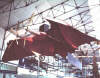
French engineer and inventor best known as a self-taught pioneer of flight before the brothers Orville and Wilbur Wright. In 1890 he constructed a steam-powered aircraft with bat-shaped wings. His craft, the Eole, which could not be steered, made the first heavier-than-air flight (of 50 m). His first patent, on 15 Apr 1866, related to railways. From the late 1870s, he registered many telephone patents. In 1881, Ader relayed music from the Paris Opera via phone lines to listeners with headphones at the Paris International Exhibition of Electricity, and demonstrated "Stereo", in a sense, by use of two carbon microphones picking up signals from two points close to each other. Ader also made inventions and improvements for bicycles (1868) and automobiles (1898). more
Clement Ader: His Flight-Claims and His Place in History, by Charles Harvard Gibbs-Smith. - book suggestion.
Died 5 Mar 1895 at age 84 (born 11 Apr 1810).
Henry Creswicke Rawlinson was an English archaeologist who, as an army officer, became interested in antiquities after his assignment to reorganize the Persian army. He accomplished the translation of the Old Persian portion of the trilingual mutillingual cuneiform inscription of Darius I on the hillside at Bisitun, Iran. This success provided the key to the deciphering, by himself and others, of Mesopotamian cuneiform script. It was soon learned that the cuneiform system had been used by many different groups and for writing a variety of languages. Semetic speaking Babylonians and Assyrians used the cuneiform for hundreds of years. Rawlinson's work was the result of a breakthrough of many discoveries and provided great insight of human history.
Henry Creswicke Rawlinson was an English archaeologist who, as an army officer, became interested in antiquities after his assignment to reorganize the Persian army. He accomplished the translation of the Old Persian portion of the trilingual mutillingual cuneiform inscription of Darius I on the hillside at Bisitun, Iran. This success provided the key to the deciphering, by himself and others, of Mesopotamian cuneiform script. It was soon learned that the cuneiform system had been used by many different groups and for writing a variety of languages. Semetic speaking Babylonians and Assyrians used the cuneiform for hundreds of years. Rawlinson's work was the result of a breakthrough of many discoveries and provided great insight of human history.
Died 5 Mar 1875 at age 91 (born 25 Nov 1783).
French astronomer and mathematician who worked particularly on the determination of the distances of the stars. He began his career as an engineer, but soon became a mathematician at the Bureau des Longitudes in 1817 and later professor of astronomy in Paris. For many years Claude Mathieu edited the work on population statistics L'Annuaire du Bureau des Longitudes produced by the Bureau des Longitudes. His work in astronomy focussed on determining the distances to stars. He published L'Histoire de l'astronomie au XVIII siècle in 1827.
French astronomer and mathematician who worked particularly on the determination of the distances of the stars. He began his career as an engineer, but soon became a mathematician at the Bureau des Longitudes in 1817 and later professor of astronomy in Paris. For many years Claude Mathieu edited the work on population statistics L'Annuaire du Bureau des Longitudes produced by the Bureau des Longitudes. His work in astronomy focussed on determining the distances to stars. He published L'Histoire de l'astronomie au XVIII siècle in 1827.
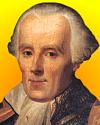
Died 5 Mar 1827 at age 77 (born 23 Mar 1749). quotes
Pierre Simon, Marquis de Laplace was a French mathematician, physicist, statistician and astronomer known for his mathematical analysis of the stability of the solar system (1773), alleviating Isaac Newton's concerns about perturbations between planets. He took an exact approach to science. He developed an explanation of surface tension of a liquid in terms of inter-molecular attractions, investigated capillary action and the speed of sound. He assisted Antoine Lavoisier (1783) investigating specific heat and heats of combustion, initiating the science of thermochemistry. He believed the solar system formed from a collapsing nebula. He contributed to the mathematics of probability and calculus, in which a differential equation is known by his name, and was involved in establishing the metric system.«
Pierre Simon, Marquis de Laplace was a French mathematician, physicist, statistician and astronomer known for his mathematical analysis of the stability of the solar system (1773), alleviating Isaac Newton's concerns about perturbations between planets. He took an exact approach to science. He developed an explanation of surface tension of a liquid in terms of inter-molecular attractions, investigated capillary action and the speed of sound. He assisted Antoine Lavoisier (1783) investigating specific heat and heats of combustion, initiating the science of thermochemistry. He believed the solar system formed from a collapsing nebula. He contributed to the mathematics of probability and calculus, in which a differential equation is known by his name, and was involved in establishing the metric system.«
Pierre-Simon Laplace, 1749-1827, by Charles Coulston Gillispie. - book suggestion.
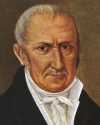
Died 5 Mar 1827 at age 82 (born 18 Feb 1745). quotes
Count Alessandro Giuseppe Antonio Anastasio Volta was an Italian physicist who invented the electric battery (1800), the first reliable, sustained supply of current. His voltaic pile used plates of two dissimilar metals and an electrolyte, a number of alternated zinc and silver disks, each separated with porous brine-soaked cardboard. Previously, only discharge of static electricity had been available, so his device enabled new uses of electricity. (Soon, with electrolysis, William Nicholson decomposed water, and Humphry Davy isolated potassium and other metals.) Volta also invented the electrophorus, the condenser and the electroscope. He contributed to meteorology, studied gases and discovered methane. The volt, a unit of electrical measurement, is named after him.« more
Count Alessandro Giuseppe Antonio Anastasio Volta was an Italian physicist who invented the electric battery (1800), the first reliable, sustained supply of current. His voltaic pile used plates of two dissimilar metals and an electrolyte, a number of alternated zinc and silver disks, each separated with porous brine-soaked cardboard. Previously, only discharge of static electricity had been available, so his device enabled new uses of electricity. (Soon, with electrolysis, William Nicholson decomposed water, and Humphry Davy isolated potassium and other metals.) Volta also invented the electrophorus, the condenser and the electroscope. He contributed to meteorology, studied gases and discovered methane. The volt, a unit of electrical measurement, is named after him.« more
Volta: Science and Culture in the Age of Enlightenment, by Giuliano Pancaldi. - book suggestion.
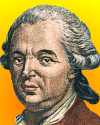
Died 5 Mar 1815 at age 80 (born 23 May 1734).
Franz Friedrich Anton Mesmer was a German physician whose system of therapeutics, known as mesmerism, was the forerunner of the modern practice of hypnotism. He spent his career offering this controversial therapy to wealthy aristocratic clients in several European capitals.
Franz Friedrich Anton Mesmer was a German physician whose system of therapeutics, known as mesmerism, was the forerunner of the modern practice of hypnotism. He spent his career offering this controversial therapy to wealthy aristocratic clients in several European capitals.
The Wizard from Vienna: Franz Anton Mesmer, by Vincent Buranelli. - book suggestion.
Died 5 Mar 1763 (born 1697). quotes
Scottish obstetrician who was the first to teach obstetrics and midwifery on a scientific basis. He was also first to establish rules for the safe use of forceps. Further, he separated obstetrics from surgery. For almost two decades, from 1720 to 1739, he practiced as a surgeon and apothecary in his home town of Lanark. He then moved to London, opened a pharmacy, and in 1741 shared his home with the Scottish anatomist, William Hunter. He commenced lecture-demonstrations to midwives and medical students on obstetrics. By offering his services free to poor women if his students were allowed to attend the childbirth, he established a trend to have medical trainees at a delivery. He favored the natural birth process, avoided any Casesarean section unless truly necessary, and used forceps with caution. Smellie retired to his hometown in 1759.«
Scottish obstetrician who was the first to teach obstetrics and midwifery on a scientific basis. He was also first to establish rules for the safe use of forceps. Further, he separated obstetrics from surgery. For almost two decades, from 1720 to 1739, he practiced as a surgeon and apothecary in his home town of Lanark. He then moved to London, opened a pharmacy, and in 1741 shared his home with the Scottish anatomist, William Hunter. He commenced lecture-demonstrations to midwives and medical students on obstetrics. By offering his services free to poor women if his students were allowed to attend the childbirth, he established a trend to have medical trainees at a delivery. He favored the natural birth process, avoided any Casesarean section unless truly necessary, and used forceps with caution. Smellie retired to his hometown in 1759.«
In 1991, U.S. patent No. 5,000,000 was issued for a process turning garbage into fuel to microbiologist Lonnie. O. Ingram of the University of Florida. His method depended on the creation of a new species of bacterium genetically formed from two other bacteria.
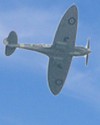
In 1936, the Supermarine Spitfire prototype made its maiden flight from Eastleigh aerodrome (now Southampton Airport), England. Its test-pilot, Capt. Joseph “Mutt” Summers, was reported to be impressed with its performance that his opinion was “Don't touch anything.” The propellor aircraft was designed by Reginald J. Mitchell, using an all-metal monocoque construction, and a high-powered liquid-cooled engine. It could climb to 33,000-ft in about nine minutes, was fast, and easy to manoeuver. Production began at Woolston, turning our the first Spitfires by mid-1938. In WW II, the role of these aircraft in the Battle of Britain (1940) is a high point in Spitfire history. By production end (20 Feb 1948), 12,000 had been built. The RAF kept them in service until 1954. Some privately-owned still remain air-worthy.«
The Spitfire Story, by Alfred Price. - book suggestion.
1884
In 1872, George Westinghouse Jr., received a U.S. patent for his “Improvement in Steam-Air Brakes” (No.124,405) for use on railroads. The brakes themselves were actuated by the pressure of compressed air held in a reservoir, whereas the steam in the title referred to their use on steam-powered locomotives. His original patent for his invention of the air brake was issued 13 Apr 1869 (No.88,929) for the use of compressed air fed from a reservoir tank along pipes to brake-cylinders and pistons, attached to each car. His improvement with patent 124,405 providing each car with an auxiliary air reservoir filled from the main reservoir and able to be used independently for each car. Air (vacuum) brakes have have since been further developed for big trucks, buses and amusement park rides, among other applications.«
A Life of George Westinghouse, by Henry G. Prout. - book suggestion.
In 1868, a stapler was patented in Birmingham, England by C.H. Gould (No. 765; provisional protection only). An abridgment of the specification for the stapling tool, published by the Patent Office (1904), described it as: “Through a short handle passes a rectangular metal tube, in which works a punch, the lower end of which guides the staple &c. into the work, a spring at the side of the handle holding the staple in position. The punch projects beyond the handle to the extent of the length of the staple, its top being fashioned as to receive the blow by which the staples are driven, and also to form a stop to prevent them from being overdriven; the blow is modified by a helical spring.”«

In 1830, limelight as a form of lighting was presented before scientists in a darkened 300-ft-long hall at the Tower of London, in a competitive trial with two other lamp designs. The Drummond Light brilliantly outshone the Argand burner and the Fresnel lamp. As invented by Thomas Drummond in 1816, limelight used jets of oxygen to assist heating solid lime (calcium oxide) to incandescence. More brilliant light was formed than by a gas flame alone. Limelight was adopted in lighthouses and for theatre stages. It was first used in 1837 to illuminate the stage of the Covent Garden Theatre. However, because it required constant tending, it was willingly superseded by subsequent inventions.«
more

Geocentric model
In 1616, Copernican theory was declared false and erroneous in The Decree of the Index signed by the Bishop of Albano, Cardinal of St. Cecilia. In it, the Holy Congregation of the Most Illustrious Lord Cardinals of the Catholic Church in Rome declared several books to contain heresies and errors that were to be prohibited from being printed in any language. In addition, the book by Nicolaus Copernicus, On the Revolutions of the Heavenly Spheres was held to teach a false doctrine, altogether contrary to the Holy Scripture, that the earth moves and the sun is motionless. No person was to be permitted to hold or teach the theory that the earth revolves around the sun. When Galileo subsequently violated the decree, he was put on trial and held under house arrest for the final eight years of his life.«
In 1590, Tycho Brahe discovered a comet in the constellation Pisces, the Fish. He had previously shown, by measurements of parallax for a comet he observed in 1577, that comets were further away than the Moon. This contradicted the teachings of Aristotle (who held comets to be a phenomenon within the atmosphere), and Brahe was the first to prove the truth.

Nicotiana tabacum
In 1558, the tobacco plant was introduced into Spain by the physician Francisco Fernandes, as a healing herb (herba panacea, sana sancta Indorum). Imiorum). He had been commissioned by Emperor Philip II to go to Mexico to investigate the products of the Empire. Cultivation in France may have started earlier, in 1556, with importation of seed from Brazil by André Thévet. He claimed to have cultivated it at Angoulême before Jean Nicot sent the seed to François II. Yet it is Nicot, the French ambassador to Lisbon, whose name survives in the word nicotine. The habit of smoking tobacco was initiated from England from the example Sir Francis Drake later brought back (27 Jul 1586) from the American Indians. Ralph Lane, the first governor of Virginia has been credited as the first English tobacco pipe smoker.«
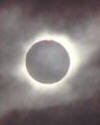
In 1223 BC, the oldest recorded eclipse occurred, according to one plausible interpretation of a date inscribed on a clay tablet retrieved from the ancient city of Ugarit, Syria (as it is now). This date is favoured by recent authors on the subject, although alternatively 3 May 1375 BC has also been proposed as plausible. Certainly by the 8th century BC, the Babylonians were keeping a systematic record of solar eclipses, and possibly by this time they may have been able to apply numerological rules to make fairly accurate predictions of the occurrence of solar eclipses. The first total solar eclipse reliably recorded by the Chinese occurred on 4 Jun 180 BC.«[Image: a modern photograph of a total solar eclipse.]




