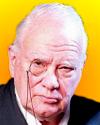
Born 4 Mar 1923; died 9 Dec 2012 at age 89. quotes
Sir Patrick Alfred Caldwell-Moore was an English astronomer, writer and broadcaster was educated at home due to childhood illness, from which time he acquired his interest in amateur observational astronomy. Moore is best known as the enthusiastic and knowledgeable presenter of the BBC TV programme The Sky at Night, which he began in 1957. With a half-century of broadcasts, this is the world's longest-running television series, and it did so with the original presenter. Moore has written over 60 books, including The Amateur Astronomer (1970), The A-Z of Astronomy (1986), and Mission to the Planets (1990). As an accomplished xylophone player, his interest in astronomy also shows in the title of one of his musical compositions: Perseus and Andromeda (1975).«
Sir Patrick Alfred Caldwell-Moore was an English astronomer, writer and broadcaster was educated at home due to childhood illness, from which time he acquired his interest in amateur observational astronomy. Moore is best known as the enthusiastic and knowledgeable presenter of the BBC TV programme The Sky at Night, which he began in 1957. With a half-century of broadcasts, this is the world's longest-running television series, and it did so with the original presenter. Moore has written over 60 books, including The Amateur Astronomer (1970), The A-Z of Astronomy (1986), and Mission to the Planets (1990). As an accomplished xylophone player, his interest in astronomy also shows in the title of one of his musical compositions: Perseus and Andromeda (1975).«
Born 4 Mar 1922; died 26 Oct 2017 at age 95.
Geoffrey Colin Tootill was an English computer scientist who, with Tom Kilburn, joined the project of Frederick Williams to design a computer memory. To test the memory, a computer nicknamed “Baby” was built, which was the world’s first stored-program computer. The machine used a novel method to store up to 32 instructions or numbers on a cathode ray tube display. On 21 June 1948, it finished its first successful test, spending 52 minutes, and about three and a half million arithmetic operations, to find the highest proper factor of 218.«
Geoffrey Colin Tootill was an English computer scientist who, with Tom Kilburn, joined the project of Frederick Williams to design a computer memory. To test the memory, a computer nicknamed “Baby” was built, which was the world’s first stored-program computer. The machine used a novel method to store up to 32 instructions or numbers on a cathode ray tube display. On 21 June 1948, it finished its first successful test, spending 52 minutes, and about three and a half million arithmetic operations, to find the highest proper factor of 218.«
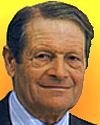
Born 4 Mar 1914; died 19 Jun 2005 at age 91.
English engineer who designed the Mulberry Harbours - the floating roadways and their anchors - which enabled landing of vehicles and equipment on the Normandy beaches following D-Day in WW II. Various prototypes designs from different engineers were tested in a howling gale at Cairn Head, Scotland. Whereas the rival designs failed, his lozenge-shaped bridge spans connected by spherical bearings survived days of stormy weather without breaking apart or washing away. The "Kite" style of anchors he devised used the force of currents to bury themselves more securely in the seafloor. After the war, he designed major port developments and projects for flood protection, around the world, from Aden to New Zealand.«
English engineer who designed the Mulberry Harbours - the floating roadways and their anchors - which enabled landing of vehicles and equipment on the Normandy beaches following D-Day in WW II. Various prototypes designs from different engineers were tested in a howling gale at Cairn Head, Scotland. Whereas the rival designs failed, his lozenge-shaped bridge spans connected by spherical bearings survived days of stormy weather without breaking apart or washing away. The "Kite" style of anchors he devised used the force of currents to bury themselves more securely in the seafloor. After the war, he designed major port developments and projects for flood protection, around the world, from Aden to New Zealand.«
Born 4 Mar 1914; died 16 Jan 2000 at age 85. quotes
Robert Rathbun Wilson was an American physicist who was the first director of Fermilab. From 1967, he led the design and construction of Fermilab (the Fermi National Accelerator Laboratory) near Chicago, Illinois. He also improved the environment by restoring prairie at the site. It began operating in 1972 with the world's most powerful particle accelerator. With later improvements, it retained that status for well over three decades until it was superceded by the LHC (Large Hadron Collider) at the CERN laboratory in Geneva, Switzerland. Wilson is remembered for his justification of the needed financing at a Senate hearing in 1969, where he said “It has nothing to do with defending our country, except to make it worth defending.” He resigned in 1978 because he did not believe the government was giving it sufficient funding for its research mission.«
Robert Rathbun Wilson was an American physicist who was the first director of Fermilab. From 1967, he led the design and construction of Fermilab (the Fermi National Accelerator Laboratory) near Chicago, Illinois. He also improved the environment by restoring prairie at the site. It began operating in 1972 with the world's most powerful particle accelerator. With later improvements, it retained that status for well over three decades until it was superceded by the LHC (Large Hadron Collider) at the CERN laboratory in Geneva, Switzerland. Wilson is remembered for his justification of the needed financing at a Senate hearing in 1969, where he said “It has nothing to do with defending our country, except to make it worth defending.” He resigned in 1978 because he did not believe the government was giving it sufficient funding for its research mission.«
Born 4 Mar 1907; died 23 Sep 1966 at age 59.
Soviet physicist.
Soviet physicist.
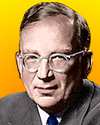
Born 4 Mar 1904; died 19 Aug 1968 at age 64. quotes
Russian-born American nuclear physicist, cosmologist and writer who was one of the foremost advocates of the big-bang theory, which describes the origin of the universe as a colossal explosion that took place billions of years ago. In 1954, he expanded his interests into biochemistry and his work on deoxyribonucleic acid (DNA) made a basic contribution to modern genetic theory.
Russian-born American nuclear physicist, cosmologist and writer who was one of the foremost advocates of the big-bang theory, which describes the origin of the universe as a colossal explosion that took place billions of years ago. In 1954, he expanded his interests into biochemistry and his work on deoxyribonucleic acid (DNA) made a basic contribution to modern genetic theory.
Mr Tompkins in Paperback, by George Gamow. - book suggestion.
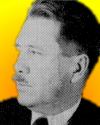
Born 4 Mar 1903; died 19 Feb 1983 at age 79.
American immunochemist, who with his wife Lyle, during the 1930's, made a worldwide survey of the distribution of blood types. He discovered that blood groups are inherited and not influenced by environment. By genetic analysis of the blood groups that human races are populations that differ in the difference of their alleles. On this basis, he divided the world population into 13 geographically distinct races with different blood group gene profiles. Later, Boyd discovered lectins, which are antibody-like proteins, in plants. He also studied the blood groups of mummies.
American immunochemist, who with his wife Lyle, during the 1930's, made a worldwide survey of the distribution of blood types. He discovered that blood groups are inherited and not influenced by environment. By genetic analysis of the blood groups that human races are populations that differ in the difference of their alleles. On this basis, he divided the world population into 13 geographically distinct races with different blood group gene profiles. Later, Boyd discovered lectins, which are antibody-like proteins, in plants. He also studied the blood groups of mummies.
Born 4 Mar 1895; died 5 Nov 1970 at age 75.
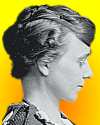
Margaret Dorothy Foster was an American chemist who, just three days after graduating, joined the U.S. Geological Survey in 1918 as their first female chemist. Her focus for years was analysis of natural waters: surface waters, hot springs and ground waters. She wrote papers on new methods for quantitative analysis of manganese, boron, sulphate and fluoride in water. Foster also studied the ground waters of the South Atlantic Coastal Plain and in the Houston-Galveston area in Texas. During WW II, she was recruited for the Manhattan Project, where she worked on new quantitative methods of analysis for uranium and for thorium. After the war, she turned her attention to the geochemistry of the platy minerals: clays, micas, chlorites and glauconites.«
Margaret Dorothy Foster was an American chemist who, just three days after graduating, joined the U.S. Geological Survey in 1918 as their first female chemist. Her focus for years was analysis of natural waters: surface waters, hot springs and ground waters. She wrote papers on new methods for quantitative analysis of manganese, boron, sulphate and fluoride in water. Foster also studied the ground waters of the South Atlantic Coastal Plain and in the Houston-Galveston area in Texas. During WW II, she was recruited for the Manhattan Project, where she worked on new quantitative methods of analysis for uranium and for thorium. After the war, she turned her attention to the geochemistry of the platy minerals: clays, micas, chlorites and glauconites.«
Born 4 Mar 1881; died 5 Sep 1948 at age 67.
Richard Chace Tolman was an American physicist and chemist who demonstrated that electrons are the charge-carrying entities in the flow of electricity, and also made a measurement of its mass. During the Manhattan Project of WW II, he was the chief scientific adviser to Brig. General Leslie Groves, the head of military affairs overseeing the development of the atomic bomb. After the war he was adviser to the U.S. representative to the United Nations Atomic Energy Commission.
Richard Chace Tolman was an American physicist and chemist who demonstrated that electrons are the charge-carrying entities in the flow of electricity, and also made a measurement of its mass. During the Manhattan Project of WW II, he was the chief scientific adviser to Brig. General Leslie Groves, the head of military affairs overseeing the development of the atomic bomb. After the war he was adviser to the U.S. representative to the United Nations Atomic Energy Commission.
Born 4 Mar 1877; died 27 Jul 1963 at age 86.
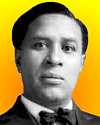
Black-American inventor and businessman who established the Cleveland Call newspaper (1920), invented a hair straightening cream, woman's hat fastener, an automobile clutch, a safety hood breathing device (1912) which he improved as a gas mask used by some soldiers in WW I, and a traffic signal. By age 30, he had spent time working as a handyman and taught himself enough about repairing sewing machines to start a repair business. Two years later, he started a tailoring shop with 32 employees. He developed and was successful selling G.A. Morgan Hair Refining Cream to straighten hair. When he invented a traffic signal in 1922 (not the red-yellow-green lights type), several other traffic signals had already been previously patented by other inventors. He was nearly blind from 1943 due to glaucoma.«
Black-American inventor and businessman who established the Cleveland Call newspaper (1920), invented a hair straightening cream, woman's hat fastener, an automobile clutch, a safety hood breathing device (1912) which he improved as a gas mask used by some soldiers in WW I, and a traffic signal. By age 30, he had spent time working as a handyman and taught himself enough about repairing sewing machines to start a repair business. Two years later, he started a tailoring shop with 32 employees. He developed and was successful selling G.A. Morgan Hair Refining Cream to straighten hair. When he invented a traffic signal in 1922 (not the red-yellow-green lights type), several other traffic signals had already been previously patented by other inventors. He was nearly blind from 1943 due to glaucoma.«
Born 4 Mar 1877; died 13 Jul 1934 at age 57.
Robert Fritz Graebner was a German ethnologist who advanced the theory of the Kulturkreise, or culture complex, which postulated diffusions of primitive culture spheres derived from a single archaic type. His scheme launched the culture-historical school of ethnology in Europe and stimulated much field research.
Robert Fritz Graebner was a German ethnologist who advanced the theory of the Kulturkreise, or culture complex, which postulated diffusions of primitive culture spheres derived from a single archaic type. His scheme launched the culture-historical school of ethnology in Europe and stimulated much field research.
Born 4 Mar 1864; died 28 Jul 1940 at age 76.
American marine engineer who used the first ship-model testing facility in the U.S. to evaluate basic principles in the design of ships. The Experimental Model Basin built at the Washington (D.C.) Navy Yard (1899) enabled experimentation on the shape of a ship's hull that affect its motion against the resistance of the water. He developed the internationally known Taylor Standard Series Method (1910) that enabled an estimation of water resistance from the planned dimensions before a ship was built.
American marine engineer who used the first ship-model testing facility in the U.S. to evaluate basic principles in the design of ships. The Experimental Model Basin built at the Washington (D.C.) Navy Yard (1899) enabled experimentation on the shape of a ship's hull that affect its motion against the resistance of the water. He developed the internationally known Taylor Standard Series Method (1910) that enabled an estimation of water resistance from the planned dimensions before a ship was built.
Born 4 Mar 1862; died 8 Oct 1940 at age 78.
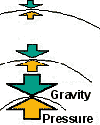
Swiss astrophysicist and mathematician who wrote Gaskugeln (Gas Spheres, 1907), giving a mathematical model of stellar structure as the expansion and compression of gas spheres, wherein the forces of gravity and gas pressure are in equilibrium. He expanded on earlier work by J. H. Lane (1869) and A. Ritter (1878-83) who first derived equations describing stars as gaseous chemical, spherical bodies held together by their own gravity and obeying the known gas laws of thermodynamics. For four decades, the Lane-Emden equation was the foundation of theoretical work on the structure of stars: their central temperatures and pressures, masses, and equilibria. Emden also devised a hypothesis, no longer taken seriously, to explain sunspots.«
Swiss astrophysicist and mathematician who wrote Gaskugeln (Gas Spheres, 1907), giving a mathematical model of stellar structure as the expansion and compression of gas spheres, wherein the forces of gravity and gas pressure are in equilibrium. He expanded on earlier work by J. H. Lane (1869) and A. Ritter (1878-83) who first derived equations describing stars as gaseous chemical, spherical bodies held together by their own gravity and obeying the known gas laws of thermodynamics. For four decades, the Lane-Emden equation was the foundation of theoretical work on the structure of stars: their central temperatures and pressures, masses, and equilibria. Emden also devised a hypothesis, no longer taken seriously, to explain sunspots.«
Born 4 Mar 1859; died 31 Dec 1905 at age 46.
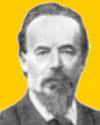
Russian physicist and electrical engineer acclaimed in Russia as the inventor of radio. He became an instructor at the Russian Navy's Torpedo School. Learning of Hertz's work, in 1895 Popov constructed an apparatus that could register electrical disturbances due to lightning. He applied it for receiving man-made signals. In 1896, he demonstrated a radiotelegraph system which transmitted Morse code. In Feb 1904, Popov first demonstrated radio transmission of the human voice. His invention was first used by the Russian navy. However, Russia's first radio factory was established by the Marconi company.
Russian physicist and electrical engineer acclaimed in Russia as the inventor of radio. He became an instructor at the Russian Navy's Torpedo School. Learning of Hertz's work, in 1895 Popov constructed an apparatus that could register electrical disturbances due to lightning. He applied it for receiving man-made signals. In 1896, he demonstrated a radiotelegraph system which transmitted Morse code. In Feb 1904, Popov first demonstrated radio transmission of the human voice. His invention was first used by the Russian navy. However, Russia's first radio factory was established by the Marconi company.
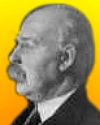
Born 4 Mar 1854; died 23 Mar 1945 at age 91.
Sir (William) Napier Shaw was an English meteorologist who applied his training in mathematics. He studied the upper atmosphere, using instruments carried by kites and high-altitude balloons. He measured (1906) the movement of air in two anti-cyclones, finding descent rates of 350 and 450 metres per day. He calculated the reduction in pressure due to a certain depression to correspond to the removal of two million million tons of air. He introduced the millibar unit for measurement of air pressure (1000 millibar = 1 bar = 1 standard atmosphere) and the tephigram to illustrate the temperature of a vertical profile of the atmosphere. He also co-authored an early work on atmospheric polluiton, The Smoke Problem of Great Cities (1925).«
Sir (William) Napier Shaw was an English meteorologist who applied his training in mathematics. He studied the upper atmosphere, using instruments carried by kites and high-altitude balloons. He measured (1906) the movement of air in two anti-cyclones, finding descent rates of 350 and 450 metres per day. He calculated the reduction in pressure due to a certain depression to correspond to the removal of two million million tons of air. He introduced the millibar unit for measurement of air pressure (1000 millibar = 1 bar = 1 standard atmosphere) and the tephigram to illustrate the temperature of a vertical profile of the atmosphere. He also co-authored an early work on atmospheric polluiton, The Smoke Problem of Great Cities (1925).«
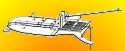
American inventor and manufacturer of pins. After 20 years as a carpenter, he moved to England where he perfected and patented in London a machine to make wrought-iron nails (1835), and the same year devised and patented a machine for making pins with solid heads. Shortly thereafter, he returned to the U.S. and sought a partner. By 1840, the pin-making firm of Slocum and Jillson was manufacturing at Poughkeepsie, N. Y. Meanwhile the question of packaging pins held Slocum's attention, and on 30 Sept 1841, he obtained patent No. 2,275 for a machine for sticking pins in paper. Until he retired, Slocum continued in the pin manufacturing business and improved his pin sticking machine.[Image: original patent diagram of pin sticking machine]
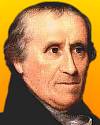
Age 79
Born 4 Mar 1754; died 2 Oct 1846 at age 92. quotes
American physician who pioneered smallpox vaccination and fostered an aggressive campaign to inoculate Americans against smallpox. He studied the researches of English physician Edward Jenner and followed with his own experiments. On 8 Jul 1800, Waterhouse introduced Edward Jenner's method of vaccination into America by inoculating his five-year-old son, Daniel Oliver, and a household servant with vaccine obtained from England. Vaccinations of three more Waterhouse children and another servant soon followed. Whereas Dr. Zabdiel Boylston and others had previously used inoculation in the U.S., Waterhouse was the American physician who established it as a general practice.«
American physician who pioneered smallpox vaccination and fostered an aggressive campaign to inoculate Americans against smallpox. He studied the researches of English physician Edward Jenner and followed with his own experiments. On 8 Jul 1800, Waterhouse introduced Edward Jenner's method of vaccination into America by inoculating his five-year-old son, Daniel Oliver, and a household servant with vaccine obtained from England. Vaccinations of three more Waterhouse children and another servant soon followed. Whereas Dr. Zabdiel Boylston and others had previously used inoculation in the U.S., Waterhouse was the American physician who established it as a general practice.«
The Life and Scientific and Medical Career of Benjamin Waterhouse, by I. Bernard Cohen. - book suggestion.
Born 4 Mar 1394; died 13 Nov 1460 at age 66.
Portuguese prince and navigator.
Portuguese prince and navigator.

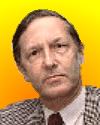
Died 4 Mar 2011 at age 85 (born 24 Nov 1925).
Dutch engineer and physicist who, with Italian physicist Carlo Rubbia, discovered the W particle and the Z particle by colliding protons and antiprotons, for which both men shared the Nobel Prize for Physics. These subatomic particles (units of matter smaller than an atom) transmit the weak nuclear force, one of four fundamental forces in nature. The discovery supported the unified electroweak theory put forward in the 1970s. Working at CERN in Switzerland, Van der Meer improved the design of particle accelerators used produce collisions between beams of subatomic particles. He invented a device that would monitor and adjust the particle beam with correcting magnetic fields by a system of “kickers” placed around the accelerator ring.
Dutch engineer and physicist who, with Italian physicist Carlo Rubbia, discovered the W particle and the Z particle by colliding protons and antiprotons, for which both men shared the Nobel Prize for Physics. These subatomic particles (units of matter smaller than an atom) transmit the weak nuclear force, one of four fundamental forces in nature. The discovery supported the unified electroweak theory put forward in the 1970s. Working at CERN in Switzerland, Van der Meer improved the design of particle accelerators used produce collisions between beams of subatomic particles. He invented a device that would monitor and adjust the particle beam with correcting magnetic fields by a system of “kickers” placed around the accelerator ring.
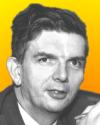
Died 4 Mar 1997 at age 80 (born 6 May 1916).
American physicist who worked in such wide-ranging fields as microwave physics, cosmology, and relativity. As an inspired theorist and a successful experimentalist, his unifying theme was the application of powerful and scrupulously controlled experimental methods to issues that really matter. He also made a number of significant contributions to radar technology and to the field of atomic physics. His visualization of an oscillating universe stimulated the discovery of the cosmic microwave background, the most direct evidence that our universe really did expand from a dense state. A key instrument in measurements of this fossil of the Big Bang is the microwave radiometer he invented. His patents ranged from clothes dryers to lasers.
American physicist who worked in such wide-ranging fields as microwave physics, cosmology, and relativity. As an inspired theorist and a successful experimentalist, his unifying theme was the application of powerful and scrupulously controlled experimental methods to issues that really matter. He also made a number of significant contributions to radar technology and to the field of atomic physics. His visualization of an oscillating universe stimulated the discovery of the cosmic microwave background, the most direct evidence that our universe really did expand from a dense state. A key instrument in measurements of this fossil of the Big Bang is the microwave radiometer he invented. His patents ranged from clothes dryers to lasers.
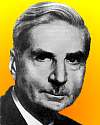
Died 4 Mar 1976 at age 89 (born 23 Jul 1886).
Swiss-born German physicist whose research in solid-state physics led to development of a number of electronic devices. He discovered the Schottky effect, an irregularity in the emission of thermions in a vacuum tube and invented the screen-grid tetrode tube (1915). The Schottky diode is a high speed diode with very little junction capacitance (also known as a "hot-carrier diode" or a "surface-barrier diode.") It uses a metal-semiconductor junction as a Schottky barrier, rather than the semiconductor-semiconductor junction of a conventional diode.«
Swiss-born German physicist whose research in solid-state physics led to development of a number of electronic devices. He discovered the Schottky effect, an irregularity in the emission of thermions in a vacuum tube and invented the screen-grid tetrode tube (1915). The Schottky diode is a high speed diode with very little junction capacitance (also known as a "hot-carrier diode" or a "surface-barrier diode.") It uses a metal-semiconductor junction as a Schottky barrier, rather than the semiconductor-semiconductor junction of a conventional diode.«
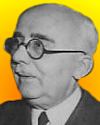
Died 4 Mar 1963 at age 86 (born 5 Mar 1876).
French engineer whose invention (1907) made the first telephoto transmission by wire, from Paris to Lyon to Bordeaux and back to Paris. He further developed the Belinograph able to make the first transatlantic radio facsimile transmission, on 4 Aug 1921, between Annapolis, Md., and Belin's laboratories at La Malmaison, France. His invention scanned an image on a cylinder reflecting a light beam onto a photoelectric cell which converted varying reflected light intensity into electrical impulses. His equipment was adopted in Britain in 1928, and used almost exclusively by European news media in the 1930s -'40s, when the term "Belino" came into general use for all kinds of picture transmission. By 1923, he had dabbled in ideas for television.« more
French engineer whose invention (1907) made the first telephoto transmission by wire, from Paris to Lyon to Bordeaux and back to Paris. He further developed the Belinograph able to make the first transatlantic radio facsimile transmission, on 4 Aug 1921, between Annapolis, Md., and Belin's laboratories at La Malmaison, France. His invention scanned an image on a cylinder reflecting a light beam onto a photoelectric cell which converted varying reflected light intensity into electrical impulses. His equipment was adopted in Britain in 1928, and used almost exclusively by European news media in the 1930s -'40s, when the term "Belino" came into general use for all kinds of picture transmission. By 1923, he had dabbled in ideas for television.« more
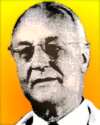
Died 4 Mar 1957 at age 73 (born 19 Mar 1883).
Evarts Ambrose Graham was an American surgeon who performed the first one-stage subtotal removal of a lung (pneumonectomy) to treat lung cancer. On 5 Apr 1933, at Barnes Hospital, St. Louis, Missouri, he operated on a fellow physician. Because the cancer involved more than one lobe, a routine removal of just one lobe was not adequate. Graham used mass ligation to remove (almost) the whole lung. It was a “subtotal” pneumonectomy because some tissue was retained in the stump and utilized for burying the open ends of the bronchi. Seven ribs were removed to permit the soft tissues of the chest wall to fill the resulting cavity. The patient recovered, was cured of the disease, and lived a full life. Graham devoted many years to the study of lung cancer and its link to cigarette smoking.«
Evarts Ambrose Graham was an American surgeon who performed the first one-stage subtotal removal of a lung (pneumonectomy) to treat lung cancer. On 5 Apr 1933, at Barnes Hospital, St. Louis, Missouri, he operated on a fellow physician. Because the cancer involved more than one lobe, a routine removal of just one lobe was not adequate. Graham used mass ligation to remove (almost) the whole lung. It was a “subtotal” pneumonectomy because some tissue was retained in the stump and utilized for burying the open ends of the bronchi. Seven ribs were removed to permit the soft tissues of the chest wall to fill the resulting cavity. The patient recovered, was cured of the disease, and lived a full life. Graham devoted many years to the study of lung cancer and its link to cigarette smoking.«
Evarts A. Graham: The Life, Lives, and Times of the Surgical Spirit of St. Louis, by C. Barber Mueller. - book suggestion.
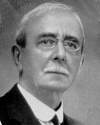
Died 4 Mar 1952 at age 94 (born 27 Nov 1857). quotes
English neurophysiologist who won (with Edgar Adrian) the Nobel Prize for Physiology or Medicine in 1932 for research into the function of the neuron. Sherrington proposed the key concept of nociception: pain as the evolved response to a potentially harmful, "noxious" stimulus in 1898. In his book, The Integrative Action of the Nervous System, (1906) he compared various sensory stimuli (such as those which normally elicit pain or nociception vs. those evoking the scratch reflect) competing in the production of various behavioral responses using the same motor pathways, in what he called "the struggle between dissimilar arcs for mastery over their final common path."
English neurophysiologist who won (with Edgar Adrian) the Nobel Prize for Physiology or Medicine in 1932 for research into the function of the neuron. Sherrington proposed the key concept of nociception: pain as the evolved response to a potentially harmful, "noxious" stimulus in 1898. In his book, The Integrative Action of the Nervous System, (1906) he compared various sensory stimuli (such as those which normally elicit pain or nociception vs. those evoking the scratch reflect) competing in the production of various behavioral responses using the same motor pathways, in what he called "the struggle between dissimilar arcs for mastery over their final common path."
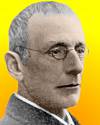
Died 4 Mar 1951 at age 89 (born 3 Dec 1861). quotes
British geologist who coined the name mélange for a certain form of large-scale breccia, a metamorphic rock formed from the grinding and mixing of material at a downward moving tectonic plate in a subduction zone. His magnum opus was the now-classic two-volume The Geology of Anglesey (1919). It was the result of his nearly 25-year devotion to producing a detailed survey of the island. Anglesey lies off the NW coast of Wales with an area of 276 sq. mi. (714 km²). His career began with the Geological Survey in Scotland, which he left in 1895 to begin his chosen study of Anglesey.«
British geologist who coined the name mélange for a certain form of large-scale breccia, a metamorphic rock formed from the grinding and mixing of material at a downward moving tectonic plate in a subduction zone. His magnum opus was the now-classic two-volume The Geology of Anglesey (1919). It was the result of his nearly 25-year devotion to producing a detailed survey of the island. Anglesey lies off the NW coast of Wales with an area of 276 sq. mi. (714 km²). His career began with the Geological Survey in Scotland, which he left in 1895 to begin his chosen study of Anglesey.«

Died 4 Mar 1944 at age 77 (born 1 Jan 1867).
British technologist who with his brother Francis Edward Elmore, jointly developed flotation processes to separate valuable ore, such as copper, from the gangue (worthless rock) with which it is associated when mined. In 1898, they obtained a patent for the first practical equipment (British patent No. 21,948). Pulverized ore is mixed with water and brought into contact with thick oil. The oil entraps the metallic constituents, which are afterwards separated, and gangue passed away with the water. They installed their equipment at mines in north Wales, northern England, and at the Broken Hill lead and zinc mines in Australia. Today, flotation methods remain vital in the mining industry, processing millions of tons of ores each year. more
British technologist who with his brother Francis Edward Elmore, jointly developed flotation processes to separate valuable ore, such as copper, from the gangue (worthless rock) with which it is associated when mined. In 1898, they obtained a patent for the first practical equipment (British patent No. 21,948). Pulverized ore is mixed with water and brought into contact with thick oil. The oil entraps the metallic constituents, which are afterwards separated, and gangue passed away with the water. They installed their equipment at mines in north Wales, northern England, and at the Broken Hill lead and zinc mines in Australia. Today, flotation methods remain vital in the mining industry, processing millions of tons of ores each year. more
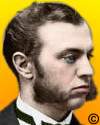
Died 4 Mar 1927 at age 81 (born 10 Feb 1846). quotes
American chemist who codiscovered saccharin. He taught chemistry at Johns Hopkins University from 1876 (where he became its second president 1901-13). He introduced advanced laboratory instruction using teaching methods he had learned in Germany under Rudolph Fittig. Remsen specialized in the benzene ring and related groups. With Constantin Fahlberg, a student working under his direction, he first synthesized orthobenzoyl sulfimide (1879). Fahlberg accidentally discovered its intensely sweet taste by touching his fingers to his lips while unknowingly having a few grains on them. The compound was patented and marketed under the trade name “saccharin.” more
American chemist who codiscovered saccharin. He taught chemistry at Johns Hopkins University from 1876 (where he became its second president 1901-13). He introduced advanced laboratory instruction using teaching methods he had learned in Germany under Rudolph Fittig. Remsen specialized in the benzene ring and related groups. With Constantin Fahlberg, a student working under his direction, he first synthesized orthobenzoyl sulfimide (1879). Fahlberg accidentally discovered its intensely sweet taste by touching his fingers to his lips while unknowingly having a few grains on them. The compound was patented and marketed under the trade name “saccharin.” more
The Life of Ira Remsen, by Frederick H. Getman. - book suggestion.
Died 4 Mar 1925 at age 82 (born 27 Jan 1843).
English psychologist who had widespread influence on the practice and teaching of psychology in Great Britain, resulting particularly from his influential article (1886) in the ninth edition of the Encyclopaedia Britannica. Therein, he defined psychology's principal task as "to analyze and trace the development of individual experience as it is for the experiencing individual." For Ward, the mind is an active participant in experience. What is presented is not an aggregate of things which produce corresponding mental atoms, but a varying continuum to which the mind attends and selects. In 1904, The British Journal of Psychology began publication, edited by James Ward and W.H.R. Rivers.«
English psychologist who had widespread influence on the practice and teaching of psychology in Great Britain, resulting particularly from his influential article (1886) in the ninth edition of the Encyclopaedia Britannica. Therein, he defined psychology's principal task as "to analyze and trace the development of individual experience as it is for the experiencing individual." For Ward, the mind is an active participant in experience. What is presented is not an aggregate of things which produce corresponding mental atoms, but a varying continuum to which the mind attends and selects. In 1904, The British Journal of Psychology began publication, edited by James Ward and W.H.R. Rivers.«
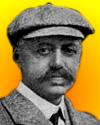
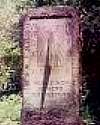
English builder who invented Daylight Saving Time. He claimed he had the idea while taking an early summer morning ride in Petts Wood near to his home in Chislehurst, London. He observed that many blinds were still down, although there was already good daylight, yet many made no use of it. He used his wealth as a prominent home builder to campaign for a scheme of adjusting clocks with the season and published a pamphlet in 1907. His original idea was to make four weekly changes of 20-mins each, for a total of 80-mins. The first Daylight Saving Bill, proposing a single one hour at the change of season failed in 1908. After his death, the idea was adopted during WW I for wartime fuel savings. A memorial was erected in Petts Wood.[Image right: Sundial on the Willett memorial tin Petts Wood.]
Seize the Daylight: The Curious and Contentious Story of Daylight Savings Time, by David Prerau. - book suggestion.
Died 4 Mar 1910 at age 53 (born 12 Jan 1857).
Swedish physicist, son of Anders Ångström, who invented an electric compensation pyrheliometer and other devices for infra-red photography. With these, he studied the sun's heat radiation.«
Swedish physicist, son of Anders Ångström, who invented an electric compensation pyrheliometer and other devices for infra-red photography. With these, he studied the sun's heat radiation.«
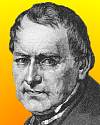
Died 4 Mar 1853 at age 78 (born 26 Apr 1774). quotes
Baron Christian Leopold von Buch was a German geologist, paleontologist and geographer who took geological research trips in Europe on which he travelled as far north as Lapland. He investigated Vesuvius with his life-long friend Alexander von Humboldt, and examined the huge craters of the Canary Islands. His broad interests in geology also included the study of fossils, stratigraphy, and in particular the Jurassic system.«[EB gives birth date as 26 Apr 1774. DSB gives 25 Apr 1774.] more
Baron Christian Leopold von Buch was a German geologist, paleontologist and geographer who took geological research trips in Europe on which he travelled as far north as Lapland. He investigated Vesuvius with his life-long friend Alexander von Humboldt, and examined the huge craters of the Canary Islands. His broad interests in geology also included the study of fossils, stratigraphy, and in particular the Jurassic system.«[EB gives birth date as 26 Apr 1774. DSB gives 25 Apr 1774.] more
Travels through Norway and Lapland during the years 1806, 1807, and 1808, by Leopold Von Buch. - book suggestion.
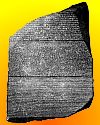
Rosetta Stone
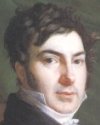
French Egyptologist who established scientific methods in archaeology and pioneered in deciphering Egyptian hieroglyphics. He was well prepared, with a genius for languages, having by age 13 mastered Latin, Greek, Arabic, Syrian, and Chaldean and later Hebrew, Persian, Chinese, and Coptic, an old Egyptian language written in Greek letters. He started interpreting Egyptian hieroglyphics, building on the earlier efforts of Thomas Young. Champollion succeeded in deciphering the Rosetta Stone, a stone slab unearthed (1799) at Rosetta (near Alexandria, Egypt) inscribed in two languages and three scripts: Egyptian hieroglyphic and demotic, and Greek, each recording.a decree (196 BC) of Ptolemy V Epiphanes (reigned 205-180).«
The Rosetta Stone: The Story of the Decoding of Hieroglyphics, by Robert Sole, et al. - book suggestion.
In 1991, the "Rotoblator," an artery cleaning tool, was announced by Dr. Maurice Buchbinder at the annual meeting of the American College of Cardiology. Using a diamond head rotating at 200,000 rpm on a small shaft (only nine thousandths of an inch) inserted in a clogged artery, obstructions could be successfully removed in about 95% of cases. This procedure is particularly useful for hardened, calcified blockages. The blockage is pulverized to particles smaller than the size of a red blood cell - particles that harmlessly exit the bloodstream. The device, dubbed a Rotablator, won Food and Drug Administration approval in 1993, and is manufactured by Heart Technology Inc. of Bellevue, Wash.
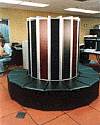
In 1977, the first Freon-cooled Cray-1 supercomputer, costing $19,000,000, was shipped to Los Alamos Laboratories, NM, and was used to help the defense industry create sophisticated weapons systems. This system had a peak performance of 133 megaflops and used the newest technology, integrated circuits and vector register technology. The Cray-1 looked like no other computer before or since. It was a cylindrical machine 7 feet tall and 9 feet in diameter, weighed 30 tons and required its own electrical substation to provide it with power (an electric bill around $35,000/month). The inventor, Seymour Cray, died 5 Oct 1996 in an auto accident. His innovations included vector register technology, cooling technologies, and magnetic amplifiers.

In 1967, the first North Sea gas was piped ashore to BP's Easington terminal on the East Riding of Yorkshire coast of England. Thus this year also saw the beginning of the ten year national Conversion programme which involved the physical conversion of every appliance in the country from coal gas to natural gas. The first surveys in the North Sea had begun in 1962. The West Sole field was discovered in September 1965. The field lies 70 kilometres off the Humberside coast, in approximately 28 metres of water. Drilling of the production wells began in July 1966, and in March 1967 the first North Sea natural gas was piped ashore. Within ten years, the West Sole field was supplying almost all of Britain's gas.
-1965
In 1962, the Atomic Energy Commission announced that the first atomic power plant in Antarctica, the PM-3A, Naval Nuclear Power Unit, was in operation at McMurdo Sound. Between 1 Jan and 1 Mar 1962, the prefabricated plant was assembled on Observation Hill by a team of contractors and military technicians. This source of power was initially chosen when engineers realized that a fission power plant could operate for years without new fuel. In 1970, management and funding of all Antarctic operations was consolidated by President Nixon under the National Science Foundation. The NSF was to take over the funding of PM-3A as of 1 Jul 1972, but it was decommissioned that year, and replaced with a diesel electricity generator.
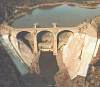
In 1930, the Coolidge Dam on Gila River in Arizona was dedicated by President Calvin Coolidge. Built 31 miles east of Globe, Ariz., on the San Carlos Indian Reservation, it irrigates 100,000 acres. Coolidge Dam was designed and constructed, and is owned and operated, by the Bureau of Indian Affairs (BIA), and was contructed between 1924 and 1928. The dam used 200,000 cu yd of concrete and consists of three domes, which are supported by massive buttresses on 100-foot centers. It rises 249 feet, with a crest length of 580 feet. Two uncontrolled ogee crest spillways are concrete lined and located on each abutment.

In 1890, the Forth Railway Bridge was opened, spanning the Forth river between Edinburgh and Dundee, Scotland. It remains the main railway link over the “Forth,” crossed by about 200 trains a day.It was built between 1882 and 1890 for the Forth Bridge Railway Company, a consortium set up by the North British, North Eastern, Great Northern and Midland Railways. Pioneering the use of mild steel (in place of wrought iron) in large structures, it was designed by John Fowler and Benjamin Baker and built by Tancred Arrol and Co. Its total length being 8300-ft is comprised of 3 double cantilevers and high approach girders.
more
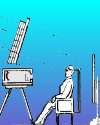
In 1840, the world’s first commercial photography studio was opened in New York City by John Johnson and Alexander S. Wolcott. On 6 Oct 1839, Johnson had taken to Wolcott’s residence a full description of Daguerre’s discovery. That afternoon they worked to produce a camera and plates. The same day, they exposed and processed their first Daguerreotypes. Johnson later wrote that they ended the day “little dreaming or knowing into what a labyrinth such a beginning was hastening us.” Over the next few months, they experimented in various aspects of the construction of the camera, lighting, and using persons as subjects. By 8 May 1840, Wolcott had patented a camera using a mirror reflector to correct the reversed image from the usual single lens.
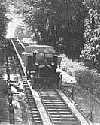
In 1826, the first chartered railroad in the U.S. was chartered as the Granite Railway in Quincy, Mass. It was organized to transport granite blocks from quarries in the Blue Hills that were used to build the Bunker Hill monument. The Granite Railway was an inclined plane built to carry granite to Neponset wharf and thence to Charlestown via barges for construction of the Bunker Hill Monument.The Granite Railway also carried stone to Boston Harbor for shipping, as well as for the Minot's Ledge lighthouse at the entrance to Boston Harbor. The three-mile track was powered by gravity in one direction and beast-powered in the other. A pioneer in the American railroad industry, Gridley Bryant, engineered its design and construction and many of his inventions are still in use today. The Railway is a Civil Engineering Landmark.




