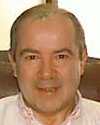
Born 30 Sep 1943.
German biochemist who received the 1988 Nobel Prize for Chemistry, along with Hartmut Michel and Robert Huber, for the determination of the three-dimensional structure of certain proteins that are essential to photosynthesis. Using X-ray crystallography (1982-85), they unravelled the full details of how a membrane-bound protein is built up, revealing the structure of the molecule atom by atom. The protein was taken from a bacterium which, like green plants and algae, uses light energy from the sun to build organic substances. Photosynthesis in bacteria is simpler than in algae and higher plants, but the work has led to increased understanding of photosynthesis in those organisms as well.
German biochemist who received the 1988 Nobel Prize for Chemistry, along with Hartmut Michel and Robert Huber, for the determination of the three-dimensional structure of certain proteins that are essential to photosynthesis. Using X-ray crystallography (1982-85), they unravelled the full details of how a membrane-bound protein is built up, revealing the structure of the molecule atom by atom. The protein was taken from a bacterium which, like green plants and algae, uses light energy from the sun to build organic substances. Photosynthesis in bacteria is simpler than in algae and higher plants, but the work has led to increased understanding of photosynthesis in those organisms as well.
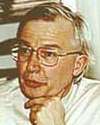
Born 30 Sep 1939.
French chemist who shared (with Charles J. Pedersen and Donald J. Cram) the 1987 Nobel Prize for Chemistry, for his contribution to the laboratory synthesis of molecules that mimic the vital chemical functions of molecules in living organisms. Such molecules have a highly selective, structure specific interaction. These molecules can “recognize”each other and choose with which other molecules they will form complexes. Of low molecular weight and with very special properties, the molecules in these compounds bind in a selective manner, like a key fits a lock.
French chemist who shared (with Charles J. Pedersen and Donald J. Cram) the 1987 Nobel Prize for Chemistry, for his contribution to the laboratory synthesis of molecules that mimic the vital chemical functions of molecules in living organisms. Such molecules have a highly selective, structure specific interaction. These molecules can “recognize”each other and choose with which other molecules they will form complexes. Of low molecular weight and with very special properties, the molecules in these compounds bind in a selective manner, like a key fits a lock.
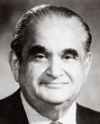
Born 30 Sep 1917; died 22 Jan 1994 at age 76.
American inventor of the teleprompter, who headed the TelePrompTer company. In the mid 50's, Kahn designed and built what was perhaps the first remotely controlled, multi-image, rear projection system in the world for the U.S. Army's facility in Huntsville, Ala., to make persuasive presentations to visiting Congressmen. With five images (one large, 3¼ by 4 slide or film image in the center flanked smaller slides at each side) and random access it could search and select among 500 slides. TelePrompTer also made many technological contributions to the early cable TV industry. In 1961, Kahn and Hub Schlafley demonstrated Key TV, an early pay TV concept, by showing the second Patterson vs. Johansson heavyweight fight, essentially giving birth to pay-per-view.
American inventor of the teleprompter, who headed the TelePrompTer company. In the mid 50's, Kahn designed and built what was perhaps the first remotely controlled, multi-image, rear projection system in the world for the U.S. Army's facility in Huntsville, Ala., to make persuasive presentations to visiting Congressmen. With five images (one large, 3¼ by 4 slide or film image in the center flanked smaller slides at each side) and random access it could search and select among 500 slides. TelePrompTer also made many technological contributions to the early cable TV industry. In 1961, Kahn and Hub Schlafley demonstrated Key TV, an early pay TV concept, by showing the second Patterson vs. Johansson heavyweight fight, essentially giving birth to pay-per-view.
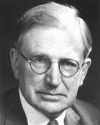
Born 30 Sep 1905; died 8 Aug 1996 at age 90. quotes
Nevill Francis Mott was an English physicist who shared (with PhilipW. Anderson and John H. Van Vleck of the U.S.) the 1977 Nobel Prize for Physics for his independent researches on the magnetic and electrical properties of amorphous semiconductors. Whereas the electric properties of crystals are described by the Band Theory - which compares the conductivity of metals, semiconductors, and insulators - a famous exception is provided by nickel oxide. According to band theory, nickel oxide ought to be a metallic conductor but in reality is an insulator. Mott refined the theory to include electron-electron interaction and explained so-called Mott transitions, by which some metals become insulators as the electron density decreases by separating the atoms from each other in some convenient way.
Nevill Francis Mott was an English physicist who shared (with PhilipW. Anderson and John H. Van Vleck of the U.S.) the 1977 Nobel Prize for Physics for his independent researches on the magnetic and electrical properties of amorphous semiconductors. Whereas the electric properties of crystals are described by the Band Theory - which compares the conductivity of metals, semiconductors, and insulators - a famous exception is provided by nickel oxide. According to band theory, nickel oxide ought to be a metallic conductor but in reality is an insulator. Mott refined the theory to include electron-electron interaction and explained so-called Mott transitions, by which some metals become insulators as the electron density decreases by separating the atoms from each other in some convenient way.
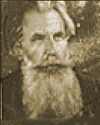
Born 30 Sep 1891; died 7 Sep 1956 at age 64.
Soviet scientist and explorer responsible for the Soviet program of exploration and exploitation of Arctic resources; through his many activities he exercised a wide and diverse influence on Soviet life and thought. In 1937, on drifting ice near the North Pole, he established a scientific station notable for its oceanographic researches (1937). In the late 1940's he advanced a theory of the formation of the Earth from a rotating cloud of dust and gas. Schmidt led an expedition on the maiden voyage (1933) of the steamship Chelyuskin, which became ice-bound and went under in the Bering Strait. All the 111 scientists and crew members made it just in time to disembark the doomed vessel and, within a month, they were all ferried safely to the mainland.
Soviet scientist and explorer responsible for the Soviet program of exploration and exploitation of Arctic resources; through his many activities he exercised a wide and diverse influence on Soviet life and thought. In 1937, on drifting ice near the North Pole, he established a scientific station notable for its oceanographic researches (1937). In the late 1940's he advanced a theory of the formation of the Earth from a rotating cloud of dust and gas. Schmidt led an expedition on the maiden voyage (1933) of the steamship Chelyuskin, which became ice-bound and went under in the Bering Strait. All the 111 scientists and crew members made it just in time to disembark the doomed vessel and, within a month, they were all ferried safely to the mainland.
Born 30 Sep 1887; buried 3 Jun 1957 at age 69.
Leslie Herbert Lampitt was an English analytical chemist and food scientist who as chief chemist of Lyons founded the largest food laboratory in Europe. After WW I service, his suggestion to Samuel Gluckstein of the food company J. Lyons & Co. that science should be applied to food production was accepted. Begining in Jul 1919, he founded a 3,000 sq. ft. Bio-Chemical Department, a laboratory analyzing food samples that was the first of its kind in Europe. As the staff and activity grew, by 1928, the lab had 35,000 sq.ft. in a new seven-story building. In Jun 1949, Oxford graduate Margaret Roberts joined as a research chemist, but later as Margaret Thatcher, she became Britain's first woman Prime Minister. Lampitt was active in several chemistry societies, both academic and industrial. He advocated standards for such products as tea, coffee, jam, cream and cheese.«
Leslie Herbert Lampitt was an English analytical chemist and food scientist who as chief chemist of Lyons founded the largest food laboratory in Europe. After WW I service, his suggestion to Samuel Gluckstein of the food company J. Lyons & Co. that science should be applied to food production was accepted. Begining in Jul 1919, he founded a 3,000 sq. ft. Bio-Chemical Department, a laboratory analyzing food samples that was the first of its kind in Europe. As the staff and activity grew, by 1928, the lab had 35,000 sq.ft. in a new seven-story building. In Jun 1949, Oxford graduate Margaret Roberts joined as a research chemist, but later as Margaret Thatcher, she became Britain's first woman Prime Minister. Lampitt was active in several chemistry societies, both academic and industrial. He advocated standards for such products as tea, coffee, jam, cream and cheese.«
Laboratory Organisation, by Leslie Herbert Lampitt. - book suggestion.
Born 30 Sep 1883; died 18 Jan 1971 at age 87.
American civil engineer whose professional and political activities built on her family's tradition of women leaders. In 1905, she was the first woman in the U.S. to obtain a degree in civil engineering and the first junior member of the American Society of Civil Engineers. Fresh from college, she wrote a paper on the water supply of Washington, DC which was a reference for studies on the transport of solids in liquids for over 50 years. In 1908, she married Lee De Forest, inventor of the radio vacuum tube, for whom she worked as a laboratory assistant until 1909, when they separated (they divorced in 1912). In 1908, on a honeymoon trip to France, De Forest transmitted voice communication from the Eiffel Tower to receivers 500 miles away.
American civil engineer whose professional and political activities built on her family's tradition of women leaders. In 1905, she was the first woman in the U.S. to obtain a degree in civil engineering and the first junior member of the American Society of Civil Engineers. Fresh from college, she wrote a paper on the water supply of Washington, DC which was a reference for studies on the transport of solids in liquids for over 50 years. In 1908, she married Lee De Forest, inventor of the radio vacuum tube, for whom she worked as a laboratory assistant until 1909, when they separated (they divorced in 1912). In 1908, on a honeymoon trip to France, De Forest transmitted voice communication from the Eiffel Tower to receivers 500 miles away.
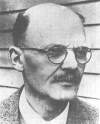
Born 30 Sep 1882; died 24 Sep 1945 at age 62.
Hans Wilhelm Geiger was a German physicist who introduced the Geiger counter, the first successful detector of individual alpha particles and other ionizing radiations. After earning his Ph.D. at the University of Erlangen in 1906, he collaborated at the University of Manchester with Ernest Rutherford. He used the first version of his particle counter, and other detectors, in experiments that led to the identification of the alpha particle as the nucleus of the helium atom and to Rutherford's statement (1912) that the nucleus occupies a very small volume in the atom. The Geiger-Müller counter (developed with Walther Müller) had improved durability, performance and sensitivity to detect not only alpha particles but also beta particles (electrons) and ionizing electromagnetic photons. Geiger returned to Germany in 1912 and continued to investigate cosmic rays, artificial radioactivity, and nuclear fission.
Hans Wilhelm Geiger was a German physicist who introduced the Geiger counter, the first successful detector of individual alpha particles and other ionizing radiations. After earning his Ph.D. at the University of Erlangen in 1906, he collaborated at the University of Manchester with Ernest Rutherford. He used the first version of his particle counter, and other detectors, in experiments that led to the identification of the alpha particle as the nucleus of the helium atom and to Rutherford's statement (1912) that the nucleus occupies a very small volume in the atom. The Geiger-Müller counter (developed with Walther Müller) had improved durability, performance and sensitivity to detect not only alpha particles but also beta particles (electrons) and ionizing electromagnetic photons. Geiger returned to Germany in 1912 and continued to investigate cosmic rays, artificial radioactivity, and nuclear fission.
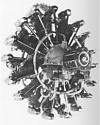
Born 30 Sep 1882; died 24 Jun 1950 at age 67.
Charles Lanier Lawrance was an American aeronautical engineer who designed the first successful air-cooled aircraft engine, used on many historic early flights. He also designed a new type of wing section with an exceptionally good lift-to-drag ratio. His wing design was used widely in World War I. By the mid-1920s his improvements in engine power and reliability made a remarkable series of long-distance flights possible, including those of Admiral Byrd, Charles Lindbergh, Amelia Earhart and Clarence Chamberlin. Despite the sensational publicity of the Lindbergh flight, Lawrance remained in relative obscurity - upon which he commented, "Who remembers Paul Revere's horse?" For his J-5 Whirlwind engine, Lawrance was awarded the annual Collier Trophy in 1928.
Charles Lanier Lawrance was an American aeronautical engineer who designed the first successful air-cooled aircraft engine, used on many historic early flights. He also designed a new type of wing section with an exceptionally good lift-to-drag ratio. His wing design was used widely in World War I. By the mid-1920s his improvements in engine power and reliability made a remarkable series of long-distance flights possible, including those of Admiral Byrd, Charles Lindbergh, Amelia Earhart and Clarence Chamberlin. Despite the sensational publicity of the Lindbergh flight, Lawrance remained in relative obscurity - upon which he commented, "Who remembers Paul Revere's horse?" For his J-5 Whirlwind engine, Lawrance was awarded the annual Collier Trophy in 1928.
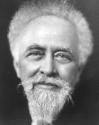
Born 30 Sep 1870; died 17 Apr 1942 at age 71. quotes
Jean-Baptiste Perrin was a physicist who provided decisive experimental proof of the atomic nature of matter through his studies of erratic Brownian motion in fluids, in which tiny particles are battered by liquid molecules. Building on Albert Einstein’s theoretical explanation, he suspended minute particles in a gamboge emulsion and analyzed their movements. From this work, Perrin was able to calculate Avogadro’s number, which specifies the number of molecules in a gram-molecular weight of a substance—for example, the number in two grams of hydrogen. His result closely matched that predicted by the kinetic theory of gases. In recognition of this achievement, Perrin was awarded the 1926 Nobel Prize in Physics.«
Jean-Baptiste Perrin was a physicist who provided decisive experimental proof of the atomic nature of matter through his studies of erratic Brownian motion in fluids, in which tiny particles are battered by liquid molecules. Building on Albert Einstein’s theoretical explanation, he suspended minute particles in a gamboge emulsion and analyzed their movements. From this work, Perrin was able to calculate Avogadro’s number, which specifies the number of molecules in a gram-molecular weight of a substance—for example, the number in two grams of hydrogen. His result closely matched that predicted by the kinetic theory of gases. In recognition of this achievement, Perrin was awarded the 1926 Nobel Prize in Physics.«
Atoms, by Jean Perrin. - book suggestion.
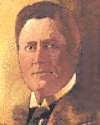
Born 30 Sep 1861; died 26 Jan 1932 at age 70. quotes
American manufacturer whose Wrigley's chewing gum company became the largest producer and distributor of chewing gum in the world. He left his father's soap factory in 1891 when he moved to Chicago. There his uncle supplied seed money on the condition Wrigley take a cousin as partner, and they started manufacturing soap, baking powder, and later, chewing gum. When the gum became very popular, they dropped the other products. In 1899 he introduced spearmint gum, which lagged in sales until a major advertising campaign in 1907; within a year spearmint gum sales increased tenfold. In 1911, he bought Zeno Manufacturing Company, previously contracted to make his gum, and the William Wrigley, Jr., Company was founded. more
American manufacturer whose Wrigley's chewing gum company became the largest producer and distributor of chewing gum in the world. He left his father's soap factory in 1891 when he moved to Chicago. There his uncle supplied seed money on the condition Wrigley take a cousin as partner, and they started manufacturing soap, baking powder, and later, chewing gum. When the gum became very popular, they dropped the other products. In 1899 he introduced spearmint gum, which lagged in sales until a major advertising campaign in 1907; within a year spearmint gum sales increased tenfold. In 1911, he bought Zeno Manufacturing Company, previously contracted to make his gum, and the William Wrigley, Jr., Company was founded. more
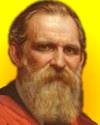
Born 30 Sep 1842; died 13 Mar 1920 at age 77. quotes
English geologist who proposed what came to be called the Ordovician period (505 to 438 million years old) of geologic strata. Lapworth is famous for his work with marine fossils called graptolites. By fastidiously collecting the tiny, colonial sea creatures, he figured out the original order of layered rocks that had been faulted and folded in England's Southern Uplands. This method of correlating rocks with graptolites became a model for similar research throughout the world. In 1879, Lapworth proposed a new classification of Lower Paleozoic rocks with the Ordovician, between the redefined Cambrian and Silurian periods, Lapworth convincingly settled a heated dispute. The name comes from an ancient Welsh tribe, the Ordovices.
English geologist who proposed what came to be called the Ordovician period (505 to 438 million years old) of geologic strata. Lapworth is famous for his work with marine fossils called graptolites. By fastidiously collecting the tiny, colonial sea creatures, he figured out the original order of layered rocks that had been faulted and folded in England's Southern Uplands. This method of correlating rocks with graptolites became a model for similar research throughout the world. In 1879, Lapworth proposed a new classification of Lower Paleozoic rocks with the Ordovician, between the redefined Cambrian and Silurian periods, Lapworth convincingly settled a heated dispute. The name comes from an ancient Welsh tribe, the Ordovices.
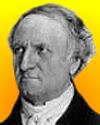
Born 30 Sep 1802; died 30 Mar 1876 at age 73. quotes
Antoine Jérôme Balard was a French chemist who in 1826 discovered the element bromine, determined its properties, and studied some of its compounds. Later he proved the presence of bromine in sea plants and animals. This discovery was a by-product of a more general chemical investigation of the sea and its life forms. Bromine had an atomic weight that was close to the arithmetic mean of two other known halogens, chlorine and iodine, suggesting they formed a “chemical family.” He also researched the inexpensive extraction of salts from seawater. He discovered oxamic acid by using heat to decompose ammonium hydrogen oxylate. He studied and named amyl alcohol. Louis Pasteur and Marcellin erthelot were among his students.
Antoine Jérôme Balard was a French chemist who in 1826 discovered the element bromine, determined its properties, and studied some of its compounds. Later he proved the presence of bromine in sea plants and animals. This discovery was a by-product of a more general chemical investigation of the sea and its life forms. Bromine had an atomic weight that was close to the arithmetic mean of two other known halogens, chlorine and iodine, suggesting they formed a “chemical family.” He also researched the inexpensive extraction of salts from seawater. He discovered oxamic acid by using heat to decompose ammonium hydrogen oxylate. He studied and named amyl alcohol. Louis Pasteur and Marcellin erthelot were among his students.
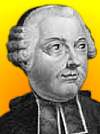
Born 30 Sep 1715; died 3 Aug 1780 at age 64.
French philosopher, psychologist, logician, economist, and the leading advocate in France of the ideas of John Locke (1632-1704). In his works La Logique (1780) and La Langue des calculs (1798), Condillac emphasized the importance of language in logical reasoning, stressing the need for a scientifically designed language and for mathematical calculation as its basis. He combined elements of Locke's theory of knowledge with the scientific methodology of Newton; all knowledge springs from the senses and association of ideas. Condillac devoted careful attention to questions surrounding the origins and nature of language, and enhanced contemporary awareness of the importance of the use of language as a scientific instrument.[Death date as given in Dict. of Sci. Bio. Enc. Brit. gives death as 2/3 Aug 1780.]
French philosopher, psychologist, logician, economist, and the leading advocate in France of the ideas of John Locke (1632-1704). In his works La Logique (1780) and La Langue des calculs (1798), Condillac emphasized the importance of language in logical reasoning, stressing the need for a scientifically designed language and for mathematical calculation as its basis. He combined elements of Locke's theory of knowledge with the scientific methodology of Newton; all knowledge springs from the senses and association of ideas. Condillac devoted careful attention to questions surrounding the origins and nature of language, and enhanced contemporary awareness of the importance of the use of language as a scientific instrument.[Death date as given in Dict. of Sci. Bio. Enc. Brit. gives death as 2/3 Aug 1780.]

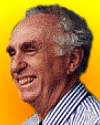
Died 30 Sep 2014 at age 87 (born 24 Jun 1927). quotes
Martin Lewis Perl was an American physicist who received the 1995 Nobel Prize for Physics for discovering a subatomic particle that he named the tau, a massive lepton with a negative charge. The tau, which he found in the mid-1970s, was the first evidence of a third “generation” of fundamental particles. It is a superheavy cousin of the electron, identical in all respects except that the tau is more than 3,500 times heavier than the electron and survives less than a trillionth of a second, whereas the electron is stable.
Martin Lewis Perl was an American physicist who received the 1995 Nobel Prize for Physics for discovering a subatomic particle that he named the tau, a massive lepton with a negative charge. The tau, which he found in the mid-1970s, was the first evidence of a third “generation” of fundamental particles. It is a superheavy cousin of the electron, identical in all respects except that the tau is more than 3,500 times heavier than the electron and survives less than a trillionth of a second, whereas the electron is stable.
The Particle Garden: Our Universe As Understood by Particle Physicists, by Gordon Kane, Heather Mimnaugh. - book suggestion.
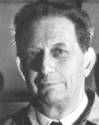
Died 30 Sep 1994 at age 92 (born 8 May 1902). quotes
French biologist who contributed to the understanding of lysogeny, in which a bacterial virus, or bacteriophage, infects bacteria and is transmitted to subsequent bacterial generations solely through the cell division of its host. The observation of isolated bacteria led him to the conclusion that lysogenic bacteria did not secrete bacteriophages, that the production of bacteriophages led to the death of the bacterium, and above all that this production must be induced by external factors. It was this hypothesis which, together with Louis Siminovitch and Niels Kjeldgaard, led Lwoff to discover the inductive action of ultraviolet irradiation (1950). His discoveries brought him (with François Jacob and Jacques Monod) the 1965 Nobel Prize for Physiology or Medicine.
French biologist who contributed to the understanding of lysogeny, in which a bacterial virus, or bacteriophage, infects bacteria and is transmitted to subsequent bacterial generations solely through the cell division of its host. The observation of isolated bacteria led him to the conclusion that lysogenic bacteria did not secrete bacteriophages, that the production of bacteriophages led to the death of the bacterium, and above all that this production must be induced by external factors. It was this hypothesis which, together with Louis Siminovitch and Niels Kjeldgaard, led Lwoff to discover the inductive action of ultraviolet irradiation (1950). His discoveries brought him (with François Jacob and Jacques Monod) the 1965 Nobel Prize for Physiology or Medicine.
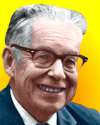
Died 30 Sep 1985 at age 85 (born 26 Apr 1900). quotes
Charles Francis Richter was an American seismologist who devised the Richter Scale that measures earthquake magnitudes which he developed with his colleague, Beno Gutenberg, in the early 1930s. The scale assigns numerical ratings to the energy released by earthquakes. Richter used a seismograph to record actual earth motion during an earthquake. That is an instrument generally consisting of a constantly unwinding roll of paper, anchored to a fixed place, and a pendulum or magnet suspended with a marking device above the roll. The scale takes into account the instrument's distance from the epicenter. Gutenberg suggested that the scale be logarithmic so, for example, a quake of magnitude 7 would be ten times stronger than a 6. He wrote the article on Earthquakes for the 1974 edition of Encyclopædia Britannica.
Charles Francis Richter was an American seismologist who devised the Richter Scale that measures earthquake magnitudes which he developed with his colleague, Beno Gutenberg, in the early 1930s. The scale assigns numerical ratings to the energy released by earthquakes. Richter used a seismograph to record actual earth motion during an earthquake. That is an instrument generally consisting of a constantly unwinding roll of paper, anchored to a fixed place, and a pendulum or magnet suspended with a marking device above the roll. The scale takes into account the instrument's distance from the epicenter. Gutenberg suggested that the scale be logarithmic so, for example, a quake of magnitude 7 would be ten times stronger than a 6. He wrote the article on Earthquakes for the 1974 edition of Encyclopædia Britannica.
Richter’s Scale: Measure of an Earthquake, Measure of a Man, by Susan Hough. - book suggestion.
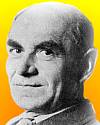
Died 30 Sep 1969 at age 82 (born 20 Oct 1886). quotes
Sir Frederic Charles Bartlett was an English psychologist who was Britain’s most outstanding cognitive psychologist between the World Wars. He wrote on practical (ergonomic) problems in applied psychology. In his pioneering cognitive approach to understanding human memory, Bartlett observed that in remembering stories or events, distortions tend to occur. In his most famous experiment, Bartlett had subjects read a folk tale, and tested their recall several times, analyzing changes. He concluded that people tend to remember what they regard as most important and recall what would have been expected rather than what actually occurred. He was knighted for work on such topics as fatigue and visual perception with the RAF during WWII.«
Sir Frederic Charles Bartlett was an English psychologist who was Britain’s most outstanding cognitive psychologist between the World Wars. He wrote on practical (ergonomic) problems in applied psychology. In his pioneering cognitive approach to understanding human memory, Bartlett observed that in remembering stories or events, distortions tend to occur. In his most famous experiment, Bartlett had subjects read a folk tale, and tested their recall several times, analyzing changes. He concluded that people tend to remember what they regard as most important and recall what would have been expected rather than what actually occurred. He was knighted for work on such topics as fatigue and visual perception with the RAF during WWII.«
Thinking, by Sir Frederic Bartlett. - book suggestion.
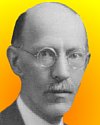
Died 30 Sep 1959 at age 89 (born 13 Jan 1870).
American zoologist who developed the first successful animal-tissue cultures and pioneered organ transplantation techniques. In an early experiment, using tissue grafting techniques, he joined parts of embryos from differently coloured frogs to observe the movement of cells during the subsequent development of the embryos produced in this way. In another experiment, he took tissue from an amphibian embryo that would have formed a left limb, inverted and transferred it to the embryo's right side, where it formed a right limb. He discovered the hanging-drop culture method (1907), a new method of studying cells, by which he kept fragments of living tissue alive in suitable media and watch them multiply. Using this technique, he settled a controversy about the embryonic origins of nerve fibres. The hanging-drop method has also been valuable in oncology, genetics, virology and other fields.
American zoologist who developed the first successful animal-tissue cultures and pioneered organ transplantation techniques. In an early experiment, using tissue grafting techniques, he joined parts of embryos from differently coloured frogs to observe the movement of cells during the subsequent development of the embryos produced in this way. In another experiment, he took tissue from an amphibian embryo that would have formed a left limb, inverted and transferred it to the embryo's right side, where it formed a right limb. He discovered the hanging-drop culture method (1907), a new method of studying cells, by which he kept fragments of living tissue alive in suitable media and watch them multiply. Using this technique, he settled a controversy about the embryonic origins of nerve fibres. The hanging-drop method has also been valuable in oncology, genetics, virology and other fields.
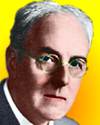
Died 30 Sep 1953 at age 71 (born 11 Oct 1881). quotes
English mathematician, meteorologist, physicist and psychologist who first applied mathematics to accurate weather prediction. For this, he used the mathematical method of finite differences (1922). At first, limited computer power hobbled forecasting: three months computation time to predict weather for the next 24 hours. After WWII, as successive electronic computers grew faster, his methods were increasingly practical. He wrote several books applying mathematics to the causes of war. He contributed to calculus and the theory of diffusion for eddy-diffusion in the atmosphere. The Richardson number, a quantity involving gradients (change over distance) of temperature and wind velocity, is named after him.«
English mathematician, meteorologist, physicist and psychologist who first applied mathematics to accurate weather prediction. For this, he used the mathematical method of finite differences (1922). At first, limited computer power hobbled forecasting: three months computation time to predict weather for the next 24 hours. After WWII, as successive electronic computers grew faster, his methods were increasingly practical. He wrote several books applying mathematics to the causes of war. He contributed to calculus and the theory of diffusion for eddy-diffusion in the atmosphere. The Richardson number, a quantity involving gradients (change over distance) of temperature and wind velocity, is named after him.«
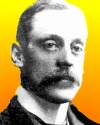
Died 30 Sep 1940 at age 81 (born 28 Nov 1858).
English metallurgist (Baronet) who developed manganese steel, an alloy of exceptional durability that found uses in the construction of railroad rails and rock-crushing machinery. Hadfield discovered manganese steel in 1882. It was hardened by quenching it in water from a temperature of a thousand degrees centigrade. The hard steel was to be used in the manufacture of tram wheels. He patented his work in 1883-4 but continued to carry out further experiments before publicising his findings in 1888, which were supported by a lecture tour. The first World War provided new markets for manganese steel: spur armour plate and shells, tank treads and soldier's helmets. By 1919, Hadfields Steel Foundry Co. Ltd. were Sheffield's biggest employers.[DSB and EB give birth date as 28 Nov 1858. Current Bio. gives 29 Nov 1858.]
English metallurgist (Baronet) who developed manganese steel, an alloy of exceptional durability that found uses in the construction of railroad rails and rock-crushing machinery. Hadfield discovered manganese steel in 1882. It was hardened by quenching it in water from a temperature of a thousand degrees centigrade. The hard steel was to be used in the manufacture of tram wheels. He patented his work in 1883-4 but continued to carry out further experiments before publicising his findings in 1888, which were supported by a lecture tour. The first World War provided new markets for manganese steel: spur armour plate and shells, tank treads and soldier's helmets. By 1919, Hadfields Steel Foundry Co. Ltd. were Sheffield's biggest employers.[DSB and EB give birth date as 28 Nov 1858. Current Bio. gives 29 Nov 1858.]
Died 30 Sep 1939 at age 70 (born 21 Nov 1868).
American physician and pediatric pathologist. Her first experimental work involved infant diarrhea and confirmed earlier studies relating the dysentery bacillus to the disease. At the Rockefeller Institute of Medical Research, she collaborated on the first experimental work on polio in the U.S., worked on an early investigation of pneumonia and developed, with Harold Amoss, a method for preparing antimeningitis serum. She also pioneered in early research on mumps, indicating, though not proving, its viral nature. After 1921, Wollstein investigated pediatric pathology at the Babies Hospital, especially jaundice, congenital anomalies, tuberculosis, meningitis, and leukemia. In 1930, she was the first female member of the American Pediatric Society.
American physician and pediatric pathologist. Her first experimental work involved infant diarrhea and confirmed earlier studies relating the dysentery bacillus to the disease. At the Rockefeller Institute of Medical Research, she collaborated on the first experimental work on polio in the U.S., worked on an early investigation of pneumonia and developed, with Harold Amoss, a method for preparing antimeningitis serum. She also pioneered in early research on mumps, indicating, though not proving, its viral nature. After 1921, Wollstein investigated pediatric pathology at the Babies Hospital, especially jaundice, congenital anomalies, tuberculosis, meningitis, and leukemia. In 1930, she was the first female member of the American Pediatric Society.
Died 30 Sep 1888 at age 69 (born 17 Jul 1819).
Eunice Newton Foote was a American physicist, inventor and social activist whose experiments anticipated modern climate science. In 1856 she demonstrated that carbon dioxide and water vapor absorb heat and can warm the air, showing with simple apparatus that CO₂ trapped more heat than ordinary air. She concluded that an atmosphere rich in CO₂ would raise Earth’s temperature—an early statement of the greenhouse effect. Her paper, read at an American Association meeting, was among the first to link atmospheric composition with climate, before John Tyndall’s more widely recognized work.«
Eunice Newton Foote was a American physicist, inventor and social activist whose experiments anticipated modern climate science. In 1856 she demonstrated that carbon dioxide and water vapor absorb heat and can warm the air, showing with simple apparatus that CO₂ trapped more heat than ordinary air. She concluded that an atmosphere rich in CO₂ would raise Earth’s temperature—an early statement of the greenhouse effect. Her paper, read at an American Association meeting, was among the first to link atmospheric composition with climate, before John Tyndall’s more widely recognized work.«
Died 30 Sep 1846 (born 1796).
German archaeologist who is remembered for his works on the everyday life of the ancient Romans and Greeks. From 1842 he was professor of classical archaeology at Leipzig. His early studies of Plautus' comedies aroused his interest in Roman daily life and led to his publication of Gallus (1838), the story of a Roman youth. Derived from Suetonius' Life of Augustus and embellished to include all aspects of Roman life and customs, the book became a classic in its field, the English translation passing through 10 editions between 1844 and 1891. Charikles (1840), a similar work on Greek life, was also successful.
German archaeologist who is remembered for his works on the everyday life of the ancient Romans and Greeks. From 1842 he was professor of classical archaeology at Leipzig. His early studies of Plautus' comedies aroused his interest in Roman daily life and led to his publication of Gallus (1838), the story of a Roman youth. Derived from Suetonius' Life of Augustus and embellished to include all aspects of Roman life and customs, the book became a classic in its field, the English translation passing through 10 editions between 1844 and 1891. Charikles (1840), a similar work on Greek life, was also successful.
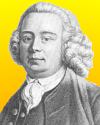
Died 30 Sep 1772 (born 1716).
English pioneer canal builder, who constructed the first English canal of major economic importance. He apprenticed (1733) as a millwright and wheelwright, making mills, dams and sluices. In 1742, he designed and built an engine for draining coalpits at Clifton, Lancashire. On 1 Jul 1759, the Duke of Bridgwater commissioned Brindley to build a canal to move coal from his Worsley mine 16-km (10-mile) to the textile manufacturing centre at Manchester. Completed in 1765, Brindley's solution to the problem included a subterranean channel, extending from the barge basin at the head of the canal into the mines, and the Barton Aqueduct, which carried the canal over the River Irwell. In his lifetime, he was responsible for around 365 miles of inland waterways.
English pioneer canal builder, who constructed the first English canal of major economic importance. He apprenticed (1733) as a millwright and wheelwright, making mills, dams and sluices. In 1742, he designed and built an engine for draining coalpits at Clifton, Lancashire. On 1 Jul 1759, the Duke of Bridgwater commissioned Brindley to build a canal to move coal from his Worsley mine 16-km (10-mile) to the textile manufacturing centre at Manchester. Completed in 1765, Brindley's solution to the problem included a subterranean channel, extending from the barge basin at the head of the canal into the mines, and the Barton Aqueduct, which carried the canal over the River Irwell. In his lifetime, he was responsible for around 365 miles of inland waterways.

In 2010, California law AB 2398, was signed, the first U.S. law making carpet manufacturers responsible for end-of-life carpet. A small, visible fee per sq. yd. is added at purchase, for a dedicated fund managed by the industry’s stewardship program (CARE), under CalRecycle oversight, to support carpet collection, transport, recycling incentives, market development, education, and administration. The landmark law accelerated work on designing carpets for recyclability and on tools and processes to identify and recycle post-consumer carpet. This diverted over 37,000 tons of used carpet from California landfills in 2024. It became an influential model for carpet Extended Producer Responsibility (EPR) policy in the U.S. and in the world.«

Spirit of Texas
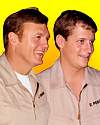
Colburn (L) & Perot

In 1963, the first birth of a gerenuk in the U.S. occurred at the Zoological Park, Bronx Park, New York City. Gerenuks (Litocranius walleri) are reddish-brown antelopes from eastern Africa. It is also known as the giraffe gazelle, for its the long neck. When its neck isn't quite long enough for it to reach certain branches, a geranuk will sometimes be seen standing on its hind legs to reach them.
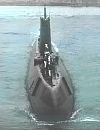
In 1954, the world’s first nuclear submarine, the USS Nautilus, was commissioned at Groton, Conn. Its nuclear reactor eliminated diesel engines which previously limited a sub’s range and speed. Nuclear power also eliminated diesel fuel storage spaces and periodic surfacing to recharge batteries. Nautilus was launched 21 Jan 1954, and could dive longer, faster, and deeper than any submarine before it. It was 319-ft long, 27-ft beam (hull diameter), could dive to 700-ft, travel at over 20 knots, and was crewed by 11 officers and 105 enlisted men. Nautilus continued to break records in 1958 as the first vessel to travel under the Arctic ice and cross the North Pole. Decommissioned in 1980, the sub was converted into a museum in 1985. K-19, the first Soviet nuclear submarine, was commissioned 30 Apr 1960.
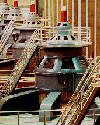
In 1935, the Boulder Dam across the Colorado River, at Boulder City, Nevada, was dedicated. The concrete-arch dam, subsequently named Hoover Dam (1947), supplied the first U.S. hydroelectric plant to produce a million kilowatts. This production peak occurred in June 1943, though the first of its four generators was placed into operation on 26 Oct 1936. The power serves the Los Angeles area.
In 1927, the 7th Conférence Générale des Poids et Mesures (CGPM) slightly modified the definition of the metre. It was still defined as the distance between two lines on the International prototype metre, but it was now specified that it should be supported horizontally on two cylinders of less than 1 cm diameter, placed symetrically, and 571 mm apart.
In 1907, motor car speed traps were protested in a letter to The Times, London. Lord Montagu of Beaulieu (whose son founded the National Motor Museum) wrote to challenge anti-motorist complaints as opposing progress. To combat dust cloud nuisance from traffic, he called for more suitable roads: "reserved only for motorists and rubber-tired non-animal traffic - at least between large centres of population." About speed traps, he continued, "By all means let police-traps be placed where there is any reason to think danger may exist, but ... At present, the police neglect their other duties and look upon trapping as a regular sport" producing income to local government from the £5 or £10 fines for speeds of 20 or 30 mph.
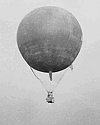
In 1906, the world's first international balloon race began. It was won by a coal-gas balloon, the United States. Pilot Lt. Frank P. Lahm of the U.S. Signal Corps and his co-pilot Maj. Henry B. Hersey, of the Weather Bureau, flew 402 miles (647-km) from Paris, France, to Scarborough, England, in 22-hr 15-min, to win the Gordon-Bennett Cup. The race sponsor, James Gordon-Bennett (1841-1918), publisher of the New York Herald, was known for financing Henry Stanley's expedition into Africa to find David Livingstone. The 1906 balloon race launched at the Jardin des Tuleries, with 250,000 spectators. Of 17 entrants, only seven reached England safely. The American win promoted ballooning back home, and nominated the U.S. as host for the next race, in 1907, held at St. Louis, Missouri.«[Image shows the 1907 race launch of the United States with Major Hersey as pilot, replacing Lahm who had health problems.] more

In 1902, the "making of cellulose esters" was jointly patented by William H. Walker, Arthur D. Little and Harry S. Mork of Massachusetts. (U.S. No. 709922). A month later, on 28 Oct 1902, they also patented artificial silk (No. 712,200). Viscose was an early name for the product. The term rayon was adopted by the textile industry in 1924 to replace "artificial silk" and similar names. It was said to derive from the French for "shine" - a reference to its silklike lustre. Unlike most man-made fibers, rayon is not synthetic. Made from wood pulp, a naturally-occurring, cellulose-based raw material, rayon's properties are more similar to those of natural cellulosic fibers, such as cotton or linen, than those of petroleum-based synthetic fibers such as nylon.
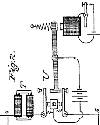
(USPTO)
In 1890, Thomas A. Edison was granted U.S. patent No. 437422 for telegraphy, Nos. 437423,-4,-6 for a phonograph; No. 437425 for a phonograph-recorder; No. 437427 for a “Method of Making Phonograph Blanks”; No. 437428 for a “Propelling Device for Electrical Cars”; and No. 437429 for a phonogram blank.[Image: detail from Patent No. 437422.]

In 1882, the world’s first hydroelectric power plant in the U.S. was opened on the Fox River, in Appleton, Wisc. Powered by a water wheel, a single dynamo provided 12.5 kilowatts enough for 180 lights, of ten candlepower each. Appleton paper manufacturer H.F. Rogers, had been inspired by Thomas Edison’s plans for a steam-powered electricity production station in New York. He had financial support from a personal friend of Edison, and two other men, all from Appleton. Rogers began building the power plant at his riverside paper mill during the summer of 1882. Later known as the Appleton Edison Light Company, it produced enough electricity to light Rogers’ home, the plant itself, and a nearby building.[Image: Appleton Dam 1880-1920]
In 1881, the Godalming town council in Surrey, England, voted to have the world's first public electricity supply. The contract expired that day with a gas company that lit the community's high street. I instead of renewing that contract at a cost of £210 a year, the council accepted an offer from Calder & Barrett for £195. Earlier in the week, the mayor and councillors saw a demonstration of electrical lighting by that firm, and had inspected the generating plant. The AC generator was driven by a water-wheel on the River Wey at one of the leather mills owned by John Pullman. It could supplied lighting to the mill, street, and some businesses and homes. Though the Thames Embankment in London had arc lamps a couple of years earlier, Godalming preceded Edison's first public supply scheme in London in Jan 1882.«[Aside: Jack Phillips (1887-1912), Chief Wireless Operator on the Titanic, learned Morse code working at Godalming Post Office.]
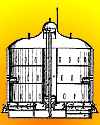
(USPTO)
In 1862, U.S. patent No. 36,593 was issued for a revolving turret for battleships to the inventor, Theodore Ruggles Timby (born Dover, NY, 5 Apr 1822). When Ericsson built the first turret battleship in the world, the Monitor, he added a turret based on Timby's design to the ship.«[Image: detail from Patent No. 36,593]
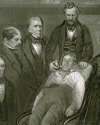
In 1846, dentist Dr. William Morton used an experimental anesthetic, ether, for the first time on one of his patients at Massachusetts General Hospital in Boston for tooth extraction.