
Born 24 Feb 1955; died 5 Oct 2011 at age 56. quotes
Steven Paul Jobs was an American inventor and entrepreneur who, in 1976, co-founded Apple Inc. with Steve Wozniak to manufacture personal computers. During his life he was issued or applied for 338 patents as either inventor or co-inventor of not only applications in computers, portable electronic devices and user interfaces, but also a number of others in a range of technologies. From the outset, he was active in all aspects of the Apple company, designing, developing and marketing. After the initial success of the Apple II series of personal computers, the Macintosh superseded it with a mouse-driven graphical interface. Jobs kept Apple at the forefront of innovative, functional, user-friendly designs with new products including the iPad tablet and iPhone. Jobs was also involved with computer graphics movies through his purchase (1986) of the company that became Pixar.«
Steven Paul Jobs was an American inventor and entrepreneur who, in 1976, co-founded Apple Inc. with Steve Wozniak to manufacture personal computers. During his life he was issued or applied for 338 patents as either inventor or co-inventor of not only applications in computers, portable electronic devices and user interfaces, but also a number of others in a range of technologies. From the outset, he was active in all aspects of the Apple company, designing, developing and marketing. After the initial success of the Apple II series of personal computers, the Macintosh superseded it with a mouse-driven graphical interface. Jobs kept Apple at the forefront of innovative, functional, user-friendly designs with new products including the iPad tablet and iPhone. Jobs was also involved with computer graphics movies through his purchase (1986) of the company that became Pixar.«
Steve Jobs, by Walter Isaacson. - book suggestion.
Born 24 Feb 1946.
Russian mathematician who was awarded the Fields Medal in 1978 for his contributions to the theory of Lie groups, though he was not allowed by the Soviet government to travel to Finland to receive the award. In 1990 Margulis immigrated to the United States. Margulis' work was largely involved in solving a number of problems in the theory of Lie groups. In particular, Margulis proved a long-standing conjecture by Atle Selberg concerning discrete subgroups of semisimple Lie groups. The techniques he used in his work were drawn from combinatorics, ergodic theory, dynamical systems, and differential geometry.
Russian mathematician who was awarded the Fields Medal in 1978 for his contributions to the theory of Lie groups, though he was not allowed by the Soviet government to travel to Finland to receive the award. In 1990 Margulis immigrated to the United States. Margulis' work was largely involved in solving a number of problems in the theory of Lie groups. In particular, Margulis proved a long-standing conjecture by Atle Selberg concerning discrete subgroups of semisimple Lie groups. The techniques he used in his work were drawn from combinatorics, ergodic theory, dynamical systems, and differential geometry.
Born 24 Feb 1897; died 16 Jul 1954 at age 57.
Dutch-American archaeologist who established the relationship between Egypt and Mesopotamia and completed a thoroughly documented reconstruction of ancient Mesopotamian culture and art. The excavations he directed in Egypt (1922, 1925-29) and Iraq (1929-37) were conducted with exemplary archaeological scholarship. In 1925, Frankfort resumed work which had been started by Naville at Abydos excavating the Osireion, discovered by Petrie (1902) who named it from his interpretation as a symbolic tomb of Osiris. Frankfort's initial project site was situated to the West of Seti's Temple but expanded to record the fine reliefs of the temple of Seti itself.«
Dutch-American archaeologist who established the relationship between Egypt and Mesopotamia and completed a thoroughly documented reconstruction of ancient Mesopotamian culture and art. The excavations he directed in Egypt (1922, 1925-29) and Iraq (1929-37) were conducted with exemplary archaeological scholarship. In 1925, Frankfort resumed work which had been started by Naville at Abydos excavating the Osireion, discovered by Petrie (1902) who named it from his interpretation as a symbolic tomb of Osiris. Frankfort's initial project site was situated to the West of Seti's Temple but expanded to record the fine reliefs of the temple of Seti itself.«
The Art and Architecture of the Ancient Orient, by Henri Frankfort. - book suggestion.

American entomologist who did pioneering work in the systematic classification of scale insects, moths and butterflies. His wife, Anna Botsford, illustrated these subjects in his earlier books. He published works for both the layman and the scientist. After he graduated from Cornell University, he taught there. He spent a summer in Alabama (1878) studying the cotton-leaf worm, Alabama argillacea, and shortly afterwards became the chief entomologist of the United States Department of Agriculture (1879-82), after which he returned to a university position. Over a number of years his research included studing the wing venation of insects, making notable new contributions to the field. Later in life, he turned his interest to morphology.«[Image right: Illustration by Anna Botsford Comstock from A Manual for the Study of Insects(source)]
A Manual for the Study of Insects, by John Henry Comstock. - book suggestion.
Born 24 Feb 1841; died 19 Jan 1927 at age 85.
German organic chemist who, assisted by Carl Liebermann, synthesized (1868) the orange-red dye alizarin, which in the textile industry quickly supplanted the natural source of the dye from the madder plant root. Alizarin (dihydroscyanthraquinone) was recognized by Graebe and Liebermann, as a derivative of anthracene, a hydrocarbon contained in coal-tar. Also in 1868, they elaborated a method for preparing it commercially from anthracene. Upon this, one of the early German dyestuff products, arose rapidly a great chemical industry. Graebe also introduced the chemical terms "ortho," "meta," and "para," well known to organic chemistry students, which indicate the position of groups attached to a benzene ring.
German organic chemist who, assisted by Carl Liebermann, synthesized (1868) the orange-red dye alizarin, which in the textile industry quickly supplanted the natural source of the dye from the madder plant root. Alizarin (dihydroscyanthraquinone) was recognized by Graebe and Liebermann, as a derivative of anthracene, a hydrocarbon contained in coal-tar. Also in 1868, they elaborated a method for preparing it commercially from anthracene. Upon this, one of the early German dyestuff products, arose rapidly a great chemical industry. Graebe also introduced the chemical terms "ortho," "meta," and "para," well known to organic chemistry students, which indicate the position of groups attached to a benzene ring.
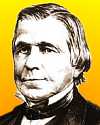
Born 24 Feb 1809; died 8 Apr 1879 at age 70.
American entomologist and physician whose scientific zeal was developed, in part, as a student for a year, from 1826, of Amos Eaton's Rensselaer School, which had an all-science curriculum. He trained in medicine, but his interest in natural history soon prevailed. He returned to the family farm, and diligently studied insects, especially in their relationshipship to crops—whether they were beneficial or damaging. He gained the nickname, “Bug Catcher of Salem.” From 1854, he published reports on insects, and based on the modest financial grants he received (15 Apr 1854-1870) from New York state encouraging his work in economic entomology, has been considered the first entomologist in the service of a state, though informally. His reports included information on insect life cycles, and the conditions and problems of agriculture.«
American entomologist and physician whose scientific zeal was developed, in part, as a student for a year, from 1826, of Amos Eaton's Rensselaer School, which had an all-science curriculum. He trained in medicine, but his interest in natural history soon prevailed. He returned to the family farm, and diligently studied insects, especially in their relationshipship to crops—whether they were beneficial or damaging. He gained the nickname, “Bug Catcher of Salem.” From 1854, he published reports on insects, and based on the modest financial grants he received (15 Apr 1854-1870) from New York state encouraging his work in economic entomology, has been considered the first entomologist in the service of a state, though informally. His reports included information on insect life cycles, and the conditions and problems of agriculture.«
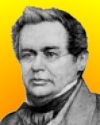
Born 24 Feb 1804; died 10 Feb 1865 at age 60.
Heinrich Friedrich Emil Lenz was a Russian physicist who devised Lenz's Law to describe the direction of flow of electric current generated by a wire moving through a magnetic field. Lenz worked on electrical conduction and electromagnetism. In 1833 he reported investigations into the way electrical resistance changes with temperature, showing that an increase in temperature increases the resistance (for a metal). He is best-known for Lenz's law, which he discovered in 1834 while investigating magnetic induction. It states that the current induced by a change flows so as to oppose the effect producing the change. Lenz's law is a consequence of the, more general, law of conservation of energy.
Heinrich Friedrich Emil Lenz was a Russian physicist who devised Lenz's Law to describe the direction of flow of electric current generated by a wire moving through a magnetic field. Lenz worked on electrical conduction and electromagnetism. In 1833 he reported investigations into the way electrical resistance changes with temperature, showing that an increase in temperature increases the resistance (for a metal). He is best-known for Lenz's law, which he discovered in 1834 while investigating magnetic induction. It states that the current induced by a change flows so as to oppose the effect producing the change. Lenz's law is a consequence of the, more general, law of conservation of energy.
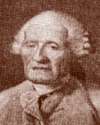
Born 24 Feb 1709; died 21 Nov 1782 at age 73. quotes
French inventor of automata - robot devices of later significance for modern industry. In 1737-38, he produced a transverse flute player, a pipe and tabor player, and a mechanical duck, which was especially noteworthy, not only imitating the motions of a live duck, but also the motions of drinking, eating, and "digesting." He made improvements in the mechanization of silk weaving, but his most important invention was ignored for several decades - that of automating the loom by means of perforated cards that guided hooks connected to the warp yarns. (Later reconstructed and improved by J.-M. Jacquard, it became one of the most important inventions of the Industrial Revolution.) He also invented many machine tools of permanent importance.
French inventor of automata - robot devices of later significance for modern industry. In 1737-38, he produced a transverse flute player, a pipe and tabor player, and a mechanical duck, which was especially noteworthy, not only imitating the motions of a live duck, but also the motions of drinking, eating, and "digesting." He made improvements in the mechanization of silk weaving, but his most important invention was ignored for several decades - that of automating the loom by means of perforated cards that guided hooks connected to the warp yarns. (Later reconstructed and improved by J.-M. Jacquard, it became one of the most important inventions of the Industrial Revolution.) He also invented many machine tools of permanent importance.
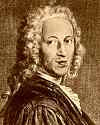
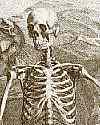
German anatomist who was the first to show the connection of the vascular systems of the mother and the fetus. He is best known for the excellent drawings in his Tabulae sceleti et musculorum corporis humani (1747; “Tables of the Skeleton and Muscles of the Human Body”). Together with Hermann Boerhaave, he edited the works of the physicians Andreas Vesalius and William Harvey.(source)
Born 24 Feb 1663; died 5 Aug 1729 at age 66. quotes
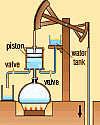
English engineer and inventor of the the world's first successful atmospheric steam engine. His invention of c.1711 came into use by 1725 to pump water out of coal mines or raise water to power water-wheels. On each stroke, steam filled a cylinder closed by a piston, then a spray of water chilled and condensed the steam in the cylinder creating a vacuum, then atmospheric pressure pushed the piston down. A crossbeam transferred the motion of the piston to operating the pump. This was wasteful of fuel needed to reheat the cylinder for the next stroke. Despite being slow and inefficient, Newcomen's engine was relied on for the first 60 years of the new steam age it began, perhaps the single most important invention of the Industrial Revolution. more
English engineer and inventor of the the world's first successful atmospheric steam engine. His invention of c.1711 came into use by 1725 to pump water out of coal mines or raise water to power water-wheels. On each stroke, steam filled a cylinder closed by a piston, then a spray of water chilled and condensed the steam in the cylinder creating a vacuum, then atmospheric pressure pushed the piston down. A crossbeam transferred the motion of the piston to operating the pump. This was wasteful of fuel needed to reheat the cylinder for the next stroke. Despite being slow and inefficient, Newcomen's engine was relied on for the first 60 years of the new steam age it began, perhaps the single most important invention of the Industrial Revolution. more
The Steam Engine of Thomas Newcomen, by L.T.C. Rolt. - book suggestion.


Died 24 Feb 2006 at age 60 (born 8 May 1945).
English archaeologist who was expert on the prehistory of Europe and the origins of agriculture. He proposed (1980) a theory of a “Secondary Products Revolution” whereby farmers spurred profound advances by trading milk, wool and textiles. Starting a few thousand years after the initial domestication of animals in the Near East for meat, this revolution in approach made farming possible even on agriculturally marginal land not previously used. A profound global effect on human development resulted in a social division between those deriving benefits from using animals to haul ploughs (as in Europe), and leaving those that did not much poorer. He also studied large-scale aspects of global colonization, development of metallurgy and urbanism.«
English archaeologist who was expert on the prehistory of Europe and the origins of agriculture. He proposed (1980) a theory of a “Secondary Products Revolution” whereby farmers spurred profound advances by trading milk, wool and textiles. Starting a few thousand years after the initial domestication of animals in the Near East for meat, this revolution in approach made farming possible even on agriculturally marginal land not previously used. A profound global effect on human development resulted in a social division between those deriving benefits from using animals to haul ploughs (as in Europe), and leaving those that did not much poorer. He also studied large-scale aspects of global colonization, development of metallurgy and urbanism.«
Economy and Society in Prehistoric Europe, by Andrew Sherratt. - book suggestion.

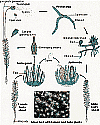
moss life cycle
American botanist who was an expert on the anatomical structure and life cycles of mosses, ferns and liverworts. He was interested in establishing the evolution of vascular plants, which he believed occurred on land from primitive mosses. He also studied the geographic distribution of plants. At a time before it was generally accepted, he thought Wegener's theory of Continental Drift (1912) was plausible. Campbell recognized that a primordial supercontinent, Gondwana, splitting into smaller land masses that drifted apart would resolve many of the puzzling facts in geographical distribution, both of animals and plants.«
Died 24 Feb 1947 at age 87 (born 30 May 1859). quotes
French psychopathologist and neurologist influential in bringing about in France and the United States a connection between academic psychology and the clinical treatment of mental illnesses. He stressed psychological factors in hypnosis and contributed to the modern concept of mental and emotional disorders involving anxiety, phobias, and other abnormal behaviour. Janet is remembered for his dissociation theory of hysteria and hypnosis. His first case study, that of a hypnotic subject named Léonie, was published in 1886. He introduced the words dissociation and subconscious into psychological terminology and attributed hysteria and hypnotic susceptibility to inherited dispositions toward imbalances in psychic energy and psychic tension.
French psychopathologist and neurologist influential in bringing about in France and the United States a connection between academic psychology and the clinical treatment of mental illnesses. He stressed psychological factors in hypnosis and contributed to the modern concept of mental and emotional disorders involving anxiety, phobias, and other abnormal behaviour. Janet is remembered for his dissociation theory of hysteria and hypnosis. His first case study, that of a hypnotic subject named Léonie, was published in 1886. He introduced the words dissociation and subconscious into psychological terminology and attributed hysteria and hypnotic susceptibility to inherited dispositions toward imbalances in psychic energy and psychic tension.
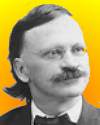
c. 1887
Died 24 Feb 1923 at age 85 (born 29 Jan 1838).
American chemist who is best known for his collaboration with the physicist A.A. Michelson in an attempt to measure the relative motion of the Earth through a hypothetical ether (1887). He also studied the variations of atmospheric oxygen content. He specialized in accurate quantitative measurements, such as those of the vapour tension of mercury, thermal expansion of gases, or the combining weights of hydrogen and oxygen. Morley assisted Michelson in the latter's persuit of measurements of the greatest possible accuracy to detect a difference in the speed of light through an omnipresent ether. Yet the ether could not be detected and the physicists had seriously to consider that the ether did not exist, even questioning much orthodox physical theory.
American chemist who is best known for his collaboration with the physicist A.A. Michelson in an attempt to measure the relative motion of the Earth through a hypothetical ether (1887). He also studied the variations of atmospheric oxygen content. He specialized in accurate quantitative measurements, such as those of the vapour tension of mercury, thermal expansion of gases, or the combining weights of hydrogen and oxygen. Morley assisted Michelson in the latter's persuit of measurements of the greatest possible accuracy to detect a difference in the speed of light through an omnipresent ether. Yet the ether could not be detected and the physicists had seriously to consider that the ether did not exist, even questioning much orthodox physical theory.
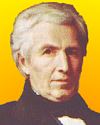
Died 24 Feb 1875 at age 88 (born 20 Apr 1786). quotes
French engineer and inventor of the wire-cable suspension bridge and the tubular steam-engine boiler. Séguin (a nephew of Joseph Montgolfier, the pioneer balloonist) developed an early interest in machinery. By 1822, he was studying the strength of wire cables. With his brother Camille he studied the principles of the suspension bridge, at that time built with chain cables. In 1824, they built a bridge suspended from cables of parallel wire strands over the Rhône River at Tournon, the first such bridge, then copied around the world. Séguin also improved locomotive efficiency with his invention of the multiple fire-tube boiler, in place of the water-tube boiler used by the earlier steam engines. The brothers collaborated in the construction of the first French railroad (1824-33).
French engineer and inventor of the wire-cable suspension bridge and the tubular steam-engine boiler. Séguin (a nephew of Joseph Montgolfier, the pioneer balloonist) developed an early interest in machinery. By 1822, he was studying the strength of wire cables. With his brother Camille he studied the principles of the suspension bridge, at that time built with chain cables. In 1824, they built a bridge suspended from cables of parallel wire strands over the Rhône River at Tournon, the first such bridge, then copied around the world. Séguin also improved locomotive efficiency with his invention of the multiple fire-tube boiler, in place of the water-tube boiler used by the earlier steam engines. The brothers collaborated in the construction of the first French railroad (1824-33).
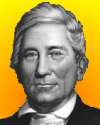
Died 24 Feb 1874 at age 84 (born 4 Feb 1790).
American naturalist and clergyman, a Lutheran minister who published studies of southern animals and works on botany and agriculture. He met John James Audubon in 1831 and helped him write the text of The Birds of America (1840-44). After visiting the German naturalist and explorer Alexander von Humboldt at the University of Berlin in 1838, Bachman did much of the writing and edited all of Audubon's Viviparous Quadrupeds of North America, 3 vol. (1845-49). He also published The Unity of the Human Race (1850), in which he theorized that all humans are of one species. Audubon named the Bachman's Sparrow in honor of his friend. Bachman discovered and named the Bachman's Warbler (a bird probably extinct today).
American naturalist and clergyman, a Lutheran minister who published studies of southern animals and works on botany and agriculture. He met John James Audubon in 1831 and helped him write the text of The Birds of America (1840-44). After visiting the German naturalist and explorer Alexander von Humboldt at the University of Berlin in 1838, Bachman did much of the writing and edited all of Audubon's Viviparous Quadrupeds of North America, 3 vol. (1845-49). He also published The Unity of the Human Race (1850), in which he theorized that all humans are of one species. Audubon named the Bachman's Sparrow in honor of his friend. Bachman discovered and named the Bachman's Warbler (a bird probably extinct today).

Died 24 Feb 1868 at age 77 (born 30 May 1790).
English physicist and journalist was self-educated in mathematics and science. An early interest investigating a theory of lunar motion (1811) led to considering the nature of heat and derived an equation relating the pressure and volume of a gas to the number, mass and speed of its particles. He published a preliminary notice of his theory in Annals of Philosophy in 1816. In his later career, he took an interest in steam-powered transportation, and became the editor (1836) of Railway Magazine and Annals of Science. He published in it his own scientific papers, including one giving a calculation (1932) on the speed of sound in air, which is the first known calculation of the mean molecular speed of a molecule from the kinetic theory of gases, though it is often Joule's later work that is recognized for this accomplishment.
English physicist and journalist was self-educated in mathematics and science. An early interest investigating a theory of lunar motion (1811) led to considering the nature of heat and derived an equation relating the pressure and volume of a gas to the number, mass and speed of its particles. He published a preliminary notice of his theory in Annals of Philosophy in 1816. In his later career, he took an interest in steam-powered transportation, and became the editor (1836) of Railway Magazine and Annals of Science. He published in it his own scientific papers, including one giving a calculation (1932) on the speed of sound in air, which is the first known calculation of the mean molecular speed of a molecule from the kinetic theory of gases, though it is often Joule's later work that is recognized for this accomplishment.
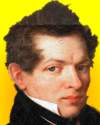
Died 24 Feb 1856 at age 63 (born 1 Dec 1792). quotes
Russian mathematician who, with János Bolyai of Hungary, is considered the founder of non-Euclidean geometry. Lobachevsky constructed and studied a type of geometry in which Euclid’s parallel postulate is false (the postulate states that through a point not on a certain line only one line can be drawn not meeting the first line). This was not well received at first, but his greatest vindication came with the advent of Einstein’s theory of relativity when it was demonstrated experimentally that the geometry of space is not described by Euclid’s geometry. Apart from geometry, Lobachevsky also did important work in the theory of infinite series, algebraic equations, integral calculus, and probabilty.[EB gives New Style: born 1 Dec 1792, died 24 Feb 1856. (Old Style: 20 Nov 1792, died 12 Feb 1856). DSB>give birth as 2 Dec 1792.]
Russian mathematician who, with János Bolyai of Hungary, is considered the founder of non-Euclidean geometry. Lobachevsky constructed and studied a type of geometry in which Euclid’s parallel postulate is false (the postulate states that through a point not on a certain line only one line can be drawn not meeting the first line). This was not well received at first, but his greatest vindication came with the advent of Einstein’s theory of relativity when it was demonstrated experimentally that the geometry of space is not described by Euclid’s geometry. Apart from geometry, Lobachevsky also did important work in the theory of infinite series, algebraic equations, integral calculus, and probabilty.[EB gives New Style: born 1 Dec 1792, died 24 Feb 1856. (Old Style: 20 Nov 1792, died 12 Feb 1856). DSB>give birth as 2 Dec 1792.]
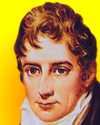
Died 24 Feb 1815 at age 49 (born 14 Nov 1765). quotes
American inventor, engineer and artist who brought steamboating from the experimental stage to commercial success. He did not invent the steamboat, which had been built in the early 1700s, but rather applied his engineering skills to their design. He changed the proportions, arrangements, and velocities of already proposed ideas. In 1807, work was completed on the Clermont, the first steamboat that was truly successful, and the culmination of many years of work. Its maiden voyage was on 17 Aug from New York City to Albany, a distance of 150 miles completed in 32 hours. A mechanical genius with many talents, he also designed a system of inland waterways, a submarine (Nautilus, 1801), and a steam warship. more
American inventor, engineer and artist who brought steamboating from the experimental stage to commercial success. He did not invent the steamboat, which had been built in the early 1700s, but rather applied his engineering skills to their design. He changed the proportions, arrangements, and velocities of already proposed ideas. In 1807, work was completed on the Clermont, the first steamboat that was truly successful, and the culmination of many years of work. Its maiden voyage was on 17 Aug from New York City to Albany, a distance of 150 miles completed in 32 hours. A mechanical genius with many talents, he also designed a system of inland waterways, a submarine (Nautilus, 1801), and a steam warship. more
The Fire of His Genius: Robert Fulton and the American Dream, by Kirkpatrick Sale. - book suggestion.
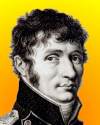
Died 24 Feb 1812 at age 36 (born 23 Jun 1775). quotes
French physicist who discovered that light, when reflected, becomes partially plane polarized; i.e., its rays vibrate in the same plane. He served in Napoleon's corps of engineers, fought in Egypt, and contracted the plague during Napoleon's aborted campaign in Palestine. Posted to Europe after 1801, he began research in optics. In 1808, he discovered that light rays may be polarized by reflection, while looking through a crystal of Iceland spar at the windows of a building reflecting the rays of the Sun. He noticed that on rotating the crystal the light was extinguished in certain positions. Applying corpuscular theory, he argued that light particles have sides or poles and coined the word "polarization."[EB and Chambers Dict. of Sci. give date of birth 23 Jun 1775. For death they give 23 Feb 1812 and 1812 respectively. DSB gives dates 23 Jul 1775 - 24 Feb 1812.]
French physicist who discovered that light, when reflected, becomes partially plane polarized; i.e., its rays vibrate in the same plane. He served in Napoleon's corps of engineers, fought in Egypt, and contracted the plague during Napoleon's aborted campaign in Palestine. Posted to Europe after 1801, he began research in optics. In 1808, he discovered that light rays may be polarized by reflection, while looking through a crystal of Iceland spar at the windows of a building reflecting the rays of the Sun. He noticed that on rotating the crystal the light was extinguished in certain positions. Applying corpuscular theory, he argued that light particles have sides or poles and coined the word "polarization."[EB and Chambers Dict. of Sci. give date of birth 23 Jun 1775. For death they give 23 Feb 1812 and 1812 respectively. DSB gives dates 23 Jul 1775 - 24 Feb 1812.]
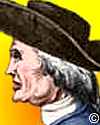
Died 24 Feb 1810 at age 78 (born 10 Oct 1731). quotes
English chemist and physicist who conducted experiments with diverse interests in his private laboratory. Most notably, he determined the mass and density of the Earth. He investigated the properties of hydrogen and carbon dioxide, including comparing their density to that of air. Cavendish also showed that water was a compound and measured the specific heat of various substances. His manuscripts (published 1879) revealed discoveries he made in electrostatics before Coulomb, Ohm and Faraday - including deducing the inverse square law of electrostatic attraction and repulsion. He also found specific inductive capacity. His family name is attached to the Cavendish Laboratory (founded 1871, funded by a later family member) at Cambridge University.« more
English chemist and physicist who conducted experiments with diverse interests in his private laboratory. Most notably, he determined the mass and density of the Earth. He investigated the properties of hydrogen and carbon dioxide, including comparing their density to that of air. Cavendish also showed that water was a compound and measured the specific heat of various substances. His manuscripts (published 1879) revealed discoveries he made in electrostatics before Coulomb, Ohm and Faraday - including deducing the inverse square law of electrostatic attraction and repulsion. He also found specific inductive capacity. His family name is attached to the Cavendish Laboratory (founded 1871, funded by a later family member) at Cambridge University.« more
Cavendish: The Experimental Life, by Christa Jungnickel and Russell McCormmach. - book suggestion.
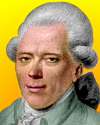
Died 24 Feb 1799 at age 56 (born 1 Jul 1742). quotes
German physicist and satirical writer, best known for his aphorisms and his ridicule of metaphysical and romantic excesses. At Göttingen University, Lichtenberg did research in a wide variety of fields, including geophysics, volcanology, meteorology, chemistry, astronomy, and mathematics. His most important were his investigations into physics. Notably, he constructed a huge electrophorus and, in the course of experimentations, discovered in 1777 the basic principle of modern xerographic copying; the images that he reproduced are still called “Lichtenberg figures.” These are radial patterns formed when sharp, pointed conducting bodies at high voltage get near enough to insulators to discharge electrically, or seen on persons struck by lightning.
German physicist and satirical writer, best known for his aphorisms and his ridicule of metaphysical and romantic excesses. At Göttingen University, Lichtenberg did research in a wide variety of fields, including geophysics, volcanology, meteorology, chemistry, astronomy, and mathematics. His most important were his investigations into physics. Notably, he constructed a huge electrophorus and, in the course of experimentations, discovered in 1777 the basic principle of modern xerographic copying; the images that he reproduced are still called “Lichtenberg figures.” These are radial patterns formed when sharp, pointed conducting bodies at high voltage get near enough to insulators to discharge electrically, or seen on persons struck by lightning.
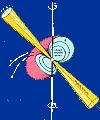
In 1968, Nature carried the announcement of the discovery of a pulsar (a pulsating radio source). The first pulsar was discovered by a graduate student, Jocelyn Bell, on 28 Nov 1967, then working under the direction of Prof. Anthony Hewish. The star emitted radio pulses with clock-like precision. It was observed at the Mullard Radio Astronomy Observatory, Cambridge University, England. A special radio telescope, was used with 2,048 antennae arrayed across 4.4 acres. Pulsars prompted studies in quantum-degenerate fluids, relativistic gravity and interstellar magnetic fields.«
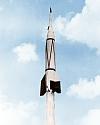
In 1949, "the first recorded man-made object to reach extraterrestrial space" was launched from the White Sands Proving Grounds, New Mexico. The two-stage rocket, called "Bumper WAC Corporal" Round 5, had a first stage that was a V-2 rocket (German A-4) rocket with the warhead replaced by a launching compartment. After the V-2 reached its highest altitude, the second stage was launched having received its "bump" toward outer space from it. From its mount in the nose cone a modified "WAC Corporal" sounding rocket which completed the flight. It was the first to carry telemetry transmitting technical information to groud stations, including high-altitude temperature measurements. It reached a record speed of 5,150 mph and a record altitude of 244 miles.«

In 1938, DuPont began commercial production of nylon toothbrush bristles for the so-called “Miracle Tuft Toothbrush.” Before 1938, the world relied on toothbrush bristles of neck hairs from wild swine from Siberia, Poland and China. When DuPont created nylon it was the toothbrush which was the first item to benefit from the use of nylon. There were many advantages in this new brush including a dramatic reduction in production costs and the ability to control bristle texture. Wheareas, whereas bristles made with wild boar hairs fell out, wouldn't dry very well or became full of bacteria. At first, the consumers were not entirely satisfied because the early nylon bristles were very stiff and hurt the gums. By 1950, Du Pont produced softer nylon bristles.
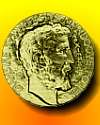
In 1931, the Fields Medal was established to recognize outstanding contributions to mathematics. It was conceived since there was no Nobel Prize for mathematicians. Although John Charles Fields probably thought of the medal at some earlier time, the first recorded mention of it was made on 24 Feb 1931 in minutes of a committee meeting. He was chairman of the Committee of the International Congress which had been set up by the University of Toronto to organize the 1924 Congress in Toronto. After the event, Fields proposed that income of $2,500 remaining from that convention would be designated for two medals to be awarded at future International Mathematical Congresses. In 1936, the first awards were made in Oslo.« [Image: Obverse of the Fields Medal, showing a picture of Archimedes] more
[Image: Obverse of the Fields Medal, showing a picture of Archimedes] more
In 1925, an ice jam was removed using thermite for the first time in the U.S. Some 250,000-tons of ice jamming the St. Lawrence River near Waddington, N.Y., broke up just hours after the reaction of three 90-lb thermite charges (a mixture of finely divided magnesium and red iron oxide, which, when ignited, gives a violent reaction that produces hot molten iron.) The method was devised by Howard Turner Barnes, of McGill University, Canada, and patented 17 Nov 1925 (U.S. No. 1,562,137). The following year he similarly helped break up an ice gorge in a stretch of the Allegheny River, at Franklin, Pa. He had studied of the properties of ice and the engineering problem of ice at intakes of hydroelectric stations on the St. Lawrence River. He succeeded (1908) Ernest Rutherford as Macdonald Professor of Physics.«[Image: Small-scale thermite reaction on ice.] more
In 1924, U.S. Navy officials and the media witnessed the 95-sec flight of the latest design of a helicopter - designated No. 5 - built by Henry Berliner. It reached a height of 15-ft and could maneuver in a radius of 150-ft, at a speed up to about 40 mph. The 641-lb aircraft had rigid wings spanning 38-ft with a 13-ft diameter rotor mounted on each winf that provided the power for the flight. Although in the past two decades there had been trials of helicopters designed by others (including Berliner's father Emile on 11 Jul 1908), this day's test is claimed to be the first controlled helicopter flight. The aircraft - the oldest intact helicopter in the world - is now loaned by the Smithsonian Institution for display at Berliner's testing site in College Park Aviation Museum, Maryland.«
In 1908, the U.S. awarded its first airship contract to Capt. Thomas S. Baldwin, chosen from bids received on 15 Feb 1908. The request for bids on a lighter-than-air airship had been made by the Chief Signal Officer on 16 Dec 1907. (Baldwin received this government contract just 3½ years since he had made the first successful U.S.-made airship circuit flight in his California Arrow, on 3 Aug 1904 and exhibited at the St. Louis World's Fair on 31 Oct 1904.) A week after requesting bids on an airship, on 23 Dec 1907, the government provided specifications and called for bids on its first heavier-than-air military flying machine.«
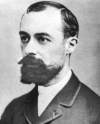
In 1896, Henri Becquerel read a report to the French Academy of Sciences of his investigation of the phosphorescent rays of some “double sulfate of uranium and potassium” crystals. He reported that he placed the crystals on the outside of a photographic plate wrapped in sheets of very thick black paper and exposed the whole to the sun for several hours. When he developed the photographic plate, he saw a black silhouette of the substance, exposed on the negative. When he placed a coin or metal screen between the uranium crystals and the wrapped plate, he saw images of those objects on the negative. He did not yet know yet that the sun is not necessary to initiate the rays, nor did he yet realize that he had accidentally discovered radioactivity. He would learn more from a further accidental discovery on 26 Feb 1896.
more
Radioactivity: A History of a Mysterious Science, by Marjorie C. Malley. - book suggestion.
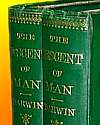
In 1871, Charles Darwin's Descent of Man was published in London. In it, Darwin wrote, "The sole object of this work is to consider, firstly, whether man, like every other species, is descended from some pre-existing form; secondly, the manner of his development; and thirdly, the value of the differences between the so-called races of man... During many years it has seemed to me highly probable that sexual selection has played an important part in differentiating the races of man; but in my Origin of Species I contented myself by merely alluding to this belief. When I came to apply this view to man, I found it indispensable to treat the whole subject in full detail."[Image: titles on the two-volume first edition of Descent of Man.]
From So Simple a Beginning: Darwin's Four Great Books, by Charles Darwin, Edward O. Wilson. - book suggestion.
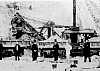
In 1839, Mr. William Smith Otis, civil engineer of Philadelphia, Penn., was issued a U.S. patent for the steam shovel (No. 1,089) for excavating and removing earth from railroads or canals. The patent drawing showed the crane mounted on a carriage or railroad car. A load of earth could be taken up by the scraper, raised by the crane and turned to be dumped, such as in railcars, and released. The patent described how a steam engine of a kind already in ordinary use, was installed with a power control mechanism for the crane, and a system of pulleys to move its arms and bucket. It could move about 380 cubic metres of earth a day, with its 1.1 cubic metre capacity shovel and 180° slewing wooden jib. It was first used on the Western Railroad in Mass.[Image: Steam shovel built by John Souther in his Globe Locomotive Works in South Boston, Mass. shown behind railcars it is loading with gravel (1857).]




