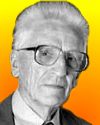
Born 3 Aug 1915; died 7 Nov 2003 at age 88. quotes
Donald Redfield Griffin was an American biophysicist, known for his research in animal navigation, animal behaviour, and sensory biophysics. With Robert Galambos, he studied bat echolocation (1938), a term he coined (1944) for how the bat's ears replace eyes in flight guidance. Using specialized high-frequency sound equipment by G.W. Pierce, they found that bats in flight produced ultrasonic sounds used to avoid obstacles. In WW II, he used physiological principles to design such military equipment as cold-weather clothing and headphones. Griffin also worked extensively on bird navigation. In the late 1940s, he flew in a Piper Cub to observe the flight paths of gannets and gulls. In his career, he pioneered rigorous techniques to study animals in their natural environment.«
Donald Redfield Griffin was an American biophysicist, known for his research in animal navigation, animal behaviour, and sensory biophysics. With Robert Galambos, he studied bat echolocation (1938), a term he coined (1944) for how the bat's ears replace eyes in flight guidance. Using specialized high-frequency sound equipment by G.W. Pierce, they found that bats in flight produced ultrasonic sounds used to avoid obstacles. In WW II, he used physiological principles to design such military equipment as cold-weather clothing and headphones. Griffin also worked extensively on bird navigation. In the late 1940s, he flew in a Piper Cub to observe the flight paths of gannets and gulls. In his career, he pioneered rigorous techniques to study animals in their natural environment.«
Animal Minds: Beyond Cognition to Consciousness, by Donald R. Griffin. - book suggestion.
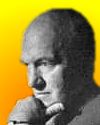
Born 3 Aug 1909; died 23 Mar 2002 at age 92.
Neal Elgar Miller was an American psychologist and neuroscientist who was the first to identify and promote biofeedback. He demonstrated experimentally that individuals may learn to control their heart rate and digestion in the same sense that walking is a learned activity. This work began in the 1950s when he investigated how such functions of the autonomic system could be consciously controlled by an animal or person. Proof came from his experiments with rats that he trained to control these functions using a system of rewards and punishment. At first, few scientists accepted these ideas, but gradually his theories on biofeedback gained support and are now widely accepted. In 1964, he was awarded the National Medal of Science.«
Neal Elgar Miller was an American psychologist and neuroscientist who was the first to identify and promote biofeedback. He demonstrated experimentally that individuals may learn to control their heart rate and digestion in the same sense that walking is a learned activity. This work began in the 1950s when he investigated how such functions of the autonomic system could be consciously controlled by an animal or person. Proof came from his experiments with rats that he trained to control these functions using a system of rewards and punishment. At first, few scientists accepted these ideas, but gradually his theories on biofeedback gained support and are now widely accepted. In 1964, he was awarded the National Medal of Science.«
Social Learning and Imitation, by Neal Elgar Miller and John Dollard. - book suggestion.
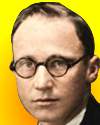
Born 3 Aug 1900; died 21 Oct 1970 at age 70. quotes
John Thomas Scopes was an American teacher and geologist whose was the defendant in the infamous Scopes Monkey Trial (10 Jul 1925), challenging the constitutionality of the Butler Act, a Tennessee law signed 21 Mar 1925to prohibit the teaching of evolution in the state’s schools. He took a job at Tennessee high-school in Spring 1924, teaching algebra, chemistry and physics for one year. Then, although he wasn't sure he had actually done any teaching of evolution, nevertheless, at the urging of businessmen wanting publicity for Dayton, Tennessee, he agreed to stand trial in a test case funded by the American Civil Liberties Union. Although the trial jury voted guilty, on appeal, the verdict was thrown out on a technicality. After the trial Scopes earned a master’s degree in geology, and went to work for the Gulf Oil Co., and later United Gas Corp.«
John Thomas Scopes was an American teacher and geologist whose was the defendant in the infamous Scopes Monkey Trial (10 Jul 1925), challenging the constitutionality of the Butler Act, a Tennessee law signed 21 Mar 1925to prohibit the teaching of evolution in the state’s schools. He took a job at Tennessee high-school in Spring 1924, teaching algebra, chemistry and physics for one year. Then, although he wasn't sure he had actually done any teaching of evolution, nevertheless, at the urging of businessmen wanting publicity for Dayton, Tennessee, he agreed to stand trial in a test case funded by the American Civil Liberties Union. Although the trial jury voted guilty, on appeal, the verdict was thrown out on a technicality. After the trial Scopes earned a master’s degree in geology, and went to work for the Gulf Oil Co., and later United Gas Corp.«
Center of the Storm: Memoirs of John T. Scopes, by John Scopes. - book suggestion.
Born 3 Aug 1875; died 15 Jul 1930 at age 54. quotes
American physician who championed the use of scopolamine hydrobromide in criminology, which became known as a “truth serum.” Based on research into its use as a general birth anaesthetic by J. Christian Gauss, House interpreted from the results that a patient in the twilight state was unable to tell a lie. From 1924, House convinced Texas criminologists, to use the drug to “assist” in determination of guilt or innocence of a suspect. Later, it was found by legal challenges and CIA research in the 1950s that House's confidence was misplaced; its value was very much exaggerated. Any “truth” confessed under the drug's influence was distorted by the drug's halucinogenic side effects. Such use was ended. (Scopolamine is still used in minute doses to control motion sickness, and as a veterinary preanesthetic medication.« more
American physician who championed the use of scopolamine hydrobromide in criminology, which became known as a “truth serum.” Based on research into its use as a general birth anaesthetic by J. Christian Gauss, House interpreted from the results that a patient in the twilight state was unable to tell a lie. From 1924, House convinced Texas criminologists, to use the drug to “assist” in determination of guilt or innocence of a suspect. Later, it was found by legal challenges and CIA research in the 1950s that House's confidence was misplaced; its value was very much exaggerated. Any “truth” confessed under the drug's influence was distorted by the drug's halucinogenic side effects. Such use was ended. (Scopolamine is still used in minute doses to control motion sickness, and as a veterinary preanesthetic medication.« more
Born 3 Aug 1851; died 21 Feb 1901 at age 49. quotes
Irish physicist whose suggestion of a way to produce waves helped lay a foundation for wireless telegraphy. He also first developed a theory, independently discovered by Hendrik Lorentz, that a material object moving through an electromagnetic field would exhibit a contraction of its length in the direction of motion. This is now known as the Lorentz-FitzGerald contraction, which Albert Einstein used in his own special theory of relativity. He also was first to propose the structure of comets as a head made of large stones, but a tail make of such smaller stones (less than 1-cm diam.) that the pressure of light radiation from the sun could deflect them. FitzGerald also studied electrolysis as well as electromagnetic radiation.«
Irish physicist whose suggestion of a way to produce waves helped lay a foundation for wireless telegraphy. He also first developed a theory, independently discovered by Hendrik Lorentz, that a material object moving through an electromagnetic field would exhibit a contraction of its length in the direction of motion. This is now known as the Lorentz-FitzGerald contraction, which Albert Einstein used in his own special theory of relativity. He also was first to propose the structure of comets as a head made of large stones, but a tail make of such smaller stones (less than 1-cm diam.) that the pressure of light radiation from the sun could deflect them. FitzGerald also studied electrolysis as well as electromagnetic radiation.«
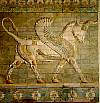
Born 3 Aug 1844; died 25 Feb 1920 at age 75.
French archaeologist and civil engineer who in 1884-86 undertook major excavations at the ancient site of Susa (modern Shush, Iran) uncovering the palaces of the ancient Persian kings Darius I the Great and Artaxerxes II. He was helped by a French physician at the Persian court to reopen the 1852 excavations done by W.K. Loftus. Dieulafoy's exploration resulted in revealing part of the palace and other structures, and in settling the topographical details of the city. He also recovered unique and beautiful features of art and architecture, including the pillars with capitals of bulls' heads, three great porticoes and the hall of columns, the frieze of lions, and that of archers now in the Louvre.«Image: winged bull glazed bricks from Susa (Louvre).
French archaeologist and civil engineer who in 1884-86 undertook major excavations at the ancient site of Susa (modern Shush, Iran) uncovering the palaces of the ancient Persian kings Darius I the Great and Artaxerxes II. He was helped by a French physician at the Persian court to reopen the 1852 excavations done by W.K. Loftus. Dieulafoy's exploration resulted in revealing part of the palace and other structures, and in settling the topographical details of the city. He also recovered unique and beautiful features of art and architecture, including the pillars with capitals of bulls' heads, three great porticoes and the hall of columns, the frieze of lions, and that of archers now in the Louvre.«Image: winged bull glazed bricks from Susa (Louvre).
Born 3 Aug 1811; died 8 Apr 1861 at age 49.
American inventor of the automatic safety brake for elevators, which later made high-rise buildings practical. Before this invention, elevators of his time were extremely dangerous. In 1852, he was employed at a New York bed factory. He realized the need for a “safety elevator” to move people and equipment safely to the upper floors of the building. He strikingly demonstrated his solution at the Crystal Palace Exposition in New York in 1854. In front of a large crowd, Otis ascended in his new elevator. He called for the elevator's cable to be cut with an axe, but the elevator platform did not fall. The brake he invented used toothed guiderails in the elevator shaft and a spring-loaded bar that automatically caught in the toothed rail if the elevator car if the cable failed.
American inventor of the automatic safety brake for elevators, which later made high-rise buildings practical. Before this invention, elevators of his time were extremely dangerous. In 1852, he was employed at a New York bed factory. He realized the need for a “safety elevator” to move people and equipment safely to the upper floors of the building. He strikingly demonstrated his solution at the Crystal Palace Exposition in New York in 1854. In front of a large crowd, Otis ascended in his new elevator. He called for the elevator's cable to be cut with an axe, but the elevator platform did not fall. The brake he invented used toothed guiderails in the elevator shaft and a spring-loaded bar that automatically caught in the toothed rail if the elevator car if the cable failed.
Otis Giving Rise to the Modern City: Giving Rise to the Modern City, by Jason Goodwin. - book suggestion.
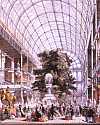
English architect who designed the Crystal Palace for the Great Exhibition of 1851 in Hyde Park, London. In 1832, Paxton became Manager to the Duke of Devonshire's estates where he created lakes, arboreta, and greenhouses. Between 1836-40 he designed and built a large greenhouse, at the time the largest glass building in the world. In 1844 he constructed the "emperor fountain", at 280 feet the tallest in Europe. He also built a second smaller glasshouse for a giant Amazonian lily where it flowered in 1849, the first time ever in cultivation. Paxton's superiority in conservatory design led to his work as the innovative architect of the Crystal Palace. In his later years he was active in urban planning projects.[Image right: Great Exhibition, interior of Crystal Palace. Although EB gives his birth year as 1801, Paxton's gravestone shows 1803. John Anthony explains, in his 1973 biography, that the confusion began when Paxton had felt the need to appear older to gain employment at the Horticultural Society (1823), and misrepresented to them that he was born in 1801.]
The Busiest Man in England: A Life of Joseph Paxton, Gardener, Architect & Victorian Visionary, by Kate Colquhoun. - book suggestion.
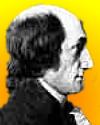
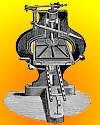
English politician (3rd Earl Stanhope) who believed strongly in the liberty of the individual. He was also an active experimental scientist and inventor. In 1771, he won a prize from the Swedish Academy for a paper on the pendulum, and was elected a fellow of the Royal Society in Nov 1772 before his 20th birthday. His Principles of Electricity (1779) included his nacent theory on the “return stroke” of electric current resulting from lightning's contact with the earth. He introduced the first successful iron-frame printing press (1798) and a process of stereotyping to produce moulds from a printing forme to cast printing plates. He worked in steam navigation (1795-97), invented a microscope lens and created two calculating machines.«[Image right: Stanhope printing press.]
Charles Earl Stanhope and the Oxford University Press, by Horace Hart. - book suggestion.

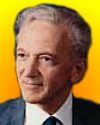
Died 3 Aug 2003 at age 79 (born 12 Apr 1924).
Austrian-American physician whose pioneering "Kiss of Life" procedure of mouth-to-mouth resuscitations is credited with saving countless lives. In the 1960s the technique was combined with new chest compressions, producing what's known today as CPR, or cardio-pulmonary resuscitation. He also helped create the organization that, in 1976, became the World Association for disaster and Emergency Medicine. Although there are ancient references to the apparent use of mouth-to-mouth resuscitation in the Bible, the technique fell out of practice until rediscovered by Safar in the 1950s. Also credited with playing a key role was his colleague, Dr James Elam. Safar survived a Nazi labor camp before emigrating to the U.S. after WW II.
Austrian-American physician whose pioneering "Kiss of Life" procedure of mouth-to-mouth resuscitations is credited with saving countless lives. In the 1960s the technique was combined with new chest compressions, producing what's known today as CPR, or cardio-pulmonary resuscitation. He also helped create the organization that, in 1976, became the World Association for disaster and Emergency Medicine. Although there are ancient references to the apparent use of mouth-to-mouth resuscitation in the Bible, the technique fell out of practice until rediscovered by Safar in the 1950s. Also credited with playing a key role was his colleague, Dr James Elam. Safar survived a Nazi labor camp before emigrating to the U.S. after WW II.
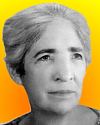
Died 3 Aug 1969 at age 80 (born 6 Dec 1888). quotes
U.S. zoologist who wrote two laboratory manuals and a comprehensive six-volume reference work, The Invertebrates, (1940-67) covering most phyla of its subject. This work, important for its organization, description and classification of invertebrates, is a reference still used today. Hyman continued her laboratory studies throughout her life and published some 145 scientific papers. The sixth volume was her last, completed at the age of seventy-eight, when she was suffering from Parkinson's disease.
U.S. zoologist who wrote two laboratory manuals and a comprehensive six-volume reference work, The Invertebrates, (1940-67) covering most phyla of its subject. This work, important for its organization, description and classification of invertebrates, is a reference still used today. Hyman continued her laboratory studies throughout her life and published some 145 scientific papers. The sixth volume was her last, completed at the age of seventy-eight, when she was suffering from Parkinson's disease.
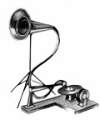
German-American inventor who made important contributions to telephone technology and developed the phonograph record disk, the microphone in 1877 and the gramophone in 1887. Whereas Thomas Edison invented cylindrical records, Berliner came up with the idea of using disks. He coined the word gramophone as is trademark. Later, he became a pioneer in helicopter design.
Died 3 Aug 1927 at age 60 (born 11 Jan 1867). quotes
English psychologist and a major figure in the establishment of experimental psychology in the United States. A disciple of the German psychologist Wilhelm Wundt, the founder of experimental psychology, Titchener gave Wundt's theory on the scope and method of psychology a precise, systematic expression. The acknowledged leader of structuralism, Titchener was rated as the most distinguished psychologist in the United States, its most representative experimentalist, and an inspiring teacher who guided many of his pupils in the direction of scientific procedure.
English psychologist and a major figure in the establishment of experimental psychology in the United States. A disciple of the German psychologist Wilhelm Wundt, the founder of experimental psychology, Titchener gave Wundt's theory on the scope and method of psychology a precise, systematic expression. The acknowledged leader of structuralism, Titchener was rated as the most distinguished psychologist in the United States, its most representative experimentalist, and an inspiring teacher who guided many of his pupils in the direction of scientific procedure.
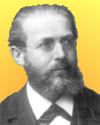
Died 3 Aug 1917 at age 67 (born 26 Oct 1849).
Ferdinand Georg Frobenius was a German mathematician who made major contributions to group theory, especially the concept of abstract groups (with Ludwig Stickleberger) and the theory of finite groups of linear substitutions (with Issai Schur), that later found important uses in the theory of finite groups as it applies to quantum mechanics. He also contributed to means of solving linear homogenous differential equations. The fact so many of Frobenius's papers read like present day text-books on the topics which he studied is a clear indication of the importance that his work, in many different areas, has had in shaping the mathematics which is studied today.
Ferdinand Georg Frobenius was a German mathematician who made major contributions to group theory, especially the concept of abstract groups (with Ludwig Stickleberger) and the theory of finite groups of linear substitutions (with Issai Schur), that later found important uses in the theory of finite groups as it applies to quantum mechanics. He also contributed to means of solving linear homogenous differential equations. The fact so many of Frobenius's papers read like present day text-books on the topics which he studied is a clear indication of the importance that his work, in many different areas, has had in shaping the mathematics which is studied today.
Pioneers of Representation Theory: Frobenius, Burnside, Schur, and Brauer, by Charles W. Curtis. - book suggestion.
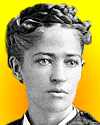
Died 3 Aug 1913 at age 74 (born 8 Mar 1839).
Josephine Garis Cochran was an inventor invented a commercially viable design for a dishwasher using water jets aimed at the china held firmly in a rack. She was inspired to have an efficient way to clean dishes, also safer from chipping and breaking, than by servants. U.S. patent, No. 355,139 was issued to her on 28 Dec 1886. Once developed, she started advertising her product as the Garis-Cochran Dish-Washing Machine Co. It was a big boost for her business when her machines were used in the large kitchens at the 1893 Columbian Exposition. Her father, John Garis was a civil engineer. A great-grandfather was John Fitch, the steam boat inventor. By 1940, her company evolved into Kitchen Aid, of Whirlpool Corp.«
Josephine Garis Cochran was an inventor invented a commercially viable design for a dishwasher using water jets aimed at the china held firmly in a rack. She was inspired to have an efficient way to clean dishes, also safer from chipping and breaking, than by servants. U.S. patent, No. 355,139 was issued to her on 28 Dec 1886. Once developed, she started advertising her product as the Garis-Cochran Dish-Washing Machine Co. It was a big boost for her business when her machines were used in the large kitchens at the 1893 Columbian Exposition. Her father, John Garis was a civil engineer. A great-grandfather was John Fitch, the steam boat inventor. By 1940, her company evolved into Kitchen Aid, of Whirlpool Corp.«
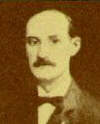
Died 3 Aug 1888 at age 46 (born 4 Nov 1841).
Benjamin Franklin Goodrich was an American industrialist who founded the B.F. Goodrich Rubber Co. in Akron, Ohio. After the Civil War, during which he served as an Army surgeon, Goodrich with J.P. Morris acquired the Hudson River Rubber Co. for $5,000.00 under a license agreement with Charles Goodyear. This company, failed, as did their next in Melrose, NY. Goodrich moved to Akron and began a partnership, the Goodrich, Tew and Co., on 31 Dec 1870 and began making such rubber products as fire hoses, industrial belts and bicycle tires on 19 Feb 1871. Following its reorganization (1874), the B.F. Goodrich Company was incorporated in 1880.
Benjamin Franklin Goodrich was an American industrialist who founded the B.F. Goodrich Rubber Co. in Akron, Ohio. After the Civil War, during which he served as an Army surgeon, Goodrich with J.P. Morris acquired the Hudson River Rubber Co. for $5,000.00 under a license agreement with Charles Goodyear. This company, failed, as did their next in Melrose, NY. Goodrich moved to Akron and began a partnership, the Goodrich, Tew and Co., on 31 Dec 1870 and began making such rubber products as fire hoses, industrial belts and bicycle tires on 19 Feb 1871. Following its reorganization (1874), the B.F. Goodrich Company was incorporated in 1880.
B. F. Goodrich: Tradition and Transformation, 1870-1995, by Mansel G. Blackford and K. Austin Kerr. - book suggestion.
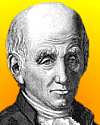
Died 3 Aug 1806 at age 79 (born 7 Apr 1727).
French botanist who established natural classification as a fundamental aim of biology. From 1748 he spent five years exploring Senegal, where he not only described and collected its flora and fauna, but also collected objects of commerce, drew maps, made meteorological and astronomical observations, and studied the languages. He classified the mollusks in an original way: by the anatomical structure of the living animals within the shells. The number and diversity of tropical plants in Senegal led him to consider grouping plants based on all their physical characteristics (rather than a few arbitrarily selected ones), with an emphasis on families. In 1763, he published his sytem in Familles des Plantes. The baobob tree is known by the genus Adansonia.«
French botanist who established natural classification as a fundamental aim of biology. From 1748 he spent five years exploring Senegal, where he not only described and collected its flora and fauna, but also collected objects of commerce, drew maps, made meteorological and astronomical observations, and studied the languages. He classified the mollusks in an original way: by the anatomical structure of the living animals within the shells. The number and diversity of tropical plants in Senegal led him to consider grouping plants based on all their physical characteristics (rather than a few arbitrarily selected ones), with an emphasis on families. In 1763, he published his sytem in Familles des Plantes. The baobob tree is known by the genus Adansonia.«
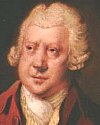
Died 3 Aug 1792 at age 59 (born 23 Dec 1732). quotes
English industrialist and inventor whose introduction of power-driven mechanization of textile factory production methods were enormously successful. The Spinning-Frame machine he invented (1769, British patent No. 931) to spin cotton yarn used multiple sets of paired rollers that turned at different speeds able to draw out yarn of the correct thickness, and a set of spindles to twist the fibres firmly together. It produced a far stronger thread that that made by the Spinning-Jenny of James Hargreaves. Arkwright's machine was too large to be manually driven, so he powered it with a water-wheel (1771) when it became known as the Water Frame. Arkwright's textile business expanded, he built more factories, and later adopted steam power.«
English industrialist and inventor whose introduction of power-driven mechanization of textile factory production methods were enormously successful. The Spinning-Frame machine he invented (1769, British patent No. 931) to spin cotton yarn used multiple sets of paired rollers that turned at different speeds able to draw out yarn of the correct thickness, and a set of spindles to twist the fibres firmly together. It produced a far stronger thread that that made by the Spinning-Jenny of James Hargreaves. Arkwright's machine was too large to be manually driven, so he powered it with a water-wheel (1771) when it became known as the Water Frame. Arkwright's textile business expanded, he built more factories, and later adopted steam power.«
The Arkwrights: Spinners of Fortune, by R.S Fitton. - book suggestion.
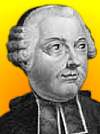
Died 3 Aug 1780 at age 64 (born 30 Sep 1715).
French philosopher, psychologist, logician, economist, and the leading advocate in France of the ideas of John Locke (1632-1704). In his works La Logique (1780) and La Langue des calculs (1798), Condillac emphasized the importance of language in logical reasoning, stressing the need for a scientifically designed language and for mathematical calculation as its basis. He combined elements of Locke's theory of knowledge with the scientific methodology of Newton; all knowledge springs from the senses and association of ideas. Condillac devoted careful attention to questions surrounding the origins and nature of language, and enhanced contemporary awareness of the importance of the use of language as a scientific instrument.[Death date as given in Dict. of Sci. Bio. Enc. Brit. gives death as 2/3 Aug 1780.]
French philosopher, psychologist, logician, economist, and the leading advocate in France of the ideas of John Locke (1632-1704). In his works La Logique (1780) and La Langue des calculs (1798), Condillac emphasized the importance of language in logical reasoning, stressing the need for a scientifically designed language and for mathematical calculation as its basis. He combined elements of Locke's theory of knowledge with the scientific methodology of Newton; all knowledge springs from the senses and association of ideas. Condillac devoted careful attention to questions surrounding the origins and nature of language, and enhanced contemporary awareness of the importance of the use of language as a scientific instrument.[Death date as given in Dict. of Sci. Bio. Enc. Brit. gives death as 2/3 Aug 1780.]
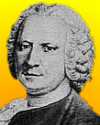
Died 3 Aug 1770 at age 66 (born 16 Sep 1703).
French apothecary and chemist, who first proposed the modern definition of salts, and was first to distinguish neutral, acid, and basic salts. In 1742 he was appointed experimental demonstrator of chemistry at the Jardin du Roi in Paris. He founded the French school of chemistry. He also explained the dehydrating action of sulfuric acid, proposed a theory of distillation, studied the reaction of essential oils with nitric acid, studied the chemical components of plants, analyzed mineral waters and established that the Egyptians used sodium carbonate, succinic acid, and coal to effect mummification. Antoine Laurent Lavoisier and Joseph Proust were among his students.
French apothecary and chemist, who first proposed the modern definition of salts, and was first to distinguish neutral, acid, and basic salts. In 1742 he was appointed experimental demonstrator of chemistry at the Jardin du Roi in Paris. He founded the French school of chemistry. He also explained the dehydrating action of sulfuric acid, proposed a theory of distillation, studied the reaction of essential oils with nitric acid, studied the chemical components of plants, analyzed mineral waters and established that the Egyptians used sodium carbonate, succinic acid, and coal to effect mummification. Antoine Laurent Lavoisier and Joseph Proust were among his students.
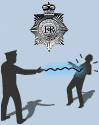
In 2003, police in London, England, used the Taser electric stun gun on a suspect for the first time in that country. It was part of a year-long trial commenced 21 Apr 2003 as an alternative to conventional guns. A man had called police, saying he had been shot. When the police arrived, they found he was carrying two handguns. The Taser was fired during a brief seige that followed, though one of its pair of barbed darts attached to cables failed to make contact on the man and the 50,000-volt electric shock was not delivered. The Daily Telegraph reported on 5 Aug 2003, that a spokesman for the Association of Chief Police Officers said the use of the Taser was the first operational deployment against a human suspect in England and Wales.
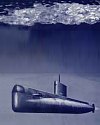
In 1958, the USS Nautilus, became the first submarine to travel under the geographic North Pole. This was the first atomic-powered submarine in the U.S. Navy. Attempts earlier in the year had failed due to unfavorable ice-pack conditions. The crew created a post office while under the North Pole and canceled their letters with a home-made North Pole Stamp. (The Post Master General later declared it to be a legal post office.) Cmdr. W.R. Anderson (who afterwards received the Medal of Merit) sailed with 116 crewmen, at a speed of about 20 knots. Between 1-5 Aug 1958, the Nautilus had traveled 1,830 miles at 400-ft under the 10 to 15-ft thick icecap, and discovered the Arctic Basin under the pole was 13,410 feet deep.«
In 1926, the first traffic lights in Britain were installed at Piccadilly Circus.
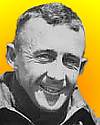
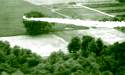
John Macready - Aviation Pioneer: At the Earth's Ceiling, by Sally Macready Wallace. - book suggestion.
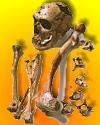
In 1908, a nearly complete, buried, skeleton of a Neanderthal was discovered in a cave at La Chapelle-aux-Saints, France, by two young clergymen, brothers Amédée and Jean Bouyssonie. It was examined by Marcellin Boule, who overlooked its arthritic condition, and his published description that characterized the Neanderthal as a shuffling, bent-kneed, and hairy creature capable of "rudimentary intellectual abilities" became stereotypical. This mistake was corrected by research in the 1950s. The species had been named after the Neander Valley, Germany, where the earliest find was made in Aug 1856. Neanderthal fossils have since been found at 80 sites in Europe, the Middle East and parts of Western Asia.
In 1908, the Philadelphia Subway opened, also known as Tube Transportation. The original 1908 section, built with private capital, ran east and west in Market Street. Municipal funds were not used until a subsequent line that opened in 1928.
In 1904, the first successful airship circuit flight in the U.S. was made by Capt. Thomas S. Baldwin at Oakland, California. His cigar-shaped, hydrogen-filled balloon, the California Arrow, was equipped with a motorcycle engine built by Glenn Curtiss, driving a propeller. Spherical balloons had long been making ascents, but were at the mercy of the prevailing winds. Baldwin's powered dirigible returned to its starting point. An earlier U.S. dirigble, the California Eagle, built by Dr. August Greth, flew on 18 Oct 1903 (two months before the Wright's historic flight). However, it neither completed a circuit, nor was totally successful, because after problems, it ditched in the San Francisco Bay. Baldwin's California Arrow was exhibited at the St. Louis World's Fair, flown on 31 Oct 1904 by Roy Knabenshue.«
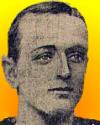
In 1903, Thomas Edison's concern about X-Ray injury was front page news in the New York World newspaper. Under the headline “Edison Fears Hidden Perils of the X-rays” the history of injuries of his laboratory employee were described. Clarence Dally had an arm and hand amputated because of cancer caused by exposure to X-rays. Edison's own experience was that viewing with his own X-ray fluoroscope harmed his own eyesight two years earlier. The focus of his left eye was disturbed by his experiments causing him to abandon research on X-rays. Edison, the “Wizard of Menlo Park,” was also quoted saying, “I am afraid of radium and polonium too, and I don't want to monkey with them.”[Image: Clarence M. Dally, from the newspaper article]
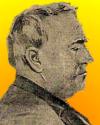
In 1903, Thomas Edison's opinion of radium was quoted within an article in the New York World newspaper. “I have had several pieces of it from Mme. Curie in Paris, and I have experimented with it. I do not see its commercial utility, but it opens up a great field of thought and scientific research. It overturns all the old theories of force and energy... I have a peculiar theory about radium, and I believe it is the correct one. I believe that there is some mysterious ray pervading the universe that is fluorescing to it. In other words, that all its energy is not self-constructed but that there is a mysterious something in the atmosphere that scientists have not found that is drawing out those infinitesimal atoms and distributing them forcefully and indestructibly.”[Image: Thomas Edison, from the newspaper article]
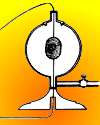
In 1874, a Canadian patent for an “Electric Light” (Lumière électrique) was issued to inventors Dr. Henry Woodward and Mathew Evans, of Toronto, Ontario. Their claim was: The placing of carbons, in lamps or other suitable vessels, filled with rarified gas, possessing the property of not chemically combining with the carbon when in a state of incandescence in connection with the arrangement of electrodes, fixing or connecting the carbon. The Canadian patent was granted for five years. When the invention was patented in the United States (4 Jan 1875), it predated the patents of Thomas Edison and Joseph Wilson Swan.
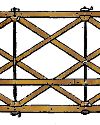
In 1840, William Howe was issued a U.S. patent (No. 1,711) for a Truss Bridge. It differed from his earlier patent (10 Jul 1840, No. 1685) because - importantly - he replaced the wooden post members in his frame with vertical iron rods, furnished with screw nuts, to effect tensioning. He described “straining up, and cambering” by tightening the screws. The frame had top and bottom horizontal members, and crossed diagonal braces and counter-braces. Although these were originally envisioned using timber, the Howe Truss was later used in steel bridges. It was popular as a railroad bridge because it had good strength over long spans. Timber truss covered bridges were also built as road bridges. Wooden walls and roof were added to protect the frame from weathering. A few remaining examples have been conserved.«[Image: detail of part of frame, showing vertical iron rods and wooden members.]
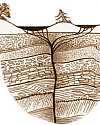
In 1769, The La Brea Tar Pits in Los Angeles, California were first noticed by a Spanish expedition. Juan Crespi, a Franciscan friar with the expedition of Gaspar de Portola (the first Spanish governor of the Californias), in 1769-70, wrote "The 3rd, we proceeded for three hours on a good road; to the right were extensive swamps of bitumen which is called chapapote. We debated whether this substance, which flows melted from underneath the earth, could occasion so many earthquakes." The name La Brea comes from the Spanish word for "tar." A scientific publication first recorded the fossils found there in 1875, the work of Professor William Denton. Evidence exists that prehistoric native Americans used and traded the asphalt.
In 1596, David Fabricius discovered the light variation of Mira (first variable star).





