
Born 28 Oct 1955. quotes
William Henry (Bill) Gates III is an American businessman who was an early popularizer of personal computer software. By age 13, Gates had already developed his first software program. He dropped out of Harvard in 1975 to pursue his passion with friend Paul Allen. They co-founded Microsoft, which released Windows, an operating system that became globally ubiquitous. Its business practices were at times ruled to be anti-competitive in several court battles. Later in life, Gates pivoted to philanthropy, focusing on global health and education through the Bill & Melinda Gates Foundation. Though not a scientist by training, his investments in scientific research, particularly in health and renewable energy sectors, have been significant.«
William Henry (Bill) Gates III is an American businessman who was an early popularizer of personal computer software. By age 13, Gates had already developed his first software program. He dropped out of Harvard in 1975 to pursue his passion with friend Paul Allen. They co-founded Microsoft, which released Windows, an operating system that became globally ubiquitous. Its business practices were at times ruled to be anti-competitive in several court battles. Later in life, Gates pivoted to philanthropy, focusing on global health and education through the Bill & Melinda Gates Foundation. Though not a scientist by training, his investments in scientific research, particularly in health and renewable energy sectors, have been significant.«
Bill Gates: Hero or Villain?, by Michael Lancaster. - book suggestion.
Born 28 Oct 1937.
Marcian Edward “Ted” Hoff Jr. is an American electrical engineer who conceived the 4004, the world's first commercial microprocessor, adapting existing integrated circuit (IC) technology to combine memory, arithmetic and logic functions as a computer on a single silicon chip. He led the project at Intel, together with Stanley Mazor, Masatoshi Shima and Federico Faggin. The 4004 had a 256-byte ROM, a 32-bit RAM, a 10-bit shift register (a form of RAM) and a 4-bit microprocessor. It squeezed 2300 transistors into a 16-pin package. Because as one chip, it replaced several hardwired ICs in a programmable calculator, the 4004 revolutionized the electronics industry. When released in Nov 1971, the 4004 made it possible to include data processing in hundreds of devices.«
Marcian Edward “Ted” Hoff Jr. is an American electrical engineer who conceived the 4004, the world's first commercial microprocessor, adapting existing integrated circuit (IC) technology to combine memory, arithmetic and logic functions as a computer on a single silicon chip. He led the project at Intel, together with Stanley Mazor, Masatoshi Shima and Federico Faggin. The 4004 had a 256-byte ROM, a 32-bit RAM, a 10-bit shift register (a form of RAM) and a 4-bit microprocessor. It squeezed 2300 transistors into a 16-pin package. Because as one chip, it replaced several hardwired ICs in a programmable calculator, the 4004 revolutionized the electronics industry. When released in Nov 1971, the 4004 made it possible to include data processing in hundreds of devices.«
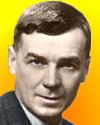
Born 28 Oct 1914; died 18 Aug 1994 at age 79.
Richard Laurence Millington Synge was a British biochemist who shared the 1952 Nobel Prize for Chemistry with A.J.P. Martin for their development of partition chromatography, notably paper chromatography. Some of chemistry's advances need new methods for separating various substances. In filter-paper chromatography, a drop of a mixture of substances is dropped on a strip of filter paper, which is allowed to draw up a suitable solvent (ex. butyl alcohol-water), by capillary action. The spot begins to move, then gradually segregates into several spots. Some spots rapidly follow the solvent, while others lag behind. The result is a resolution of the mixture into component parts. One drop of extremely complicated mixtures can be analyzed in this simple way.
Richard Laurence Millington Synge was a British biochemist who shared the 1952 Nobel Prize for Chemistry with A.J.P. Martin for their development of partition chromatography, notably paper chromatography. Some of chemistry's advances need new methods for separating various substances. In filter-paper chromatography, a drop of a mixture of substances is dropped on a strip of filter paper, which is allowed to draw up a suitable solvent (ex. butyl alcohol-water), by capillary action. The spot begins to move, then gradually segregates into several spots. Some spots rapidly follow the solvent, while others lag behind. The result is a resolution of the mixture into component parts. One drop of extremely complicated mixtures can be analyzed in this simple way.
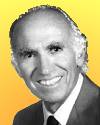
Born 28 Oct 1914; died 23 Jun 1995 at age 80. quotes
American Jewish physician and medical researcher, born in New York City, who developed the first safe and effective vaccine for poliomyelitis. His early work (1946) was research on the influenza virus. In 1963, he became director of the Salk Institute for Biological Studies at the Univ. of California, San Diego. He developed a vaccine against poliomyelitis by cultivating three strains of the virus separately in monkey tissue. The virus was separated from the tissue, stored for a week, killed with formaldehyde, then tested to make certain that it is dead. A series of three or four injections with the killed virus vaccine was required to confer immunity.
American Jewish physician and medical researcher, born in New York City, who developed the first safe and effective vaccine for poliomyelitis. His early work (1946) was research on the influenza virus. In 1963, he became director of the Salk Institute for Biological Studies at the Univ. of California, San Diego. He developed a vaccine against poliomyelitis by cultivating three strains of the virus separately in monkey tissue. The virus was separated from the tissue, stored for a week, killed with formaldehyde, then tested to make certain that it is dead. A series of three or four injections with the killed virus vaccine was required to confer immunity.
Jonas Salk: Beyond the Microscope, by Victoria Sherrow. - book suggestion.
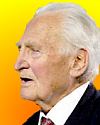
Born 28 Oct 1912; died 24 Jul 2005 at age 92. quotes
William Richard Shaboe Doll was an English epidemiologist who was one of the first two researchers to link cigarette smoking to lung cancer, as published in the British Medical Journal in 1950. In the same journal, fifty years later, Doll published (22 Jun 2004) the first research that quantified the damage over the lifetime of a generation, based on a 50-year study of a group of almost 35,000 British doctors who smoked. The study found that almost half of persistent cigarette smokers were killed by their habit, and a quarter died before age 70. Persons who quit by age 30 had normal life expectancy. Even quitting at age 50 saved six more years of life over those who continued smoking. He studied other health effects, such as those caused by asbestos and electromagnetic fields.«
William Richard Shaboe Doll was an English epidemiologist who was one of the first two researchers to link cigarette smoking to lung cancer, as published in the British Medical Journal in 1950. In the same journal, fifty years later, Doll published (22 Jun 2004) the first research that quantified the damage over the lifetime of a generation, based on a 50-year study of a group of almost 35,000 British doctors who smoked. The study found that almost half of persistent cigarette smokers were killed by their habit, and a quarter died before age 70. Persons who quit by age 30 had normal life expectancy. Even quitting at age 50 saved six more years of life over those who continued smoking. He studied other health effects, such as those caused by asbestos and electromagnetic fields.«
Geography of Disease, by Richard Doll. - book suggestion.
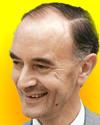
Born 28 Oct 1893; died 8 Dec 1970 at age 77. quotes
English chemist who fundamentally transformed our understanding of organic reaction mechanisms. Ingold elucidated the electronic theory of organic reactions, introducing the concepts of nucleophiles and electrophiles. Ingold’s findings on resonance structures, aromaticity, and molecular orbital theory played pivotal roles in the development of modern organic chemistry. He also coined the E/Z notation for geometric isomerism. His studies on substitution reactions in haloalkanes advanced the S_N1 and S_N2 nomenclature, delineating between uni- and bimolecular nucleophilic substitution processes. Ingold’s legacy lies in framing the rules and concepts that underpin the discipline today.«
English chemist who fundamentally transformed our understanding of organic reaction mechanisms. Ingold elucidated the electronic theory of organic reactions, introducing the concepts of nucleophiles and electrophiles. Ingold’s findings on resonance structures, aromaticity, and molecular orbital theory played pivotal roles in the development of modern organic chemistry. He also coined the E/Z notation for geometric isomerism. His studies on substitution reactions in haloalkanes advanced the S_N1 and S_N2 nomenclature, delineating between uni- and bimolecular nucleophilic substitution processes. Ingold’s legacy lies in framing the rules and concepts that underpin the discipline today.«
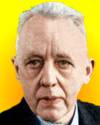
Born 28 Oct 1892; died 18 May 1965 at age 72. quotes
Dutch science historian, noted in particular for his work on the history of mathematics and mechanics. He published comprehensive studies of Archimedes, and an extensive examination of the Scientific Revolution’s mechanization concept. His seminal work, The Mechanization of the World Picture, delves into the transition from the Aristotelian worldview to the mechanistic perspective of the 17th century. Dijksterhuis emphasized the historical continuity of scientific thought and its development. His writings and insights have greatly contributed to the understanding of the evolution of scientific thought from antiquity to the modern age.«
Dutch science historian, noted in particular for his work on the history of mathematics and mechanics. He published comprehensive studies of Archimedes, and an extensive examination of the Scientific Revolution’s mechanization concept. His seminal work, The Mechanization of the World Picture, delves into the transition from the Aristotelian worldview to the mechanistic perspective of the 17th century. Dijksterhuis emphasized the historical continuity of scientific thought and its development. His writings and insights have greatly contributed to the understanding of the evolution of scientific thought from antiquity to the modern age.«
Archimedes, by Eduard Jan Dijksterhuis. - book suggestion.
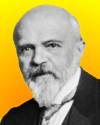
(EB)
Born 28 Oct 1867; died 16 Apr 1941 at age 73.
German experimental embryologist and philosopher who was the last great spokesman for vitalism, the theory that life cannot be explained as physical or chemical phenomena. In 1891, he separated the first two cells formed by a dividing sea urchin egg and discovered that each would form a whole larva. Driesch concluded that the fate of a cell is not determined at the two-cell stage, but by its position in the whole organism. He published his first wholly theoretical monograph that year and, in 1892, speculated that vitalistic interpretations of biological data might be reasonable. His experimental results gave strong impetus to the then new science of experimental embryology. He also studied embryonic induction, enzyme action, and nuclear and cytoplasmic interaction.
German experimental embryologist and philosopher who was the last great spokesman for vitalism, the theory that life cannot be explained as physical or chemical phenomena. In 1891, he separated the first two cells formed by a dividing sea urchin egg and discovered that each would form a whole larva. Driesch concluded that the fate of a cell is not determined at the two-cell stage, but by its position in the whole organism. He published his first wholly theoretical monograph that year and, in 1892, speculated that vitalistic interpretations of biological data might be reasonable. His experimental results gave strong impetus to the then new science of experimental embryology. He also studied embryonic induction, enzyme action, and nuclear and cytoplasmic interaction.
The Crisis in Psychology, by Hans Adolf Eduard Driesch. - book suggestion.
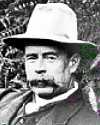
Born 28 Oct 1855; died 5 Jun 1912 at age 56.
Australian anthropologist who did pioneering fieldwork among the Aborigines of central Australia. After working for the South Australian telegraph Department throughout Central Australia (1875-99), he became stationmaster at the Alice Springs Overland Telegraph station. Gillen became very interested in the Aboriginal people. He took a special interest in the Arrentic people who lived near his home. He learned their language, became a friend of the group and was welcomed as a member of their society. He met Baldwin Spencer when, in 1894, the Horn Expedition visited Alice Springs to make an appraisal of the areas geology and the Aboriginal culture. Together, they later made many anthropological expeditions which showed the Aboriginal complex yet subtle culture.
Australian anthropologist who did pioneering fieldwork among the Aborigines of central Australia. After working for the South Australian telegraph Department throughout Central Australia (1875-99), he became stationmaster at the Alice Springs Overland Telegraph station. Gillen became very interested in the Aboriginal people. He took a special interest in the Arrentic people who lived near his home. He learned their language, became a friend of the group and was welcomed as a member of their society. He met Baldwin Spencer when, in 1894, the Horn Expedition visited Alice Springs to make an appraisal of the areas geology and the Aboriginal culture. Together, they later made many anthropological expeditions which showed the Aboriginal complex yet subtle culture.
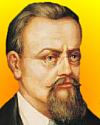
Born 28 Oct 1845; died 19 Apr 1888 at age 42.
Polish physicist who liquefied the “permanent gases” such as nitrogen and carbon monoxide in larger quantities than previously accomplished by Cailletet, whose method he improved. In 1883, he achieved the static liquefaction of oxygen and air. He was the first to liquify hydrogen. Although he achieved it only in a transient fine mist, he published (1885) remarkably accurate data: critical temperature 33 K, critical pressure, 13.3 atm and boiling point, 23 K (modern values 33.3 K, 12.8 atm, 20.3 K). He may also have had a hint of strange electrical properties at very low temperatures, but his research was cut short upon his accidental death. Wroblewski died as a result of burns in a fire started when he overturned a kerosene lamp in his laboratory.*
Polish physicist who liquefied the “permanent gases” such as nitrogen and carbon monoxide in larger quantities than previously accomplished by Cailletet, whose method he improved. In 1883, he achieved the static liquefaction of oxygen and air. He was the first to liquify hydrogen. Although he achieved it only in a transient fine mist, he published (1885) remarkably accurate data: critical temperature 33 K, critical pressure, 13.3 atm and boiling point, 23 K (modern values 33.3 K, 12.8 atm, 20.3 K). He may also have had a hint of strange electrical properties at very low temperatures, but his research was cut short upon his accidental death. Wroblewski died as a result of burns in a fire started when he overturned a kerosene lamp in his laboratory.*
Born 28 Oct 1741; died 21 Apr 1800 at age 58. quotes
French physicist and priest who is remembered for his studies of electricity, including its atmospheric phenomena, application to the growth of plants, in classifying human ailments according to their positive or negative electrical reactions and for therapies. His work in more diverse fields included urban public health, agriculture, aerostatics and fires, volcanoes and earthquakes. He was influenced by his friendship with Benjamin Franklin, and promoted the use of lightning rods in southern France. Bertholon invented the electrovegetometer to use in his investigation of the application of electricity to the growth of plants.«
French physicist and priest who is remembered for his studies of electricity, including its atmospheric phenomena, application to the growth of plants, in classifying human ailments according to their positive or negative electrical reactions and for therapies. His work in more diverse fields included urban public health, agriculture, aerostatics and fires, volcanoes and earthquakes. He was influenced by his friendship with Benjamin Franklin, and promoted the use of lightning rods in southern France. Bertholon invented the electrovegetometer to use in his investigation of the application of electricity to the growth of plants.«

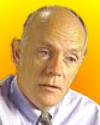
Died 28 Oct 2005 at age 62 (born 6 Jun 1943). quotes
Richard Errett Smalley was an American chemist and physicist, known as the father of nanotechnology, who shared the 1996 Nobel Prize for Chemistry with Robert F. Curl, Jr., and Sir Harold W. Kroto for their joint 1985 discovery of carbon60 (C60, or buckminsterfullerene, or buckyball) and the fullerenes.
Richard Errett Smalley was an American chemist and physicist, known as the father of nanotechnology, who shared the 1996 Nobel Prize for Chemistry with Robert F. Curl, Jr., and Sir Harold W. Kroto for their joint 1985 discovery of carbon60 (C60, or buckminsterfullerene, or buckyball) and the fullerenes.
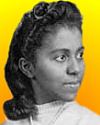
1942
Died 28 Oct 2003 at age 82 (born 16 Apr 1921).
American biochemist who was the first African-American woman to receive a Ph.D. in Chemistry (1947). Her postdoctoral research at the Rockefeller Institute included studying the composition and metabolism of components of cell nuclei, determining the base composition of deoxypentose nucleic acids, and calculating the rate of uptake of labeled glycine by components of cell nuclei. Seven years later, she took a university position. She taught biochemistry and researched the metabolism of the arterial wall and its relationship to aging, hypertension, and atherosclerosis. Later, she studied the uptake, synthesis, and distribution of creatine in cell cultures and tissues. She retired in 1986.«
American biochemist who was the first African-American woman to receive a Ph.D. in Chemistry (1947). Her postdoctoral research at the Rockefeller Institute included studying the composition and metabolism of components of cell nuclei, determining the base composition of deoxypentose nucleic acids, and calculating the rate of uptake of labeled glycine by components of cell nuclei. Seven years later, she took a university position. She taught biochemistry and researched the metabolism of the arterial wall and its relationship to aging, hypertension, and atherosclerosis. Later, she studied the uptake, synthesis, and distribution of creatine in cell cultures and tissues. She retired in 1986.«
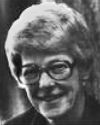
Died 28 Oct 1997 at age 76 (born 25 Oct 1921). quotes
American immunologist who discovered that the differences in amino acid composition of antibodies explains the efficiency and effectiveness with which they combat a huge range of foreign invaders. During WWII, her post-graduate studies included assisting with projects developing an Asiatic cholera vaccine, and combatting transmission of airborne pathogens in army barracks. In 1970 she became a professor of Microbiology and Immunology, after which she discovered the J chain (a B cell antibody subunit). In 1991, with colleagues, she identified a specialized intracellular pathway that transports antibodies into blood circulation, allowing for the multiplication of B cells essential in fighting infection.«*
American immunologist who discovered that the differences in amino acid composition of antibodies explains the efficiency and effectiveness with which they combat a huge range of foreign invaders. During WWII, her post-graduate studies included assisting with projects developing an Asiatic cholera vaccine, and combatting transmission of airborne pathogens in army barracks. In 1970 she became a professor of Microbiology and Immunology, after which she discovered the J chain (a B cell antibody subunit). In 1991, with colleagues, she identified a specialized intracellular pathway that transports antibodies into blood circulation, allowing for the multiplication of B cells essential in fighting infection.«*
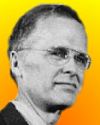
Died 28 Oct 1988 at age 63 (born 3 Dec 1924).
American computer scientist who invented the FORTRAN (FORmula TRANslation) programming language in the mid 1950s. He had previously developed an assembly language for IBM's 701 computer when he suggested the development of a compiler and higher level language for the IBM 704. As the first high-level computer programming language, FORTRAN was able to convert standard mathematical formulas and expressions into the binary code used by computers. Thus a non-specialist could write a program in familiar words and symbols, and different computers could use programs generated in the same language. This paved the way for other computer languages such as COBOL, ALGOL and BASIC.
American computer scientist who invented the FORTRAN (FORmula TRANslation) programming language in the mid 1950s. He had previously developed an assembly language for IBM's 701 computer when he suggested the development of a compiler and higher level language for the IBM 704. As the first high-level computer programming language, FORTRAN was able to convert standard mathematical formulas and expressions into the binary code used by computers. Thus a non-specialist could write a program in familiar words and symbols, and different computers could use programs generated in the same language. This paved the way for other computer languages such as COBOL, ALGOL and BASIC.
Died 28 Oct 1983 at age 77 (born 24 Sep 1906).
Polidore F. F. Swings was a Belgian astrophysicist who made spectroscopic studies to identify elements and structure of stars and comets. He discovered the first interstellar molecule, the CH radical (1937). In comet atmospheres he studied the "Swings bands" - certain carbon emission lines. In 1941, with a slit spectrograph he identified a "Swings effect" in the violet CN bands (3875 A) - a fluorescence partly due to solar radiation that shows emmission line excitation differences dependant on the Doppler shift caused by a comet's motion relative to the Sun. He co-authored an Atlas of Cometary Spectra with Leo Haser in 1956.
Polidore F. F. Swings was a Belgian astrophysicist who made spectroscopic studies to identify elements and structure of stars and comets. He discovered the first interstellar molecule, the CH radical (1937). In comet atmospheres he studied the "Swings bands" - certain carbon emission lines. In 1941, with a slit spectrograph he identified a "Swings effect" in the violet CN bands (3875 A) - a fluorescence partly due to solar radiation that shows emmission line excitation differences dependant on the Doppler shift caused by a comet's motion relative to the Sun. He co-authored an Atlas of Cometary Spectra with Leo Haser in 1956.
Died 28 Oct 1965 at age 89 (born 13 Jan 1876).
Luther Pfahler Eisenhart was an American mathematician who was active in differential and Riemann geometry, plus contributions in relativity theory. Differential geometry extends the concepts of plane geometry (such as the distance between two points, the angle between two crossing curves, or curvature of a plane curve), to study the geometry of smooth shapes and spaces, also known as smooth manifolds. This involves applying calculus. It extends into physics as it provides tools to formulate general relativity. Eisenhart’s career at Princeton began in Sep 1900 as an instructor in mathematics. When this campus added the Institute of Advanced Studies, he began to work with Albert Einstein, as well as Oswald Veblen, and John von Neumann.«
Luther Pfahler Eisenhart was an American mathematician who was active in differential and Riemann geometry, plus contributions in relativity theory. Differential geometry extends the concepts of plane geometry (such as the distance between two points, the angle between two crossing curves, or curvature of a plane curve), to study the geometry of smooth shapes and spaces, also known as smooth manifolds. This involves applying calculus. It extends into physics as it provides tools to formulate general relativity. Eisenhart’s career at Princeton began in Sep 1900 as an instructor in mathematics. When this campus added the Institute of Advanced Studies, he began to work with Albert Einstein, as well as Oswald Veblen, and John von Neumann.«
Died 28 Oct 1922 at age 84 (born 26 Mar 1838). quotes
Scottish chemist and physiologist who built up chemistry as a major subject at the University of Edinburgh. A professorship of chemistry there is named after him. With a DSc (1862) from London University, he went to Germany, studying chemistry under Bunsen at Heidelberg, and then Kolbe at Marburg (where he made perhaps the first synthesis of adipic acid) before joining the faculty at Edinburgh University. He improved on Kekulé’s graphical representation of the structure of organic compounds. In 1865, he introduced the parallel lines symbol for a double bond. In 1892, he proposed the Crum Brown rule, predicting how substituents enter the benzene ring. In physiology, he investigated the sensations of vertigo.«
Scottish chemist and physiologist who built up chemistry as a major subject at the University of Edinburgh. A professorship of chemistry there is named after him. With a DSc (1862) from London University, he went to Germany, studying chemistry under Bunsen at Heidelberg, and then Kolbe at Marburg (where he made perhaps the first synthesis of adipic acid) before joining the faculty at Edinburgh University. He improved on Kekulé’s graphical representation of the structure of organic compounds. In 1865, he introduced the parallel lines symbol for a double bond. In 1892, he proposed the Crum Brown rule, predicting how substituents enter the benzene ring. In physiology, he investigated the sensations of vertigo.«
Died 28 Oct 1916 at age 77 (born 3 Dec 1838). quotes
American meteorologist, inventor and astronomer, America’s first professional meteorologist, “father of the U.S. Weather Bureau.” He interpreted (1867) the Magellanic Clouds as separate satellites of the Milky Way. From 1 Sep 1869, Abbe issued bulletins and warnings as a private weather reporting service in Cincinnati, Ohio. By 9 Feb 1870, Congress authorized a newly named National Weather Service, under the Signal Service. Abbe was the only American experienced in gathering telegraphic reports to draw weather maps and make forecasts. Hence, Abbe was asked to lead the nation’s official weather forecaster; he accepted on 3 Jan 1871. He wrote on the atmosphere, the climate in relation to crops, and introduced the system of Standard Time.«
American meteorologist, inventor and astronomer, America’s first professional meteorologist, “father of the U.S. Weather Bureau.” He interpreted (1867) the Magellanic Clouds as separate satellites of the Milky Way. From 1 Sep 1869, Abbe issued bulletins and warnings as a private weather reporting service in Cincinnati, Ohio. By 9 Feb 1870, Congress authorized a newly named National Weather Service, under the Signal Service. Abbe was the only American experienced in gathering telegraphic reports to draw weather maps and make forecasts. Hence, Abbe was asked to lead the nation’s official weather forecaster; he accepted on 3 Jan 1871. He wrote on the atmosphere, the climate in relation to crops, and introduced the system of Standard Time.«
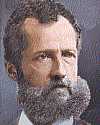
Died 28 Oct 1899 at age 45 (born 11 May 1854). quotes
German-American inventor of the Linotype typesetting machine (1886), regarded as the greatest advance in printing since the development of moveable type 400 years earlier. He moved to the U.S. in 1872. At the age of 32, he designed and built his first linotype machine. With it, the two operations of setting and casting type in lead lines were performed simply by touching the keys of a board similar to the keyboard of a typewriter. His invention enabled one operator to be machinist, type-setter, justifier and typefounder. His machine was first used in 1886 by the New York Tribune newspaper, followed by many great improvements on its design. He died at the early age of 45. more
German-American inventor of the Linotype typesetting machine (1886), regarded as the greatest advance in printing since the development of moveable type 400 years earlier. He moved to the U.S. in 1872. At the age of 32, he designed and built his first linotype machine. With it, the two operations of setting and casting type in lead lines were performed simply by touching the keys of a board similar to the keyboard of a typewriter. His invention enabled one operator to be machinist, type-setter, justifier and typefounder. His machine was first used in 1886 by the New York Tribune newspaper, followed by many great improvements on its design. He died at the early age of 45. more
The Biography of Ottmar Mergenthaler, Inventor of the Linotype, by Carl Schlesinger (ed.). - book suggestion.
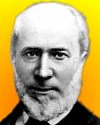
Died 28 Oct 1880 at age 68 (born 20 Jan 1812). quotes
French-born American psychiatrist who opened the world's first school for the severely mentally retarded (1839). He was a student of Jean Gaspard Itard, who suggested this speciality. Seguin developed a sensory training method. In 1850, Seguin moved to the U.S. where he set up more teaching centres for the retarded. In his book, Idiocy: and its Treatment by the Physiological Method (1866), he described the approach he used at the Seguin Physiological School in New York City. When the Association of Medical Officers of American Institutions for Idiotic and Feebleminded Persons was formed, Seguin became its first president. This later changed its name to the American Association on Mental Retardation.«
French-born American psychiatrist who opened the world's first school for the severely mentally retarded (1839). He was a student of Jean Gaspard Itard, who suggested this speciality. Seguin developed a sensory training method. In 1850, Seguin moved to the U.S. where he set up more teaching centres for the retarded. In his book, Idiocy: and its Treatment by the Physiological Method (1866), he described the approach he used at the Seguin Physiological School in New York City. When the Association of Medical Officers of American Institutions for Idiotic and Feebleminded Persons was formed, Seguin became its first president. This later changed its name to the American Association on Mental Retardation.«
Died 28 Oct 1841 at age 49 (born 12 Jan 1792).
Swedish chemist, (a pupil of Jöns Berzelius) who discovered lithium (reported 1818) in a compound obtained from petalite. This mineral was found in the iron mine of Uto, in Sweden. The alkaline component, named lithia, was lithium oxide. Arfwedson was unable isolate lithium as metal because that required electrolysis with stronger batteries than he had available. (The separation was eventually done by Humphry Davy.) Petalite is now known to be lithium aluminium silicate. He afterwards also discovered lithium in two other minerals, spodumene and lepidolite. Arfwedson abandoned scientific endeavour to spend his time running his family's manufactories and mines that he inherited.«
Swedish chemist, (a pupil of Jöns Berzelius) who discovered lithium (reported 1818) in a compound obtained from petalite. This mineral was found in the iron mine of Uto, in Sweden. The alkaline component, named lithia, was lithium oxide. Arfwedson was unable isolate lithium as metal because that required electrolysis with stronger batteries than he had available. (The separation was eventually done by Humphry Davy.) Petalite is now known to be lithium aluminium silicate. He afterwards also discovered lithium in two other minerals, spodumene and lepidolite. Arfwedson abandoned scientific endeavour to spend his time running his family's manufactories and mines that he inherited.«
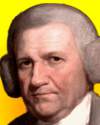
Died 28 Oct 1792 at age 68 (born 8 Jun 1724). quotes
English civil engineer who coined the term “civil engineering” (to distinguish from military engineers). He built the third Eddystone Lighthouse, Plymouth, Devon, using dovetailed blocks of portland stone (1756-59). He discovered the best mortar for underwater construction to be limestone with a high proportion of clay. Smeaton also constructed the Forth and Clyde Canal in Scotland between the Atlantic and the North Sea; built bridges in towns including Perth, Banff, and Coldstream, Scotland; and completed Ramsgate harbour, Kent. He introduced cast-iron shafts and gearing into wind and water mills, designed large atmospheric pumping engines for mines, and improved the safety of the diving bell.)
English civil engineer who coined the term “civil engineering” (to distinguish from military engineers). He built the third Eddystone Lighthouse, Plymouth, Devon, using dovetailed blocks of portland stone (1756-59). He discovered the best mortar for underwater construction to be limestone with a high proportion of clay. Smeaton also constructed the Forth and Clyde Canal in Scotland between the Atlantic and the North Sea; built bridges in towns including Perth, Banff, and Coldstream, Scotland; and completed Ramsgate harbour, Kent. He introduced cast-iron shafts and gearing into wind and water mills, designed large atmospheric pumping engines for mines, and improved the safety of the diving bell.)
Smeaton's Tower, by Christopher Severn. - book suggestion.
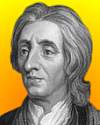
Died 28 Oct 1704 at age 72 (born 29 Aug 1632). quotes
English physician who was the most important philosopher during the Age of Reason. He spent over 20 years developing the ideas he published in most significant work, Essay Concerning Human Understanding (1690) which analysed the nature of human reason, and promoted experimentation as the basis of knowledge. He established primary qualities, (ex. solidity, extension, number) as distinct from secondary qualities identified by the sense organs (ex. colour, sound). Thus the world is otherwise silent and without colour. Locke recognised that science is made possible when the primary world mechanically affects the sense organs, thereby creating ideas that faithfully represent reality. He was an acquaintance of Robert Boyle.«
English physician who was the most important philosopher during the Age of Reason. He spent over 20 years developing the ideas he published in most significant work, Essay Concerning Human Understanding (1690) which analysed the nature of human reason, and promoted experimentation as the basis of knowledge. He established primary qualities, (ex. solidity, extension, number) as distinct from secondary qualities identified by the sense organs (ex. colour, sound). Thus the world is otherwise silent and without colour. Locke recognised that science is made possible when the primary world mechanically affects the sense organs, thereby creating ideas that faithfully represent reality. He was an acquaintance of Robert Boyle.«
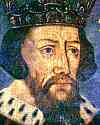
Died 28 Oct 900 (born 849). quotes
English monarch who in the Dark Ages recognized the value of learning, not merely for himself but for the benefit of the people of his country. He not only encouraged men of learning, but he laboured himself and gave proof of his own learning. He made every effort that worthwhile Latin books should be translated into Anglo-Saxon, and brought in scholars from Wales and the Continent to assist. He did much work himself, translating the works of Boethius and Bede.[Year of death uncertain; sources vary. Asimov’s Bio Enc of Sci and Tech: 28 Oct 900. Brit Auth Before 1800 (1952): 28 Oct 901. Enc Brit: only the year 899.]
English monarch who in the Dark Ages recognized the value of learning, not merely for himself but for the benefit of the people of his country. He not only encouraged men of learning, but he laboured himself and gave proof of his own learning. He made every effort that worthwhile Latin books should be translated into Anglo-Saxon, and brought in scholars from Wales and the Continent to assist. He did much work himself, translating the works of Boethius and Bede.[Year of death uncertain; sources vary. Asimov’s Bio Enc of Sci and Tech: 28 Oct 900. Brit Auth Before 1800 (1952): 28 Oct 901. Enc Brit: only the year 899.]
Alfred the Great: The Man Who Made England, by Justin Pollard. - book suggestion.
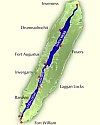
In 1992, scientists using sonar to map Scotland's Loch Ness made contact with a mysterious object, but declined to speculate what that implies about whether the legendary monster “Nessie” exists. The average depth of Loch Ness is 470 ft (145 m) and it has has a maximum depth of 788 ft (240 m). The term “cryptozoology” was coined in the late 1950s by French zoologist Bernard Heuvelmans to describe the study of such unverified animals. Loch Ness lies on the Great Glen fault-line and is very elongated, some 23 miles (37 km) long, with an average width of about 1 mile (2 km). Due to its great depth Loch Ness never freezes.[Note: measurements vary with different sources.]
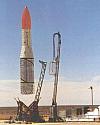
In 1971, Britain became the sixth nation with its satellite launched into orbit by a Black Arrow rocket from Woomera, Australia. The Prospero, a Black Knight 1 satellite, had 86-kg mass at launch, 4-m diam. and transmitted on 137.56 MHz (still heard in 2000, although the onboard tape recorder failed after 730 replays on 24 May 1973). Its mission was to test solar cells and other technology experiments. Prospero is the only satellite launched by a British rocket. The Black Arrow was a 3-stage rocket only 13 m high. The Royal Aircraft Establishment developed the space launcher Black Arrow from 1964 until the project was cancelled by the British government in Jul 1971. The USSR's Sputnik was the first satellite (4 Oct 1957).«
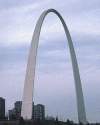
In 1965, the Gateway Arch (630' (190m) high) was completed in St. Louis, Missouri. This graceful sweeping tapered curve of stainless steel is the tallest memorial in the U.S. The architect of the catenary curve arch was Eero Saarinen who won the design competition in 1947. It was constructed 1961-66 in the Jefferson National Expansion Memorial Park, established on the banks of the Mississippi River, on 21 Dec 1935, to commemorate the westward growth of the United States between 1803 and 1890. Cost for the $30 million national monument was shared by the federal government and the City of St. Louis. The memorial arch has an observation room at the top for visitors reached by trams running inside the legs of the arch.

In 1946, a five-man commission of civilians was appointed by President Harry S. Truman. The Atomic Energy Commission was established by the U.S. Atomic Energy Act approved 1 Aug 1946 to develop and utilize atomic energy toward improving the public welfare, increasing the standard of living, strengthening free competition in private enterprise, and promoting world peace. The first meeting took place on 13 Nov 1946, although the official confirmation by the Senate occurred later, on 9 Apr 1947. The chairman was David Eli Lilienthal.
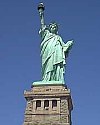
In 1886, the monument of Liberty Enlightening the World, popularly called the Statue of Liberty, was unveiled in New York Harbor. It was dedicated by confetti (the first ticker tape parade) in the New York Harbor by President Cleveland in the presence of its sculptor, Frederic Auguste Bartholdi. It was a gift from the people of France to commemorate the 100th anniversary of American independence. In 1876, a preview of the statue, the right hand and torch, was exhibited at the Centennial Exhibition in Philadelphia, Pa. The statue was assembled on Liberty Island (formerly Bedloe Island), 151-ft tall on a 155-ft high granite pedestal. Its copper skin is supported by a massive internal iron pylon and secondary skeletal framework.«
more
The Statue of Liberty, by Barry Moreno. - book suggestion.
(USPTO)
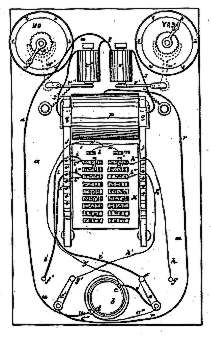
In 1868, Thomas Edison of Boston, Mass., first patent application was received and recorded by the Patent Office. It was for an “Electrographic Vote Recorder.” The device, the first of its kind, would enable a legislator to register a vote either for or against an issue by turning a switch to the right or left. His application was executed (signed and dated) on 13 Oct 1868, and issued by the U.S. Patent Office on 1 Jun 1869 (No. 90,646). He eventually held over 1,500 patents.«
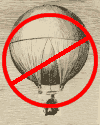
In 1799, according to surviving lists of patent titles, Moses McFarland, of Massachusetts, received a patent titled a "Federal Balloon." Some sources incorrectly call this the first U.S. patent of an aeronautical design. The Patent Office fire in 1836 destroyed all full records, but the Collections of the Massachusetts Historical Society of 1799 include a letter from Timothy Pickering about the "absurdity of name for Major McFarland's exercising machine," which says "I wish Major McFarland has hit on a proper name for his machine; it has no relation to a 'balloon' and his motive for calling it 'federal' is rather fanciful than solid... but if it is substantially useful in promoting health, I should... call it McFarland's Exercising Machine..."[Ref: Collections of the Massachusetts Historical Society 6 (1799) page 136.]* more
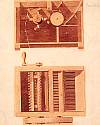
In 1793, Eli Whitney applied for a patent for his cotton gin, which was granted the following March. Southern planters of the time desperately needed to make cotton-growing profitable, especially since tobacco-growing was in decline due to over-supply and soil exhaustion. Long-staple cotton, which was easy to separate from its seeds, could be grown only along the coast. The one variety that grew inland had sticky green seeds that were time-consuming to pick out of the fluffy white cotton bolls. Whitney solved this problem, and reinvigorated cotton planting throughout the South. The original patent was destroyed in the 1836 Patent Office fire.«[Image: detail from copy of Whitney's patent made by the Patent Office in 1845.]




