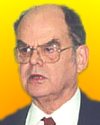
Born 13 Oct 1932.
American mathematician who was awarded the Fields Medal in 1970 for his work in group theory, solving (with Walter Feit) one of its thorniest problems, the so-called "odd order" problem. (Group theory is a branch of mathematics that focuses on the study of symmetries - such as the symmetries of a geometric figure, or symmetries that arise in solutions to algebraic equations.) Thompson's proof, with 253 pages of equations, filled an entire issue of the Pacific Journal of Mathematics. It stands out as one of math's longest and most complex. Thompson also collaborated on the classification of the finite simple groups, the building blocks of more general groups. Group theory has important applications in physics, chemistry and other fields.
American mathematician who was awarded the Fields Medal in 1970 for his work in group theory, solving (with Walter Feit) one of its thorniest problems, the so-called "odd order" problem. (Group theory is a branch of mathematics that focuses on the study of symmetries - such as the symmetries of a geometric figure, or symmetries that arise in solutions to algebraic equations.) Thompson's proof, with 253 pages of equations, filled an entire issue of the Pacific Journal of Mathematics. It stands out as one of math's longest and most complex. Thompson also collaborated on the classification of the finite simple groups, the building blocks of more general groups. Group theory has important applications in physics, chemistry and other fields.
Born 13 Oct 1916.
American physicist.
American physicist.
Born 13 Oct 1908.
American biophysicist.
American biophysicist.
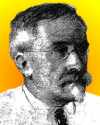
Born 13 Oct 1867; died 16 Aug 1941 at age 73.
William Zebina Ripley was an American economist and anthropologist whose early book The Races of Europe: A Sociological Study (1899) directed the attention of American social scientists to the existence of subdivisions of geographic races. He gave broad classifications of the European Caucasians into three local races: the northern (Teutonic) and southern (Mediterranean) populations are probably of extremely ancient origin, but the central (Alpine) group has descended from more recent migrants from Asia. Ripley was trained in civil engineering, though he spent most of his career as professor of political economy. In 1920-23 he drew up for the Interstate Commerce Commission the Ripley Plan for the regional consolidation of U.S. railways.
William Zebina Ripley was an American economist and anthropologist whose early book The Races of Europe: A Sociological Study (1899) directed the attention of American social scientists to the existence of subdivisions of geographic races. He gave broad classifications of the European Caucasians into three local races: the northern (Teutonic) and southern (Mediterranean) populations are probably of extremely ancient origin, but the central (Alpine) group has descended from more recent migrants from Asia. Ripley was trained in civil engineering, though he spent most of his career as professor of political economy. In 1920-23 he drew up for the Interstate Commerce Commission the Ripley Plan for the regional consolidation of U.S. railways.
Railroads, Rates and Regulations, by William Z. Ripley. - book suggestion.
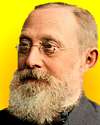
Born 13 Oct 1821; died 5 Sep 1902 at age 80. quotes
German pathologist and statesman who originated the concept that disease arises in the individual cells of a tissue and, with publication of his Cellular Pathology (1858), founded the science of cellular pathology. Virchow also worked on improving sanitary conditions in Berlin, and believed that environmental factors such as poor living conditions could be as much a cause of disease as germs. He also helped develop the science of anthropology in Germany and to make Berlin a European centre of medicine. Virchow encouraged his friend Heinrich Schliemann in his determination to discover the site of Homer's Troy and actually worked on the dig at Hissarlik in 1879. more
German pathologist and statesman who originated the concept that disease arises in the individual cells of a tissue and, with publication of his Cellular Pathology (1858), founded the science of cellular pathology. Virchow also worked on improving sanitary conditions in Berlin, and believed that environmental factors such as poor living conditions could be as much a cause of disease as germs. He also helped develop the science of anthropology in Germany and to make Berlin a European centre of medicine. Virchow encouraged his friend Heinrich Schliemann in his determination to discover the site of Homer's Troy and actually worked on the dig at Hissarlik in 1879. more
Collected Essays on Public Health & Epidemiology, by Rudolf Virchow. - book suggestion.
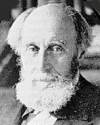
Born 13 Oct 1820; died 19 Nov 1899 at age 79. quotes
Canadian geologist who made numerous contributions to paleobotany and extended the knowledge of Canadian geology. Dawson was born and raised in Pictou, Nova Scotia, where the many sandstone and coal formations provided fertile ground for his boyhood interest. Often fossil leaves could be found while gathering shale to make slate pencils. Thus, as a boy, he developed an incurable interest in geology and was an avid collector of local fossils. His working life began with mining companies and doing field work. He studied the geology of Nova Scotia, with a particular interest in the fossil forests of the coal-bearing strata. During his early scientific explorations, which culminated in the publication of Acadian Geology, he made many important discoveries of fossil life, great and small. These included fossil plants, trackways of lowly invertebrates, footprints, skeletons of reptiles and amphibians, millipedes and the earliest land snails. Dawson discovered the oldest land plant known at the time, Psilophyton (1859), from Devonian rocks (dating from 408 - 360 million years ago). In Air Breathers of the Coal Period (1863) he described newly discovered fossil animals He had an uncanny ability to understand the ancient environments in which rocks had formed and to decipher their correct ages. Dawson's energetically promoted scientific institutions in Canada, though he opposed Darwin's evolutionary theories.[DSB gives dates 13 Oct 1820 - 19 Nov 1899. EB gives 30 Oct 1820 - 20 Nov 1899.]
Canadian geologist who made numerous contributions to paleobotany and extended the knowledge of Canadian geology. Dawson was born and raised in Pictou, Nova Scotia, where the many sandstone and coal formations provided fertile ground for his boyhood interest. Often fossil leaves could be found while gathering shale to make slate pencils. Thus, as a boy, he developed an incurable interest in geology and was an avid collector of local fossils. His working life began with mining companies and doing field work. He studied the geology of Nova Scotia, with a particular interest in the fossil forests of the coal-bearing strata. During his early scientific explorations, which culminated in the publication of Acadian Geology, he made many important discoveries of fossil life, great and small. These included fossil plants, trackways of lowly invertebrates, footprints, skeletons of reptiles and amphibians, millipedes and the earliest land snails. Dawson discovered the oldest land plant known at the time, Psilophyton (1859), from Devonian rocks (dating from 408 - 360 million years ago). In Air Breathers of the Coal Period (1863) he described newly discovered fossil animals He had an uncanny ability to understand the ancient environments in which rocks had formed and to decipher their correct ages. Dawson's energetically promoted scientific institutions in Canada, though he opposed Darwin's evolutionary theories.[DSB gives dates 13 Oct 1820 - 19 Nov 1899. EB gives 30 Oct 1820 - 20 Nov 1899.]
(EB)
Born 13 Oct 1814; died 8 Apr 1882 at age 67.
Jules (-Étienne-Joseph) Quicherat was a French historian and one of the founders of archaeology in France. As a pioneering archaeologist, he was a major force in French scholarship during the 19th century. In 1847, he inaugurated a course of archaeological lectures at the École des Chartes. His students circulated his principles throughout France, recognizing him as the "founder of national archaeology". He wrote on the history of medieval France, and also edited texts of the trial and rehabilitation of Joan of Arc (1841-49).
Jules (-Étienne-Joseph) Quicherat was a French historian and one of the founders of archaeology in France. As a pioneering archaeologist, he was a major force in French scholarship during the 19th century. In 1847, he inaugurated a course of archaeological lectures at the École des Chartes. His students circulated his principles throughout France, recognizing him as the "founder of national archaeology". He wrote on the history of medieval France, and also edited texts of the trial and rehabilitation of Joan of Arc (1841-49).
Born 13 Oct 1796; died 18 Apr 1860 at age 63.
Swedish anatomist was known for his pioneering studies in human cranial morphology. As professor at the Karolinska Institute, he made detailed anatomical investigations of the brain, ear, and skull. He introduced the cephalic index—a ratio of skull breadth to length—which became a foundational, though later controversial, tool in physical anthropology for classifying human populations as dolichocephalic or brachycephalic. Retzius also advanced comparative anatomy, studying animal and human structures to trace evolutionary relationships. His meticulous methods and precise anatomical drawings influenced 19th-century anthropology, neurology, and medical education across Europe.«
Swedish anatomist was known for his pioneering studies in human cranial morphology. As professor at the Karolinska Institute, he made detailed anatomical investigations of the brain, ear, and skull. He introduced the cephalic index—a ratio of skull breadth to length—which became a foundational, though later controversial, tool in physical anthropology for classifying human populations as dolichocephalic or brachycephalic. Retzius also advanced comparative anatomy, studying animal and human structures to trace evolutionary relationships. His meticulous methods and precise anatomical drawings influenced 19th-century anthropology, neurology, and medical education across Europe.«
Born 13 Oct 1787; died 29 Aug 1854 at age 66.
English inventor, painter and writer was known for combining art with practical science. He improved wire-drawing by passing metal through jeweled dies, yielding smoother wire, and co-patented an oblique pen with S. Mordan (1831). In 1838 he created a cork substitute of felt coated with vulcanized rubber, leading to work with Charles Macintosh & Co. He patented compressed lozenges of alkali carbonates for medicine, new wadding for firearms, and a method of refining graphite for pencils. Later he advanced uses for vulcanized india-rubber (1844–51). A founder of the Royal Geographical Society, Brockedon’s inventive output spanned early materials science, polymer chemistry, and mechanical engineering.«
English inventor, painter and writer was known for combining art with practical science. He improved wire-drawing by passing metal through jeweled dies, yielding smoother wire, and co-patented an oblique pen with S. Mordan (1831). In 1838 he created a cork substitute of felt coated with vulcanized rubber, leading to work with Charles Macintosh & Co. He patented compressed lozenges of alkali carbonates for medicine, new wadding for firearms, and a method of refining graphite for pencils. Later he advanced uses for vulcanized india-rubber (1844–51). A founder of the Royal Geographical Society, Brockedon’s inventive output spanned early materials science, polymer chemistry, and mechanical engineering.«
Illustrations Of The Passes Of The Alps: By Which Italy Communicates With France, Switzerland, And Germany, by William Brockedon. - book suggestion.
Born 13 Oct 1776; died 1 Mar 1862 at age 85. quotes
English mathematician and engineer who invented two varieties of achromatic (non-colour-distorting) telescope lenses. In 1819, Barlow began work on the problem of deviation in ship compasses caused by the presence of iron in the hull. For his method of correcting the deviation by juxtaposing the compass with a suitably shaped piece of iron, he was awarded the Copley Medal. In 1822, he built a device which is to be considered one of the first models of an electric motor supplied by continuous current. He also worked on the design of bridges, in particular working (1819-26) with Thomas Telford on the design of the bridge over the Menai Strait, the first major modern suspension bridge. Barlow was active during the period of railway building in Britain.
English mathematician and engineer who invented two varieties of achromatic (non-colour-distorting) telescope lenses. In 1819, Barlow began work on the problem of deviation in ship compasses caused by the presence of iron in the hull. For his method of correcting the deviation by juxtaposing the compass with a suitably shaped piece of iron, he was awarded the Copley Medal. In 1822, he built a device which is to be considered one of the first models of an electric motor supplied by continuous current. He also worked on the design of bridges, in particular working (1819-26) with Thomas Telford on the design of the bridge over the Menai Strait, the first major modern suspension bridge. Barlow was active during the period of railway building in Britain.

Died 13 Oct 2003 at age 85 (born 15 Jul 1918). quotes
Bertram Neville Brockhouse was a Canadian physicist who developed neutron diffraction techniques used to study the structure and properties of matter, for which he shared the Nobel Prize for Physics in 1994 (with American physicist Clifford G. Shull). By devising instrumentation to measure the energy of neutrons scattered from a solid material, Brockhouse provided insight to its atomic structure. It made possible advances in semiconductor technology. His Triple-Axis Neutron Spectrometer is now widely used not only to investigate atomic structures, but also virus and DNA molecules.«
Bertram Neville Brockhouse was a Canadian physicist who developed neutron diffraction techniques used to study the structure and properties of matter, for which he shared the Nobel Prize for Physics in 1994 (with American physicist Clifford G. Shull). By devising instrumentation to measure the energy of neutrons scattered from a solid material, Brockhouse provided insight to its atomic structure. It made possible advances in semiconductor technology. His Triple-Axis Neutron Spectrometer is now widely used not only to investigate atomic structures, but also virus and DNA molecules.«
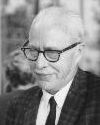
Died 13 Oct 1987 at age 85 (born 10 Feb 1902). quotes
Walter Houser Brattain was an American physicist who shared (with John Bardeen and William B. Shockley) the Nobel Prize for Physics in 1956 for investigating semiconductors (materials of which transistors are made) and for the development of the transistor. At college, he said, he majored in physics and math because they were the only subjects he was good at. He became a solid physicist with a good understanding of theory, but his strength was in physically constructing experiments. Working with the ideas of Shockley and Bardeen, Brattain’s hands built the first transistor. Shortly, the transistor replaced the bulkier vacuum tube for many uses and was the forerunner of microminiature electronic parts.
Walter Houser Brattain was an American physicist who shared (with John Bardeen and William B. Shockley) the Nobel Prize for Physics in 1956 for investigating semiconductors (materials of which transistors are made) and for the development of the transistor. At college, he said, he majored in physics and math because they were the only subjects he was good at. He became a solid physicist with a good understanding of theory, but his strength was in physically constructing experiments. Working with the ideas of Shockley and Bardeen, Brattain’s hands built the first transistor. Shortly, the transistor replaced the bulkier vacuum tube for many uses and was the forerunner of microminiature electronic parts.
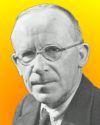
Died 13 Oct 1963 at age 70 (born 13 Jun 1893).
Alan Arnold Griffith was a British aeronautical engineer. During the late 1920s, A.A. Griffith and F. Whittle independently made the first practical proposals for the use of gas turbine engines in aircraft. Griffith concentrated on developing an axial flow compressor, and in 1929 he proposed a gas turbine engine driving a propeller, the so called turbo-prop engine. Earlier, in 1917, with G.I.Taylor, he published a pioneering article on the use of soap films in solving torsion problems. In 1920, he published a seminal article on the theory of the brittle fracture. At Rolls Royce (1939-60) he designed turbojet engines, and in the 1950s, vertical take-off aircraft. He developed the remarkable "flying bedstead" which first flew in 1954.
Alan Arnold Griffith was a British aeronautical engineer. During the late 1920s, A.A. Griffith and F. Whittle independently made the first practical proposals for the use of gas turbine engines in aircraft. Griffith concentrated on developing an axial flow compressor, and in 1929 he proposed a gas turbine engine driving a propeller, the so called turbo-prop engine. Earlier, in 1917, with G.I.Taylor, he published a pioneering article on the use of soap films in solving torsion problems. In 1920, he published a seminal article on the theory of the brittle fracture. At Rolls Royce (1939-60) he designed turbojet engines, and in the 1950s, vertical take-off aircraft. He developed the remarkable "flying bedstead" which first flew in 1954.
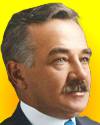
Died 13 Oct 1945 at age 88 (born 13 Sep 1857).
Milton Snavely Hershey was an American manufacturer who transformed the chocolate industry, turning milk chocolate from a luxury, to a mass-produced commodity. He apprenticed in confectionery until 1876, then opened a candy shop in Philadelphia, with little success. He pivoted to making caramels, and next founded the Hershey Chocolate Co. (1894) using machinery he saw at the 1893 World’s Columbian Exposition. He innovated to consistently blend milk, sugar, and cocoa, overcoming the challenges of milk’s variability. By continually refining processes, he supplied an affordable product of consistent quality. In 1903, he established a factory at Hershey, Pennsylvania, that became the world’s largest. He applied his fortune philanthropically.«
Milton Snavely Hershey was an American manufacturer who transformed the chocolate industry, turning milk chocolate from a luxury, to a mass-produced commodity. He apprenticed in confectionery until 1876, then opened a candy shop in Philadelphia, with little success. He pivoted to making caramels, and next founded the Hershey Chocolate Co. (1894) using machinery he saw at the 1893 World’s Columbian Exposition. He innovated to consistently blend milk, sugar, and cocoa, overcoming the challenges of milk’s variability. By continually refining processes, he supplied an affordable product of consistent quality. In 1903, he established a factory at Hershey, Pennsylvania, that became the world’s largest. He applied his fortune philanthropically.«
Hershey: Milton S. Hershey’s Extraordinary Life of Wealth, Empire, and Utopian Dreams, by Michael D'Antonio. - book suggestion.
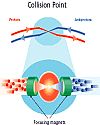
In 1985, at the Fermi National Accelerator Laboratory in Illinois, the first observation was made of proton-antiproton collisions by the Collider Detector at Fermilab (CDF) with 1.6 TeV center-of-mass energy. In all, 23 of collisions were detected in Oct 1985. The Tevatron, four miles in circumference (originally named the Energy Doubler), is the world's highest-energy particle accelerator. Its low-temperature cooling system was the largest ever built when it was placed in operation in 1983. Its 1,000 superconducting magnets are cooled by liquid helium to -268 deg C (-450 deg F). Fermilab (originally named the National Accelerator Laboratory) was commissioned by the U.S. Atomic Energy Commission, in a bill signed by President Johnson on 21 Nov 1967.
21st Century Complete Guide to Fermilab, by Fermilab: four CD set. - book suggestion.
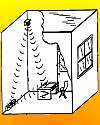
In 1953, the first U.S. patent for a burglar alarm operated by ultrasonic sound was issued to Samuel Bagno of New York City (No. 2,655,645) on a system for movement detection in a confined space by intruders or fire. It was manufactured as the Alertronic and first sold in Jun 1950. A sound source produced waves of 19,000 hertz, a frequency too high for normal human hearing. An intruder could be detected by the alarm by a difference in frequency of the reflected waves from the moving body (the Doppler effect). The device would then sound an alarm.
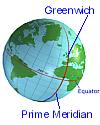
In 1884, Greenwich was adopted as the universal meridian. At the behest of the U.S. President, 41 delegates from 25 nations met in Washington, DC, for the International Meridian Conference. At the Conference several important principles were established: a single world meridian passing through the principal Transit Instrument at the Observatory at Greenwich; that all longitude would be calculated both east and west from this meridian up to 180°; a universal day; and studies of the decimal system to the division of time and space. Resolution 2, fixing the Meridian at Greenwich was passed 22-1 (San Domingo voted against, France & Brazil abstained). Greenwich lies on the River Thames, a few miles from central London.
Greenwich Time and Longitude, by Derek Howse. - book suggestion.
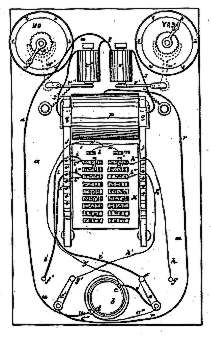
(USPTO)
In 1868, Thomas Edison executed his first patent, by signing and dating his application. It was received by the U.S. Patent Office with an application date of 28 Oct 1868, and it was issued as No. 90,646 on 1 Jun 1869. His invention was an “Electrographic Vote-Recorder,” the first of its kind, which he designed for use by legislative bodies, such as the U.S. Congress, who would have been enabled to vote for or against an issue by turning a switch to the right or left. His idea remained unappreciated. Thus, his first patented invention was, in effect, a failure. His next invention was a Printing Telegraph, U.S. Patent No. 91,527, issued 22 Jun 1869. He eventually held over 1,500 patents.«
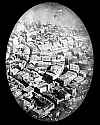
In 1860, the first successful aerial photograph in the U.S. was taken over Boston by James Wallace Black in a balloon, The Queen of the Air with Samuel Archer King as navigator held by a cable 1,200 feet above the city. Eight pictures were exposed, using wet plates prepared in the balloon as needed. One good photograph resulted - Boston as the Eagle and the Wild Goose See It, which showed an area bounded by Brattle Street on the north, the harbour on the east, Sumner Street on the south, and Park Street on the west. (Credit for the first aerial photograph goes to French author and artist Felix Tournachon who used the nom de plume Nadar. He captured the first aerial photo from a balloon tethered over the Bievre Valley in 1858, though his work is lost.)
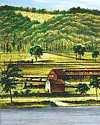
In 1853, the Pennsylvania and Lehigh Zinc Company Mill in Bethlehem, Pennsylvania, was completed. When it began processing calamine ores, it was the first commercial zinc production in the U.S. The four-acre site was purchased by Samuel Wetherill of Philadelphia. Early output focused on zinc oxide for white paint, produced along with barrels for packaging. The refining of metallic zinc followed later. Incorporated on 2 May 1855, the company also owned zinc mines on 160 acres at nearby Friedensville, discovered about 1845 by T. H. Roepper of Bethlehem. It was later acquired by the New Jersey Zinc Company, which expanded the American zinc industry.«
more





