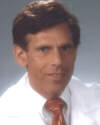
Born 11 Oct 1945.
American physician, co-founder of International Bone Marrow Registry, and a pioneer in bone marrow transplantation. Gale has received much attention for the assistance he has given foreign governments in treating radiation victims - to the Soviet Union (1986) after the Chernobyl disaster and to Brazil (1987) following an accident in Goiania. As a specialist in bone marrow transplants, he volunteeredto treat Chernobyl victims and was invited by Mikhail Gorbachev to travel with a group to Moscow immediately after the April 1986 accident. He operated with bone marrow transplants on 13 Chernobyl victims. However, many of the highly exposed Chernobyl survivors have since died from latent radiation effects.
American physician, co-founder of International Bone Marrow Registry, and a pioneer in bone marrow transplantation. Gale has received much attention for the assistance he has given foreign governments in treating radiation victims - to the Soviet Union (1986) after the Chernobyl disaster and to Brazil (1987) following an accident in Goiania. As a specialist in bone marrow transplants, he volunteeredto treat Chernobyl victims and was invited by Mikhail Gorbachev to travel with a group to Moscow immediately after the April 1986 accident. He operated with bone marrow transplants on 13 Chernobyl victims. However, many of the highly exposed Chernobyl survivors have since died from latent radiation effects.
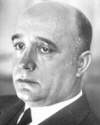
Born 11 Oct 1884; died 30 Mar 1949 at age 64.
Friedrich Karl Rudolf Bergius was a German chemist who invented a process to convert coal dust and hydrogen directly into gasoline and lubricating oils without isolating intermediate products (Stuttgart, 25 Jun 1921). Bergius succeeded, during distillation of coal, in forcing hydrogen under high pressure to combine chemically with the coal, transforming more carbon from the coal into oils than is possible with conventional distillation. To solve heat distribution and temperature regulation problems, Bergius invented treating a mixture of pulverized coal in oil with the gas under high pressure. For his work in developing the chemical high pressure hydrogenation method necessary for this process he shared the 1931 Nobel Prize for Chemistry with Carl Bosch of Germany.
Friedrich Karl Rudolf Bergius was a German chemist who invented a process to convert coal dust and hydrogen directly into gasoline and lubricating oils without isolating intermediate products (Stuttgart, 25 Jun 1921). Bergius succeeded, during distillation of coal, in forcing hydrogen under high pressure to combine chemically with the coal, transforming more carbon from the coal into oils than is possible with conventional distillation. To solve heat distribution and temperature regulation problems, Bergius invented treating a mixture of pulverized coal in oil with the gas under high pressure. For his work in developing the chemical high pressure hydrogenation method necessary for this process he shared the 1931 Nobel Prize for Chemistry with Carl Bosch of Germany.
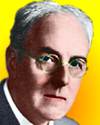
Born 11 Oct 1881; died 30 Sep 1953 at age 71. quotes
English mathematician, meteorologist, physicist and psychologist who first applied mathematics to accurate weather prediction. For this, he used the mathematical method of finite differences (1922). At first, limited computer power hobbled forecasting: three months computation time to predict weather for the next 24 hours. After WWII, as successive electronic computers grew faster, his methods were increasingly practical. He wrote several books applying mathematics to the causes of war. He contributed to calculus and the theory of diffusion for eddy-diffusion in the atmosphere. The Richardson number, a quantity involving gradients (change over distance) of temperature and wind velocity, is named after him.«
English mathematician, meteorologist, physicist and psychologist who first applied mathematics to accurate weather prediction. For this, he used the mathematical method of finite differences (1922). At first, limited computer power hobbled forecasting: three months computation time to predict weather for the next 24 hours. After WWII, as successive electronic computers grew faster, his methods were increasingly practical. He wrote several books applying mathematics to the causes of war. He contributed to calculus and the theory of diffusion for eddy-diffusion in the atmosphere. The Richardson number, a quantity involving gradients (change over distance) of temperature and wind velocity, is named after him.«
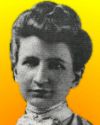
Born 11 Oct 1871; died 31 Mar 1945 at age 73.
American archaeologist and social activist who gained renown for her discoveries of ancient remains in Crete. She went to Crete in 1900, and with the encouragement of Arthur Evans, began to excavate a Minoan site at Kavousi where she discovered some Iron Age Tombs. From 1901-05 she led a large team that excavated the early Bronze Age Minoan town of Gournia, becoming the first woman to head a major archaeological dig. As a community of humble artisans, Gournia was of particular interest to archaeologists, complementing as it did the more elaborate palaces being unearthed at Knossos and elsewhere. In 1908 she published her monumental work on Gournia. During WW I she went to Corfu to help nurse the Serbians (1916).
American archaeologist and social activist who gained renown for her discoveries of ancient remains in Crete. She went to Crete in 1900, and with the encouragement of Arthur Evans, began to excavate a Minoan site at Kavousi where she discovered some Iron Age Tombs. From 1901-05 she led a large team that excavated the early Bronze Age Minoan town of Gournia, becoming the first woman to head a major archaeological dig. As a community of humble artisans, Gournia was of particular interest to archaeologists, complementing as it did the more elaborate palaces being unearthed at Knossos and elsewhere. In 1908 she published her monumental work on Gournia. During WW I she went to Corfu to help nurse the Serbians (1916).
Born to Rebel: The Life of Harriet Boyd Hawes, by Mary Allsebrook. - book suggestion.
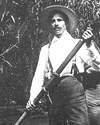
Early 1900's
Born 11 Oct 1865; died 30 May 1947 at age 81. quotes
American zoologist whose classification of many new species of marine protozoans helped establish systematic marine biology. Named director of the University of Illinois Biological Experiment Station in Havana, IL. (1895-1903), Kofoid investigated plankton in the river and backwater lakes. He joined the newly founded Scripps Institution of Oceanography (1903). Kofoid was a member of their scientific staff on the US Fish Commission Steamer Albatross during the Albatross Expedition (l904-5) off the coast of San Diego, CA. Two summers (1908,9), he toured the marine biological stations of Europe, buying instruments and collecting information on buildings and aquaria to help plan the San Diego Marine Biological Station.
American zoologist whose classification of many new species of marine protozoans helped establish systematic marine biology. Named director of the University of Illinois Biological Experiment Station in Havana, IL. (1895-1903), Kofoid investigated plankton in the river and backwater lakes. He joined the newly founded Scripps Institution of Oceanography (1903). Kofoid was a member of their scientific staff on the US Fish Commission Steamer Albatross during the Albatross Expedition (l904-5) off the coast of San Diego, CA. Two summers (1908,9), he toured the marine biological stations of Europe, buying instruments and collecting information on buildings and aquaria to help plan the San Diego Marine Biological Station.
Born 11 Oct 1855; died 25 Feb 1920 at age 64.
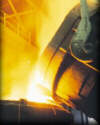
American metallurgist who invented a device to ensure uniform humidity in the air stream going into blast furnaces. With prior experience at several iron works, Gayley was hired by the Edgar Thomson Steel Works as Superintendent of the Blast Furnaces (1885). In this capacity was an economist, and made a record reduction in the coke consumption. He invented the bronze cooling plate for blast furnace walls, the auxiliary casting stand for Bessemer steel plants, and was the first to use the compound condensing blowing engine with the Blast Furnace. He also invented the dry-air blast, for which the Franklin Institute awarded him the Elliott Cresson medal. Gayley rose to first vice-president of the U.S.Steel Corp and acquired a large fortune.
American metallurgist who invented a device to ensure uniform humidity in the air stream going into blast furnaces. With prior experience at several iron works, Gayley was hired by the Edgar Thomson Steel Works as Superintendent of the Blast Furnaces (1885). In this capacity was an economist, and made a record reduction in the coke consumption. He invented the bronze cooling plate for blast furnace walls, the auxiliary casting stand for Bessemer steel plants, and was the first to use the compound condensing blowing engine with the Blast Furnace. He also invented the dry-air blast, for which the Franklin Institute awarded him the Elliott Cresson medal. Gayley rose to first vice-president of the U.S.Steel Corp and acquired a large fortune.
Born 11 Oct 1844; died 14 May 1919 at age 74. quotes
American businessman who founded H.J. Heinz Co.and invented its “57 varieties” slogan was a born salesman. His entrepreneur and business genius had roots in post-Civil War Pittsburgh, where iron, steel and glass factories were forging industrial America. By age 12 he was peddling produce from the family garden. At 25, in 1869, he and a friend launched Heinz & Noble. Its first product: Henry's mother's grated horseradish, bottled in clear glass to reveal its purity. Heinz & Noble thrived until an overabundance of crops in 1875 brought bankruptcy. But Henry plunged back in, eventually building a model factory complex along the Allegheny River. By 1896, at only 52, the pickle king had become a millionaire and celebrity. more
American businessman who founded H.J. Heinz Co.and invented its “57 varieties” slogan was a born salesman. His entrepreneur and business genius had roots in post-Civil War Pittsburgh, where iron, steel and glass factories were forging industrial America. By age 12 he was peddling produce from the family garden. At 25, in 1869, he and a friend launched Heinz & Noble. Its first product: Henry's mother's grated horseradish, bottled in clear glass to reveal its purity. Heinz & Noble thrived until an overabundance of crops in 1875 brought bankruptcy. But Henry plunged back in, eventually building a model factory complex along the Allegheny River. By 1896, at only 52, the pickle king had become a millionaire and celebrity. more
H. J. Heinz: A Biography, by Quentin R. Skrabec. - book suggestion.
Born 11 Oct 1799; died 5 Jan 1877 at age 77.
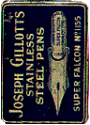
A pioneer of the steel pen, born in Sheffield. An English engineer Bryan Donkin patented a steel pen point in 1803 but did not commercially exploit his patent. In 1830, steel makers (William Joseph Gillott, William Mitchell, James Stephen Perry) mainly in Birmingham, England developed the machine production technique for cheap long wearing steel pen nibs. Tempered steel sheet was stamped to produce the basic nib then shaped, slit and the tip formed. More than most other metals, stainless steel has the elasticity needed to give the variety of penmanship styles available from the quill pen. By 1850 quill pen usage was fading and the quality of the steel nibs had been improved by tipping them with hard alloys of iridium, rhodium and osmium.
A pioneer of the steel pen, born in Sheffield. An English engineer Bryan Donkin patented a steel pen point in 1803 but did not commercially exploit his patent. In 1830, steel makers (William Joseph Gillott, William Mitchell, James Stephen Perry) mainly in Birmingham, England developed the machine production technique for cheap long wearing steel pen nibs. Tempered steel sheet was stamped to produce the basic nib then shaped, slit and the tip formed. More than most other metals, stainless steel has the elasticity needed to give the variety of penmanship styles available from the quill pen. By 1850 quill pen usage was fading and the quality of the steel nibs had been improved by tipping them with hard alloys of iridium, rhodium and osmium.
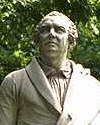
Born 11 Oct 1758; died 2 Mar 1840 at age 81.
Heinrich Wilhelm Matthaus Olbers was a German physician and astronomer who, while practising medicine at Bremen, calculated the orbit of the comet of 1779, discovered the minor planets (asteroids) Pallas (1802) and Vesta (1807), and discovered five comets (all but one already observed at Paris). Olbers invented a method for calculating the velocity of falling stars. He is also known for Olber's paradox which asks “why is the night sky dark if there are so many bright stars all around to light it?”Image: Monument in Bremen, Germany
Heinrich Wilhelm Matthaus Olbers was a German physician and astronomer who, while practising medicine at Bremen, calculated the orbit of the comet of 1779, discovered the minor planets (asteroids) Pallas (1802) and Vesta (1807), and discovered five comets (all but one already observed at Paris). Olbers invented a method for calculating the velocity of falling stars. He is also known for Olber's paradox which asks “why is the night sky dark if there are so many bright stars all around to light it?”Image: Monument in Bremen, Germany
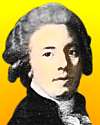
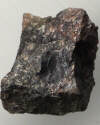
wolframite
Spanish chemist and mineralogist who assisted his older brother Juan José in experiments to separate tungsten metal from its wolframite ore (1783). Two years earlier, Swedish chemist Carl Scheele discovered tungstic acid, though did not isolate the elemental form, from a mineral known since about 1758 as tung sten (Swedish, heavy stone; which is now known as scheelite). The Elhuyar brothers, working at the Seminary of Bergara, succeeded in extracting the metal by reducing tungstic acid with charcoal. For the first time, Basque scientists entered the history of science. Each became a director of a school of mines, but in different countries. Although Juan José discovered tungsten metal, Fausto became better known.«

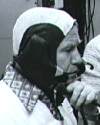
Died 11 Oct 2019 at age 85 (born 30 May 1934). quotes
Aleksey (Alexei) Arkhipovich Leonov was a Soviet cosmonaut, who was the first man to climb out of a spacecraft in space. On 18 Mar 1965, Voskhod 2 was launched into space carrying Leonov with Pavel Belyayev aboard. On the second orbit Leonov left the spacecraft through the air lock while still tethered to the vessel. He took motion pictures and practiced moving outside of the spacecraft for 10 minutes. Voskhod 2 made 17 orbits at about 110 miles (177 km) above earth. Ten years later, on 17 Jul 1975, Leonov commanded the Soviet Soyuz craft that linked in orbit with a U.S. Apollo craft.
Aleksey (Alexei) Arkhipovich Leonov was a Soviet cosmonaut, who was the first man to climb out of a spacecraft in space. On 18 Mar 1965, Voskhod 2 was launched into space carrying Leonov with Pavel Belyayev aboard. On the second orbit Leonov left the spacecraft through the air lock while still tethered to the vessel. He took motion pictures and practiced moving outside of the spacecraft for 10 minutes. Voskhod 2 made 17 orbits at about 110 miles (177 km) above earth. Ten years later, on 17 Jul 1975, Leonov commanded the Soviet Soyuz craft that linked in orbit with a U.S. Apollo craft.

c. 1950's
Died 11 Oct 2003 at age 76 (born 1 Aug 1927).
English botanist and conservationist, who was was one of the most influential botanists of his generation. He made a significant contribution to conservation as the co-author (with Max Walters) of the Atlas of the British Flora (1962), one of the most important British natural history publications of the 20th century. This compilation precisely was initiated in 1954 by the Botanical Society of the British Isles (BSBI) to record the incidence of all British flowering plants. Perring was a senior member of the team of researchers. Using a map of the country in 10 km grid squares, each square was visited, and the plants there recorded. Later, he encouraged zoologists to make similar atlases of distribution for mammals, butterflies, and other life forms.
English botanist and conservationist, who was was one of the most influential botanists of his generation. He made a significant contribution to conservation as the co-author (with Max Walters) of the Atlas of the British Flora (1962), one of the most important British natural history publications of the 20th century. This compilation precisely was initiated in 1954 by the Botanical Society of the British Isles (BSBI) to record the incidence of all British flowering plants. Perring was a senior member of the team of researchers. Using a map of the country in 10 km grid squares, each square was visited, and the plants there recorded. Later, he encouraged zoologists to make similar atlases of distribution for mammals, butterflies, and other life forms.
Died 11 Oct 1996 at age 89 (born 18 Apr 1907).
Finnish mathematician who was awarded one of the first two Fields Medals in 1936 for his work with Riemann surfaces. He also won the Wolf Prize in 1981.
Finnish mathematician who was awarded one of the first two Fields Medals in 1936 for his work with Riemann surfaces. He also won the Wolf Prize in 1981.
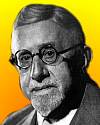
Died 11 Oct 1962 at age 90 (born 12 Nov 1871).
Austrian agronomist who was one of three scientists who independently (as did Hugo de Vries and Carl Correns) rediscovered Gregor Mendel's work on the laws of genetics of the 1860's. Von Tschermak published his findings in June 1900.«
Austrian agronomist who was one of three scientists who independently (as did Hugo de Vries and Carl Correns) rediscovered Gregor Mendel's work on the laws of genetics of the 1860's. Von Tschermak published his findings in June 1900.«
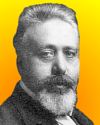
Died 11 Oct 1940 at age 80 (born 3 May 1860).
Italian mathematician who made important contributions to calculus, and mathematical theories in astronomy, elasticity and biometrics. His mathematical talent appeared as a young boy. In 1905, he began to develop the theory of dislocations in crystals that led to improved understanding of the behaviour of ductile materials. During WWI he established the Italian Office of War Inventions and designed weapons for use by airships, for which he proposed the use of helium instead of flammable hydrogen. He is remembered for achievements in function theory and differential equations. In biology, in 1925, he formulated a pair of differential equations relating populations of prey and predators (also independently proposed by Alfred J. Lotka in 1925).«
Italian mathematician who made important contributions to calculus, and mathematical theories in astronomy, elasticity and biometrics. His mathematical talent appeared as a young boy. In 1905, he began to develop the theory of dislocations in crystals that led to improved understanding of the behaviour of ductile materials. During WWI he established the Italian Office of War Inventions and designed weapons for use by airships, for which he proposed the use of helium instead of flammable hydrogen. He is remembered for achievements in function theory and differential equations. In biology, in 1925, he formulated a pair of differential equations relating populations of prey and predators (also independently proposed by Alfred J. Lotka in 1925).«
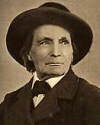
Died 11 Oct 1915 at age 91 (born 22 Dec 1823). quotes
French entomologist and author who popularized insect natural history. He wrote ten volumes of Souvenirs entomologiques (1879-1907) in which he recorded his perceptive field observations of insect behaviour. Although his career began as a professor of physics, and in 1866 he isolated alizarin (the colouring agent in madder), his life work became the study of insects, about which he wrote in elegant prose. From his study of parasitic wasps he deduced that much of the wasp's behaviour is inherited and not learned. Victor Hugo dubbed him “the insects' Homer” and Edmond Rostand named him the “Virgil of insects.” Darwin cited him as “an incomparable observer.”«
French entomologist and author who popularized insect natural history. He wrote ten volumes of Souvenirs entomologiques (1879-1907) in which he recorded his perceptive field observations of insect behaviour. Although his career began as a professor of physics, and in 1866 he isolated alizarin (the colouring agent in madder), his life work became the study of insects, about which he wrote in elegant prose. From his study of parasitic wasps he deduced that much of the wasp's behaviour is inherited and not learned. Victor Hugo dubbed him “the insects' Homer” and Edmond Rostand named him the “Virgil of insects.” Darwin cited him as “an incomparable observer.”«
Fabre's Book of Insects, by Jean-Henri Fabre, et al. - book suggestion.
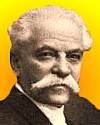
Died 11 Oct 1910 at age 76 (born 13 Feb 1834).
German chemist who invented new industrial chemical processes that enabled the German company BASF (Badische Anilin und Soda Fabrik) to become the leading manufacturer of synthetic dyestuffs for two decades from 1869. Before joining them (1866), he benefitted from time he spent in England, working on mauveine (the first synthetic dye) and learning about the new synthetic dyes William Perkins had developed. Caro improved upon those methods of synthesis. Caro propelled the rise of the German dye industry, which led to Germany’s wider dominance in industrial chemistry, and the emergence of the industrial research laboratory. He helped synthesize artificial alizarin (a natural dye), discovered methylene blue (1877), the first acidic azo dye (1878), and the powerful oxidizing agent, Caro's acid, H2SO5 (1898).«
German chemist who invented new industrial chemical processes that enabled the German company BASF (Badische Anilin und Soda Fabrik) to become the leading manufacturer of synthetic dyestuffs for two decades from 1869. Before joining them (1866), he benefitted from time he spent in England, working on mauveine (the first synthetic dye) and learning about the new synthetic dyes William Perkins had developed. Caro improved upon those methods of synthesis. Caro propelled the rise of the German dye industry, which led to Germany’s wider dominance in industrial chemistry, and the emergence of the industrial research laboratory. He helped synthesize artificial alizarin (a natural dye), discovered methylene blue (1877), the first acidic azo dye (1878), and the powerful oxidizing agent, Caro's acid, H2SO5 (1898).«
Heinrich Caro and the Creation of Modern Chemical Industry, by Carsten Reinhardt and Anthony S. Travis. - book suggestion.
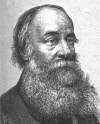
Died 11 Oct 1889 at age 70 (born 24 Dec 1818). quotes
English physicist who established that the various forms of energy - mechanical, electrical, and heat - are basically the same and can be changed, one into another. Thus he formed the basis of the law of conservation of energy, the first law of thermodynamics. He discovered (1840) the relationship between electric current, resistance, and the amount of heat produced. In 1849 he devised the kinetic theory of gases, and a year later announced the mechanical equivalent of heat. Later, with William Thomson (Lord Kelvin), he discovered the Joule-Thomson effect. The SI unit of energy or work , the joule (symbol J), is named after him. It is defined as the work done when a force of 1 newton moves a distance of 1 metre in the direction of the force.
English physicist who established that the various forms of energy - mechanical, electrical, and heat - are basically the same and can be changed, one into another. Thus he formed the basis of the law of conservation of energy, the first law of thermodynamics. He discovered (1840) the relationship between electric current, resistance, and the amount of heat produced. In 1849 he devised the kinetic theory of gases, and a year later announced the mechanical equivalent of heat. Later, with William Thomson (Lord Kelvin), he discovered the Joule-Thomson effect. The SI unit of energy or work , the joule (symbol J), is named after him. It is defined as the work done when a force of 1 newton moves a distance of 1 metre in the direction of the force.
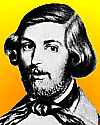
Died 11 Oct 1852 at age 29 (born 16 Apr 1823). quotes
German mathematician whose work covered a range of topics including the theory of elliptic functions, and quadratic and cubic forms, which led to cyclotomy, the reciprocity theorem for cubic residues, and also theorems for quadratic and biquadratic residues from partition of prime numbers.«
German mathematician whose work covered a range of topics including the theory of elliptic functions, and quadratic and cubic forms, which led to cyclotomy, the reciprocity theorem for cubic residues, and also theorems for quadratic and biquadratic residues from partition of prime numbers.«
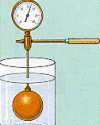
Died 11 Oct 1705 at age 42 (born 31 Aug 1663). quotes
French physicist who developed the air thermometer - which relies on increase in volume of a gas (rather than a liquid) with temperature - and used it (1702) to measure change in temperature in terms of a proportional change in pressure. This observation led to the concept of absolute zero in the19th century. Deaf since childhood, Amontons worked on inventions for the deaf, such as the first telegraph, which relied on a telescope, light, and several stations to transmit information over large distances. Amontons' laws of friction, relied upon by engineers for 300 years, state that the frictional force on a body sliding over a surface is proportional to the load that presses them together and is also independent of the areas of the surfaces.
French physicist who developed the air thermometer - which relies on increase in volume of a gas (rather than a liquid) with temperature - and used it (1702) to measure change in temperature in terms of a proportional change in pressure. This observation led to the concept of absolute zero in the19th century. Deaf since childhood, Amontons worked on inventions for the deaf, such as the first telegraph, which relied on a telescope, light, and several stations to transmit information over large distances. Amontons' laws of friction, relied upon by engineers for 300 years, state that the frictional force on a body sliding over a surface is proportional to the load that presses them together and is also independent of the areas of the surfaces.
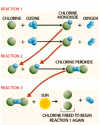
In 1995, Americans Mario Molina and Sherwood Rowland, and Dutch scientist Paul Crutzen won the Nobel Prize in chemistry for their work warning that CFCs are eating away Earth's ozone layer. In 1970, Dr. Crutzen showed that nitrogen oxides are important in the natural balance of ozone in the upper atmosphere. Thus research rapidly escalated into global biogeochemical cycles. In 1974, Drs. Molina and Rowland established that there was a threat to the ozone layer from man-made chlorofluorocarbons (CFCs), such as gases then used in spray cans. More than a decade before the Antarctic ozone hole was discovered, their research stirred the international response to control the emissions of CFCs to protect the ozone layer.
In 1994, the space probe Magellan ended its mission to explore Venus when flight controllers lowered its orbit into Venus' dense atmosphere and it plunged toward the surface. Radio contact was lost the next day. Although much of Magellan was vaporized, some sections are thought to have hit the planet's surface intact. Launched 4 May 1989 in the cargo bay with the STS-30 Space Shuttle Atlantis mission, Magellan arrived at its planned polar orbit around Venus on 10 Aug 1990. As it circled once every 3-hr 15-min, the planet rotated slowly beneath it, and Magellan had collected radar images of the surface in strips about 17-28 km (10-17 mi) wide and radioed back the information on the large shield volcanoes, vast lava plains and sparse craters.«
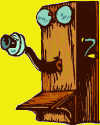
In 1983, the last hand-cranked (magneto) telephones in the United States went out of service as 440 telephone customers in Bryant Pond, Maine, were switched to direct-dial service. Prior to that time a resident's number could be as short as 33. Those living close enough to the telephone office might get to answer the phone, even if they were outside because the operator could just yell out the window! The last hand-cranked telphone call in Bryant pond was made the following day, on 12 Oct 1983.
In 1968, the first manned Apollo mission, Apollo 7, was launched on a Saturn 1-B rocket from Cape Kennedy. The astronauts onboard were the Captain Wally Schirra, Jr. (Navy), with crew members Donn Fulton Eisele (Air Force) and R. Walter Cunningham (civilian). They circled for 11 days, up to 183 miles above the Earth, in 90 minute orbits. They tested maneuvering the Apollo, first by detaching it from the upper stage of the rocket, Next, they turned the Apollo around to reposition its nose toward the rocket. On the subsequent Apollo 11 mission, the vehicle would link to the moon landing craft carried inside the cylinder. For Apollo 11, the stage would then boost the combined crafts towards the moon.«
In 1958, the lunar probe Pioneer 1 was launched atop a Thor-Able rocket, from the Eastern Test range (now the Kennedy Space Center). Its intended mission was to reach the moon, but it failed to go as far as planned and fell back to Earth. It transmitted 43 hours of data before burning up in the atmosphere. NASA (the National Aeronautics and Space Administration) had just been formed at the beginning of the month.«

In 1957, the Jodrell Bank radio telescope, the world's largest radio telescope, designed by Sir Bernard Lovell, began operating. Though the telescope is popularly known for tracking and communicating with man-made satellites, its prime function is the study of the universe by means of radio waves emitted by distatant stars. The radiation received from meteors, the moon, the Andromeda Galaxy, and the Milky Way offers new information daily about the origins of life on this planet and the possibilities of life on other worlds. The building of the telescope was fraught with mishaps and frustrations—financial, political, and otherwise—yet, through his perseverance, Sir Bernard Lovell made its creation a reality.
Story of Jodrell Bank, by Sir Bernard Lovell. - book suggestion.
In 1938, R. Games Slayter (died 15 Oct 1964) and John H. Thomas patent glass wool and the machinery to make it. Games Slayter, the driving force behind Owens Corning technology and innovation, sought to make a finer glass fiber material. In 1932, Dale Kleist, a young researcher under Jack Thomas (Slayter's research assistant), working on an unrelated experiment accidentally caused a jet of compressed air to strike a stream of molten glass, resulting in fine glass fibers. By Fall 1932, Kleist refined the process by using steam, to make glass fiber material thin enough for commercial fiber glass insulation. From March 1933, Games Slayter directed Jack Thomas in experiments using glass wool, instead of natural or other synthetic fibers, on textile machinery.
In 1892, Thomas A. Edison was issued a patent for an “Electrical Depositing-Meter” (U.S. No. 484,183).
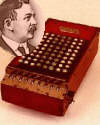
In 1887, a patent for an adding machine was granted to Dorr Eugene Felt of Chicago, Illinois. His Comptometer was the first practical key-driven calculator with sufficient speed, reliablility and economic benefit. He called his original prototype the “Macaroni box”, a rough model that Felt created over the year-end holidays in 1884-85. The casing was a grocery macaroni box, assembled with a jackknife, using meat skewers as keys, staples as key guides, and elastic bands for springs. Door improved his design, and produced his earliest commercial wooden-box Comptometer from 1887 to 1903. The first steel case Model A , introduced in 1904 became te standard for the remainder for all “shoebox” models. Electric motor drive was added in the 1920s.
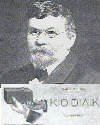
In 1881, roll film for cameras was patented by David H. Houston, who was a Scottish immigrant that travelled to homestead in Dakota (1879) on a 400-acre farm, 30 miles NE of Fargo. His many patents ranged from a disc plow to a portable camera. George Eastman bought 21 patents on cameras from him, including the invention that made Houston famous - a portable camera designed in 1879, for which Houston received $5000 plus monthly royalties for life. This camera suited the everyday person, rather than a professional photographer's big studio camera on wheels. First sold by Eastman in 1881 for $25, the Kodak camera came loaded with a 100-exposure film that Houston would process and reload the camera for $10. Houston died a rich man in 1906.
In 1811, the first steam-powered ferryboat, the Juliana, began operation by between New York City and Hoboken, NJ. Its inventor, John Stevens, designed improvements in steamboats, obtained one of the first U.S. patents (1791) and experimented on the Passaic River, (1798 - 1800), with the steamboat, Polacca, but unsuccessfully due to excessive vibrations and leaks. By 1803, Stevens had patented an improved multitubular boiler and outfitted the Little Juliana which sailed successfully in New York harbor (1804) and thus was one of the earliest twin screw sailboats. After building other ships, in 1811, he bought a commercial ferry license in NY state and operated a horse powered ferry while building the first steam ferry, Juliana.




