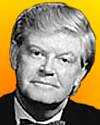
Born 4 May 1926; died 10 Feb 2005 at age 78. quotes
David Allan Bromley was a Canadian-American physicist who was considered the “father of modern heavy ion science” for his pioneering experiments on both the structure and dynamics of atomic nuclei. He was a leader in developing particle accelerators detection systems and computer-based data acquisition and analysis systems. While at Atomic Energy of Canada (1955-60) he installed the first tandem Van Der Graaff accelerator. He was founder and director (1963-89) of the A.W. Wright Nuclear Structure Laboratory at Yale University, which has produced more experimental nuclear physicists than any other facility. During this time he became active on numerous national and international science policy boards. From 1980-89, he was a member of the White House Science Council.«
David Allan Bromley was a Canadian-American physicist who was considered the “father of modern heavy ion science” for his pioneering experiments on both the structure and dynamics of atomic nuclei. He was a leader in developing particle accelerators detection systems and computer-based data acquisition and analysis systems. While at Atomic Energy of Canada (1955-60) he installed the first tandem Van Der Graaff accelerator. He was founder and director (1963-89) of the A.W. Wright Nuclear Structure Laboratory at Yale University, which has produced more experimental nuclear physicists than any other facility. During this time he became active on numerous national and international science policy boards. From 1980-89, he was a member of the White House Science Council.«
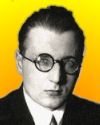
Born 4 May 1899; died 8 Apr 1971 at age 71.
German automotive industrialist who took part, with Max Valier and Friedrich Wilhelm Sander, in experiments with rocket propulsion for automobiles and aircraft. On 11 Apr 1928, at Berlin, they tested the first manned rocket automobile. On 30 Sep 1929, von Opel piloted the Opel Sander Rak.1, a glider powered with 16 rockets of 50 pounds of thrust each, and made successful flight of 75 seconds, covering almost 2 miles near Frankfurt-am-Main, Germany, Von Opel as pilot. By sponsoring these early tests of rocket-powered transport, Opel popularized the idea of rocket propulsion in Germany.
German automotive industrialist who took part, with Max Valier and Friedrich Wilhelm Sander, in experiments with rocket propulsion for automobiles and aircraft. On 11 Apr 1928, at Berlin, they tested the first manned rocket automobile. On 30 Sep 1929, von Opel piloted the Opel Sander Rak.1, a glider powered with 16 rockets of 50 pounds of thrust each, and made successful flight of 75 seconds, covering almost 2 miles near Frankfurt-am-Main, Germany, Von Opel as pilot. By sponsoring these early tests of rocket-powered transport, Opel popularized the idea of rocket propulsion in Germany.
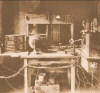
Station 8XK
1920
1920
Born 4 May 1874; died 11 Dec 1941 at age 67.
American electrical engineer whose interest in radiotelephony led to the establishment of the first commercial radio station. Conrad worked for Westinghouse as assistant chief engineer at its East Pittsburgh Works and acquired over 200 patents in his lifetime. As an amateur, having built a transmitting station on the second floor of the garage behind his home in Wilkinsburg, Pa., when he substituted a phonograph for his microphone, he discovered a large audience of listeners who had built their own crystal radio sets and who, upon hearing the music, wrote or phoned requests for more music and news. When he became swamped with these requests, he decided to broadcast regular, scheduled programs to satisfy his listeners. He coined the term "broadcast."
American electrical engineer whose interest in radiotelephony led to the establishment of the first commercial radio station. Conrad worked for Westinghouse as assistant chief engineer at its East Pittsburgh Works and acquired over 200 patents in his lifetime. As an amateur, having built a transmitting station on the second floor of the garage behind his home in Wilkinsburg, Pa., when he substituted a phonograph for his microphone, he discovered a large audience of listeners who had built their own crystal radio sets and who, upon hearing the music, wrote or phoned requests for more music and news. When he became swamped with these requests, he decided to broadcast regular, scheduled programs to satisfy his listeners. He coined the term "broadcast."
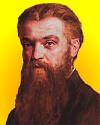
Born 4 May 1845; died 3 Mar 1879 at age 33. quotes
British philosopher and mathematician who developed the theory of biquaternions (a generalization of the Irish mathematician Sir William Rowan Hamilton's theory of quaternions) and then linked them with more general associative algebras. In 1870, he survived a shipwreck near Sicily while on an expedition to Italy to obtain scientific data from an eclipse. Influenced by the work of Riemann and Lobachevsky, Clifford studied non-euclidean geometry. In 1870 he wrote On the Space Theory of Matter in which he argued that energy and matter are simply different types of curvature of space. In this work he presented ideas which were to form a fundamental role in Einstein's general theory of relativity.
British philosopher and mathematician who developed the theory of biquaternions (a generalization of the Irish mathematician Sir William Rowan Hamilton's theory of quaternions) and then linked them with more general associative algebras. In 1870, he survived a shipwreck near Sicily while on an expedition to Italy to obtain scientific data from an eclipse. Influenced by the work of Riemann and Lobachevsky, Clifford studied non-euclidean geometry. In 1870 he wrote On the Space Theory of Matter in which he argued that energy and matter are simply different types of curvature of space. In this work he presented ideas which were to form a fundamental role in Einstein's general theory of relativity.
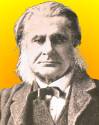
Born 4 May 1825; died 29 Jun 1895 at age 70. quotes
English biologist who made his reputation as a marine biologist while a ship's surgeon. Later he turned to the study of fossils, especially of fishes and reptiles He is best known as the main advocate of Charles Darwin's theory of evolution. In 1860, one year after The Origin of Species was published, Huxley debated with the bishop of Oxford, Samuel Wilberforce, at the British Association for the Advancement of Science. During the discussion Wilberforce asked whether he traced his ancestry to the apes. Huxley's withering reply was that given the choice of a miserable ape and a man who could make such a remark at a serious scientific gathering, he would select the ape. Huxley coined the word agnostic to describe his own beliefs. more
English biologist who made his reputation as a marine biologist while a ship's surgeon. Later he turned to the study of fossils, especially of fishes and reptiles He is best known as the main advocate of Charles Darwin's theory of evolution. In 1860, one year after The Origin of Species was published, Huxley debated with the bishop of Oxford, Samuel Wilberforce, at the British Association for the Advancement of Science. During the discussion Wilberforce asked whether he traced his ancestry to the apes. Huxley's withering reply was that given the choice of a miserable ape and a man who could make such a remark at a serious scientific gathering, he would select the ape. Huxley coined the word agnostic to describe his own beliefs. more
Thomas Henry Huxley: The Evolution of a Scientist, by Sherrie L. Lyons. - book suggestion.
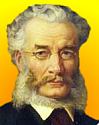
Born 4 May 1806; died 25 Jun 1879 at age 73.
English inventor who worked with Charles Wheatstone in developing electric telegraphy. Of the pair, Cooke contributed a superior business ability, whereas Wheatstone is generally considered the more important of the two in the history of the telegraph. After Cooke attended a demonstration of the use of wire in transmitting messages, he began his own experiments with telegraphy (1836) and formed a partnership with Wheatstone. Their first patent (1837) was impractical because of cost. They demonstrated their five-needle telegraph on 24 July 1837 when they ran a telegraph line along the railway track from Euston to Camden Town able to transmit and successfully receive a message. In 1845, they patented a single-needle electric telegraph.
English inventor who worked with Charles Wheatstone in developing electric telegraphy. Of the pair, Cooke contributed a superior business ability, whereas Wheatstone is generally considered the more important of the two in the history of the telegraph. After Cooke attended a demonstration of the use of wire in transmitting messages, he began his own experiments with telegraphy (1836) and formed a partnership with Wheatstone. Their first patent (1837) was impractical because of cost. They demonstrated their five-needle telegraph on 24 July 1837 when they ran a telegraph line along the railway track from Euston to Camden Town able to transmit and successfully receive a message. In 1845, they patented a single-needle electric telegraph.
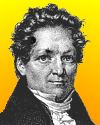
Born 4 May 1777; died 21 Jun 1857 at age 80.
French chemist, teacher, and author of an influential four-volume text on basic chemical theory and practice (1813-16). In 1808, he was the first to isolate the element boron in collaboration with Gay-Lussac. His independent achievements included studies of esters (1807), the discovery of hydrogen peroxide (1818), and work in organophosphorus compounds. He also produced a pigment known as Thenard's blue, which is stable at high temperatures and so can be used in porcelain.
French chemist, teacher, and author of an influential four-volume text on basic chemical theory and practice (1813-16). In 1808, he was the first to isolate the element boron in collaboration with Gay-Lussac. His independent achievements included studies of esters (1807), the discovery of hydrogen peroxide (1818), and work in organophosphorus compounds. He also produced a pigment known as Thenard's blue, which is stable at high temperatures and so can be used in porcelain.
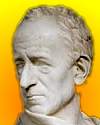
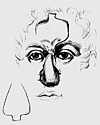
Joseph Constantine Carpue was an English surgeon and anatomist who introduced the Indian method rhinoplasty, reconstructing a nose from a flap of forehead skin. Having first practiced on several cadavers, Carpue operated at the Duke of York's Hospital, Chelsea, England, on a British military officer who had lost his nose to the toxic effects of mercury treatments for his liver, though his nasal bones were entire (23 Oct 1814), and another whose nose and cheek was mutilated by a sword. These two successful operations mark the first modern plastic surgery. He published the technique in 1816. However, it had been practiced from ancient times in India. Gaspar Tagliacotius, a Venetian surgeon had described, in 1598, how nose replacement skin could be grafted from the skin of the shoulder or arm, but the procedure fell into disuse in Italy.«[Image right: Plate from a Carpue publication showing a refined flap.] more
An Account of Two Successful Operations for Restoring a Lost Nose, by Joseph Constantine Carpue. - book suggestion.
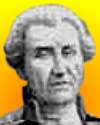
Born 4 May 1733; died 20 Feb 1799 at age 65.
French mathematician and nautical astronomer noted for his studies of fluid mechanics and his development of instruments for navigation and geodesy, the study of the size and shape of the Earth. Borda joined the navy, took part in several scientific voyages and played a role in the American War of Independence. He was one of the main driving forces in the introduction of the decimal system. Borda made good use of calculus and experiment to unify areas of physics. For his surveying, he also developed a series of trigonometric tables. In 1782, while in command of a flotilla of six French ships, he was captured by the British. Borda's health declined after his release. He is one of 72 scientists commemorated by plaques on the Eiffel tower.
French mathematician and nautical astronomer noted for his studies of fluid mechanics and his development of instruments for navigation and geodesy, the study of the size and shape of the Earth. Borda joined the navy, took part in several scientific voyages and played a role in the American War of Independence. He was one of the main driving forces in the introduction of the decimal system. Borda made good use of calculus and experiment to unify areas of physics. For his surveying, he also developed a series of trigonometric tables. In 1782, while in command of a flotilla of six French ships, he was captured by the British. Borda's health declined after his release. He is one of 72 scientists commemorated by plaques on the Eiffel tower.

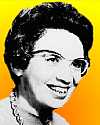
Died 4 May 2001 at age 92 (born 19 Dec 1908).
American psychologist known as the "test guru," for her pioneering development of psychometrics, the measurement and understanding of psychological traits. Her seminal work, Psychological Testing (1954), remains a classic text in the subject. In it, she drew attention to the ways in which trait development is influenced by education and heredity. She explored how variables in the measurement of those traits include differences in training, culture, and language. In 1972, she became the first woman to be elected president of the American Psychological Association in half a century. For her accomplishments, she was awarded the National Medal of Science in 1987.«
American psychologist known as the "test guru," for her pioneering development of psychometrics, the measurement and understanding of psychological traits. Her seminal work, Psychological Testing (1954), remains a classic text in the subject. In it, she drew attention to the ways in which trait development is influenced by education and heredity. She explored how variables in the measurement of those traits include differences in training, culture, and language. In 1972, she became the first woman to be elected president of the American Psychological Association in half a century. For her accomplishments, she was awarded the National Medal of Science in 1987.«
Psychological Testing, by Anne Anastasi. - book suggestion.
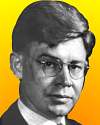
Died 4 May 1974 at age 67 (born 12 May 1906).
William Maurice Ewing was an American geologist and geophysicist who made fundamental contributions to understanding of marine sediments and ocean basins. He worked in a range of subjects, making contributions to earthquake seismology, explosion seismology, marine acoustics, sedimentology, and tectonics. He adapted seismic exploration methods to use in the oceans; explicated a large segment of the earthquake seismogram, the coda; did studies of Earth's free oscillations; and described the ocean sound channel and the dispersion of sound in seawater. He also developed or greatly improved the bathythermograph, the piston corer, heat-flow probes, sonar, hydrophones, gravimeters and deep-sea cameras.
William Maurice Ewing was an American geologist and geophysicist who made fundamental contributions to understanding of marine sediments and ocean basins. He worked in a range of subjects, making contributions to earthquake seismology, explosion seismology, marine acoustics, sedimentology, and tectonics. He adapted seismic exploration methods to use in the oceans; explicated a large segment of the earthquake seismogram, the coda; did studies of Earth's free oscillations; and described the ocean sound channel and the dispersion of sound in seawater. He also developed or greatly improved the bathythermograph, the piston corer, heat-flow probes, sonar, hydrophones, gravimeters and deep-sea cameras.
The Floor of the Sea: Maurice Ewing and the Search to Understand the Earth, by William Wertenbaker. - book suggestion.
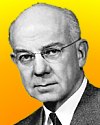
Died 4 May 1972 at age 86 (born 8 Mar 1886).
American biochemist who shared (with Philip S. Hench and Tadeus Reichstein) the Nobel Prize for Physiology or Medicine in 1950 for research on the structure and biological effects of adrenal cortex hormones.
American biochemist who shared (with Philip S. Hench and Tadeus Reichstein) the Nobel Prize for Physiology or Medicine in 1950 for research on the structure and biological effects of adrenal cortex hormones.
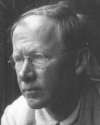
Died 4 May 1961 at age 75 (born 31 Aug 1885). quotes
English mathematician who made extensive and notable contributions to the study of algebraic invariants and concomitants of quadratics. Turnbull was also interested in the history of mathematics, writing The Mathematical Discoveries of Newton (1945), and began work on the Correspondence of Isaac Newton.
English mathematician who made extensive and notable contributions to the study of algebraic invariants and concomitants of quadratics. Turnbull was also interested in the history of mathematics, writing The Mathematical Discoveries of Newton (1945), and began work on the Correspondence of Isaac Newton.
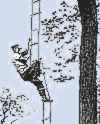
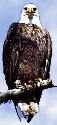
Canadian naturalist, ornithologist, bander and banker whose investigations were among the first to implicate DDT in raptor declines and thus pesticides as environmental threats. Upon retirement from a career in banking (1938) he expanded his interest in nature, and at age 58, he began his study of Florida's bald eagles. In the early 1940s, Broley followed 125 active nests along the peninsula's west coast from Tampa to Fort Myers and banded some 150 young eaglets each year. After 1947, he found the eagle population was declining precipitously. He noted this coincided with the start of DDT spraying in the area. Having concluded that DDT was the culprit, he wrote and lectured on the topic. Later, the early 1960's, others confirmed his suspicions.[Image left: Broley banding young eagles in 1946, using a rope ladder to climb a tree. Image right: Bald eagle (source)]
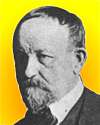
Died 4 May 1919 at age 68 (born 16 Jun 1850). quotes
Max Emil Julius Delbrück was a German chemist who spent a forty-five year career leading development in the fermentation industry. He established a school for distillation workers, a glass factory for the manufacture of reliable apparatus and instruments, and an experimental distillery. Giving attention to the raw resources, he founded teaching and experimental institutions to improve cultivation of potatoes and hops. He researched physiology of yeast and application in the process of fermentation, production of pure cultures, and the action of enzymes. He started the journals Zeitschrift fur Spiritus-Industrie (1867) and Wochenschrift für Brauerei, for the alcohol and brewery industries, which he co-edited. His nephew, also named Max Delbrück, became a microbiologist who won the Nobel Prize in Physiology or Medicine in 1969.«
Max Emil Julius Delbrück was a German chemist who spent a forty-five year career leading development in the fermentation industry. He established a school for distillation workers, a glass factory for the manufacture of reliable apparatus and instruments, and an experimental distillery. Giving attention to the raw resources, he founded teaching and experimental institutions to improve cultivation of potatoes and hops. He researched physiology of yeast and application in the process of fermentation, production of pure cultures, and the action of enzymes. He started the journals Zeitschrift fur Spiritus-Industrie (1867) and Wochenschrift für Brauerei, for the alcohol and brewery industries, which he co-edited. His nephew, also named Max Delbrück, became a microbiologist who won the Nobel Prize in Physiology or Medicine in 1969.«
Died 4 May 1919 at age 49 (born 15 Dec 1869). quotes
American geologist who extended ideas on sedimentary rocks made by marine sedimentation to modification by the action of rivers, winds, and ice. He proposed (1916) that the bright red colour of many Devonian rocks indicated an arid climate that baked them dry, like bricks. He suggested droughts caused lung-fish to evolve into air-breathing land vertebrates, including tetrapods. He applied the new science of radioactive dating in 1917 to recalculate Earth's age to a few billion years, at a time when many geologists still preferred an age of 100 million years. He also emphasized that geological processes vary in intensity in a cyclical rather than a uniform fashion, so current rates of geological change used in prior estimates were not reliable guides.«
American geologist who extended ideas on sedimentary rocks made by marine sedimentation to modification by the action of rivers, winds, and ice. He proposed (1916) that the bright red colour of many Devonian rocks indicated an arid climate that baked them dry, like bricks. He suggested droughts caused lung-fish to evolve into air-breathing land vertebrates, including tetrapods. He applied the new science of radioactive dating in 1917 to recalculate Earth's age to a few billion years, at a time when many geologists still preferred an age of 100 million years. He also emphasized that geological processes vary in intensity in a cyclical rather than a uniform fashion, so current rates of geological change used in prior estimates were not reliable guides.«
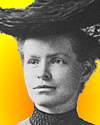
Died 4 May 1912 at age 50 (born 7 Jul 1861). quotes
American geneticist who was born in the year that the Civil War began, and despite difficult times and limited women’s educational opportunities, became one of the first American women to achieve recognition for her contributions to scientific research. As a cell biologist and geneticist, her great contribution to science was as one of the first scientists to find that sex is determined by a single difference between two classes of sperm—the presence or absence of an X chromosome. more
American geneticist who was born in the year that the Civil War began, and despite difficult times and limited women’s educational opportunities, became one of the first American women to achieve recognition for her contributions to scientific research. As a cell biologist and geneticist, her great contribution to science was as one of the first scientists to find that sex is determined by a single difference between two classes of sperm—the presence or absence of an X chromosome. more
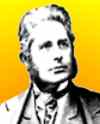
Died 4 May 1900 at age 73 (born 14 Apr 1827). quotes
English archaeologist often called the "father of British archaeology," who stressed the need for total excavation of sites, thorough stratigraphic observation and recording, and prompt and complete publication. Like Sir Flinders Petrie, Pitt-Rivers adopted a sociological approach to the study of excavated objects and emphasized the instructional value of common artifacts. His London home became so crowded with items such as skulls, stone implements, pottery and other works of art that he decided to open a public museum at Bethnal Green, which he arranged according to his evolutionary system. When his collection became too large for Bethnal Green, it was transferred to the University of Oxford, where it is seen today.
English archaeologist often called the "father of British archaeology," who stressed the need for total excavation of sites, thorough stratigraphic observation and recording, and prompt and complete publication. Like Sir Flinders Petrie, Pitt-Rivers adopted a sociological approach to the study of excavated objects and emphasized the instructional value of common artifacts. His London home became so crowded with items such as skulls, stone implements, pottery and other works of art that he decided to open a public museum at Bethnal Green, which he arranged according to his evolutionary system. When his collection became too large for Bethnal Green, it was transferred to the University of Oxford, where it is seen today.
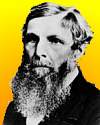
Died 4 May 1879 at age 68 (born 28 Nov 1810).
English engineer and naval architect who influenced ship design by developing a method of studying scale models propelled through water and applying the information thus obtained to full-size ships. His first job was as a civil engineer, working for the British railway system. It was not until a few years later that Froude became a naval engineer. He discovered the laws by which the performance of a model in a towing-tank could be extrapolated to the full-size ship when both have the same geometrical shape. This laboratory work was of great concern to the British navy, to maximize the speed and efficiency of their ships. He developed the bilge keel and developed the Froude number as a measure of the effect of gravity on fluid motion.
English engineer and naval architect who influenced ship design by developing a method of studying scale models propelled through water and applying the information thus obtained to full-size ships. His first job was as a civil engineer, working for the British railway system. It was not until a few years later that Froude became a naval engineer. He discovered the laws by which the performance of a model in a towing-tank could be extrapolated to the full-size ship when both have the same geometrical shape. This laboratory work was of great concern to the British navy, to maximize the speed and efficiency of their ships. He developed the bilge keel and developed the Froude number as a measure of the effect of gravity on fluid motion.
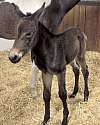
In 2003, the first cloned equine, a mule foal was born at the University of Idaho, U.S., named Idaho Gem. Researchers cloned the mule using a cell from a mule fetus and an egg from a horse. Mules are almost always sterile because donkeys have 62 chromosomes, horses have 64 and mules end up with 63. Equines such as horses, donkeys and mules are difficult to reproduce in the lab using in vitro fertilization and cloning. The cloning success rate was low. Out of 307 attempts, there were 21 pregnancies and three carried to full term. Idaho Gem was the first to be born; two others followed in June and July. The project's major sponsor was a mule racing enthusiast. Unable to breed new animals from proven race stock, mule cloning is an option.
In 1989, the space probe Magellan was carried in the cargo bay by the STS-30 Space Shuttle Atlantis mission launched from Kennedy Space Center in Florida. The space probe was named after the 16th-century Portuguese explorer Ferdinand Magellan. This was the first planetary spacecraft to be released from a shuttle in Earth orbit. It arrived at its planned polar orbit around Venus on 10 Aug 1990, which it circled once every 3-hr 15-min. As the planet rotated slowly beneath it, Magellan collected radar images of the surface in strips about 17-28 km (10-17 mi) wide and radioed back the information. Its mission included taking other measurements. On 11 Oct 1994, it was directed towards the surface, collecting data until it burned up in the atmosphere.«
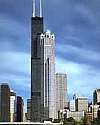
In 1973, the first building over 1,400-ft topped out at 1,454-ft. (finished in 1974), took 3 years to build, and is 1,707-ft tall including its antennas. This, the Sears Building in Chicago, Illinois, stands on Jackson Boulevard between Adams and Franklin Streets. The Sears Tower was designed for more than 12,000 occupants. It took the title of tallest building from the 1,250-ft Empire State Building of New York City which had been dedicated on 1 May 1931.
In 1933, the discovery of radio waves from the centre of the Milky Way galaxy was by described by Karl Jansky in a paper he read to the International Radio Union in Washington. The galactic radio waves were very low intensity, short wavelength (14.6 m, frequency about 20 MHz) and required sensitive apparatus for their detection. Their intensity varied regularly with the time of day, and with the seasons. They came from an unchanging direction in space, independent of terrestrial sources. He had conducted his research on static hiss at the radio research department of Bell Telephone Labs, Holmdel, N.J. The New York Times carried a front page report the next day.«
In 1927, the first U.S. balloon flight ascent to exceed an altitude of 40,000-ft was made by Captain Hawthorne C. Gray of the U.S. Army Air Service, over Scott Field, Illinois. The nearly 2-hour free flight reached an altitude of 42,470-ft. The balloon had 80,000-cu.ft. capacity and used sand ballast. Because of trouble resulting in a descent that was too rapid, Gray parachuted out at 8,900-ft. Because Gray was not in command of the landing, the ascent did not make an official record.
In 1892, a process for commercial production of acetylene was made by Thomas.L. Wilson in Spray, N.C., though it happened by accident. His experiment to produce metallic calcium by fusing lime and coal tar in an electric furnace was unsuccessful, and the slaglike waste product was dumped in a nearby stream. The water reacted with the slag and liberated a gas, recognized to be acetylene gas, which was previously known, but had only been made on a laboratory scale. Now Thomas Wilson, of the Wilson Aluminum Company had a method for production of acetylene on a commercial scale. Acetylene has an important use in welding applications.
In 1886, a three patents for recording and reproducing speech and other sounds relating to a phonograph disk record was issued to Chichester Bell and Charles S. Tainter (No. 341,212-4). Alexander Graham Bell was a joint patentee on two of them. From these designs, Bell & Tainter manufactured the first practical phonograph.
In 1884, the first photograph of a lightning flash made in the U.S. was made by W. C. Gurley of the Marietta Observatory, Ohio. The flash was about 3 miles away.
Out of the Blue: A History of Lightning: Science, Superstition, and Amazing Stories of Survival, by John Friedman. - book suggestion.
In 1869, the first U.S. patent for an offshore oil-drill rig was issued to T.F. Rowland for his "submarine drilling apparatus" (No. 89,794).
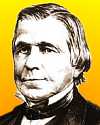
In 1854, Asa Fitch became the first state entomologist in the U.S. when he was appointed in New York state by the executive committee of the N.Y. State Agricultural Society. His work was funded by an appropriation made by the N.Y. state legislature on 15 Apr 1854, and was designated to examine and describe the insects of the state, particularly those that damaged vegetation. In this position Fitch helped define the role for the scientist in solving public problems, such as crop damage caused by insects. His first report, concerning insects affecting fruit, was published the following year in the Society's Journal. His annual reports became standard reading for entomologists and agriculturists.
In 1845, erection of the first U.S. iron truss bridge with parallel chords and open web was completed. Work on erecting the 34-ft span began the previous night using trusses that had been manufactured between Jan and Mar 1845 at Pottstown, Penn. The bridge carried tracks for the main line of the Philadelphia and Reading Railroad Company until 1901. It was a half-mile east of the Flat Rock Tunnel, north of West Manayunk station.
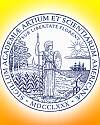
In 1780, the first U.S. national arts and science society was incorporated. It was chartered in Boston, Mass. “to cultivate every art and science which may tend to advance the interest, dignity, honor and happiness of a free, independent and virtuous people.” The first society president was James Bowdoin (1780-90). The original incorporators were later joined by Benjamin Franklin, George Washington, Thomas Jefferson, Alexander Hamilton, John Quincy Adams, and others.[Image: The Minerva Seal of the society]




