(NASA)
Born 2 Jun 1930; died 8 Jul 1999 at age 69. quotes
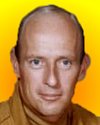
Charles Peter Conrad was an American astronaut was the third man to walk on the moon during the Apollo 12 mission (14-24 Nov, 1969). He had other experience in space on Gemini 5 (launched 21 Aug 1965, logging a new space endurance record of 8 days), on Gemini 11 (launched 18 Sep 1966, first orbit rendezvous and docking), and the Skylab 2 mission (1973). After service as a U.S. Navy test pilot, Conrad had been selected in 1962 to join NASA's second group of astronauts. On 14 Feb1996, Conrad was a crew member for a record-breaking flight around the world in a Lear jet. He died at age 69 from internal injuries after he crashed on his motorcycle.«[Image: Conrad from Skylab2 crew photo.]
Charles Peter Conrad was an American astronaut was the third man to walk on the moon during the Apollo 12 mission (14-24 Nov, 1969). He had other experience in space on Gemini 5 (launched 21 Aug 1965, logging a new space endurance record of 8 days), on Gemini 11 (launched 18 Sep 1966, first orbit rendezvous and docking), and the Skylab 2 mission (1973). After service as a U.S. Navy test pilot, Conrad had been selected in 1962 to join NASA's second group of astronauts. On 14 Feb1996, Conrad was a crew member for a record-breaking flight around the world in a Lear jet. He died at age 69 from internal injuries after he crashed on his motorcycle.«[Image: Conrad from Skylab2 crew photo.]
Rocketman: Astronaut Pete Conrad's Incredible Ride to the Moon and Beyond, by Nancy Conrad, et al. - book suggestion.
Born 2 Jun 1924; died 11 Sep 2004 at age 80.
English nuclear scientist who volunteered to ingest a minute amount of plutonium as part of European research to track plutonium in the body's metabolism. He was one of 12 volunteers aged 26 to 67 who were injected with plutonium between 1992-98. Reuters reported on 8 Aug 1999 that Voice, age 73, had volunteered again to inhale plutonium for further study 18 months earlier. The miniscule dose was a soluble compound of Pu-237, which he regarded as having little risk, and he remained in good health. Sensitive detectors measured how much and where plutonium was retained, in which organs, and how quickly expelled. He was one of the first western scientists to visit Chernobyl after the explosion (1986). He died of unrelated natural causes.«
English nuclear scientist who volunteered to ingest a minute amount of plutonium as part of European research to track plutonium in the body's metabolism. He was one of 12 volunteers aged 26 to 67 who were injected with plutonium between 1992-98. Reuters reported on 8 Aug 1999 that Voice, age 73, had volunteered again to inhale plutonium for further study 18 months earlier. The miniscule dose was a soluble compound of Pu-237, which he regarded as having little risk, and he remained in good health. Sensitive detectors measured how much and where plutonium was retained, in which organs, and how quickly expelled. He was one of the first western scientists to visit Chernobyl after the explosion (1986). He died of unrelated natural causes.«
Born 2 Jun 1922; died 5 Dec 1995 at age 73.
U.S. geochemist who in 1953 made the first precise measurement of the Earth's age, 4.55 billion years. He pioneered in three major areas of geochemical research. (1) He provided the first reliable ages of the earth and meteorites (1962), using analysis of the isotopic compositions and concentrations of lead in terrestrial materials and meteorites. This has been a benchmark for researchers. (2) He established the patterns of isotopic evolution of lead on earth, by analysis of critical rocks, sediments and waters of the planet. Thus he created a powerful tool for identifying, tracing and evaluating the nature of the major geochemical reservoirs in the crust, mantle, and oceans. (3) He studied environmental lead pollution.
U.S. geochemist who in 1953 made the first precise measurement of the Earth's age, 4.55 billion years. He pioneered in three major areas of geochemical research. (1) He provided the first reliable ages of the earth and meteorites (1962), using analysis of the isotopic compositions and concentrations of lead in terrestrial materials and meteorites. This has been a benchmark for researchers. (2) He established the patterns of isotopic evolution of lead on earth, by analysis of critical rocks, sediments and waters of the planet. Thus he created a powerful tool for identifying, tracing and evaluating the nature of the major geochemical reservoirs in the crust, mantle, and oceans. (3) He studied environmental lead pollution.
Born 2 Jun 1907; died 15 Mar 1998 at age 90.
American inventor and engineer who created the recliner chair and started the La-Z-Boy furniture company to manufacture it. He learned some drafting through correspondence school lessons, and by 1925 he held his first patent - a band saw guide. In 1928, he and his cousin Edward M. Knabusch made a reclining porch chair out of some wooden slats. It would automatically reclined as a sitter leaned back. Since it was a seasonal item, his sales prospects improved by adding plush upholstery for year-round indoor use. He planned and designed a manufacturing facility (opened Nov 1941) which utilized the mass-production methods of Detroit's automotive industry. By the 1960s, he created a model incorporated rocking together with reclining.«
American inventor and engineer who created the recliner chair and started the La-Z-Boy furniture company to manufacture it. He learned some drafting through correspondence school lessons, and by 1925 he held his first patent - a band saw guide. In 1928, he and his cousin Edward M. Knabusch made a reclining porch chair out of some wooden slats. It would automatically reclined as a sitter leaned back. Since it was a seasonal item, his sales prospects improved by adding plush upholstery for year-round indoor use. He planned and designed a manufacturing facility (opened Nov 1941) which utilized the mass-production methods of Detroit's automotive industry. By the 1960s, he created a model incorporated rocking together with reclining.«

American physicist who invented the technology for pulse radar while employed at the U.S. Naval Research Laboratory. From pioneering work with early radio leaders, Dr. Page conceived and developed circuitry and components in the 1930's for early pulse radar systems which used short bursts of electromagnetic radiation to detect and locate distant objects. During WW II, this invention was vital to the Allies for detection of enemy planes, ships, and other targets. After the war, Page continued research into peacetime applications of radar, airborne radio and other fields of electronics. He held sixty-five patents for innovations in these fields, now applied in navigation, weather forecasting, astronomy, automation and related technical fields.«
The Origin of Radar, by Robert Morris Page. - book suggestion.
Born 2 Jun 1881; died 17 Aug 1966 at age 85.
English electronics engineer whose numerous inventions contributed to the development of radio communications. He joined the Marconi Company in 1902, and for his earliest work he devised the elements of direction-finding equipment. Round became Chief of Marconi Research in 1921. He was a prolific inventor. Amongst other inventions he designed the Straight Eight Gramophone Recording System, a large audience public address system which was used to relay King George's speech at the Wembley Exhibitions. A talking picture system he invented was used to record sound on to film during the 1930's cinema boom. In total he produced 117 patents. The last was "Pressure Wave Transmission Arrangements" (1964), at age 83.
English electronics engineer whose numerous inventions contributed to the development of radio communications. He joined the Marconi Company in 1902, and for his earliest work he devised the elements of direction-finding equipment. Round became Chief of Marconi Research in 1921. He was a prolific inventor. Amongst other inventions he designed the Straight Eight Gramophone Recording System, a large audience public address system which was used to relay King George's speech at the Wembley Exhibitions. A talking picture system he invented was used to record sound on to film during the 1930's cinema boom. In total he produced 117 patents. The last was "Pressure Wave Transmission Arrangements" (1964), at age 83.
Born 2 Jun 1854; died 27 Apr 1932 at age 77.
German physiologist who showed the available energy content of food was the same whether the material was consumed organically or merely burned (1894). He determined that no single type of food produced energy, but that the body variously made ready use of carbohydrates, fats and proteins. In 1883, he used geometry to compare metabolic rates of animals of different sizes. Thus, if an animal is N times taller than another, it has surface area N2 greater and mass N3 greater. Thus total metabolic rate (dependent on heat loss over surface area, N2), would be proportional to M2/3. Specific metabolic rate (the energy burnt M2/3, per unit of mass, M) would be proportional to M1/3. It took 50 years before this simple explanation was improved.
German physiologist who showed the available energy content of food was the same whether the material was consumed organically or merely burned (1894). He determined that no single type of food produced energy, but that the body variously made ready use of carbohydrates, fats and proteins. In 1883, he used geometry to compare metabolic rates of animals of different sizes. Thus, if an animal is N times taller than another, it has surface area N2 greater and mass N3 greater. Thus total metabolic rate (dependent on heat loss over surface area, N2), would be proportional to M2/3. Specific metabolic rate (the energy burnt M2/3, per unit of mass, M) would be proportional to M1/3. It took 50 years before this simple explanation was improved.
Born 2 Jun 1850; died 13 Jun 1931 at age 81. quotes
(1st Baron Trent) English chemist who founded Boots Company, Ltd. At 13 he inherited his father's herbalist shop, and in 1877 opened his first chemist's shop in Nottingham. In 1880, under the “Boots Cash Chemists” name, Boot advertised herbal preparations, household products and basic remedies at reduced prices. That year, the business extended to Lincoln and Sheffield. Boots Pure Drug Company Limited began production in 1888 of simple pharmaceuticals. He began large-scale drug manufacture in 1892. He retired and sold the business in 1920. By 1931, Boots shops had the largest pharmaceutical retail trade in the world, with over a thousand branches. As a philanthropist, he donated land and development support for Nottingham University.
(1st Baron Trent) English chemist who founded Boots Company, Ltd. At 13 he inherited his father's herbalist shop, and in 1877 opened his first chemist's shop in Nottingham. In 1880, under the “Boots Cash Chemists” name, Boot advertised herbal preparations, household products and basic remedies at reduced prices. That year, the business extended to Lincoln and Sheffield. Boots Pure Drug Company Limited began production in 1888 of simple pharmaceuticals. He began large-scale drug manufacture in 1892. He retired and sold the business in 1920. By 1931, Boots shops had the largest pharmaceutical retail trade in the world, with over a thousand branches. As a philanthropist, he donated land and development support for Nottingham University.
Born 2 Jun 1850; died 29 Mar 1935 at age 84.
English physiologist and co-inventor of the prone-pressure method (Schafer method) of artificial respiration adopted by the Royal Life Saving Society. In 1894, Sharpey-Schafer (with George Oliver) (1841-1915) demonstrated that the action of a specific hormone—adrenaline (epinephrine), an extract of the adrenal gland—on blood vessels and muscle contraction. Upon injection into normal animals it produced a striking elevation in blood pressure. They also noted that the smooth muscles of the animal's bronchi relaxed. Their work stimulated interest in the study of the nature and functions of hormones. Later, adrenaline became the first hormone to be isolated and crystallized. Sharpey-Schafer also suspected that another hormone was produced by the islets of Langerhans in the pancreas. He adopted the name insulin (1914, from the Latin for "island") independently coining the same word used by J. DeMeyer (1909 in a paper in French) for a secretion of the pancreas.
English physiologist and co-inventor of the prone-pressure method (Schafer method) of artificial respiration adopted by the Royal Life Saving Society. In 1894, Sharpey-Schafer (with George Oliver) (1841-1915) demonstrated that the action of a specific hormone—adrenaline (epinephrine), an extract of the adrenal gland—on blood vessels and muscle contraction. Upon injection into normal animals it produced a striking elevation in blood pressure. They also noted that the smooth muscles of the animal's bronchi relaxed. Their work stimulated interest in the study of the nature and functions of hormones. Later, adrenaline became the first hormone to be isolated and crystallized. Sharpey-Schafer also suspected that another hormone was produced by the islets of Langerhans in the pancreas. He adopted the name insulin (1914, from the Latin for "island") independently coining the same word used by J. DeMeyer (1909 in a paper in French) for a secretion of the pancreas.
Born 2 Jun 1834; died 31 May 1915 at age 80.
Sir Arthur Herbert Church was an English chemist and mineralogist who was a leading authority in the chemistry of painting, and gave valuable assistance in the work of preserving the paintings in the Houses of Parliament. He discovered turacin, an animal pigment containing copper, and of several minerals, including the only British cerium mineral. In addition to publishing many books on agricultural chemistry, Church also wrote on earthenware and precious stones. His Laboratory Guide for Agricultural Students had eight editions in his lifetime. He also did research on vegetable albinism colein, and aluminium in vascular cryptogams. Church served three years as president of the Mineralogical Society.« more
Sir Arthur Herbert Church was an English chemist and mineralogist who was a leading authority in the chemistry of painting, and gave valuable assistance in the work of preserving the paintings in the Houses of Parliament. He discovered turacin, an animal pigment containing copper, and of several minerals, including the only British cerium mineral. In addition to publishing many books on agricultural chemistry, Church also wrote on earthenware and precious stones. His Laboratory Guide for Agricultural Students had eight editions in his lifetime. He also did research on vegetable albinism colein, and aluminium in vascular cryptogams. Church served three years as president of the Mineralogical Society.« more
Born 2 Jun 1824; died 8 Nov 1911 at age 87. quotes
English physician (1st Baronet) who was a founding father of clinical science. He recognized the importance of pathology and made his mark with the publication on his Lectures on Pathological Anatomy (1863). He identified the visceral lesions of syphilis. His additional contributions to the previous descriptions by other physicians at Guy's Hospital, improved the understanding of Addison's, Bright's and Hodgkin's diseases. Sir Thomas Barlow described Wilks as having “started the systematic and practical teaching of morbid anatomy, and for nearly thirty years Wilks represented and embodied at Guy's Hospital the important combination of a great morbid anatomist, and a great clinical physician and teacher.” Wilks (1896-1900) and Barlow (1910-14), served terms as President of the Royal College of Physicians.«
English physician (1st Baronet) who was a founding father of clinical science. He recognized the importance of pathology and made his mark with the publication on his Lectures on Pathological Anatomy (1863). He identified the visceral lesions of syphilis. His additional contributions to the previous descriptions by other physicians at Guy's Hospital, improved the understanding of Addison's, Bright's and Hodgkin's diseases. Sir Thomas Barlow described Wilks as having “started the systematic and practical teaching of morbid anatomy, and for nearly thirty years Wilks represented and embodied at Guy's Hospital the important combination of a great morbid anatomist, and a great clinical physician and teacher.” Wilks (1896-1900) and Barlow (1910-14), served terms as President of the Royal College of Physicians.«

Born 2 Jun 1787; died 30 Nov 1845 at age 58.
Swedish chemist who discovered the element vanadium. He examined iron ore after a mine manager had pointed out an interesting test. He was told, if a batch of was treated with hydrochloric acid and a black powder appeared, then the iron would be brittle. By further study he found this was not always true, for sometimes a black powder appeared from iron that was not brittle (1831). By analysis of the powder, although similar to chromium or uranium, he determined it was a new element. Sefström named it vanadium after a Norse goddess. An earlier, but tentative, discovery had been made in 1801 by Andrés Manuel del Río, a Spanish mineralogist who lacked confidence in his discovery of a new element that he named erythronium. This was later found to be the same as vanadium.
Swedish chemist who discovered the element vanadium. He examined iron ore after a mine manager had pointed out an interesting test. He was told, if a batch of was treated with hydrochloric acid and a black powder appeared, then the iron would be brittle. By further study he found this was not always true, for sometimes a black powder appeared from iron that was not brittle (1831). By analysis of the powder, although similar to chromium or uranium, he determined it was a new element. Sefström named it vanadium after a Norse goddess. An earlier, but tentative, discovery had been made in 1801 by Andrés Manuel del Río, a Spanish mineralogist who lacked confidence in his discovery of a new element that he named erythronium. This was later found to be the same as vanadium.

Died 2 Jun 2018 at age 99 (born 31 Jul 1918).
American biochemist who, together with John E. Walker, received half the 1997 Nobel Prize for Chemistry for their work explaining the enzymatic process involved in the production of the energy-storage molecule adenosine triphosphate (ATP), which fuels the metabolic processes of the cells of all living things and how the enzyme ATP synthase catalyses the formation of ATP. Boyer and his co-workers proposed, on the basis of biochemical data, a mechanism for how ATP is formed from adenosine diphosphate (ADP) and inorganic phosphate. Walker and his co-workers have established the structure of the enzyme and verified the mechanism proposed by Boyer.
American biochemist who, together with John E. Walker, received half the 1997 Nobel Prize for Chemistry for their work explaining the enzymatic process involved in the production of the energy-storage molecule adenosine triphosphate (ATP), which fuels the metabolic processes of the cells of all living things and how the enzyme ATP synthase catalyses the formation of ATP. Boyer and his co-workers proposed, on the basis of biochemical data, a mechanism for how ATP is formed from adenosine diphosphate (ADP) and inorganic phosphate. Walker and his co-workers have established the structure of the enzyme and verified the mechanism proposed by Boyer.
Died 2 Jun 2015 at age 88 (born 16 Jul 1926).
American biochemist who was a awarded a share of the 2004 Nobel Prize in Chemistry (with Israelis Aaron Ciechanover and Avram Hershko) for discovering the role of the protein ubiquitin in cells. This small protein molecule attaches to other proteins, tagging them for removal, which are thus recognized by the cell's proteasomes. These structures are the cell's waste-disposal units, where the proteins are broken down into tiny pieces for reuse. This ubiquitin-mediated process cleans up unwanted proteins resulting during cell division, and performs quality control on newly synthesized proteins. Faulty protein-breakdown processes lead to such conditions as cystic fibrosis, several neurodegenerative diseases, and certain types of cancer.«
American biochemist who was a awarded a share of the 2004 Nobel Prize in Chemistry (with Israelis Aaron Ciechanover and Avram Hershko) for discovering the role of the protein ubiquitin in cells. This small protein molecule attaches to other proteins, tagging them for removal, which are thus recognized by the cell's proteasomes. These structures are the cell's waste-disposal units, where the proteins are broken down into tiny pieces for reuse. This ubiquitin-mediated process cleans up unwanted proteins resulting during cell division, and performs quality control on newly synthesized proteins. Faulty protein-breakdown processes lead to such conditions as cystic fibrosis, several neurodegenerative diseases, and certain types of cancer.«
Died 2 Jun 2000 at age 72 (born 8 Aug 1927).
Russian ophthalmic surgeon who, developed the radial keratotomy (RK) procedure (1974) to improve vision by surgery. Short-sightedness (myopia) could be corrected by reshaping the cornea with a series of minute, shallow incisions in a spoke-like pattern. The correction can be long-lasting, but can also be subject to complications after a time. In the U.S., there are now about 250,000 RK surgeries each year. It can be effective for patients with at least 1.50 diopters of myopia, but less than 6.00 D. A newer procedure uses a laser (LASIK).
Russian ophthalmic surgeon who, developed the radial keratotomy (RK) procedure (1974) to improve vision by surgery. Short-sightedness (myopia) could be corrected by reshaping the cornea with a series of minute, shallow incisions in a spoke-like pattern. The correction can be long-lasting, but can also be subject to complications after a time. In the U.S., there are now about 250,000 RK surgeries each year. It can be effective for patients with at least 1.50 diopters of myopia, but less than 6.00 D. A newer procedure uses a laser (LASIK).
Died 2 Jun 1943 at age 90 (born 25 Apr 1853).
American civil engineer and railroad executive who, as chief engineer of the Panama Canal from late 1905 to Apr 1907, laid the basis for that project's successful completion. He was recognized as the world's foremost railway civil engineer when he arrived on the Isthmus in 1905. The fundamental problem that he faced was one of restoring confidence and morale. A yellow fever epidemic, followed by the unexpected resignation of the first Chief Engineer, John F. Wallace, had made the Canal Zone a scene of chaos and hysteria. He found no order, no plan on the job. He planned the main features of the waterway and lobbied openly in May and June 1906 for a high-level, lock-type canal. On 29 Jun 1906, the President's signature put into that plan into law.
American civil engineer and railroad executive who, as chief engineer of the Panama Canal from late 1905 to Apr 1907, laid the basis for that project's successful completion. He was recognized as the world's foremost railway civil engineer when he arrived on the Isthmus in 1905. The fundamental problem that he faced was one of restoring confidence and morale. A yellow fever epidemic, followed by the unexpected resignation of the first Chief Engineer, John F. Wallace, had made the Canal Zone a scene of chaos and hysteria. He found no order, no plan on the job. He planned the main features of the waterway and lobbied openly in May and June 1906 for a high-level, lock-type canal. On 29 Jun 1906, the President's signature put into that plan into law.
Died 2 Jun 1926 at age 60 (born 6 Nov 1865).
British physician who studied tropical diseases in India (1890-97) as an army officer. In 1900, he determined a protozoon to be the disease agent for kala-azar, a disease now sometimes known as leishmaniasis. Later, he developed a vaccine against typhoid fever used during WW I that was believed to have reduced the incidence of the disease. Kala Azar or Black Fever probably existed for centuries in Bengal and China, but the first recognized outbreak was in Jessore, India (1824). It caused the deaths of 750,000 people in 3 years. His first original contribution to science was the development of an easy method to stain blood for malaria parasites, to examine cells from the spleen of a soldier who had died of kala-azar. It is still used today.
British physician who studied tropical diseases in India (1890-97) as an army officer. In 1900, he determined a protozoon to be the disease agent for kala-azar, a disease now sometimes known as leishmaniasis. Later, he developed a vaccine against typhoid fever used during WW I that was believed to have reduced the incidence of the disease. Kala Azar or Black Fever probably existed for centuries in Bengal and China, but the first recognized outbreak was in Jessore, India (1824). It caused the deaths of 750,000 people in 3 years. His first original contribution to science was the development of an easy method to stain blood for malaria parasites, to examine cells from the spleen of a soldier who had died of kala-azar. It is still used today.
Died 2 Jun 1891 at age 80 (born 9 Apr 1811).
British civil engineer who consulted on railways, bridges and docks, in Britain and elsewhere. He is known for the Charing Cross and Cannon Street railways, their Thames bridges, and the East London Railway through Sir Marc Isambard Brunel’s Thames Tunnel. He was a mining engineer in Venezuela (1831-34) and later, the chief engineer of the Manchester and Leeds Railway (1845-50). With Sir John Wolfe-Barry, he built the inner District line of London underground railway. He designed a Narmada River bridge in India, was engineer of Amsterdam ship canal (1862) and wrote a report on the route chosen for the Suez Canal (1863). He worked on the original Channel Tunnel project (1872-86), and the Severn Tunnel (1887) for Great Western Railway.« more
British civil engineer who consulted on railways, bridges and docks, in Britain and elsewhere. He is known for the Charing Cross and Cannon Street railways, their Thames bridges, and the East London Railway through Sir Marc Isambard Brunel’s Thames Tunnel. He was a mining engineer in Venezuela (1831-34) and later, the chief engineer of the Manchester and Leeds Railway (1845-50). With Sir John Wolfe-Barry, he built the inner District line of London underground railway. He designed a Narmada River bridge in India, was engineer of Amsterdam ship canal (1862) and wrote a report on the route chosen for the Suez Canal (1863). He worked on the original Channel Tunnel project (1872-86), and the Severn Tunnel (1887) for Great Western Railway.« more
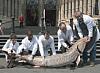
In 2004, a 2.75-meter sturgeon weighing 120 kg was caught in Swansea Bay off the coast of Wales by Robert Davies. Sturgeons are extremely rare in British waters, so this catch was interesting, but by a statute dating back to King Edward II the 14th century the fish had to be offered to the Crown if caught in Britain. When Buckingham Palace told him he could “dispose of it as he saw fit,” he auctioned it at Plymouth fish market for £700, but the local police confiscated it as a protected species under British law. Eventually, the fish was donated as a specimen for the collection at the Natural History Museum in London. (In other parts of the world where sturgeon are caught, their eggs are sold as an extravagant food - caviar.)«
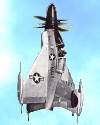
In 1954, the first test of a VTOL airplane takes place when a Convair XFY-1 Pogo demonstrated a vertical takeoff and landing. It was known as a "Tail Sitter," but as prototype to test the concept, its glory flared, and faded in a matter of months. The XFY-1 was a prototype of a point-defense interceptor fighter intended for the Navy. The sole virtue was that it didn't need a runway, for the XFY-1 was built to sit upright on its tail, and take off straight up, using enormous contra-rotating propellers on its nose. After takeoff, a Tail Sitter changed from helicopter style vertical flight to airplane by simply pushing over from the vertical ascent to conventional horizontal flight. In landing, the process was reversed to land on its tail. It was too difficult to fly.

In 1928, Kraft’s Velveeta Cheese was invented. It was packaged using the 1921 invention of a tinfoil lining that could house the cheese inside a wooden box. Its special cooking properties quickly caught on. When melted, it was as smooth as velvet (hence its name), and it would never curdle when heated. Make this dip for a Sunday football game or any special. It replaced canned cheese. James L. Kraft founded J.L Kraft Bros. cheese factory in Stockton, Illinois in 1914. He introduced the company’s first cheese in tins a year later. In 1917, Kraft cheese in tins went with WWI soldiers to foreign fronts.
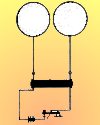
In 1896, the first radio patent was issued to Guglielmo Marconi in England for his wireless telegraphy apparatus (U.K. 12,039) for “Improvements in Transmitting Electrical Impulses and Signals, and in Apparatus Therefor.” Improvements are given in a later Marconi patent, No. 7,777 of 1900.[Image: Figure from Marconi's first wireless specification.]
In 1895, Thomas A. Edison received one of his many patents on the Phonograph (U.S. No. 541923).
In 1891, Thomas A. Edison was issued a patent for a “Sextuplex Telegraph” (U.S. No. 453,601), four years to the day after the application date. A second application made that same day for a similar device was not issued until 1894.
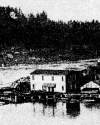
In 1889, a hydroelectric power plant generated alternating current electricity which was for the first time made available to consumers at a significant distance from its origin. A 13 mile power line linked the Willamette Falls Electric Co. power plant to Portland, Ore. Two 300 h.p. Stilwell & Bierce waterwheels together drove a single phase, 720 kilowatt generator. It was not the first hydroelectric power plant, for one had been demonstrated in Appleton, Wisc., 30 Sep 1882 with a small dynamo. Rather, it is the use of alternating current that is significant, for this makes possible long-distance transmission that overcomes the problems of direct current. AC generators driven by steam power had been in use elsewhere since 1886.
In 1883, the first electric elevated railroad in the U.S. had its trial trip. It was built around the outer edge of the main exhibition building of the Chicago Railway Exposition. The 3 ft guage track was 1,552 ft long, with tight curves at each end of radius 56 ft. The line began operation on 9 Jun 1883, with trains hauled by The Judge, a 15 h.p. electric locomotive. In less than a month, it made 1,588 trips, carried 28,805 passengers, and ran overall 446 miles before the exhibition closed on 23 Jun 1883. It was demonstrated by the Electric Railway Company which was incorporated in the State of New York in the spring of 1883 with a capital of $2,000,000 to develop the patents and inventions of Thomas Edison and Stephen D. Field.
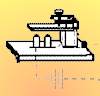
In 1875, Alexander Bell and his assistant Thomas Watson had been working on the “harmonic telegraph.” In the transmitter room, Watson had been trying to free a reed that had been too tightly wound to the pole of its electromagnet, when it produced a twang. Bell, who had been working in the receiving room heard the twang. He realized that now his dream of speech transmission must be a possibility, for the complex overtones and timbre of the twang he had just heard had a lot in common with the sound of the human voice. The next day, they continued tinkering on their experiment, anxious to achieve more ambitious results.[Image: diagram of earlier device under test in Winter 1873]
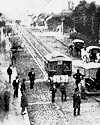
In 1873, ground was broken on San Francisco's Clay Street for the world's first cable-powered railroad. Andrew Smith Hallidie was the English-American inventor of the cable railway. He had previously installed rope-ways at Californian mines to carry ore in iron buckets across canyons. He adapted the same system to the haul street cars up the hills of the city, using an endless, moving underground wire rope to which a car could be attached to, or released from, at will. A company was formed in 1872, and Clay Street was selected as a suitable location to test the idea. The cable railway was constructed from the intersection of Clay and Kearny Streets to the crest of the hill, a distance of 2,800-ft, making a rise of 307-ft.
Cable Car Days in San Francisco, by Edgar Myron Kahn. - book suggestion.
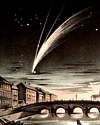
In 1858, the Donati Comet was first seen and named after its discoverer, Giovanni Battista Donati, at Florence. It was the second-brightest comet of the nineteenth century. It reached perihelion on 30 Sep 1858. When nearest the earth on 9 Oct 1858, it was about 0.5 AU away, and had developed a scimitar-shaped triple tail. At that time, its very prominent dust tail had with an apparent length of 50°, more than half the distance from the horizon to the zenith, a linear distance of over 72 million km (about 45 million mi). It was the first comet to be photographed. With an orbital period estimated at more than 2000 years, it will not return until about the year 4000. An astronomical unit, AU, equals 93 million miles, the Sun-Earth distance.[Image: Donati Comet over Paris.]
In 1857, the first practical U.S. chain-stitch sewing machine was patented by a farmer, James E. A. Gibbs of Mill Point, Va. It was a single-thread, twist-loop, rotary hook design (U.S. No. 17,427). In the same year, he formed the Willcox & Gibbs Sewing Machine Co. with James Willcox, who arranged for its manufacture. Gibbs had invented his own model out of curiosity in 1855, after seeing a newspaper illustration of a sewing machine. When Gibbs saw a tailor's Singer sewing machine, he thought it was too heavy, complicated, and expensive. Willcox and Gibbs sold their chainstitch sewing machine, on a simple iron-frame stand with treadle, for approximately $50, which was half the price of anything similar.«
In 1739, the Royal Swedish Academy of Sciences (Kungl. Vetenskapsakademien) was founded. Inspired by the Royal Society of London and l'Académie Royale des Sciences in Paris, it was created as an independent and non-governmental scientific society, with the overall objective of promoting the sciences. Founding members included the world-famous naturalist Carl Linnaeus. In its early years, it took a great interest in encouraging the uses of scientific discoveries in society, as for example in agriculture, ship building and mining. At the beginning of the 19th century, its Permanent Secretary was the distinguished chemist, Jons Berzelius. It is now known for its annual role in awarding the Nobel Prizes established in the will of inventor Alfred Nobel.«
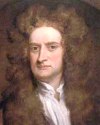
Newton