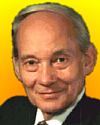
Born 9 May 1927; died 6 Feb 2019 at age 91. quotes
German physicist and biochemist who shared (with Ronald Norrish and George Porter) the 1967 Nobel Prize in Chemistry “for their studies of extremely fast chemical reactions, effected by disturbing the equlibrium by means of very short pulses of energy.” In 1954, Eigen introduced the relaxation techniques for the study of extremely fast chemical reactions (those taking less than a millisecond). His general method was to take a solution in equilibrium for a given temperature and pressure. If a short disturbance was applied to the solution the equilibrium would be very briefly destroyed and a new equilibrium quickly reached. Eigen studied exactly what happened in this very short time by means of absorption spectroscopy.
German physicist and biochemist who shared (with Ronald Norrish and George Porter) the 1967 Nobel Prize in Chemistry “for their studies of extremely fast chemical reactions, effected by disturbing the equlibrium by means of very short pulses of energy.” In 1954, Eigen introduced the relaxation techniques for the study of extremely fast chemical reactions (those taking less than a millisecond). His general method was to take a solution in equilibrium for a given temperature and pressure. If a short disturbance was applied to the solution the equilibrium would be very briefly destroyed and a new equilibrium quickly reached. Eigen studied exactly what happened in this very short time by means of absorption spectroscopy.

Born 9 May 1883; died 30 Jul 1954 at age 71. quotes
Sir Henry Clay was an English economist who became the Stanley Jevons Professor of Political Economy at the University of Manchester (1922) and was an economic adviser to the Bank of England from 1930 until his resignation in 1944 to become Warden of Nuffield College, Oxford. It was his task to develop the College, starting with plans for its building, and to recruit the first members of the new College. His writings include the book, Economics: An Introduction for the General Reader (1916), discussing the relationship of economic studies to political and social problems, which was reprinted for 30 years. In the early 1920s he wrote about industrial relations. He died in a road accident.«
Sir Henry Clay was an English economist who became the Stanley Jevons Professor of Political Economy at the University of Manchester (1922) and was an economic adviser to the Bank of England from 1930 until his resignation in 1944 to become Warden of Nuffield College, Oxford. It was his task to develop the College, starting with plans for its building, and to recruit the first members of the new College. His writings include the book, Economics: An Introduction for the General Reader (1916), discussing the relationship of economic studies to political and social problems, which was reprinted for 30 years. In the early 1920s he wrote about industrial relations. He died in a road accident.«
Economics an Introduction for the General Reader, by Henry Clay. - book suggestion.
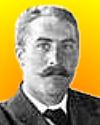
Born 9 May 1873; died 2 Mar 1939 at age 65. quotes
British Egyptologist who made one of the richest and most celebrated contributions to Egyptology: the discovery (27 Nov 1922) of the largely intact tomb of King Tutankhamen. In 1891, at age 17, with a talent for drawing and an interest in Egyptian antiquities, he was hired by the Egypt Exploration Fund in London to help with the epigraphic recording of tombs in Middle Egypt. At the beginning of 1900 Howard Carter was appointed Chief Inspector of Antiquities to the Egyptian Government with responsibilities for Upper Egypt. The Earl of Carnarvon, visited Egypt for health reasons in 1905, became interested in Egyptian antiquities and decided to finance some archaeological work. He funded Carter's excavation work beginning in 1909.[EB gives birth year as 9 May 1873. Some sources, including Enc. of World Bio give 9 May 1874. No DSB entry.]
British Egyptologist who made one of the richest and most celebrated contributions to Egyptology: the discovery (27 Nov 1922) of the largely intact tomb of King Tutankhamen. In 1891, at age 17, with a talent for drawing and an interest in Egyptian antiquities, he was hired by the Egypt Exploration Fund in London to help with the epigraphic recording of tombs in Middle Egypt. At the beginning of 1900 Howard Carter was appointed Chief Inspector of Antiquities to the Egyptian Government with responsibilities for Upper Egypt. The Earl of Carnarvon, visited Egypt for health reasons in 1905, became interested in Egyptian antiquities and decided to finance some archaeological work. He funded Carter's excavation work beginning in 1909.[EB gives birth year as 9 May 1873. Some sources, including Enc. of World Bio give 9 May 1874. No DSB entry.]
The Tomb of Tut.Ankh.Amen, by Howard Carter. - book suggestion.
(EB)
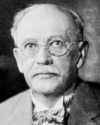
Born 9 May 1850; died 20 Aug 1936 at age 86.
British-born American electrical engineer and industrialist who founded the Weston Electrical Instrument Company. He moved to America as a young medical student in 1870. In the next few years, he revolutionized the electro-plating industry by inventing and manufacturing a highly successful electroplating dynamo, which far surpassed the efficiency of storage batteries. He patented the dynamo and a nickel-plating anode in 1875. From then until about 1917, Weston was granted 334 U.S patents. After early experiments with designs of incandescent lamps, he distinguished himself with the invention and manufacture of a series of precision electronical measuring instruments.
British-born American electrical engineer and industrialist who founded the Weston Electrical Instrument Company. He moved to America as a young medical student in 1870. In the next few years, he revolutionized the electro-plating industry by inventing and manufacturing a highly successful electroplating dynamo, which far surpassed the efficiency of storage batteries. He patented the dynamo and a nickel-plating anode in 1875. From then until about 1917, Weston was granted 334 U.S patents. After early experiments with designs of incandescent lamps, he distinguished himself with the invention and manufacture of a series of precision electronical measuring instruments.
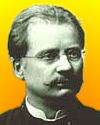
Born 9 May 1845; died 2 Feb 1913 at age 67.
Swedish scientist, engineer and inventor who pioneered in the development of high-speed turbines. After earning his Ph.D. at age 27, he worked as a technical engineer at a steel mill in his home village. In 1877, he began developing a high-speed centrifugal cream separator, a significant advance in butter-making. He perfected a vacuum milking machine in 1913. About 1882, he began working on steam turbines, and by 1889, he applied for a British patent for an impulse type, with a jet of steam impinging on a set of blades around the periphery of a wheel. His inventive talent was wide, including electric lighting, electrometallurgy, and aerodynamics. During his lifetime, he acquired 92 Swedish patents and founded 37 companies.
Swedish scientist, engineer and inventor who pioneered in the development of high-speed turbines. After earning his Ph.D. at age 27, he worked as a technical engineer at a steel mill in his home village. In 1877, he began developing a high-speed centrifugal cream separator, a significant advance in butter-making. He perfected a vacuum milking machine in 1913. About 1882, he began working on steam turbines, and by 1889, he applied for a British patent for an impulse type, with a jet of steam impinging on a set of blades around the periphery of a wheel. His inventive talent was wide, including electric lighting, electrometallurgy, and aerodynamics. During his lifetime, he acquired 92 Swedish patents and founded 37 companies.
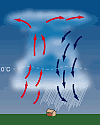
James Pollard Espy was an American meteorologist who was one of the first to collect meteorological observations by telegraph. He gave apparently the first essentially correct explanation of the thermodynamics of cloud formation and growth. Every great atmospheric disturbance begins with a rising mass of heated, thus less dense air. While rising, the air mass dilates and cools. Then, as water vapour precipitates as clouds, latent heat is liberated so the dilation and rising continues until the moisture of the air forming the upward current is practically exhausted. The heavier air flows in beneath, and, finding a diminished pressure above it, rushes upward with constantly increasing violence. Water vapour precipitated during this atmospheric disturbance results in heavy rains.[Image: Formation of a thunderstorm, mature stage]
The Philosophy of Storms, by James P. Espy. - book suggestion.
Born 9 May 1746; died 28 Jul 1818 at age 72. quotes
French mathematician who is known for his elaboration of descriptive geometry. Although the son of an itinerant tradesman, by age 22, he was teaching mathematics at the military school in Mézières, and later became professor at the École Polytechnique, which he helped found and organize. He developed the mathematics of projecting solid figures onto a plane (upon which modern engineering drawing is based) following a suggestion of the theory (1738) by Frézier. Monge further applied analysis techniques to the theory of curvature that was later taken up in the revolutionary work of Georg Riemann on geometry and curvature. He also studied aome physical science topics. While a close friend of Napoleon, Monge was appointed minister for the navy (1792-93), but was removed on the restoration of the Bourbons. He died in poverty.«[DSB gives date of birth 9 May 1746. EB gives 10 May 1746.]
French mathematician who is known for his elaboration of descriptive geometry. Although the son of an itinerant tradesman, by age 22, he was teaching mathematics at the military school in Mézières, and later became professor at the École Polytechnique, which he helped found and organize. He developed the mathematics of projecting solid figures onto a plane (upon which modern engineering drawing is based) following a suggestion of the theory (1738) by Frézier. Monge further applied analysis techniques to the theory of curvature that was later taken up in the revolutionary work of Georg Riemann on geometry and curvature. He also studied aome physical science topics. While a close friend of Napoleon, Monge was appointed minister for the navy (1792-93), but was removed on the restoration of the Bourbons. He died in poverty.«[DSB gives date of birth 9 May 1746. EB gives 10 May 1746.]


Died 9 May 1936 at age 34 (born 19 Feb 1902).
Humfry (Gilbert Garth) Payne was an English archaeologist who studied Mediterranean archaeology and is known for his book Necrocorinthia (1931), a significant work on Corinthian pottery. He did work at Knossos, and between 1930 and 1933, he led excavations of the Hera sanctuary and the ancient harbour at Perahóra (meaning "the land beyond") in the Gulf of Korinth, Greece. Later excavations there were headed by Peter Megaw in the 1960s and Richard Tomlinson in the early 1980s clarified earlier finds and opened up new areas of the temples, markets, ritual dining areas and complex water systems. Payne died at the early age of 35, and was buried at Mycenae.«
Humfry (Gilbert Garth) Payne was an English archaeologist who studied Mediterranean archaeology and is known for his book Necrocorinthia (1931), a significant work on Corinthian pottery. He did work at Knossos, and between 1930 and 1933, he led excavations of the Hera sanctuary and the ancient harbour at Perahóra (meaning "the land beyond") in the Gulf of Korinth, Greece. Later excavations there were headed by Peter Megaw in the 1960s and Richard Tomlinson in the early 1980s clarified earlier finds and opened up new areas of the temples, markets, ritual dining areas and complex water systems. Payne died at the early age of 35, and was buried at Mycenae.«
Necrocorinthia: A study of Corinthian art, by Humfry Payne. - book suggestion.
Died 9 May 1931 at age 78 (born 19 Dec 1852). quotes
Albert Abraham Michelson was a German-American physicist physicist who accurately measured the speed of light and received the 1907 Nobel Prize for Physics “for his optical precision instruments and the spectroscopic and metrological investigations” he carried out with them. He designed the highly accurate Michelson interferometer and used it to establish the speed of light as a fundamental constant. With Edward Morley, he also used it in an attempt to measure the velocity of the earth through the ether (1887). The experiment yielded null results that eventually led Einstein to his theory of relativity. He measured the standard meter bar in Paris to be 1,553,163.5 wavelengths of the red cadmium line (1892-3).«
Albert Abraham Michelson was a German-American physicist physicist who accurately measured the speed of light and received the 1907 Nobel Prize for Physics “for his optical precision instruments and the spectroscopic and metrological investigations” he carried out with them. He designed the highly accurate Michelson interferometer and used it to establish the speed of light as a fundamental constant. With Edward Morley, he also used it in an attempt to measure the velocity of the earth through the ether (1887). The experiment yielded null results that eventually led Einstein to his theory of relativity. He measured the standard meter bar in Paris to be 1,553,163.5 wavelengths of the red cadmium line (1892-3).«
The Master of Light: A biography of Albert A. Michelson, by Dorothy Michelson Livingston. - book suggestion.
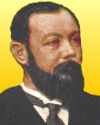
Died 9 May 1914 at age 51 (born 10 Apr 1863).
French metallurgist and chemist who invented the electric-arc furnace, widely used in making steel; and, independently of the simultaneous work of Charles M. Hall of the United States, devised the electrolytic process for preparing aluminum. This process made low-priced aluminum available for the first time, securing the widespread use of the metal and its alloys. In 1906, he built a “phaneroptere” flying machine, a precursor of the helicopter. With the American Cooper Hewitt, he designed the hydroslip, a sort of boat on runners, lifted by four propulsive vanes. He also experimented with a rocket missile. more
French metallurgist and chemist who invented the electric-arc furnace, widely used in making steel; and, independently of the simultaneous work of Charles M. Hall of the United States, devised the electrolytic process for preparing aluminum. This process made low-priced aluminum available for the first time, securing the widespread use of the metal and its alloys. In 1906, he built a “phaneroptere” flying machine, a precursor of the helicopter. With the American Cooper Hewitt, he designed the hydroslip, a sort of boat on runners, lifted by four propulsive vanes. He also experimented with a rocket missile. more
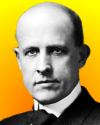
Died 9 May 1914 at age 59 (born 26 Oct 1854).
American industrialist who founded Post Cereal Company with the Grape-Nuts cereal he created. In 1890, a nervous breakdown had led Post to the sanitorium of Dr. John Harvey Kellogg, where he was fed on Kellogg's grain-intensive vegetarian diet. Early in 1895, Post began the manufacture of Postum, a grain product intended as a coffee substitute, similar to one of Kellogg's concoctions. The manufacture of Grape-Nuts, based on another Kellogg item, began the following year. Post's new company, Postum Ltd., achieved wide-scale distribution of its products through massive spending on advertising appealing to the health concerns of the American public. In 1929, Postum became General Foods Corporation.
American industrialist who founded Post Cereal Company with the Grape-Nuts cereal he created. In 1890, a nervous breakdown had led Post to the sanitorium of Dr. John Harvey Kellogg, where he was fed on Kellogg's grain-intensive vegetarian diet. Early in 1895, Post began the manufacture of Postum, a grain product intended as a coffee substitute, similar to one of Kellogg's concoctions. The manufacture of Grape-Nuts, based on another Kellogg item, began the following year. Post's new company, Postum Ltd., achieved wide-scale distribution of its products through massive spending on advertising appealing to the health concerns of the American public. In 1929, Postum became General Foods Corporation.
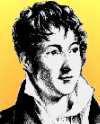
Died 9 May 1867 at age 88 (born 5 Oct 1778).
French librarian and paleographer remembered for his own writings and for editing several works of his younger brother, Jean-François Champollion, the brilliant Egyptologist who deciphered Egyptian hieroglyphics.
French librarian and paleographer remembered for his own writings and for editing several works of his younger brother, Jean-François Champollion, the brilliant Egyptologist who deciphered Egyptian hieroglyphics.
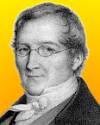
Died 9 May 1850 at age 71 (born 6 Dec 1778). quotes
French chemist best known for his work on gases. In 1805, by exploding together given volumes of hydrogen and oxygen, Gay-Lussac discovered they combined in ratio 2:1 by volume to form water. By 1808, after researches using other gases, he formulated his famous law of combining volumes - that when gases combine their relative volumes bear a simple numerical relation to each other (e.g., 1:1, 2:1) and to their gaseous product (under constant pressure and temperature). He developed techniques of quantitative chemical analysis, confirmed that iodine was an element, discovered cyanogen, improved the process for manufacturing sulphuric acid, prepared potassium and boron (1808). He made two balloon ascents to study the atmosphere.
French chemist best known for his work on gases. In 1805, by exploding together given volumes of hydrogen and oxygen, Gay-Lussac discovered they combined in ratio 2:1 by volume to form water. By 1808, after researches using other gases, he formulated his famous law of combining volumes - that when gases combine their relative volumes bear a simple numerical relation to each other (e.g., 1:1, 2:1) and to their gaseous product (under constant pressure and temperature). He developed techniques of quantitative chemical analysis, confirmed that iodine was an element, discovered cyanogen, improved the process for manufacturing sulphuric acid, prepared potassium and boron (1808). He made two balloon ascents to study the atmosphere.
Gay-Lussac: Scientist and Bourgeois, by Maurice P. Crosland. - book suggestion.
In 1962, a laser beam was bounced off the moon from earth by MIT scientists. The area of the light beam on the surface was estimated at a diameter of 4 miles.

In 1960, the U.S. Food and Drug Administration approved a pill as safe for birth control use. In 1953, Margaret Sanger, a legendary birth control crusader gave Dr. Gregory Pincus $150,000 to continue his prior research and develop a safe and effective oral contraceptive for women. The original version contained at least five times the estrogen that it does today, and ten times the progestin. Reductions addressed early medical problems, mainly with dangerous blood clots. The pill, now the most common form of birth control used by millions of women, is about 99 percent effective in preventing pregnancy. After 40 years, U.S. women still need a doctor's prescription, but the pill is available over-the-counter in many other countries.[Image: pills in a modern calendar package]
In 1949, Britain's first launderette opened in Queensway, London.*
In 1944, the first eye bank in the U.S. opened in New York City through the efforts of Dr. Richard T. Paton of Manhattan Eye, Ear and Throat Hospital and Dr. John McLean of New York Hospital. These hospitals cooperated to establish a joint project at New York Hospital, New York City. Nineteen other hospitals in the metropolitan area also cooperated and contributed eyes to the bank.
In 1936, the Hindenburg Zeppelin arrived at Lakehurst, New Jersey, USA, from Germany marking the beginning of regular transatlantic passenger service. The flight, carrying 51 passengers and 56 crew, took 61-hr 38-min.«
Zeppelin: The Story of a Great Achievement, by Harry Vissering. - book suggestion.
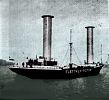
In 1926, Baden-Baden, a rotor ship invented by Anton Flettner arrived in New York having left Hamburg on 2 Apr 1926, and completed a transatlantic crossing from Germany. He replaced sails with a unique propulsion - two 9-ft diameter, 50-ft high cylinders, mounted vertically on the deck at the bow and the stern. Driven by 45-hp electric motors, they applied the aerodynamic power of the Magnus Effect (discovered 1852), which builds air pressure behind a rotating cylinder. Although a theoretical success, it was not sufficiently effective for commercial application.
In 1926, the first flight over the North Pole was made by Americans Richard Byrd and Floyd Bennett.
In 1893, the first motion picture exhibition was given by Thomas Alva Edison in Brooklyn, New York to an audience of 400 people at the Dept of Physics, Brooklyn Institute, Brooklyn, N.Y. using Edison’s Kinetograph. An optical lantern projector showed moving images of a blacksmith and his two helpers passing a bottle and forging a piece of iron. Each filmstrip had 700 images, each image being shown for 1/92 sec. The event was reported in the Scientific American of 20 May 1893.
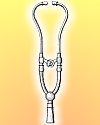
(USPTO)
In 1882, a stethoscope of the now classic design, invented by William F. Ford was issued a U.S. patent (No. 257,487).
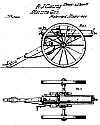
(USPTO)
In 1865, a U.S. patent was issued to Richard Jordan Gatling for the Gatling gun (U.S. No. 47,631), invented 1861. It was the first to successfully combine reliability, high firing rate and ease of loading into a single device. In the patent description, he called it a “battery-gun.” The gun was a hand-cranked to rotate a cylinder of ten barrels, each loaded from a gravity-feed magazine on top and fired on each revolution. He was motivated to invent the weapon after he noticed the majority of dead returning from the American Civil War died of illness, rather than gunshots. He thought if a rapid-firing gun could enable one man to do what previously required many, then armies could be smaller, saving men from exposure to battle and disease.«
Gatling: A Photographic Remembrance, by E. Frank Jr. Stephenson. - book suggestion.
In 1825, the first U.S. newspaper account was published of a theatre lighted by gas in New York City, the Chatham Garden and Theatre situated at what is now 80-90 Chatham Street. Previously gas lighting had been seen in theatres, it was only as a novelty, but not illumination. The New York Post and Mirror reported that the whole theatre was lighted by gas “which sheds a clear soft light over the audience and stage.” The illumination “elicited the loudest plaudits from those present”.





