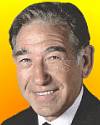
Born 17 Nov 1922.
American biochemist who shared (with Rita Levi-Montalcini) the 1986 Nobel Prize for Physiology or Medicine for “for their discoveries of growth factors.” His research was on epidermal growth factor (EGF), a protein produced in the body that is involved in normal cell growth, differentiation, wound healing, and other developmental events in the body. For example, he found that in new-born mice, it would cause earlier teething and opening of the eyes. EGF and NGF (the nerve growth factor studied by Levi-Montalcini) were the first of a number of growth-regulating signal substances now known. Their discovery led to greater understanding of the results of many diseases, such as developmental malformations, degenerative changes in senile dementia, delayed wound healing and tumours.«
American biochemist who shared (with Rita Levi-Montalcini) the 1986 Nobel Prize for Physiology or Medicine for “for their discoveries of growth factors.” His research was on epidermal growth factor (EGF), a protein produced in the body that is involved in normal cell growth, differentiation, wound healing, and other developmental events in the body. For example, he found that in new-born mice, it would cause earlier teething and opening of the eyes. EGF and NGF (the nerve growth factor studied by Levi-Montalcini) were the first of a number of growth-regulating signal substances now known. Their discovery led to greater understanding of the results of many diseases, such as developmental malformations, degenerative changes in senile dementia, delayed wound healing and tumours.«
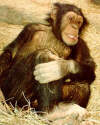
Born 17 Nov 1909; died 19 Jul 1988 at age 78.
Geoffrey (Howard) Bourne was an Australian-born American anatomist. His studies of the mammalian adrenal gland made him a pioneer in the chemistry of cells and tissues (histochemistry). Professor and Chairman of the Anatomy Department of the Emory University Medical School, Atlanta, Ga.; later became Director (1962-78) of the Yerkes Primate Research Center there. Bourne was a most articulate spokesman for nonhuman primate research. He fought vigorously to proceed with research involving all primates, especially the dwarf chimpanzee. His numerous books covered many facets of biology.
Geoffrey (Howard) Bourne was an Australian-born American anatomist. His studies of the mammalian adrenal gland made him a pioneer in the chemistry of cells and tissues (histochemistry). Professor and Chairman of the Anatomy Department of the Emory University Medical School, Atlanta, Ga.; later became Director (1962-78) of the Yerkes Primate Research Center there. Bourne was a most articulate spokesman for nonhuman primate research. He fought vigorously to proceed with research involving all primates, especially the dwarf chimpanzee. His numerous books covered many facets of biology.
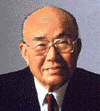
Born 17 Nov 1906; died 5 Aug 1991 at age 84.
Soichiro Honda was the Japanese engineer, race car driver and industrialist who founded the Honda Motor Company, motor cycle and car manufacturer. Born in Iwata Gun, Japan, his career began as a garage apprentice (1922) which led to opened his own garage in 1928. He began manufacturing with a piston-ring factory (1934) expanding to motor cycles in 1948, followed by the release of a sports car and light truck in 1963. Soichiro Honda retired in 1973, and was appointed a “supreme adviser.”
Soichiro Honda was the Japanese engineer, race car driver and industrialist who founded the Honda Motor Company, motor cycle and car manufacturer. Born in Iwata Gun, Japan, his career began as a garage apprentice (1922) which led to opened his own garage in 1928. He began manufacturing with a piston-ring factory (1934) expanding to motor cycles in 1948, followed by the release of a sports car and light truck in 1963. Soichiro Honda retired in 1973, and was appointed a “supreme adviser.”
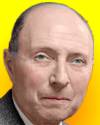
Born 17 Nov 1902; died 1 Jan 1995 at age 92. quotes
Hungarian-American physicist who shared the 1963 Nobel Prize for Physics (with Maria Goeppert Mayer and Johannes Hans Jensen) for his insight into quantum mechanics, for his contributions to the theory of the atomic nucleus and the elementary particles, particularly through the discovery and application of fundamental symmetry principles. He made many contributions to nuclear physics and played a prominent role in the development of the atomic bomb and nuclear energy.
Hungarian-American physicist who shared the 1963 Nobel Prize for Physics (with Maria Goeppert Mayer and Johannes Hans Jensen) for his insight into quantum mechanics, for his contributions to the theory of the atomic nucleus and the elementary particles, particularly through the discovery and application of fundamental symmetry principles. He made many contributions to nuclear physics and played a prominent role in the development of the atomic bomb and nuclear energy.
The Recollections of Eugene P. Wigner, by Eugene Paul Wigner, Andrew Szanton. - book suggestion.
Born 17 Nov 1878; died 4 Sep 1940 at age 61. quotes
American bacteriologist and immunologist who was an international authority on typhus, the deadly disease for which he isolated the typhus germ (1936). By 1939 he had perfected a method to produce enough anti-typhus vaccine to protect a nation. He travelled abroad to study disease outbreaks: an typhus epidemic in Serbia (1915), cholera in the Soviet Union (1923), a prison typhus epidemic in Mexico (1931) and lectured in China (1938). He published over 160 scientific papers. The cause of typhus is Rickettsia organisms carried by a louse or a rat flea and transmitted to humans by a bite from the parasites, especially in areas of poor sanitation and overcrowding. He wrote his autobiography in the third person, As I Remember Him, while dying of leukemia.«
American bacteriologist and immunologist who was an international authority on typhus, the deadly disease for which he isolated the typhus germ (1936). By 1939 he had perfected a method to produce enough anti-typhus vaccine to protect a nation. He travelled abroad to study disease outbreaks: an typhus epidemic in Serbia (1915), cholera in the Soviet Union (1923), a prison typhus epidemic in Mexico (1931) and lectured in China (1938). He published over 160 scientific papers. The cause of typhus is Rickettsia organisms carried by a louse or a rat flea and transmitted to humans by a bite from the parasites, especially in areas of poor sanitation and overcrowding. He wrote his autobiography in the third person, As I Remember Him, while dying of leukemia.«
Rats, Lice, and History...of Typhus Fever, by Hans Zinsser. - book suggestion.
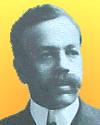
Born 17 Nov 1865; died 17 Oct 1941 at age 75.
Canadian astronomer known for his expert design of instruments and his extensive spectroscopic observations. He designed an exceptionally efficient spectrograph for the 15-inch refractor and measured radial velocities and found orbits of spectroscopic binary stars. He designed and supervised construction of the 72-inch reflector built for the new Dominion Astrophysical Observatory in Victoria and was appointed its first director in 1917. There he extended the work on radial velocities and spectroscopic binaries and studied spectra of O and B-type stars. In the 1930s he published the first detailed analysis of the rotation of the Milky Way, demonstrating that the sun is two-thirds out from the centre of our galaxy about which it revolves once in 220 million years.
Canadian astronomer known for his expert design of instruments and his extensive spectroscopic observations. He designed an exceptionally efficient spectrograph for the 15-inch refractor and measured radial velocities and found orbits of spectroscopic binary stars. He designed and supervised construction of the 72-inch reflector built for the new Dominion Astrophysical Observatory in Victoria and was appointed its first director in 1917. There he extended the work on radial velocities and spectroscopic binaries and studied spectra of O and B-type stars. In the 1930s he published the first detailed analysis of the rotation of the Milky Way, demonstrating that the sun is two-thirds out from the centre of our galaxy about which it revolves once in 220 million years.
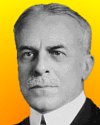
Born 17 Nov 1865; died 29 Dec 1954 at age 89.
American chemist who devised the first thermal cracking process that more than doubled the proportion of gasoline yield from crude oil by using high heat and high pressure. The crude petroleum mixture of various hydrocarbons can be separated into several groups of constituents by physical means, commonly distillation. His thermal cracking process (patented 7 Jan 1913, No. 1,049,667) chemically reformed longer molecules of less volatile components into smaller molecules thus doubling the yield of gasoline needed to fuel the motor industry. During its first 15 years in use the process saved more than 1 billion barrels of crude oil. In 1937 the invention of catalytic cracking superceded the Burton process, but it remains in wide use.«
American chemist who devised the first thermal cracking process that more than doubled the proportion of gasoline yield from crude oil by using high heat and high pressure. The crude petroleum mixture of various hydrocarbons can be separated into several groups of constituents by physical means, commonly distillation. His thermal cracking process (patented 7 Jan 1913, No. 1,049,667) chemically reformed longer molecules of less volatile components into smaller molecules thus doubling the yield of gasoline needed to fuel the motor industry. During its first 15 years in use the process saved more than 1 billion barrels of crude oil. In 1937 the invention of catalytic cracking superceded the Burton process, but it remains in wide use.«
Born 17 Nov 1855; died 31 Jan 1942 at age 86.
German physician and inventor who was an eyes and ears specialist, but is best known for inventing the first dry cell battery (1886). It used the same principle as the Leclanché cell. A carbon manganese rod was the anode. Instead of a liquid electrolyte, he devised a porous paste form with sal ammoniac, plaster, zinc chloride and water. All were sealed in a a zinc can that also was the cathode. Lechanché cells had been used for electric door bells, but those were vulnerable to breakage and spillage, as well as needing fresh water added periodically. To help a store-keeper, Gessner devised his dry cell as an better alternative. He obtained a German patent (8 Apr 1886), a British provisional patent (No. 18,754 on 22 Dec 1888), and a U.S. patent (No. 373,064 on 15 Nov 1887) as well as patents in Austria-Hungary, Belgium and France.«
German physician and inventor who was an eyes and ears specialist, but is best known for inventing the first dry cell battery (1886). It used the same principle as the Leclanché cell. A carbon manganese rod was the anode. Instead of a liquid electrolyte, he devised a porous paste form with sal ammoniac, plaster, zinc chloride and water. All were sealed in a a zinc can that also was the cathode. Lechanché cells had been used for electric door bells, but those were vulnerable to breakage and spillage, as well as needing fresh water added periodically. To help a store-keeper, Gessner devised his dry cell as an better alternative. He obtained a German patent (8 Apr 1886), a British provisional patent (No. 18,754 on 22 Dec 1888), and a U.S. patent (No. 373,064 on 15 Nov 1887) as well as patents in Austria-Hungary, Belgium and France.«
The Battery: How Portable Power Sparked a Technological Revolution, by Henry Schlesinger. - book suggestion.
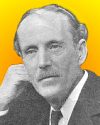
Born 17 Nov 1850; died 1 Aug 1924 at age 73.
Scottish industrial chemist who developed (1890) the process of manufacturing potassium cyanide (widely used to extract gold from low-grade ore) by passing ammonia over a heated mixture of charcoal and potassium carbonate. Beilby entered the oil-shale industry in 1869 and greatly increased the yield of paraffin and ammonia by introducing the continuous retort. Noting the destruction of metals by ammonia at high temperatures, Beilby researched the flow of solids. He inferred that when a solid is caused to flow, as in polishing, the crystalline surface is broken down to a harder and denser layer. Although much criticized, this theory explained the hardening of metals under cold working and gave valuable stimulus to further research.
Scottish industrial chemist who developed (1890) the process of manufacturing potassium cyanide (widely used to extract gold from low-grade ore) by passing ammonia over a heated mixture of charcoal and potassium carbonate. Beilby entered the oil-shale industry in 1869 and greatly increased the yield of paraffin and ammonia by introducing the continuous retort. Noting the destruction of metals by ammonia at high temperatures, Beilby researched the flow of solids. He inferred that when a solid is caused to flow, as in polishing, the crystalline surface is broken down to a harder and denser layer. Although much criticized, this theory explained the hardening of metals under cold working and gave valuable stimulus to further research.
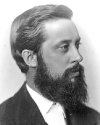
Born 17 Nov 1835; died 29 May 1908 at age 72.
American physicist and electrical engineer who initiated and developed one of the first courses in electrical engineering in the U.S. (1883), while teaching in the Physics Department at Cornell University, Ithaca, N.Y. During 1872-75, Anthony, with the aid of student George Moler, built the first American Gramme dynamo for direct current, used to power arc lamps that lighted the Cornell campus, the first American electrical outdoor-lighting system. Anthony also built a mammoth tangent galvanometer, a device which utilized the earth's magnetic field for the measurement of current. He designed the dynamo for first underground electricity distributing system. Anthony contributed to development of gas-filled electric lamps.
American physicist and electrical engineer who initiated and developed one of the first courses in electrical engineering in the U.S. (1883), while teaching in the Physics Department at Cornell University, Ithaca, N.Y. During 1872-75, Anthony, with the aid of student George Moler, built the first American Gramme dynamo for direct current, used to power arc lamps that lighted the Cornell campus, the first American electrical outdoor-lighting system. Anthony also built a mammoth tangent galvanometer, a device which utilized the earth's magnetic field for the measurement of current. He designed the dynamo for first underground electricity distributing system. Anthony contributed to development of gas-filled electric lamps.
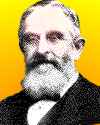
Born 17 Nov 1823; died 31 May 1908 at age 84.
British antiquarian, numismatist, and a founder of prehistoric archaeology. In about 1860, he began his searches for relics of early man in Britain. He garnered a notable collection of prehistoric stone and bronze implements. Evans found humanly made stone axes in the same layers as the bones of extinct European animals like hippopotamus, elephant, and saber-toothed tiger. In 1859, from such evidence, he announced that humans had lived much earlier than 6,000 years ago. This was much older than the long accepted Biblical chronology implied. Evans also collected coins of the ancient Britons, Romans and Anglo-Saxons. His son Sir Arthur (John) Evans followed his interests as an archaeologist.
British antiquarian, numismatist, and a founder of prehistoric archaeology. In about 1860, he began his searches for relics of early man in Britain. He garnered a notable collection of prehistoric stone and bronze implements. Evans found humanly made stone axes in the same layers as the bones of extinct European animals like hippopotamus, elephant, and saber-toothed tiger. In 1859, from such evidence, he announced that humans had lived much earlier than 6,000 years ago. This was much older than the long accepted Biblical chronology implied. Evans also collected coins of the ancient Britons, Romans and Anglo-Saxons. His son Sir Arthur (John) Evans followed his interests as an archaeologist.
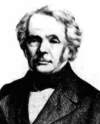
Born 17 Nov 1790; died 26 Sep 1868 at age 77. quotes
August Ferdinand Möbius was a German astronomer, mathematician and author, died in Leipzig. He is best known for his work in analytic geometry and in topology, especially remembered as one of the discoverers of the Möbius strip, which he had discovered in 1858. A Möbius strip is a two-dimensional surface with only one side. It can be constructed in three dimensions as follows. Take a rectangular strip of paper and join the two ends of the strip together so that it has a 180 degree twist. It is now possible to start at a point A on the surface and trace out a path that passes through the point which is apparently on the other side of the surface from A. Although his most famous work is in mathematics, Möbius did publish important work on astronomy.
August Ferdinand Möbius was a German astronomer, mathematician and author, died in Leipzig. He is best known for his work in analytic geometry and in topology, especially remembered as one of the discoverers of the Möbius strip, which he had discovered in 1858. A Möbius strip is a two-dimensional surface with only one side. It can be constructed in three dimensions as follows. Take a rectangular strip of paper and join the two ends of the strip together so that it has a 180 degree twist. It is now possible to start at a point A on the surface and trace out a path that passes through the point which is apparently on the other side of the surface from A. Although his most famous work is in mathematics, Möbius did publish important work on astronomy.
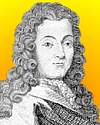
Born 17 Nov 1645; died 19 Jun 1715 at age 69. quotes
French chemist and pharmacist who prepared a comprehensive dictionary of pharmaceuticals in the Pharmacopée universelle (1697) and the Traité des drogues simples (1698). He also gave popular lectures on chemistry. His Traité de l'antimoine (1707), contains the results of his investigation into the properties and preparations of mineral antimony. His chemistry textbook, Cours de chymie (Paris, 1675), went through 31 editions by 1756. He classified compounds as animal, vegetable or mineral in origin, and explained chemical activity in mechanistic terms (ex. he supposed that “spiky” atoms were associated with acidity and porous atoms with alkalinity, the two fitting together when a chemical reaction took place).[Also spelled Nicholas.]
French chemist and pharmacist who prepared a comprehensive dictionary of pharmaceuticals in the Pharmacopée universelle (1697) and the Traité des drogues simples (1698). He also gave popular lectures on chemistry. His Traité de l'antimoine (1707), contains the results of his investigation into the properties and preparations of mineral antimony. His chemistry textbook, Cours de chymie (Paris, 1675), went through 31 editions by 1756. He classified compounds as animal, vegetable or mineral in origin, and explained chemical activity in mechanistic terms (ex. he supposed that “spiky” atoms were associated with acidity and porous atoms with alkalinity, the two fitting together when a chemical reaction took place).[Also spelled Nicholas.]
Born 17 Nov 1597; died 16 Feb 1636 at age 38.
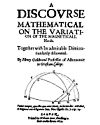
English astronomer and mathematician who co-discovered (with John Marr) the geomagnetic secular variation. This refers to the magentic declination of the earth's magnetic field, the angle between magnetic north and true north, changing on a long-term time scale over years. He detected the direction of a compass needle in London had changed by seven degrees over a period of a half-century. He became professor of astronomy at Gresham College, London on 2 Jan 1627. His navigation textbooks helped improve English navigation at the time.Using manuscripts left unfinished when his friend Henry Briggs died (1630), he completed volume two of Briggs's Trigonometrica Britannica, in 1633. Gellibrand published A Discourse Mathematicall on the Variation of the Magneticall Needle, in 1635. He died the following year, at age 39.«[Image: Title page of Gellibrand's Discourse (1635).]
English astronomer and mathematician who co-discovered (with John Marr) the geomagnetic secular variation. This refers to the magentic declination of the earth's magnetic field, the angle between magnetic north and true north, changing on a long-term time scale over years. He detected the direction of a compass needle in London had changed by seven degrees over a period of a half-century. He became professor of astronomy at Gresham College, London on 2 Jan 1627. His navigation textbooks helped improve English navigation at the time.Using manuscripts left unfinished when his friend Henry Briggs died (1630), he completed volume two of Briggs's Trigonometrica Britannica, in 1633. Gellibrand published A Discourse Mathematicall on the Variation of the Magneticall Needle, in 1635. He died the following year, at age 39.«[Image: Title page of Gellibrand's Discourse (1635).]

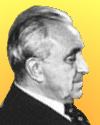
Died 17 Nov 2000 at age 95 (born 22 Nov 1904).
Louis-Eugène-Félix Néel was a French physicist who shared, (with the Swedish astrophysicist Hannes Alfvén) the Nobel Prize for Physics in 1970 for his pioneering studies of the magnetic properties of solids. His contributions to solid-state physics have found numerous useful applications, particularly in the development of improved computer memory units. About 1930 he suggested that a new form of magnetic behavior might exist - called antiferromagnetism. Above a certain temperature (the Néel temperature) this behaviour stops. Néel pointed out (1947) that materials could also exist showing ferrimagnetism. Néel has also given an explanation of the weak magnetism of certain rocks, making possible the study of the past history of the Earth's magnetic field.
Louis-Eugène-Félix Néel was a French physicist who shared, (with the Swedish astrophysicist Hannes Alfvén) the Nobel Prize for Physics in 1970 for his pioneering studies of the magnetic properties of solids. His contributions to solid-state physics have found numerous useful applications, particularly in the development of improved computer memory units. About 1930 he suggested that a new form of magnetic behavior might exist - called antiferromagnetism. Above a certain temperature (the Néel temperature) this behaviour stops. Néel pointed out (1947) that materials could also exist showing ferrimagnetism. Néel has also given an explanation of the weak magnetism of certain rocks, making possible the study of the past history of the Earth's magnetic field.
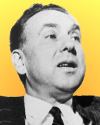
Died 17 Nov 1990 at age 75 (born 5 Feb 1915).
American scientist who was a joint recipient of the Nobel Prize for Physics in 1961 for his investigations in which he measured the sizes of the neutron and proton in the nuclei of atoms. He revealed the hitherto unknown structure of these particles and helped create an identifying order for subatomic particles. He also correctly predicted the existence of the omega-meson and rho-meson. He also studied controlled nuclear fission. Hofstadter was one of the driving forces behind the creation of the Stanford Linear Accelerator. He also made substantial contributions to gamma ray spectroscopy, leading to the use of radioactive tracers to locate tumors and other disorders. (He shared the prize with Rudolf Ludwig Mössbauer of Germany.)
American scientist who was a joint recipient of the Nobel Prize for Physics in 1961 for his investigations in which he measured the sizes of the neutron and proton in the nuclei of atoms. He revealed the hitherto unknown structure of these particles and helped create an identifying order for subatomic particles. He also correctly predicted the existence of the omega-meson and rho-meson. He also studied controlled nuclear fission. Hofstadter was one of the driving forces behind the creation of the Stanford Linear Accelerator. He also made substantial contributions to gamma ray spectroscopy, leading to the use of radioactive tracers to locate tumors and other disorders. (He shared the prize with Rudolf Ludwig Mössbauer of Germany.)
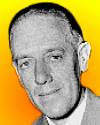
Died 17 Nov 1975 at age 78 (born 13 Aug 1897).
American biophysicist credited with formulating the modern theory of the science of biophysics. He pioneered use of electro-microscopy to monitor human nerve network and was a leader in the study of human physiology in aeronautics. During WW II, he coordinated a group physiologists, located on air bases at home and abroad, who developed the Army Air Force altitude training and night vision training programs for pilots. Meanwhile, he studied the effects of low oxygen pressure on human performance. After the war, he became president of Rockefeller Institute/University (1953-68) and was prominent in scientific and governmental organizations including the National Science Foundation and the Presidential Science Advisory Committee.«
American biophysicist credited with formulating the modern theory of the science of biophysics. He pioneered use of electro-microscopy to monitor human nerve network and was a leader in the study of human physiology in aeronautics. During WW II, he coordinated a group physiologists, located on air bases at home and abroad, who developed the Army Air Force altitude training and night vision training programs for pilots. Meanwhile, he studied the effects of low oxygen pressure on human performance. After the war, he became president of Rockefeller Institute/University (1953-68) and was prominent in scientific and governmental organizations including the National Science Foundation and the Presidential Science Advisory Committee.«
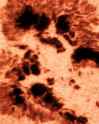
Sunspots
Died 17 Nov 1956 at age 92 (born 26 Feb 1864). quotes
English astronomer who discovered (1909) the Evershed effect - the horizontal motion of gases outward from the centres of sunspots. While photographing solar prominences and sunspot spectra, he noticed that many of the Fraunhofer lines in the sunspot spectra were shifted to the red. By showing that these were Doppler shifts, he proved the motion of the source gases. This discovery came to be known as the Evershed effect. He also gave his name to a spectroheliograph, the Evershed spectroscope. He had been introduced to workshop skills in his youth by his elder brother, Sydney Evershed. John made optical instruments reflecting his budding interest in astronomy. Sydney went on to a career with electrical devices.
English astronomer who discovered (1909) the Evershed effect - the horizontal motion of gases outward from the centres of sunspots. While photographing solar prominences and sunspot spectra, he noticed that many of the Fraunhofer lines in the sunspot spectra were shifted to the red. By showing that these were Doppler shifts, he proved the motion of the source gases. This discovery came to be known as the Evershed effect. He also gave his name to a spectroheliograph, the Evershed spectroscope. He had been introduced to workshop skills in his youth by his elder brother, Sydney Evershed. John made optical instruments reflecting his budding interest in astronomy. Sydney went on to a career with electrical devices.
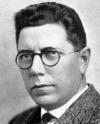
Died 17 Nov 1940 at age 61 (born 3 Jun 1879).
American zoologist, one of the founders of biometry, the application of statistics to biology and medicine. Pearl was chief statistician at the Johns Hopkins Hospital (1919-35). He pioneered studies in longevity, changes in world population, and genetics. He reported in the May 1938 Scientific American that "the smoking of tobacco was associated definitely with an impairment of life duration and the amount or degree of this impairment increased as the habitual amount of smoking increased." In 1926, he first reported health benefits of moderate alcohol consumption (as opposed to both abstinence and heavy drinking) in a modern medical light.
American zoologist, one of the founders of biometry, the application of statistics to biology and medicine. Pearl was chief statistician at the Johns Hopkins Hospital (1919-35). He pioneered studies in longevity, changes in world population, and genetics. He reported in the May 1938 Scientific American that "the smoking of tobacco was associated definitely with an impairment of life duration and the amount or degree of this impairment increased as the habitual amount of smoking increased." In 1926, he first reported health benefits of moderate alcohol consumption (as opposed to both abstinence and heavy drinking) in a modern medical light.
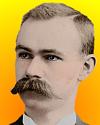
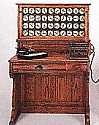
American inventor of a tabulating machine that was an important precursor of the electronic computer. For the 1890 U.S. census, he invented several punched-card machines to automate the sorting of data. The machine which read the cards used a pin going through a hole in the card to make an electrical connection with mercury placed beneath. The resulting electrical current activated a mechanical counter. It saved the U.S. 5 million dollars for the 1890 census by completing the analysis of the data in a fraction of the time it would have taken without it and with a smaller amount of manpower than would have been necessary otherwise. In 1896, he formed the Tabulating Machine Company, a precursor of IBM.
Herman Hollerith: Forgotten Giant of Information Processing, by Geoffrey Austrian. - book suggestion.
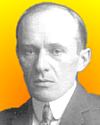
Age 46
Died 17 Nov 1926 at age 62 (born 19 May 1864).
Carl Ethan Akeley was an American naturalist and explorer who developed the taxidermic method for mounting museum displays to show animals in their natural surroundings. His method of applying skin on a finely molded replica of the body of the animal gave results of unprecedented realism and elevated taxidermy from a craft to an art. He mounted the skeleton of the famous African elephant Jumbo. He invented the Akeley cement gun (1911) to use while mounting animals, and the Akeley camera which was used to capture the first movies of gorillas. In the 1920s Akeley made a large specimen collection, part of the American Museum's famous African mammal hall. From 1919, using the skills he had acquired making clay models of animals to design taxidermy exhibits, Akeley also created a series of bronze animal casts. more
Carl Ethan Akeley was an American naturalist and explorer who developed the taxidermic method for mounting museum displays to show animals in their natural surroundings. His method of applying skin on a finely molded replica of the body of the animal gave results of unprecedented realism and elevated taxidermy from a craft to an art. He mounted the skeleton of the famous African elephant Jumbo. He invented the Akeley cement gun (1911) to use while mounting animals, and the Akeley camera which was used to capture the first movies of gorillas. In the 1920s Akeley made a large specimen collection, part of the American Museum's famous African mammal hall. From 1919, using the skills he had acquired making clay models of animals to design taxidermy exhibits, Akeley also created a series of bronze animal casts. more
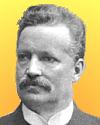
Died 17 Nov 1925 at age 75 (born 21 Nov 1849).
Swedish metallurgist who devised the Brinell hardness test, a rapid, nondestructive means of determining the hardness of metals. Brinell studied many aspects of iron and its production. Brinell´s important work on transformations in steel during heating and cooling. His discoveries about the control of the carbon containing phases is the present basis for the knowledge about properties of steel. The Brinell Hardness Test measures the relative hardness of metals and alloys, by forcing a 10mm hard steel ball into a test piece with a 3000kg load for 30 seconds and measuring the surface area of the resulting indentation. The load is reduced to 500kg for very soft materials and the steel ball is replaced with tungsten carbide for very hard materials.
Swedish metallurgist who devised the Brinell hardness test, a rapid, nondestructive means of determining the hardness of metals. Brinell studied many aspects of iron and its production. Brinell´s important work on transformations in steel during heating and cooling. His discoveries about the control of the carbon containing phases is the present basis for the knowledge about properties of steel. The Brinell Hardness Test measures the relative hardness of metals and alloys, by forcing a 10mm hard steel ball into a test piece with a 3000kg load for 30 seconds and measuring the surface area of the resulting indentation. The load is reduced to 500kg for very soft materials and the steel ball is replaced with tungsten carbide for very hard materials.
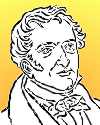
Died 17 Nov 1838 at age 65 (born 17 Dec 1772).
French physician whose advocacy of leech treatments dominated Parisian medical practice early in the19th century. Early physicians felt that the depleting effect of bloodletting was "cooling," relieving the congestion of inflamed capillaries, and saw leeches as a panacea. From his findings of blood in the mucous membranes of the gastrointestinal tract during postmortem examinations, Broussais believed all disease results from inflammation due to excessive build-up of blood. Thus, he thought that all diseases could be treated through diet and bleeding, and was said to have routinely applied 30 leeches to each of his patients. But by 1850 new techniques and drugs replaced leeches. In 1836, François Broussais presented 20 lectures on phrenology.
French physician whose advocacy of leech treatments dominated Parisian medical practice early in the19th century. Early physicians felt that the depleting effect of bloodletting was "cooling," relieving the congestion of inflamed capillaries, and saw leeches as a panacea. From his findings of blood in the mucous membranes of the gastrointestinal tract during postmortem examinations, Broussais believed all disease results from inflammation due to excessive build-up of blood. Thus, he thought that all diseases could be treated through diet and bleeding, and was said to have routinely applied 30 leeches to each of his patients. But by 1850 new techniques and drugs replaced leeches. In 1836, François Broussais presented 20 lectures on phrenology.
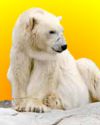
Debby
In 2008, the world's oldest polar bear died at age 41 going on 42, euthanized after suffering from several strokes and organ failure. Debby was born in the Russian Arctic in 1966, likely in December. She arrived as an orphaned cub at the Assiniboine Park Zoo, Winnipeg, Canada (6 Sep 1967). Although the exact month of birth was uncertain, she was recognized in 2007 by Guinness World Records as the oldest living polar bear. Whereas the typical lifespan of a polar bear in the wild is 20 years, Debby received good care by the conservation efforts of the zoo, and the benefit of living away from the really harsh climate in the wild. Medical treatment had included dental work, and like humans beyond middle age, a daily aspirin dose to help reduce strokes. In her lifetime, with late mate Skipper, she produced six surviving offspring. The zoo opened a new International Polar Bear Conservation Centre on 23 Jan 2012.«
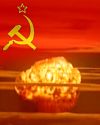
In 1978, from Moscow, Leonid I. Brezhnev said the Soviets had tested their own neutron bomb. A neutron bomb is designed primarily as a battlefield weapon to use massive bursts of radiation to kill people, rather than explosive force, to minimize damage to structures. Brezhnev gave a 50-minute monologue at the Kremlin to a visting group of U.S. seanators, including astronaut senator John Glenn. Brezhnev stated that “Many years ago our tester [Korlokov] ... tested that bomb. We tested, but we never started production of that weapon.” He added, “We do not want to unlease a nuclear war because we are not crazy.” He agreed with President Carter that tension had lessened between the two superpowers. The Associated Press reported the quotes based on a shorthand transcript made by a senate aide.«[Image: Castle-Bravo H-bomb surface test, Bikini Atoll, +20 secs (1 Mar 1954)—superimposed on Chinese flag.]

In 1976, China detonated its most powerful nuclear device in an atmospheric test. An H-6 bomber dropped it over Lop Nur desert test site in the remote Xinjiang province of Western China. It was their 21st test, equivalent to 4 megatons of TNT, reportedly 320 times greater than the Hiroshima bomb. A weak radiation cloud drifted high above the U.S. north-west Pacific coast three days later. The monster blast was to demonstrate military strength to both America and Russia. It remains their most powerful to date (2011). A photo released Jul 1977 showed many observers, mostly soldiers, watching the distant blast. A sign in front of them read “Welcome with cheers the inauguration of Hua Kuo-feng as leader of the Party and Liberation Army,” who took over from Mao Tse-tung in Oct 1976.«[Image: Castle-Bravo H-bomb surface test, Bikini Atoll, +20 secs (1 Mar 1954)—superimposed on Chinese flag.]
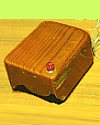
Early mouse
In 1970, a U.S. patent was issued for the computer mouse - an “X-Y Position Indicator for a Display System” (No. 3541541). The inventor was Doug Engelbart. In the lab, he and his colleagues had called it a “mouse,” after its tail-like cable. The first mouse was a simple hollowed-out wooden block, with a single push button on top. Engelbart had designed this as a tool to select text, move it around, and otherwise manipulate it. It was a key element of his larger project - the NLS (oN Line System), a computer he and some colleagues at the Stanford Research Institute had built. The NLS also allowed two or more users to work on the same document from different workstations. It had been given a public demonstration at a computer conference on 9 Dec 1968.
Bootstrapping: Douglas Engelbart, Coevolution, and the Origins of Personal Computing, by Thierry Bardini. - book suggestion.
In 1967, Surveyor 6 made a six-second flight from its landing site on the moon, first lift-off on lunar surface.*
In 1952, archeologists reported finding a 2,000-year-old mosaic floor at Circum, Cyprus, that depicts a scene from Homer's Iliad.*
In 1951, development of world's first nuclear-powered heating system was reported in Britain.*
In 1925, Dr. W. Blair Bell gave a lecture in London, advocating treatment of cancer with colloidal lead injections. The May 1926 issue of Popular Science Monthly said he the metal was injected into veins near the cancerous growth and claimed that in seventeen years of testing, out of about 200 cases treated, most of them thought hopeless, almost fifty were believed entirely and permanently cured. Bell was a surgeon, and Chair of Obstetrics and Gynaecology at Liverpool University.*
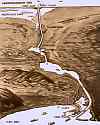
In 1869, the Suez Canal in Egypt was opened with a ceremony attended by the French Empress Eugénie (wife of Napoleon III). The 100-mile long canal cuts across the Isthmus of Suez, thus linking the Mediterranean and the Red seas, and providing a direct transportation route for trade between Europe and Asia. Its construction was accomplished by the French engineer, Ferdinand de Lesseps. As a former French consul to Cairo, de Lesseps had made an agreement (1854) with the Ottoman governor of Egypt, enabling the Suez Canal Company to be formed (1856) with the rights to construct and operate the canal for 99 years. Digging began 24 Apr 1859, by hand, with forced labour. Progress improved with European mechanical dredgers and steam shovels, but was delayed by labour disputes and a cholera epidemic. His later started work on the Panama Canal.«
Parting the Desert: The Creation of the Suez Canal, by Zachary Karabell. - book suggestion.
In 1849, the first bowler hat was sold by Lock & Co. of St. James's, London, to William Coke of Holkham, Norfolk for twelve shillings. He had placed an order intending for the hat to protect him from low-hanging branches when he was out shooting. On this day, he travelled to London to take delivery, and tested it by putting it on the floor and stamping on it. It had been made for Lock & Co. by Thomas and William Bowler, felt hat makers on Southwark Bridge Road, London. This accounts for the name by which the hat is now known, although Lock's still refer to the style as a Coke after their first customer who bought it.«*
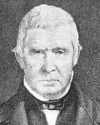
In 1797, the first patent in the U.S. for a clock was issued to Eli Terry of East Windsor, Conn. for an equation clock. The clock had two minute hands, one of which showed the mean or true time, while the other "together with the striking part and hour hand showed the apparent time, as divided by the sun according to the table of variation of the sun and clock for each day of the year." He began making clocks in 1793, in Plymouth, Conn. Terry introduced wooden geared clocks using the ideas of Eli Whitney's new armory practice to produce interchangeable gears (1802) and mass production of very inexpensive household clocks. Terry developed ways to produce wooden clock works by machine.
Eli Terry: Clockmaker of Connecticut, by Leslie Allen Jones. - book suggestion.





