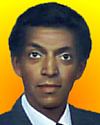
Born 1 Oct 1939.
Black-American astrophysicist who was the principal inventor of a new space camera to measure ultraviolet light which can be used to identify interstellar atoms and molecules. After several years in development, it was taken to the moon on the Apollo 16 mission (1972). Positioned on the moon's surface, the camera could also image the gases of the Earth's atmosphere. The concentration of the pollutants, such as carbon monoxide, in the air surrounding large cities could be determined for many cities at the same time. Other space cameras developed by Carruthers and his colleagues have surveyed the ozone layer and transmitted photos of distant stars and planets for computer analysis. He also pioneered in the development of electronic telescopes.
Black-American astrophysicist who was the principal inventor of a new space camera to measure ultraviolet light which can be used to identify interstellar atoms and molecules. After several years in development, it was taken to the moon on the Apollo 16 mission (1972). Positioned on the moon's surface, the camera could also image the gases of the Earth's atmosphere. The concentration of the pollutants, such as carbon monoxide, in the air surrounding large cities could be determined for many cities at the same time. Other space cameras developed by Carruthers and his colleagues have surveyed the ozone layer and transmitted photos of distant stars and planets for computer analysis. He also pioneered in the development of electronic telescopes.
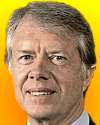
Born 1 Oct 1924. quotes
James Earl Carter, Jr. is an American president and farmer who was the 39th U.S. President (1977-81). He followed his college education in engineering by joining the Naval Academy (summer 1943), graduating in the top 10% of his class in 1946, and became a submarine officer. In 1952, the Navy assigned Carter to Adm. Hyman Rickover's nuclear submarine program. That was cut short upon the death of his father (Jul 1953). He resigned his commission and was discharged from active duty (9 Oct 1953) to take over the family farm and business and care for his mother. His experience with nuclear power training, though short, gave him insight to act with calm leadership for the nation on 1 Apr 1979, when he personally visited the Three Mile Island power station, Harrisburg, Pennsylvania, just four days after the nuclear reactor accident (28 Mar 1979).« more
James Earl Carter, Jr. is an American president and farmer who was the 39th U.S. President (1977-81). He followed his college education in engineering by joining the Naval Academy (summer 1943), graduating in the top 10% of his class in 1946, and became a submarine officer. In 1952, the Navy assigned Carter to Adm. Hyman Rickover's nuclear submarine program. That was cut short upon the death of his father (Jul 1953). He resigned his commission and was discharged from active duty (9 Oct 1953) to take over the family farm and business and care for his mother. His experience with nuclear power training, though short, gave him insight to act with calm leadership for the nation on 1 Apr 1979, when he personally visited the Three Mile Island power station, Harrisburg, Pennsylvania, just four days after the nuclear reactor accident (28 Mar 1979).« more
98 Reasons to Thank Jimmy Carter, by Arthur Milnes. - book suggestion.
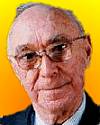
Born 1 Oct 1915. quotes
Jerome Seymour Bruner is an American psychologist who pioneered techniques for investigating infant perception. His investigations of various aspects of cognition, learning and memory in young children complimented the studies made by Jean Piaget. Their work was influential on education in America. Bruner observes that “there is no unique sequence for all learners, and the optimum in any particular case will depend upon a variety of factors, including past learning, stage of development, nature of the material, and individual differences.”«
Jerome Seymour Bruner is an American psychologist who pioneered techniques for investigating infant perception. His investigations of various aspects of cognition, learning and memory in young children complimented the studies made by Jean Piaget. Their work was influential on education in America. Bruner observes that “there is no unique sequence for all learners, and the optimum in any particular case will depend upon a variety of factors, including past learning, stage of development, nature of the material, and individual differences.”«
The Culture of Education, by Jerome Bruner. - book suggestion.
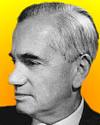
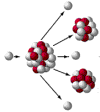
Austrian-British nuclear physicist, born in Vienna, who, with his aunt Lise Meitner, described the division of neutron-bombarded uranium into lighter elements. He named the process fission, borrowing a term from biology (1939). At the time, Meitner was working in Stockholm and Frisch (1934-39) at Copenhagen under Niels Bohr, who brought their observation to the attention of Albert Einstein and others in the United States. He did research with James Chadwick 1940-43, and was head of the Critical Assembly Group on the Los Alamos project 1943-46. After World War II, Frisch became a science writer on atomic physics for the layman.
What Little I Remember, by Otto Robert Frisch. - book suggestion.
Born 1 Oct 1881; died 28 Sep 1956 at age 74. quotes
William Edward Boeing was an American aviation pioneer who began a lumber business in 1902. His interests shifted to aviation, he trained at Glenn L. Martin’s flying school in 1915, and bought his own aircraft. In 1916, Boeing co-founded Pacific Aero Products Company (soon renamed Boeing Airplane Company). By 1920, he received a major wartime order for 200 MB-3 fighter planes. Boeing Air Transport began flying mail and passengers in Jul 1927. By mergers with other aircraft industries, he built United Aircraft and Air Transport the most profitable aviation company of its time. In 1934, government anti-trust action split it up. (United Airlines became an independent business.) Embittered, Boeing sold all his stock in the company, but volunteered as a consultant during WW II.«
William Edward Boeing was an American aviation pioneer who began a lumber business in 1902. His interests shifted to aviation, he trained at Glenn L. Martin’s flying school in 1915, and bought his own aircraft. In 1916, Boeing co-founded Pacific Aero Products Company (soon renamed Boeing Airplane Company). By 1920, he received a major wartime order for 200 MB-3 fighter planes. Boeing Air Transport began flying mail and passengers in Jul 1927. By mergers with other aircraft industries, he built United Aircraft and Air Transport the most profitable aviation company of its time. In 1934, government anti-trust action split it up. (United Airlines became an independent business.) Embittered, Boeing sold all his stock in the company, but volunteered as a consultant during WW II.«
The Story of the Boeing Company, by Bill Yenne. - book suggestion.
Born 1 Oct 1862; died 3 May 1937 at age 74.
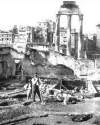
American archaeologist who was studying on a scholarship in Rome when she decided that Roman archaeology was to be her chosen field of work. In 1907, while attending a lecture in the Atrium Vestae, that she noticed that the bricks blocking up a doorway were different from those in the structure itself, and she speculated that those differences in building materials might provide a wealth of information for dating the choronology of Roman structures. Thus began thirty years of life in Rome. She was the first woman to specialize in Roman field archaeology. She established lasting criteria for the dating of ancient constructions, which advanced the serious study of Roman architecture.[Image: Photo by Ester Van Deman: Excavations of the Atrium Vestae in the Forum, Rome, Italy.]
American archaeologist who was studying on a scholarship in Rome when she decided that Roman archaeology was to be her chosen field of work. In 1907, while attending a lecture in the Atrium Vestae, that she noticed that the bricks blocking up a doorway were different from those in the structure itself, and she speculated that those differences in building materials might provide a wealth of information for dating the choronology of Roman structures. Thus began thirty years of life in Rome. She was the first woman to specialize in Roman field archaeology. She established lasting criteria for the dating of ancient constructions, which advanced the serious study of Roman architecture.[Image: Photo by Ester Van Deman: Excavations of the Atrium Vestae in the Forum, Rome, Italy.]
The Building of the Roman Aqueducts, by Esther Boise Van Deman. - book suggestion.
Born 1 Oct 1842; died 9 Aug 1888 at age 45.
(Émile-Hortensius-) Charles Cros was a French inventor and poet whose work in several fields foreshadowed or paralleled important developments. He was interested in mechanical and physical sciences. He designed an automatic telegraph and showed it at the World Fair of 1867. He sent to the Société française de photographie, in 1869, a system for reproduction of color images. Also, he delivered viable plans on 18 April 1877 to the Académie des Sciences, for an apparatus called a paléophone, which was the principle of the gramophone. Thus, he had the idea before Edison. Nevertheless, he died in poverty and was never recognized for his discoveries in his lifetime, due to more influential and better funded competitors.
(Émile-Hortensius-) Charles Cros was a French inventor and poet whose work in several fields foreshadowed or paralleled important developments. He was interested in mechanical and physical sciences. He designed an automatic telegraph and showed it at the World Fair of 1867. He sent to the Société française de photographie, in 1869, a system for reproduction of color images. Also, he delivered viable plans on 18 April 1877 to the Académie des Sciences, for an apparatus called a paléophone, which was the principle of the gramophone. Thus, he had the idea before Edison. Nevertheless, he died in poverty and was never recognized for his discoveries in his lifetime, due to more influential and better funded competitors.
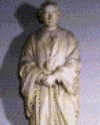
Statue of Stokes
Born 1 Oct 1804; died 10 Jan 1878 at age 73.
Physician who was the leading representative of the Irish, or Dublin, school of anatomical diagnosis, which emphasized clinical examination of patients in forming a diagnosis. With colleague, John Cheyne, he described Cheyne-Stokes respiration associated with terminal illness; and with Robert Adams described Stokes-Adams attacks, an abnormality of the heart. Stokes is regarded as one of the founders of modern cardiology. In 1838, he co-founded the Dublin Pathological Society, the first society of its kind in the Western world. Every Saturday the member physicians and surgeons met to share knowledge about clinical cases. He was also the author of two important works in the emerging field of cardiac and pulmonary diseases.Statue of Stokes
Physician who was the leading representative of the Irish, or Dublin, school of anatomical diagnosis, which emphasized clinical examination of patients in forming a diagnosis. With colleague, John Cheyne, he described Cheyne-Stokes respiration associated with terminal illness; and with Robert Adams described Stokes-Adams attacks, an abnormality of the heart. Stokes is regarded as one of the founders of modern cardiology. In 1838, he co-founded the Dublin Pathological Society, the first society of its kind in the Western world. Every Saturday the member physicians and surgeons met to share knowledge about clinical cases. He was also the author of two important works in the emerging field of cardiac and pulmonary diseases.Statue of Stokes

Died 1 Oct 1990 at age 62 (born 28 Jun 1928). quotes
Northern Irish physicist who has been described as breathing “new and exciting life into the foundations of quantum theory.” In 1964, he mathematically proved “that certain quantum correlations, unlike all other correlations in the Universe, cannot arise from any local cause,” as described in Nature a half-century later.
Northern Irish physicist who has been described as breathing “new and exciting life into the foundations of quantum theory.” In 1964, he mathematically proved “that certain quantum correlations, unlike all other correlations in the Universe, cannot arise from any local cause,” as described in Nature a half-century later.
Died 1 Oct 1974 at age 72 (born 4 Nov 1901). quotes
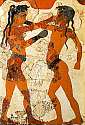
Spyridon Nikolaou Marinatos was a Greek archaeologist whose most notable discovery was the site of an ancient port city on the island of Thera, in the southern Aegean Sea. The city, the name of which was not discovered, apparently had about 20,000 inhabitants when it was destroyed by the great volcanic eruption of 1500 BC. Among the finds made at the site were the finest frescoes discovered in the Mediterranean region to that time, surpassing even those found at Knossos in Crete. The most famous of these murals is the "Two Boys Boxing" (left).[Image: "Two Boys Boxing" mural, Marinatos's most famous fresco discovery.]
Spyridon Nikolaou Marinatos was a Greek archaeologist whose most notable discovery was the site of an ancient port city on the island of Thera, in the southern Aegean Sea. The city, the name of which was not discovered, apparently had about 20,000 inhabitants when it was destroyed by the great volcanic eruption of 1500 BC. Among the finds made at the site were the finest frescoes discovered in the Mediterranean region to that time, surpassing even those found at Knossos in Crete. The most famous of these murals is the "Two Boys Boxing" (left).[Image: "Two Boys Boxing" mural, Marinatos's most famous fresco discovery.]
Died 1 Oct 1972 at age 69 (born 7 Aug 1903). quotes
Louis Seymour Bazett Leakey was an English anthropologist and archaeologist who was born in Kabete, Kenya, of English missionaries parents. Leakey was largely responsible for convincing scientists that Africa, rather than Java or China, was the most significant area to search for evidence of human origins. Leakey led fossil-hunting expeditions to eastern Africa from the 1920's. He married Mary D. Nicol in 1936 and the couple discovered many important fossils together. In 1964, on an expedition to the Olduvai Gorge in Tanzania, he found fossil remains of, he believed, the earliest member of the genus of human beings. He named the species Homo habilis. He died in London, and buried in the country of his birth on 4 Oct 1972.
Louis Seymour Bazett Leakey was an English anthropologist and archaeologist who was born in Kabete, Kenya, of English missionaries parents. Leakey was largely responsible for convincing scientists that Africa, rather than Java or China, was the most significant area to search for evidence of human origins. Leakey led fossil-hunting expeditions to eastern Africa from the 1920's. He married Mary D. Nicol in 1936 and the couple discovered many important fossils together. In 1964, on an expedition to the Olduvai Gorge in Tanzania, he found fossil remains of, he believed, the earliest member of the genus of human beings. He named the species Homo habilis. He died in London, and buried in the country of his birth on 4 Oct 1972.
Ancestral Passions: The Leakey Family and the Quest for Humankind's Beginnings, by Virginia Morell. - book suggestion.
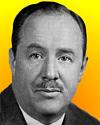
Died 1 Oct 1969 at age 69 (born 15 Jul 1900).
American physician, physician, virologist and epidemiologist who was the first in the U.S. to isolate the virus influenza A (1934) and showed that there are other strains, such as influenza B (1940). Francis developed a polyvalent vaccine effective against both strains and conducted research that led to the development of antiserums for the treatment of pneumonia. In 1953, he was asked to design, supervise, and evaluate the field trials of the polio vaccine developed by his former protegé, Jonas Salk. The trials were of unprecedented scope and magnitude, involving about 1.8 million children from across the U.S., Canada, and Finland. On 12 Apr 1955, Francis announced that the Salk vaccine was indeed "safe, effective, and potent."«
American physician, physician, virologist and epidemiologist who was the first in the U.S. to isolate the virus influenza A (1934) and showed that there are other strains, such as influenza B (1940). Francis developed a polyvalent vaccine effective against both strains and conducted research that led to the development of antiserums for the treatment of pneumonia. In 1953, he was asked to design, supervise, and evaluate the field trials of the polio vaccine developed by his former protegé, Jonas Salk. The trials were of unprecedented scope and magnitude, involving about 1.8 million children from across the U.S., Canada, and Finland. On 12 Apr 1955, Francis announced that the Salk vaccine was indeed "safe, effective, and potent."«
Died 1 Oct 1965 at age 72 (born 11 Dec 1892).
Canadian-American psychiatrist who invented the modern polygraph.
Canadian-American psychiatrist who invented the modern polygraph.
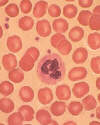
blood cells
American biochemist who helped develop the methods of cold ethanol blood fractionation (the separation of plasma proteins into fractions). During World War II he headed a team of chemists, physicians, and medical scientists who made possible the large-scale production, allowing use of the individual fractions of human plasma for treatment of the wounded - all together about a dozen different materials. Some of the results of this work include the use of serum albumin as a substitute for blood or plasma for transfusion; the use of gamma globulin for short-term protection against such diseases as measles and hepatitis; and the use of antihemophilic globulin for the treatment of hemophilia.
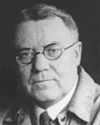
Died 1 Oct 1945 at age 73 (born 19 Oct 1871). quotes
American physiologist and neurologist who was the first to use X-rays in physiological studies. These led to his publication of The Mechanical Factors of Digestion (1911). He investigated hemorrhagic and traumatic shock during WW I. He devised the term homeostasis (1930) for how the body maintains its temperature. He worked on methods of blood storage and discovered sympathin (1931), an adrenaline-like substance that is liberated at the tips of certain nerve cells. He died from leukemia - probably a legacy from his early work with X rays. He was nominated for a Nobel Prize in 1920 for his work on digestion, but his claim was ruled out as "too old." In 1934, 1935, and 1936 he was adjudged “prizeworthy” by the appropriate Nobel jurors but was not given a prize.
American physiologist and neurologist who was the first to use X-rays in physiological studies. These led to his publication of The Mechanical Factors of Digestion (1911). He investigated hemorrhagic and traumatic shock during WW I. He devised the term homeostasis (1930) for how the body maintains its temperature. He worked on methods of blood storage and discovered sympathin (1931), an adrenaline-like substance that is liberated at the tips of certain nerve cells. He died from leukemia - probably a legacy from his early work with X rays. He was nominated for a Nobel Prize in 1920 for his work on digestion, but his claim was ruled out as "too old." In 1934, 1935, and 1936 he was adjudged “prizeworthy” by the appropriate Nobel jurors but was not given a prize.
The Mechanical Factors of Digestion, by Walter Bradford Cannon. - book suggestion.
Died 1 Oct 1876 at age 80 (born 25 Aug 1796). quotes
American businessman and philanthropist who placed $700,000 in trust (1874) to build the Lick Observatory at the summit of Mount Hamilton near San Jose, California. After he died, he was interred under the future home of the Great Lick Refracting Telescope. When constructed (1880-88), it was the world’s largest and most powerful telescope, with a 36 inch (91 cm) diameter refractor lens. Lick had a considerable fortune from real estate, and at first considered building a monumental statue, or a huge pyramid greater than any in Egypt. Eventually, he was pursuaded to leave the majority of his estate to social and scientific causes. The Observatory overlooks Silicon Valley, and is supported by the University of California.«
American businessman and philanthropist who placed $700,000 in trust (1874) to build the Lick Observatory at the summit of Mount Hamilton near San Jose, California. After he died, he was interred under the future home of the Great Lick Refracting Telescope. When constructed (1880-88), it was the world’s largest and most powerful telescope, with a 36 inch (91 cm) diameter refractor lens. Lick had a considerable fortune from real estate, and at first considered building a monumental statue, or a huge pyramid greater than any in Egypt. Eventually, he was pursuaded to leave the majority of his estate to social and scientific causes. The Observatory overlooks Silicon Valley, and is supported by the University of California.«
James Lick’s Monument: The Saga of Captain Richard Floyd and the Building of the Lick Observatory, by Helen Wright. - book suggestion.
Died 1 Oct 1795 (born 1725). quotes
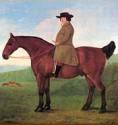
English agriculturist who revolutionized sheep and cattle breeding in England by methodical selection, inbreeding, and culling. Bakewell believed in the philosophy of “breed the best to the best to get the best.” So he assembled the “best” animals he could find and then set out to develop the “type” of animal he wanted. He closed his herd and that meant he had to retain only the genetically superior individuals to obtain the desired “type.” This meant that he had to inbreed to set the type. Bakewell's success led others to develop “breeds” that bred true or “pure” for certain characteristics when mated within the herd. Bakewell and his sister Hannah lived at Dishley Farm, just north of Loughborough, Leicestershire.
English agriculturist who revolutionized sheep and cattle breeding in England by methodical selection, inbreeding, and culling. Bakewell believed in the philosophy of “breed the best to the best to get the best.” So he assembled the “best” animals he could find and then set out to develop the “type” of animal he wanted. He closed his herd and that meant he had to retain only the genetically superior individuals to obtain the desired “type.” This meant that he had to inbreed to set the type. Bakewell's success led others to develop “breeds” that bred true or “pure” for certain characteristics when mated within the herd. Bakewell and his sister Hannah lived at Dishley Farm, just north of Loughborough, Leicestershire.
Robert Bakewell and the Longhorn Breed of Cattle, by Pat Stanley. - book suggestion.

In 2013, the Affordable Care Act (ACA), signed into law by U.S. President Obama on 23 Mar 2010, named this day to begin open enrollment for individuals and families. The historic law designed a Health Insurance Marketplace system to provide new options for affordable health insurance to all unincarcerated legal residents in America without it. The need was glaring. According to OECD Health Data (2011 report) for 40 major countries, in the U.S., life expectancy fell below 26 countries (mostly European countries with universal health coverage). Both premature mortality including all ages and the infant mortality rate was worse than 30 countries. The U.S. infant mortality rate was 360% higher than in Iceland. U.S. health expenditure as a share of GDP at almost 20% is more than double the OECD average.«The Organisation for Economic Co-operation and Development (OECD) is a forum for governments, and has 34 member countries. The OECD provides objective analyses and recommendations that are independent and evidence-based, about the economic and social well-being of people around the world. Data cited here is from the 2011 report using the then most recently available data, usually 2009. GDP = Gross Domestic Product.
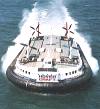
In 2000, two hovercraft that made marine history, and had operated for 32 years, made the last trips across the English Channel. The Princess Margaret was launched in 1968, and followed a year later by the Princess Anne. The revolutionary design of these hovercraft greatly reduced journey times. They could take 300 passengers and 50 cars to Calais in 35 minutes. Hovercraft were the idea of the British inventor Sir Christopher Cockerell, though it took him almost ten years to gain financial backing. The opening of the Eurotunnel brought stiff competition among ferry firms. The hovercraft were replaced with larger and smoother catamarans able to make the crossing in 45 minutes but able to carry 600 passengers and 90 cars, and use less fuel.
Hydrofoils and Hovercraft: New Vehicles for Sea and Land, by Bill Gunston. - book suggestion.
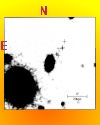
Keck LRIS I-band image
In 1995, an article was published in the Astrophysical Journal Letters confirming a red shift of z=4.25 for the most distant galaxy yet discovered, named 8C 1435+63. It was estimated to be 15,000 million lightyears away and appeared soon after the birth of the universe. The sharpest image of the galaxy was obtained using the world's largest optical telescope, the 10-m W.M. Keck telescope on the top of Mauna Kea, Hawaii, by scientists from the University of California, Berkeley. It was discovered in 1994 by English astronomers who detected its unusual pattern of strong radio emissions, but at first only a fuzzy image in visible light. Their results were still in press. Later galaxy distance records include: in 1995, 6C 0140+326, z=4.4, in 1999, TN J0924-2201 z=5.2, and in 2011,UDFj-39546284 z=10.3.«[Ref: Spinrad, Dey and Graham, 'Keck observations of the most distant galaxy: 8C 1435+63 at Z = 4.25', Astrophysical Journal, Part 2 - Letters 438, No. 2, L51-L54. The paper was received 11 Jul 1994, accepted 12 Oct 1994. Some press releases give the publication date as 1 Jan, but it actually appears in the journal for 10 Jan. The original discovery was made earlier by M. Lacy and S. Rawlings, who provided their results prior to publication; their paper was still in press with MNRAS.]
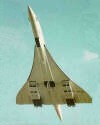
In 1969, the French Concorde prototype 001 broke the sound barrier for its first time. The inaugural flight of the aircraft had taken place on 2 Mar 1969 in Toulouse, France. The first commercial passenger supersonic flights on 21 Jan 1976 of the British and French Concorde jets marked a brilliant technological achievement. The Concorde was the world's first airplane to be entirely controlled by computer. At first, environmental groups dennounced the Concorde's noise during takeoff and its fuel consumption. Its impact on international air travel was limited by the high costs of operating the aircraft. Only British Airways and Air France operated the aircraft. Their service ended with final passenger flights on 24 Oct 2003.
The Concorde Story: 21 Years in Service, by Christopher Orlebar. - book suggestion.

In 1957, the notorious drug thalidomide was first marketed in West Germany and shortly sold in at least 46 countries. First synthesized in 1953 by Chemie Grünenthal, as a sedative, it seemed a wonder drug for pregnant women to combat symptoms associated with morning sickness. Too late it was found that the drug's molecules crossed the placental wall, especially during the first trimester, tragically affecting the proper growth of the foetus. Worldwide, over 10,000 babies were born by the early 1960s with substantial birth defects, including deafness, blindness, internal disabilities, cleft palate, deformed or even missing limbs. Survivors, now middle-aged adults, have continuing health problems. Yet, some beneficial uses have now been found for the drug.«
Dark Remedy: The Impact of Thalidomide and Its Revival as a Vital Medicine, by Trent D. Stephens. - book suggestion.
In 1956, The Physical Review published a paper by Tsung Dao Lee and Chen Ning Yang on the Question of Parity Conservation in Weak Interactions. They addressed an issue that had long been believed, but for which there had been no experimental support. Yet, there existed a Theta-Tau Puzzle (C.F. Powell, 1949) in the disintegration of certain cosmic ray particles via the nuclear weak force. Lee and Yang believed this was because of parity violation, which contradicted the generally accepted "law" of conservation of parity. They proposed a study of experiments involving weak interactions. Chien-Shiung Wu validated non-conservation of parity on 27 Dec 1956 in their suggestion to study beta decay of cobalt-60.«
In 1949, the first deliveries were made of the first practical rectangular television tube made in the U.S. The tubes were manufactured by the Kimble Glass Co., a subsidiary of Owens-Illinois, and sold for about $12. The display face of the tube measured approx. 12in. by 16in. The company had announced the tube to the trade on 10 Jul 1949.
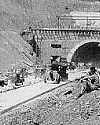
In 1940, a 260-km stretch of the Pennsylvania Turnpike between Irwin and Carlise in Pennsylvania, U.S.A., was officially opened to the public as the first American limited-access interstate-type highway. It had been in use earlier by the U.S. Army. It was not called an Interstate Highway at the time. On 29 Jun 1956, President Dwight D. Eisenhower signed the Federal-Aid Act of 1956, which established a national System of Interstate and Defense Highways. The Pennsylvania Turnpike became part of that Interstate Highway system. Although it was not newly-constructed as part of the newly established limited-access interstate road network, having opened years before the Federal-Aid Act of 1956, it has been called "The Granddaddy of the Pikes," and could be regarded as the oldest U.S. Interstate.«
The Roads That Built America: The Incredible Story of the U.S. Interstate System, by Dan McNichol. - book suggestion.
In 1933, the first cargo of taconite, a hard rock containing 25% - 30% iron, was shipped to the Ford Motor Company of River Rouge, Mich. The cargo had been produced 21 Jun 1922 by the Mesabi Iron Co. of Babbitt, Minn. The firm had begun operation in Nov 1919. Taconite is a low-grade ore containing only up to 30% magnetite and hematite as tiny particles scattered throughout a very tough variety of quartz called chert. The Mesabi Range, a giant area of low rolling hills in northeastern Minnesota is among the world's best known deposits of iron (discovered 1887). Mesabi is an Ojibwa name meaning "giant." After WW II, when other, higher grade iron ore had been depleted, an industrial method to exploit taconite ore was developed.
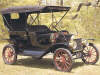
In 1908, the Ford Model T car, the first car model to be made on an assembly line, was introduced to the public at a price of $825. It was an immediate sensation. Before long, it was the largest selling car in the United States, often accounting for over half the sales in the country. True mass production was born with the Model T. As volumes rose, costs came down. By 1925, a coupe sold for $525 new, while a two-door runabout went for only $260. The first production Model T came off the assembly line on 27 Sep 1908, and the last Model T was celebrated on 26 May 1927.
In 1890, an Act of Congress reserved areas of forest land in California, and created Yosemite National Park under the control of the Secretary of the Interior. This followed the original Yosemite Grant made on 30 Jun 1864 by Act of Congress (13 Stat., 325) to the State of California of the “Yo-Semite Valley” and the land embracing the “Mariposa Big Tree Grove,” by which for all time the area was protected for “public use, resort, and recreation.” On 3 Mar 1905, the State of California receded and regranted the Yosemite Valley land to the USA transferring responsibility and maintenance costs to the federal government for the National Park, now the third oldest.«
The Yosemite, by John Muir. - book suggestion.
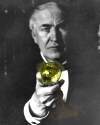
In 1880, the first electric incandescent lamp factory in the U.S. was opened in Menlo Park, N.J. The Edison Lamp Works. More than 130,000 bulbs had been manufactured by the time the plant was moved to Harrison, N.J. on 1 Apr 1882.
more
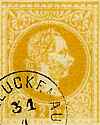
In 1869, the Austrian Postal Administration authorized the world’s first postal card, known as a Correspondz Karte. Dr. Emanuel Hermann had suggested them to provide soldiers with an inexpensive way to keep in touch with home. They were so popular that 3 million were sold in the first three months after issue. By the next year, several other governments had taken up the idea. In Britain, 75 million of the half-penny cards were posted in the the first year of use. Several other countries issued cards in that same year or the next. The U.S. authorized postal cards with an Act on 8 Jun 1872, and began selling a one-cent card on 1 May 1873.[Image: detail from postcard showing stamp.]
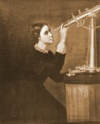
In 1847, Maria Mitchell, the first woman astronomer in the United States, discovered a comet. One night in the Autumn of 1847, Maria looked at the sky through the telescope in her homemade observatory at Nantucket, Mass. and saw a star five degrees above the North Star where there had been no star before. She had memorized the sky and was sure of her observation. It occurred to her that this might be a comet. Maria recorded the presumed comet's coordinates. The next night the star moved again. This time she was sure it was a comet. For this discovery, she was awarded a gold medal by the king of Denmark. She became the first woman elected to the American Academy of Arts and Sciences.
Maria Mitchell: A Life in Journals and Letters, by Henry Albers. - book suggestion.
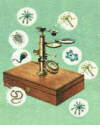
In 1846, ten years after his voyage on the Beagle, Charles Darwin began his study of barnacles, which was to appear in four volumes on living and fossil Cirripedes (barnacles). For his observations, he had a single lens microscope made to his own design. Intended to be more practical, though it did not have fine focusing, it had a larger stage than the Beagle microscope to take shallow dishes for aqueous dissections.Image: Darwin's microscope on the Beagle voyage, detail from a Falkland Islands postage stamp.




