|
After Helmholtz had finished his studies on sound, he did work in connection with the mechanism of sight. Often when driving along a road in the dark, we have been startled by the light coming from a cat's eyes. The Egyptians who were cat worshippers attributed this to the animal's mystic power, but Helmholtz thought it was only a reflection. He reasoned that if the eye were capable of reflecting light from the outside, there must be a means of looking into it from the outside. 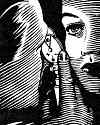 From this theory he developed an instrument which every optician uses
today to diagnose your seeing difficulty. You have all seen the small
mirror with the peephole in the center with which the specialist
actually examines the inside of your eye. Helmholtz developed this
device in 1850 - nearly a hundred years ago, but it was just the
beginning of his research on vision.
From this theory he developed an instrument which every optician uses
today to diagnose your seeing difficulty. You have all seen the small
mirror with the peephole in the center with which the specialist
actually examines the inside of your eye. Helmholtz developed this
device in 1850 - nearly a hundred years ago, but it was just the
beginning of his research on vision. He discovered and named the fault known as astigmatism and studied the muscles and actions of the eye and devised lenses to correct this fault. His book on PHYSIOLOGICAL OPTICS contains the results of all of these experiments and stands today as one of the most important works ever written on the subject. |