
 Short Stories of Science and InventionA Collection of Radio Talks byCharles F. KetteringINDEXWeekly, from September 1942 to July 1945, Charles F. Kettering gave five-minute intermission talks about Science and Invention during the radio broadcasts of the General Motors Symphony of the Air. Kettering invented the first automobile self-starter, and for 31 years directed a research laboratory for General Motors. These radio talks are a fascinating legacy from the mind of a prolific inventor. The obvious anachronisms now add a historical perspective of the war-time period in which they were written. These web pages now preserve some of the most popular stories for a new generation to read The text and art come from a General Motors booklet of selected talks. (Reprint, March 1959) |
A Radio Talk by Charles F. Kettering As no one can predict who will make an invention or how it will be used, we should not be surprised when we learn that seven hundred years ago an English monk carefully wrote this down, "I 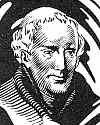 have produced an
explosion that outroared thunder and with a flash that
exceeded the brilliance of lightning." Roger
Bacon hid this formula in
a Latin cryptogram which said, "Take seven parts of saltpeter, five of
charcoal and five of sulphur." When he wrote down these dozen words,
Bacon probably had no idea they might later influence the whole course
of civilization because, as you know, he was describing gunpowder,
the first of the great family of explosives. have produced an
explosion that outroared thunder and with a flash that
exceeded the brilliance of lightning." Roger
Bacon hid this formula in
a Latin cryptogram which said, "Take seven parts of saltpeter, five of
charcoal and five of sulphur." When he wrote down these dozen words,
Bacon probably had no idea they might later influence the whole course
of civilization because, as you know, he was describing gunpowder,
the first of the great family of explosives.He may have had some conception after all of the possibilities of the mixture because he was a remarkable, farseeing man who not only experimented with chemical combinations but also predicted the use of the steamship, the automobile and the airplane, and described in detail the magnifying or reading glass. Roger Bacon lived near the end of the Dark Ages - the days of the alchemists and the Black Arts. But even in those days of superstition, he was a strong advocate of the fundamentals of modern research. He stated it this way, "Take nothing for granted - use your own eyes and test all new theories with your own hands." Roger Bacon by his work in philosophy laid the foundation for modern scientific research. He wrote once that his gunpowder mixture might completely blow up an opposing army or put it to flight by the terror of the explosion; however, he made no mention of using it in firearms. |







