
 Short Stories of Science and InventionA Collection of Radio Talks byCharles F. KetteringINDEXWeekly, from September 1942 to July 1945, Charles F. Kettering gave five-minute intermission talks about Science and Invention during the radio broadcasts of the General Motors Symphony of the Air. Kettering invented the first automobile self-starter, and for 31 years directed a research laboratory for General Motors. These radio talks are a fascinating legacy from the mind of a prolific inventor. The obvious anachronisms now add a historical perspective of the war-time period in which they were written. These web pages now preserve some of the most popular stories for a new generation to read The text and art come from a General Motors booklet of selected talks. (Reprint, March 1959) |
A Radio Talk by Charles F. Kettering
|
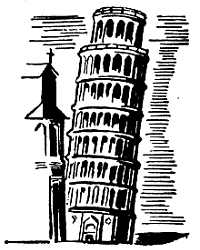 It hasn't been so long ago, I believe, that we read in the papers that
our Air Forces had bombed the Italian city of Pisa. That news probably
brought to our minds a mental picture of the Leaning Tower
and we probably wondered if it had been hit. From the best
information I am able to obtain, the Leaning Tower still stands. It is
a great curiosity in the architectural world. But it is also
a reminder of one of the most interesting experiments that
has ever been performed.
It hasn't been so long ago, I believe, that we read in the papers that
our Air Forces had bombed the Italian city of Pisa. That news probably
brought to our minds a mental picture of the Leaning Tower
and we probably wondered if it had been hit. From the best
information I am able to obtain, the Leaning Tower still stands. It is
a great curiosity in the architectural world. But it is also
a reminder of one of the most interesting experiments that
has ever been performed.







