107Stories About ChemistryINDEX |
47.
Snake with Its Tail in Its Mouth
Medicine has its specific symbol which has come down to us from ancient times. Today military doctors of many countries wear badges on their shoulder straps in the form of a snake coiled around a staff or the stem of a cup. Now there is a similar symbol in chemistry. It is a snake with its tail in its mouth. 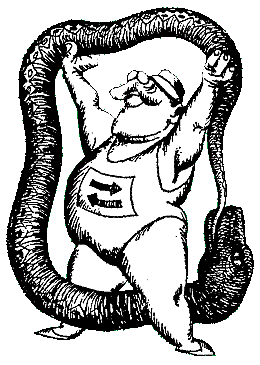 The ancients had a cult of all kinds of mystic signs, the meaning of which is often difficult to explain today. So much for mystic signs, but the �chemical snake� has a quite definite meaning. It symbolizes a reversible chemical reaction. Two atoms of hydrogen and one of oxygen combine to form a molecule of water. Simultaneously another molecule of water decomposes into its component parts. Two opposite reactions take place in the same instant: the formation of water (the forward reaction) and its decomposition (the back reaction). A chemist would represent these two contradictory processes as follows:  2H2O. 2H2O.The arrow pointing to the right indicates the forward reaction, and that pointing to the left, the back reaction. Fundamentally, all chemical reactions without exception are reversible. At first, the forward reaction predominates. The scales tilt towards the formation of water molecules. Then the opposite reaction begins to increase. Finally, there comes a moment when the number of molecules forming equals the number decomposing, and both reactions, from left to right and from right to left, proceed at an equal rate. A chemist would say that equilibrium has been established. It is established sooner or later in any chemical reaction, instantaneously in some reactions, or after several hours, days, or weeks, in others. In its practical activities chemistry pursues two aims. First, it tries to make the chemical process go to completion, so that the initial products react entirely with each other. Secondly, it strives to obtain a maximum yield of the products needed. To accomplish these aims the establishment of chemical equilibrium must be postponed as far as possible. Forward reaction - yes, back reaction - no. And here the chemist has to become something of a mathematician. He finds the ratio between two quantities, between the concentration of the substances formed and the concentration of the initial substances entering into the reaction. This ratio is a fraction. The larger the numerator, and the smaller the demoninator of any fraction, the larger the fraction. If the forward reaction predominates, the amount of the products will in time exceed the amount of the initial substances. The numerator will then be greater than the denominator and the result will be an irregular fraction. In the reverse case the fraction will be a regular one. The chemist calls the value of this fraction the equilibrium constant of the reaction and denote it by K. If he wants the reaction to result in the largest amount of the product needed he must first calculate K for different temperatures. Now here is what this �arithmetic� looks like in practice. At room temperature K for the synthesis of ammonia is about 100,000,000. It would seem that under such conditions a mixture of nitrogen and hydrogen should change instantly into ammonia. But this does not happen. The forward reaction is too slow. Would raising the temperature help? We heat the mixture to 500�C� But here the chemist would check us: �What the deuce are you doing? You�ll not get anywhere that way!� Indeed, he stopped us just in time, this chemist with his calculations. Here is what they show: at a temperature of 500�C, K is only six thousand, 6 � 103! The �green light� for the back reaction  3H2 + N2. 3H2 + N2.And we would have kept heating the mixture and wondering why we were getting nowhere. The most favourable conditions for ammonia synthesis are as low a temperature and as high a pressure as possible. This is the domain of another law acting in the realm of chemical reactions. This law is known as Le Chatelier�s principle, after the French scientist who discovered it. Imagine a spring built into a fixed support. If it is neither compressed nor stretched it may be said to be in equilibrium. But if it is compressed or stretched the spring comes out of its state of equilibrium. Simultaneously its elastic forces, those that counteract compression or stretching of the spring, begin to increase. Finally, there comes a moment when both forces again balance each other. The spring is once more in a state of equilibrium, but not the same as it was in initially. Its new equilibrium is displaced towards compression or stretching. The change in the state of equilibrium of a strained spring is an analogy (though rather a crude one) of the action of Le Chatelier's principle. Here is how it is formulated in chemistry. Let an external force act on a system in equilibrium. Then the equilibrium will shift in the direction indicated by the external influence. It will shift until the reactive forces balance those applied externally. Reverting to the production of ammonia, the equation of its synthesis shows that four volumes of gases (three volumes of hydrogen and one volume of nitrogen) give two volumes of gaseous ammonia (2NH3). Increasing the external pressure tends to reduce the volume. In this case the influence is favourable. The "spring is compressed." The reaction proceeds mainly from left to right: 2NH3,and the yield of ammonia increases. Ammonia synthesis involves a release of heat. If we heat the mixture, the reaction will proceed from right to left, because heating increases the volume of the gases, and the volume of the reactants (3H2 and N2) is larger than the volume of the resultant (2NH3). Hence, the back reaction will predominate over the forward one. The "spring" will stretch. Both influences result in a new state of equilibrium, but in the first case it corresponds to an increase in the ammonia yield, whereas in the second case the yield will decrease sharply. |




