107Stories About ChemistryINDEX |
Snake With Its Tail in Its Mouth 44. The Spirit of Chemical Science Almost everything on the Earth around us consists of chemical compounds, of a great variety of combinations of the chemical elements. Only an insignificant part of terrestrial matter is in the form of elemental substances, namely: the noble gases, the platinum metals, carbon in its various forms, and that is about all. 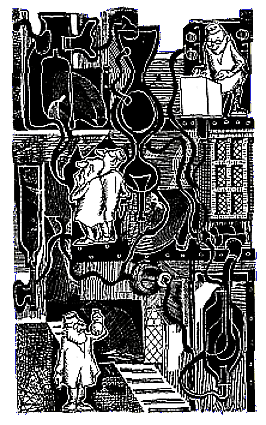 Possibly, a very long time ago the clot of cosmic matter which finally became our planet, consisted all of only the atoms of almost l00 chemical elements. Hundreds, thousands, millions of years passed. Conditions changed. The atoms reacted with one another. The gigantic laboratory of nature began to operate. During its long evolution nature, the chemist, learned to prepare all kinds of substances, from the simple water molecule to infinitely complex proteins. The evolution of the globe and of life on it is due largely to chemistry. For the great diversity of chemical compounds owes its existence to processes called chemical reactions. They are the true spirit of chemical science, and its principal subject matter. It is impossible to estimate even approximately the number of chemical reactions that occur in the world, say, in the course of only one second. For instance, for a person to pronounce the word �second� many chemical processes must occur in his brain. We speak, think, enjoy ourselves, or worry, and all these actions are backed by millions of chemical reactions. We never see these reactions, but there is also an immense number of chemical reactions that we do observe daily, just offhand, without stopping to think of them. We put a slice of lemon into a cup of strong tea and the tea becomes pale. We strike a match and a stick of wood bursts into flame and turns into charcoal. These are all chemical reactions. The primeval man who learned to light a fire was the first chemist. He accomplished at will the first chemical reaction, that of combustion. And this reaction is the most necessary, the most important in all the history of mankind. It gave our distant ancestors the heat to warm their dwellings on cold days. In our time it has opened the way to outer space by propelling rockets weighing many tons into the sky. The legend of Prometheus who gave people fire is at the same time the legend of the first chemical reaction. When simple or complex substances interact with each other, they usually let us know about it. Drop a piece of zinc into a solution of sulphuric acid. Immediately gas bubbles begin to rise from it and after some time the metal disappears. The zinc dissolves in the acid, liberating hydrogen. You could see for yourself how it all happened. Or light a lump of sulphur. It burns with a bluish flame and you can smell the asphyxlating odour of sulphur dioxide, the chemical compound which forms when sulphur combines with oxygen. Moisten anhydrous copper sulphate CuSO4, a white powder, with water and it immediately turns blue. The salt combines with the water to form crystals of blue vitriol CuSO4 � 5H2O. Substances of this kind are called crystal hydrates. Do you know what quenching of lime is? Water is poured on quicklime and the result is slaked lime Ca(OH)2. Though the substance does not change colour, it can easily be seen that a reaction has occurred, because when lime is quenched a great deal of heat is liberated. The primary and invariable condition of all chemical reactions is that they are accompanied by the liberation or absorption of thermal energy. Sometimes so much heat is liberated that it can readily be felt. When the amount of heat evolved is small, special methods of measurement are used. |




