107Stories About ChemistryINDEX |
31.
How to Change One Element into Another
Innumerable chemical reactions occur in the world around us. They all obey the authority of electron-shell chemistry. An atom may gain electrons or may lose them, becoming a negatively or a positively charged ion. An atom can combine with hundreds and thousands of others to form a giant molecule. But it always remains the carrier of the properties of the same element. Carbon forms over three million compounds, but in each of them, be it carbon dioxide CO2 or the most complicated antibiotic, carbon remains carbon. 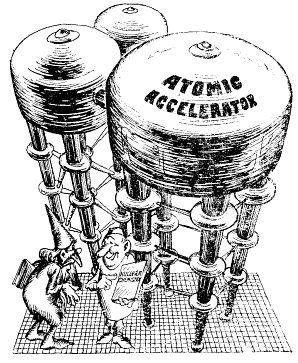 Changing an element into another involves rearranging its atomic nuclei to alter their charge. To bring about chemical processes chemists make use of high temperatures and pressures and of catalysts, substances which accelerate reactions when added in small amounts. Temperatures of thousands of degrees and pressures of hundreds of thousands of atmospheres fail to rearrange the atomic nucleus. One element cannot be changed into another in this way. But it can be done by the methods of a new science called nuclear chemistry. The �temperatures and pressures� of nuclear chemistry are protons and neutrons, nuclei of heavy hydrogen isotopes (deuterons) and nuclei of helium atoms (alpha-particles), and finally, ions of the lighter elements of the Mendeleyev Table, boron and oxygen, neon and argon. Its chemical equipment includes nuclear reactors in which certain bombarding particles are formed, and accelerators, complex apparatus for speeding up the particles to immense velocities. To penetrate the atomic nucleus the missile particle must possess a high energy (especially if it is positively charged); this makes it easier to overcome the repulsive action of the nuclear charge. Nuclear chemistry has its own system of symbols, but the equations of its reactions resemble �conventional� chemical equations. It was due to nuclear chemistry that the blank spaces in the Mendeleyev Table were finally filled. The Greek word �tecnetos� meaning �artificial� went into the name of the first element prepared artificially by man. In late 1936 a beam of fast deuterons accelerated in a cyclotron crashed down on a molybdenum plate. The swift deuterons cut through the electron shells like a knife through butter and reached the nucleus. On hitting the nucleus each deuteron, consisting of a proton and a neutron decomposed, the neutron glancing off at an angle and the proton being captured by the nucleus. This increased the nuclear charge by one unit, and molybdenum, which occupies Box No.42 changed into its right-hand neighbour, element No.43. Like in ordinary chemistry, where the same compound can be obtained by various routes, so in nuclear chemistry the same elements can be prepared artificially by means of different reactions. People learned to make technetium in kilogram quantities at the most wonderful factory in the world. This factory is the nuclear reactor, where energy is produced by slow neutrons splitting uranium nuclei. The uranium nuclei break up into different fragments, each nucleus producing two fragments. These are atomic nuclei of elements situated in the centre of the Mendeleyev Table. On fission uranium gives birth to elements which occupy more than 30 boxes of the Periodic Table, ranging from No.30 to No.64, and including technetium, and another of the stranger elements, which had been sought in vain for decades in the Earth�s crust. This was promethium, the inhabitant of Box No.61. Nuclear chemistry gave scientists elements heavier than uranium. Besides fragments, the fission of uranium nuclei gives rise to a large number of neutrons which can be taken up by unsplit nuclei. Thus it becomes possible to synthesize elements with the atomic numbers 93, 94, and so forth, known as the transuranium elements. Nuclear chemistry knows many methods of producing these elements. At present, 12 transuranium elements are known, namely: neptunium, plutonium, americium, curium, berkelium, californium, einsteinium, fermium, mendelevium, lawrencium, and kurchatovium, the latter being the heaviest transuranium element synthesized just recently (in 1964) by a group of Soviet physicists headed by P. Flerov. One of the transuranium elements, that having the atomic number 102, has not yet been named. Imagine the surprise of a mason who one day just finished laying the bricks for a new storey of a house, and on the next found that all his work had disappeared. Such is precisely the predicament of investigators studying the chemical properties of the heavy transuranium elements. These elements are very unstable, their lifetime being a matter of minutes or even seconds. When working with ordinary elements the chemist is not pressed for time. But when he lays his hand on the short-lived representatives of the Periodic Table, especially the heavy transuranium elements each minute of the investigation is �worth its weight in gold.� Not only are the objects being studied likely to disappear any second, the amounts at the chemist�s disposal are very scanty, sometimes literally a few atoms. This makes it necessary to employ special methods of investigation. They are governed by a new young branch of chemistry known as radio�chemistry, the chemistry of the radioactive elements. |




