107Stories About ChemistryINDEX |
23.
Inconsistencies
Has anybody heard of hexavalent oxygen? Or heptavalent fluorine? No, nobody has ever heard of them. We don�t like to be pessimists but we can say quite confidently that chemistry will never know such ions of oxygen and fluorine. There is no reason under the sun why these elements should shed such a large number of electrons when all they need is to acquire two or one to form a stable octet electron shell. That is why very few compounds are known in which oxygen exhibits positive valence. For example, an oxide of the composition F2O has been obtained where oxygen is positively bivalent. But this is exotics, as far as chemistry is concerned. Compounds of positively valent fluorine are also very rare. 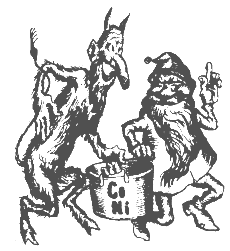 One of the items of the �Big House Regulations� states that the highest positive valence of an element shall be equal to the number of the group it belongs to. Though oxygen and fluorine break this rule, they have been registered permanently in the sixth and seventh groups. Nor has anyone ever thought of moving them; because in all other respects the chemical behaviour of oxygen and fluorine does not differ from the way of life of their heavier neighbours on the other floors of the Big House. Still, this is an inconsistency, one that chemists are well aware of; but they pay no attention, for it does no damage to the architecture of the Mendeleyev Table. Alas, there is yet another, more ponderous inconsistency. In the Middle Ages miners sometimes came across strange ores, greatly resembling iron ores. But the trouble was that iron could never be extracted from them. The miners attributed their failures to the pranks of evil spirits - the noxious goblins called kobolds in German, and the old mocking devil Nick. Later on it became clear, of course, that evil spirits had nothing to do with it. The ores did not contain iron, but two other metals that resemble it. In memory of these old delusions they were called cobalt and nickel. Also in the Middle Ages the Spanish conquerors found a strange metallic substance on the banks of the River Platino del Pino in South America. This strange lustrous, heavy metal which would not dissolve in any acid, was named platinum. Three centuries later it was. found that platinum occurs almost always together with five companions: ruthenium, rhodium, palladium, osmium, and iridium. These six rare metals are very difficult to distinguish from one another and the practically inseparable group became known as the platinum family. There came the time to place them in the Big House. Now you are all set to hear an amusing story of how involved this was and how scientists overcame all the difficulties one by one. We are sorry to disappoint you, but it was all very simple. |




